Shopping cart
- +1 564-544-6614
- [email protected]
- 24/7 Available


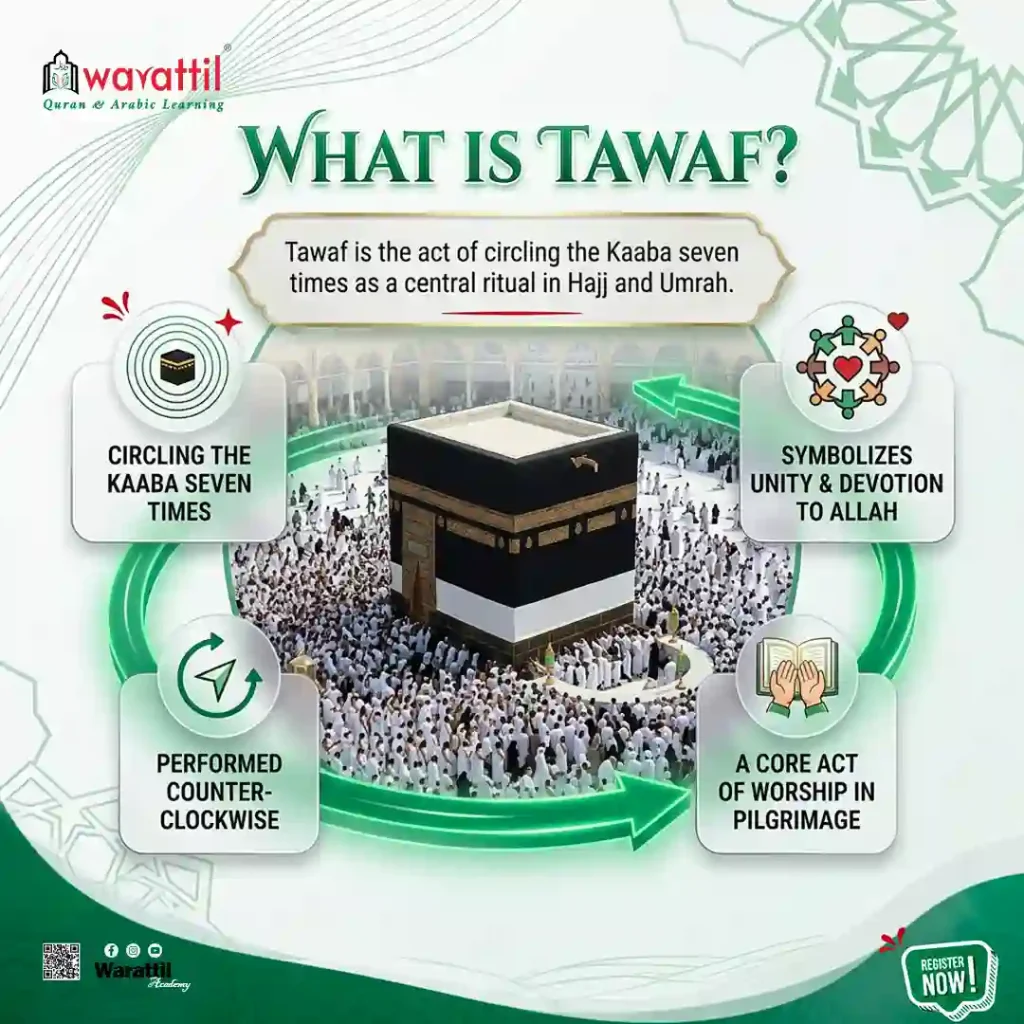
Tawaf is more than a physical act—it is a profound expression of devotion that lies at the very heart of the Islamic pilgrimages of Hajj and Umrah. Learning how to perform Tawaf correctly is essential for every pilgrim, not only to fulfil the obligations of the rites but also to appreciate the deep spiritual significance embedded in each circuit. This guide offers a detailed walkthrough of the procedure, from the required state of purity to the final prayers at Maqam Ibrahim, and clarifies the specific timing of Tawaf al-Ifadah during the Hajj.
In its most essential sense, Tawaf is the ritual act of circumambulating the Holy Kaaba, the most sacred site in Islam, seven consecutive times in a counter-clockwise direction. The word itself comes from the Arabic root tafa, meaning to circle, travel through, or roam, which gives a sense of the dynamic and living nature of this worship.
The act is not merely a physical movement but a symbolic participation in a larger cosmic order. Scholars often note that the circular motion evokes the angels surrounding the Throne of Allah, glorifying and praising their Lord, as well as the seven heavens, each containing its own focal point of worship. By performing Tawaf, a pilgrim connects their own devotion to this universal chorus, moving in harmony with all of creation around the single, central point of divinity represented by the Kaaba.

One of the most common questions asked is about the specific number of circuits. The primary reasoning rests on complete submission to divine legislation; the ritual is performed seven times because it was commanded as such by Allah and His Messenger. The Quran reminds believers, “It is not for a believing man or a believing woman, when Allah and His Messenger have decided a matter, that they should [thereafter] have any choice about their affair.”
Beyond this, scholars like Imam Ibn al-Qayyim have highlighted that the number seven possesses a unique significance throughout scripture and the cosmos. There are seven heavens and seven earths, the days of the week are seven, and a human being is created through seven stages. Further examples, such as the seven ears of grain in Prophet Yusuf’s (Joseph’s) dream, underscore that this number is woven into the very fabric of creation and revelation.
Executing the ritual correctly requires attention to specific conditions, actions, and intentions. Below is a practical guide to what you need to know about how to perform Tawaf.
Before beginning, a pilgrim must be in a state of ritual purity. This means having performed wudu (ablution) and being free from both minor and major ritual impurities on one’s body, clothes, and what one carries. The area of circumambulation must also be inside the Sacred Mosque (Masjid al-Haram) and outside the Kaaba itself; circling in the surrounding streets is not valid.
Crucially, you must form a clear intention (niyyah) in your heart. While it need not be spoken aloud, you should be conscious that you are about to perform Tawaf solely for the sake of Allah, whether it is for an obligatory Hajj, an Umrah, or a voluntary act.
The circuit begins at the Black Stone (al-Hajar al-Aswad), a stone from Paradise set into the eastern corner of the Kaaba. The ideal Sunnah is to kiss the stone. If the crowd makes this impossible, you may touch it with your hand. If even that is not possible, a gesture from a distance is perfectly acceptable. By facing the stone, placing your hands at your ears with palms facing outwards, and saying “Bismi’Llah Allahu akbar,” you have performed the act of Istilam—the salutation of the stone—without causing any harm to yourself or others.
With the Kaaba to your left side, you begin your seven circuits, moving right in a counter-clockwise direction. It is essential to maintain this orientation; if you inadvertently turn so that your left shoulder is no longer facing the Kaaba, you must return to the point where you turned and continue from there.
During the Tawaf, you should avoid cutting through the semi-circular area of Hijr Isma’il, as this space was originally part of the Kaaba’s structure as built by Prophet Ibrahim. Specific supplications are optional; you may recite any personal prayers, Qur’an, or repeat the most frequent du’a of the Prophet (peace be upon him) during Tawaf: “Our Lord, give us good things in this life, and good things in the Hereafter, and protect us from the torture of Hellfire.”
For men performing the first three circuits of a Tawaf that is followed by Sa’i (such as the Arrival Tawaf or Umrah), it is a Sunnah to practice raml, a swift, energetic walk with the right shoulder bared (iddtibaa’). The remaining four circuits are completed at a normal, walking pace.
After completing the seventh circuit, ending at the Black Stone, you should proceed to Maqam Ibrahim (the Station of Abraham). There, or at any convenient place away from the flow of pilgrims, you pray two rak’ahs of prayer behind it, facing the Kaaba. During these rak’ahs, it is a Sunnah to recite Surah Al-Kafirun in the first rak’ah and Surah Al-Ikhlas in the second. This prayer completes the core ritual of Tawaf.
Tawaf al-Ifadah, also known as Tawaf al-Ziyarah, is a fundamental pillar (fard) of Hajj without which the pilgrimage is incomplete. Understanding its timing is crucial for every pilgrim undertaking the Hajj journey.
This Tawaf is performed after the key rites on the 10th of Dhul-Hijjah, the day of Eid al-Adha. The sequence is specific: it takes place after the pilgrim has performed the pelting of the largest pillar (Jamarat al-Aqabah), offered their sacrifice (if required), and shaved or trimmed their hair.
The permissible time window for performing Tawaf al-Ifadah extends from the morning of the 10th of Dhul-Hijjah until the sunset of the 12th of Dhul-Hijjah. Performing it within these days is considered essential (wajib) by many scholars. A delay beyond the 12th without a valid excuse, such as a woman experiencing menstruation, is a transgression that requires an expiatory sacrifice (dam). Once Tawaf al-Ifadah is completed, the state of Ihram is fully ended, and all restrictions on the pilgrim are lifted.
Mastering how to perform Tawaf is a journey from understanding its legal mechanics to feeling its profound spiritual pull. It is a ritual of purification and renewal, where each of the seven circuits, from the Black Stone to Maqam Ibrahim, offers an opportunity for sins to be erased and ranks to be elevated. Through correct intention, adherence to the Prophetic method, and awareness of its deep symbolism, you can transform this central pillar of pilgrimage into a truly transcendent act of worship.

My son feels happy, amazing teachers and staff in wrattil and flexible prices MashaAllah Thank you so much
My daughter started learning in warattil academy and alhamdulilah we are really impressed and have enjoyed learning with wrattil. May Allah reward her sheikh
My teacher Ahmed is very good. He helped me recite and memorize holy Quran
Warattil is the most efficient way of learning Arabic. I like warattil curriculum and excellent teachers to support this learning Thank you so much
I highly recommend warattil Ijazah programs to anyone who wants to learn Quran properly.
Very well organized MashaAllah. I love it and this is a great course if you want to understand the Quran and learn tafsir
Warattil program is the best I have seen. The teacher is really great and is available to answer questions in a clear manner
I think warattil is the best academy in learning Arabic and I recommend Arabic course to anyone
We are so happy with ustad Hussein. He is very patient and comfortable teacher. May Allah the teachers and admin in warattil
Rating 10 mashaAllah and so grateful