Shopping cart
- +1 564-544-6614
- [email protected]
- 24/7 Available


When the word “fatwa” appears in Western headlines, it is almost always attached to a single, terrifying event: the 1989 edict by Iran’s Ayatollah Khomeini calling for the death of novelist Salman Rushdie. That moment seared a lasting image into the public mind—that a fatwa is an irrevocable death warrant. Yet for the millions of Muslims who seek or receive a fatwa every year, the reality is far more ordinary, nuanced, and consequential in a different way. Understanding what happens when a fatwa is issued requires stepping away from the sensational headlines and into the quiet, methodical world of Islamic jurisprudence.
At its most basic, a fatwa is an explanation or clarification—a non‑binding legal opinion delivered by a qualified scholar. The Arabic root of the word means “to explain” or “to clarify,” and that is precisely the function a fatwa serves: it clarifies a point of Islamic law for a person who is unsure. When a Muslim man wonders whether he should accept a teaching position at a religious school or remain in his father‑in‑law’s better‑paying business, he may turn to a mufti for guidance. When a woman is uncertain whether a particular financial transaction complies with her faith, she too may request a fatwa. It is a response to an everyday dilemma, not a declaration of war. The formal definition offered by scholars describes it as “the issuance of a non‑binding Islamic legal ruling, aided by evidence, by one qualified to do so, in response to a question regarding a particular case”. This definition immediately highlights three crucial features that separate a genuine fatwa from a polemical threat: it is non‑binding, it is evidence‑based, and it can only be delivered by a qualified individual.

Contrary to the image of a solitary cleric firing off a verdict on a whim, the issuance of a fatwa follows a disciplined, multi‑stage process—especially when it comes from an official religious body. The journey begins with an individual, known as the mustaftī, who presents a specific question about a real‑life problem. The mufti or fatwa committee must then achieve a precise understanding of the situation. In the Malaysian state of Selangor, for example, each ruling must go through “complete data collection, comprehensive information gathering, and a precise understanding of the issue”. This first stage, which jurists call al‑tashwir (defining the issue), is followed by al‑takyif (exploring its legal details and categorising it within the framework of Islamic law).
Once the question is properly framed, the mufti engages in istinbāt—the painstaking work of deriving a ruling from the primary sources of Islamic law. The scholar examines the Qurʾān, the Sunnah (authenticated prophetic tradition), the consensus of earlier scholars (ijmāʿ), and analogical reasoning (qiyās). If the matter concerns a novel situation—such as a medical technology that did not exist in earlier centuries—the ruling may be reached through independent juristic reasoning (ijtihād) or by weighing the public interest (maṣlaḥah mursalah). Far from being a capricious opinion, a properly issued fatwa is anchored in over a millennium of legal methodology. The Egyptian Dār al‑Iftāʾ emphasises that issuing legal verdicts “necessitates a profound knowledge of the primary sources of legislation based on the principles of language, rhetoric, grammar, morphology as well as a thorough perception of the reality of the times”.
When an institutional body is involved, the draft answer rarely issues from a single mind alone. In Selangor, after the initial research is complete, an “Expert Discussion” (Muzakarah Pakar) is held that brings together religious scholars, academics, and relevant stakeholders. If a firm resolution is still not reached, a smaller, more focused Baḥth al‑Masāʾil (discussion of issues) is convened. Only then does the Fatwa Committee Meeting take place, after which the precise wording (ṣīghah) of the fatwa is reviewed and harmonised by a Technical Committee before being submitted for final approval. This layered, deliberative structure is designed not to delay but to ensure that the opinion is sound, balanced, and faithful to both the sacred texts and the concrete circumstances of the questioner.
Not all fatwas are produced by state‑affiliated bodies, of course. Individual muftis, particularly those trained in the classical tradition, follow a similar intellectual discipline, albeit on a smaller scale. The renowned Pakistani scholar Mufti Muhammad Taqi Usmani has described how a fatwa in his circle would normally be issued only after it had been shown to a senior teacher for review—a practice inherited from centuries of scholarly apprenticeship. The modern internet has democratised access to fatwas, with online portals allowing Muslims anywhere to submit a question and receive a concise answer, often within days. Yet the core responsibilities remain unchanged: a mufti is expected to possess mastery of the legal sciences, command of classical Arabic, profound God‑consciousness, and a scrupulous reluctance to speak on behalf of God. The Prophet Muhammad is reported to have warned, “The most reckless of you in issuing fatwas is verging to enter Hell‑fire”.
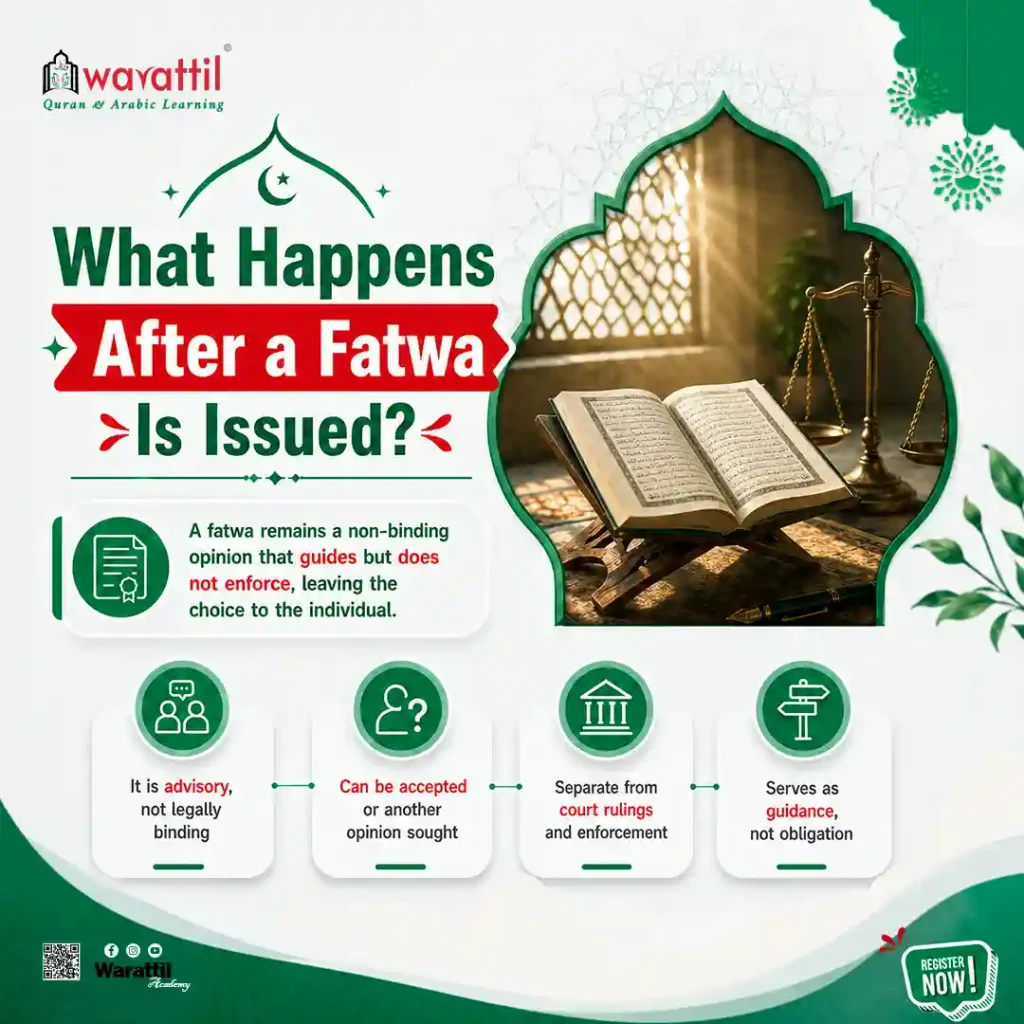
Once the ruling is pronounced, a wide spectrum of consequences may unfold—or, in many cases, none at all. Because a fatwa is inherently non‑binding, the person who asked the question is free to accept it or to seek a second opinion from another qualified mufti. The Fiqh Council of North America states plainly that “a Fatwa is different in some ways than a judicial decree (Qaḍāʾ) … especially in that a Fatwa is a non‑binding decree”. In other words, a fatwa carries the weight of scholarly authority but not the coercive force of law.
This distinction is critical. In the vast majority of Muslim‑majority countries, the judicial system and the fatwa‑issuing institutions operate on parallel tracks. A judge’s ruling is binding and enforceable; a fatwa is advisory. The Supreme Court of India underscored this point in 2014 when it ruled that fatwas have “no legal sanction” and that “no law has given any recognition to fatwas”. The court noted that while religious opinions can serve a positive role in guiding the faithful, they cannot be enforced “the moment they breach the fundamental rights of a person”. This principle—that a fatwa remains a private, spiritual counsel unless voluntarily accepted—is echoed across the Sunni legal tradition. As one classical source puts it, the fatwa “is a legal clarification … but in it there is no enforcement. The judgment requires enforcement”.
Yet the practical influence of a fatwa can be immense even without state compulsion. In communities where religious authority is deeply respected, a mufti’s opinion can shape behaviour more effectively than any statute. A fatwa declaring a certain food halal or haram can redirect consumer markets. A fatwa on medical ethics can influence the decisions of doctors and patients at the bedside. When the Islamic Research Academy at Al‑Azhar University issued a fatwa during the COVID‑19 pandemic stating that wearing a face mask during prayer was permissible, it eased the conscience of millions of believers who might otherwise have been torn between public health and ritual propriety. This quiet, instructional power is the ordinary work of the fatwa, and it touches far more lives than the rare, politicised eruption that makes the evening news.
It is also important to recognise that a fatwa is not set in stone. One of the sophisticated features of Islamic jurisprudence is its acceptance that rulings may change as the circumstances of time, place, people, and conditions shift. Egypt’s Dār al‑Iftāʾ explicitly states that “a fatwa changes according to change in four factors: time, place, people and conditions”. A ruling that was appropriate for a pre‑industrial agrarian society may be revisited when the economic and social landscape has been transformed, provided that the higher objectives (maqāṣid) of Islamic law are safeguarded. This built‑in flexibility is what has allowed the tradition to remain relevant across fourteen centuries and dozens of cultures.
Of course, the most notorious fatwas are those that deviate from this normative pattern—edicts that claim a binding character they do not legally possess, that are issued by unqualified ideologues, or that incite violence. The 1989 fatwa against Salman Rushdie is the emblematic case. It triggered riots, forced Rushdie into hiding under British police protection for nine years, and, by credible accounts, may have inspired the knife attack he suffered in 2022. Yet even here the official stance of Iran eventually shifted; the government promised it would not enforce the fatwa, though it never formally rescinded it. The Rushdie affair illustrates both the extraordinary damage a weaponised fatwa can cause and the fact that such edicts are, in the end, dependent on political will rather than inherent legal power.
Other controversial fatwas have sparked public outcry and legal pushback. In Jordan, the government amended the law to impose fines on unqualified individuals who issue fatwas, citing “the harm to society and Sharia caused by fatwas issued by non‑qualified persons”. In India, the Imrana case—in which a village cleric declared a rape victim’s marriage void—led the Supreme Court to observe that fatwas “can cause irreparable damage to the rights of an individual”. These episodes underscore a growing consensus within both Muslim communities and the wider world: a fatwa that violates the fundamental dignity and rights of a human being forfeits its claim to religious legitimacy.
When we ask what happens when a fatwa is issued, we are really asking two different questions. The first is about the disciplined, intellectually rigorous process by which a qualified mufti, often working within an institutional framework, listens to a question, searches the sacred sources, consults with colleagues, and delivers a careful, non‑binding opinion intended to guide a fellow believer through a moment of uncertainty. The second is about the rare but destructive spectacle of a political figure hijacking the form of a fatwa to legitimize violence or oppression.
The overwhelming majority of fatwas belong to the first, quieter world. They guide the faithful on matters of prayer, fasting, marriage, business ethics, and medical treatment. They evolve with time and place, and they bind only the conscience of the person who voluntarily accepts them. Until we learn to tell these two stories apart, the true nature of the fatwa will remain obscured behind a headline that captures only its darkest aberration. A fatwa is not a death sentence; it is, in its truest sense, an act of service—a scholar’s disciplined attempt to help a questioner find a path that is faithful, informed, and just.

My son feels happy, amazing teachers and staff in wrattil and flexible prices MashaAllah Thank you so much
My daughter started learning in warattil academy and alhamdulilah we are really impressed and have enjoyed learning with wrattil. May Allah reward her sheikh
My teacher Ahmed is very good. He helped me recite and memorize holy Quran
Warattil is the most efficient way of learning Arabic. I like warattil curriculum and excellent teachers to support this learning Thank you so much
I highly recommend warattil Ijazah programs to anyone who wants to learn Quran properly.
Very well organized MashaAllah. I love it and this is a great course if you want to understand the Quran and learn tafsir
Warattil program is the best I have seen. The teacher is really great and is available to answer questions in a clear manner
I think warattil is the best academy in learning Arabic and I recommend Arabic course to anyone
We are so happy with ustad Hussein. He is very patient and comfortable teacher. May Allah the teachers and admin in warattil
Rating 10 mashaAllah and so grateful