Shopping cart
- +1 564-544-6614
- [email protected]
- 24/7 Available


If you have ever witnessed the holy month of Dhul Hijjah or the celebration of Eid al-Adha, you have likely asked the fundamental question: what is Qurban in Islam? At its core, Qurban is the ritual sacrifice of specific livestock performed by Muslims worldwide. However, describing it merely as an animal slaughter is to overlook its profound spiritual depth. Qurban is an act of worship that traces its origins back to the founding father of monotheism, symbolising a believer’s absolute submission, heartfelt gratitude, and sincere devotion to the Creator.
To fully grasp the importance of Qurban, one must first understand the meaning carried by the word itself. The term is derived from the Arabic root qaraba (قرب), which means “to draw near” or “to approach.” Thus, the very essence of the act is about seeking closeness to Allah (SWT). This is why scholars often remark that Qurbani is “an act performed to seek Allah’s pleasure.” Fittingly, the Arabic term Udhiya (الأضحية) is also used in this context to refer to the sacrificial animal itself, while the Persian and Urdu term “Qurbani” came to embody the entire ritual.
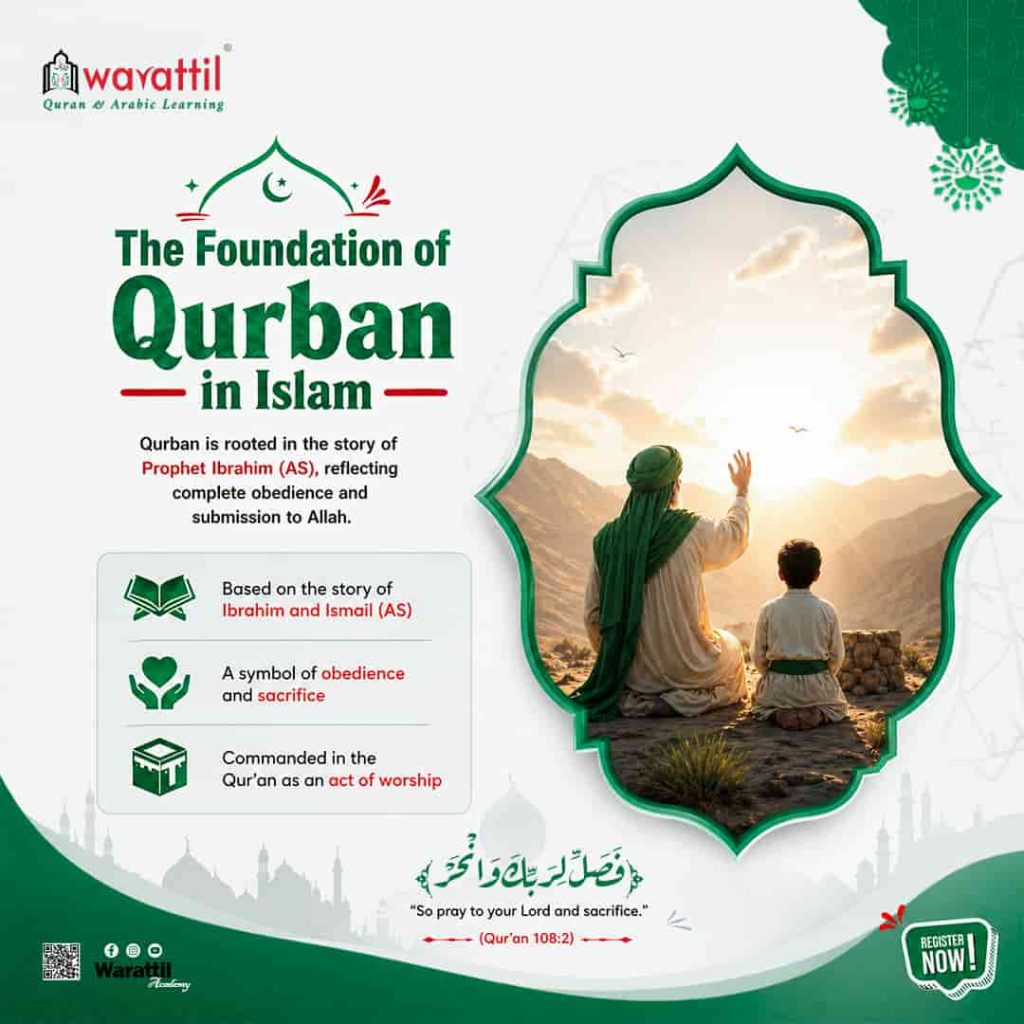
The practice of sacrifice is as old as faith itself, woven into the fabric of many religious traditions. The legacy of Qurban in Islam is fundamentally anchored in the story of Prophet Ibrahim (AS) and his son, Prophet Ismail (AS). The Qur’an narrates the profound trial in Surah As-Saffat:
“Then when the boy reached the age to work with him, Abraham said, ‘O my dear son! I have seen in a dream that I must sacrifice you. So tell me what you think.’ He replied, ‘O my dear father! Do as you are commanded. Allah willing, you will find me steadfast.’” (Qur’an, 37:102)
This conversation between a father and son reveals an unparalleled surrender to divine will. Just as Ibrahim (AS) prepared to carry out the command, Allah (SWT) ransomed Ismail (AS) with a magnificent ram, establishing a precedent of mercy and devotion. The Qur’an further commands the Prophet Muhammad ﷺ in Surah Al-Kawthar: “So pray to your Lord and sacrifice [to Him alone]” (Qur’an, 108:2). This direct instruction solidified the ritual sacrifice not merely as a cultural tradition but as a fundamental act of worship, a clear response to the question of what is Qurban in Islam—it is obedience made manifest.
Beyond the physical act, Qurban embodies a complete philosophy of submission. It is a symbolic reenactment of the willingness of Prophet Ibrahim (AS) to give up that which was most precious to him for the sake of Allah. In doing so, a Muslim demonstrates that, like Ibrahim (AS), he or she would not hesitate for a single moment to surrender to the Creator’s command, even if it came at the price of one’s life or most beloved possessions.
Crucially, the Qur’an clarifies that the divine acceptance of this act is not tied to physical matter. As it states in Surah Al-Hajj: “It is neither their meat nor their blood that reaches Allah, but it is piety from you that reaches Him” (Qur’an, 22:37). Therefore, the ultimate goal of Qurban is to cultivate taqwa—God-consciousness—within the heart of the believer, transforming a material sacrifice into a profound spiritual transaction.
Islamic jurisprudence provides clear guidance on who must perform this important act. There exists a scholarly consensus on its elevated status, though there is a difference of opinion on its precise ruling:
Regardless of the juristic classification, all scholars agree that neglecting the sacrifice without a valid reason, despite having the financial capacity, is severely disapproved. The Prophet ﷺ sternly warned: “Whoever can afford it but does not offer a sacrifice, let him not come near our prayer place.” This hadith alone underscores the immense importance placed on fulfilling this act for those who are able.
The timing of the sacrifice is precisely defined. Qurbani is performed during the sacred days of Eid al-Adha, specifically after the Eid prayer on the 10th of Dhul Hijjah until sunset on the 12th (or 13th, according to some scholars) of Dhul Hijjah. A permissible sacrifice must be one of the an’am livestock: sheep, goats, cattle, or camels. Each animal must meet strict age and health requirements—a sheep, for example, should be at least six months to one year old, while a camel must have completed five years of age—and must be free from any obvious defects. One sheep or goat fulfills the sacrifice for one individual, while a larger animal like a cow or camel can be shared among up to seven people.
Inherent to the act of Qurban is a deep commitment to charity and community. The purpose is not solely personal consumption. The prophetic tradition encourages that the meat be divided into three portions: one-third for the individual and their family, one-third for relatives and neighbours, and one-third for the poor and needy. This practice ensures that the celebration of Eid extends to every level of society, fostering bonds of brotherhood and providing a rare source of protein for those who are most vulnerable. Through this distribution, Qurban transforms a financial act of worship into a powerful instrument for social justice and communal harmony.
The spiritual merits of Qurban are unparalleled, especially when performed with a sincere heart. The blessed hadith that profoundly captures its virtue states:
The son of Adam does not do any deed on the Day of Sacrifice that is dearer to Allah than shedding blood. It will come on the Day of Resurrection with its horns and cloven hoofs and hair. Its blood is accepted by Allah before it reaches the ground. So be content when you do it.
Scholars explain that this narration vividly illustrates two profound truths: first, that the reward for Qurban is accepted by Allah (SWT) immediately and completely; and second, that on the Day of Judgement, the sacrificed animal will appear in its complete form to serve as a tangible witness to the believer’s good deed, deepening the spiritual significance of this act.
In answering the question, “what is Qurban in Islam?” we find that it is far more than a ritual slaughter. It is an annual reaffirmation of a Muslim’s pledge that, like Prophet Ibrahim (AS), their prayers, their sacrifices, their lives, and their deaths are all surrendered to Allah, the Lord of the worlds. It is a clear expression of gratitude for blessings given and a concrete form of mercy shared with humanity. When performed with pure intention and in full compliance with the prescribed rules, Qurban stands as one of the most beloved acts of worship on the Day of Sacrifice, a timeless tradition that links the believer to a legacy of unwavering faith.

My son feels happy, amazing teachers and staff in wrattil and flexible prices MashaAllah Thank you so much
My daughter started learning in warattil academy and alhamdulilah we are really impressed and have enjoyed learning with wrattil. May Allah reward her sheikh
My teacher Ahmed is very good. He helped me recite and memorize holy Quran
Warattil is the most efficient way of learning Arabic. I like warattil curriculum and excellent teachers to support this learning Thank you so much
I highly recommend warattil Ijazah programs to anyone who wants to learn Quran properly.
Very well organized MashaAllah. I love it and this is a great course if you want to understand the Quran and learn tafsir
Warattil program is the best I have seen. The teacher is really great and is available to answer questions in a clear manner
I think warattil is the best academy in learning Arabic and I recommend Arabic course to anyone
We are so happy with ustad Hussein. He is very patient and comfortable teacher. May Allah the teachers and admin in warattil
Rating 10 mashaAllah and so grateful