Shopping cart
- +1 564-544-6614
- [email protected]
- 24/7 Available


If you have ever traced the small, elegant markers in the margins of a mus’haf and wondered how many sajdahs are in the Quran, you are asking about one of the most beautifully embodied acts of devotion in Islamic practice. The widely accepted answer is 15 verses of prostration – moments in the text where the reciter and the attentive listener are called to lower themselves to the ground in worship. Yet that number, like so many details of the Quranic sciences, carries a subtle difference of opinion that reveals the depth and care with which the scholars have preserved every aspect of the Book.
A well-known narration collected by Abū Dāwūd from ʿAmr ibn al-ʿĀṣ records that the Prophet ﷺ identified fifteen sajdahs in the Quran, three of which occur in the Mufaṣṣal (the shorter surahs towards the end of the Book) and two within Sūrat al-Ḥajj. This listing has become the reference point for the Ḥanafī, Mālikī, and Ḥanbalī schools, and it is the count you will find printed in most modern muṣḥafs. Every single one of these verses contains either a direct command to bow down, a description of the righteous falling in prostration, or a mention of creation itself bowing to its Lord.
The fifteen verses, listed in the order they appear, are:
When you look at this list, you can see immediately that every sajdah carries a powerful context – there is nothing accidental about their placement. They punctuate the revelation with physical submission.
The question of how many sajdahs are in the Quran does not end at fifteen for all legal schools. The Shāfiʿī school, while fully aware of the narration listing fifteen, counts fourteen verses as formal sajdat al-tilāwah (prostration of recitation). The difference turns on a meticulous legal classification rather than a denial of the text itself.
Imam al-Shāfiʿī considered the second prostration in Sūrat al-Ḥajj (22:77) and the prostration in Sūrat Ṣād (38:24) to belong to a different category: sujūd al-shukr (prostrations of thankfulness). In his view, these two are not the ritual prostrations that a person performs during recitation or upon hearing a specific recitation verse. The verse in al-Ḥajj, coming after a passage about bowing and praying, was seen as a general call to prayerful prostration, while the prostration of Dāwūd in Sūrat Ṣād was understood as a personal act of repentance and gratitude rather than a prescribed tilāwah sajdah for the wider community. Consequently, Shāfiʿīs do not treat them as obligatory or emphatically recommended upon recitation in the same way they treat the other fourteen. This distinction, far from being a source of division, is a classic example of how juristic reasoning respects the richness of the text without ever disputing a single letter of it.
The verse in Sūrat Ṣād deserves a closer look because it illuminates the heart of the scholarly discussion. In the Ḥanafī, Mālikī, and Ḥanbalī schools, the story of Dāwūd falling down and turning in repentance is one of the fifteen standard prostrations of recitation. However, a famous incident related by Imām al-Bukhārī complicates the picture. Ibn ʿAbbās reportedly said that Sūrat Ṣād is not one of the ʿazāʾim (the emphasised prostrations), yet he also said that he saw the Prophet ﷺ prostrate in it. Al-Bukhārī himself places the narration under the chapter heading “The prostration in Sūrat Ṣād,” indicating his view that it is indeed a sajdah, but Ibn ʿAbbās’s comment suggests a nuance. Scholars reconciled this by clarifying that the Prophet’s action demonstrated its permissibility and virtue while leaving room for the position that it is a prostration of thankfulness performed at an intensely moving passage, not a prostrating verse in the strict sense. Both perspectives honour the action; neither cancels the other.
In printed Qurans today, you will typically see a small inscription such as “۩” or “سجدة” in the margin next to each prostration verse, and often a line is drawn over the exact word where the prostration is prompted. Many editions also print a brief index at the end listing all fifteen locations with their surah and verse numbers. These visual aids help the reader know exactly when to pause and prostrate, ensuring that the act is never a matter of guesswork. Whether you are reading from a Ḥafṣ or a Warsh muṣḥaf, the sajdah markers are uniformly present; the tradition of identifying these verses has been guarded with the same meticulous care that characterises the entire written tradition of the Quran.
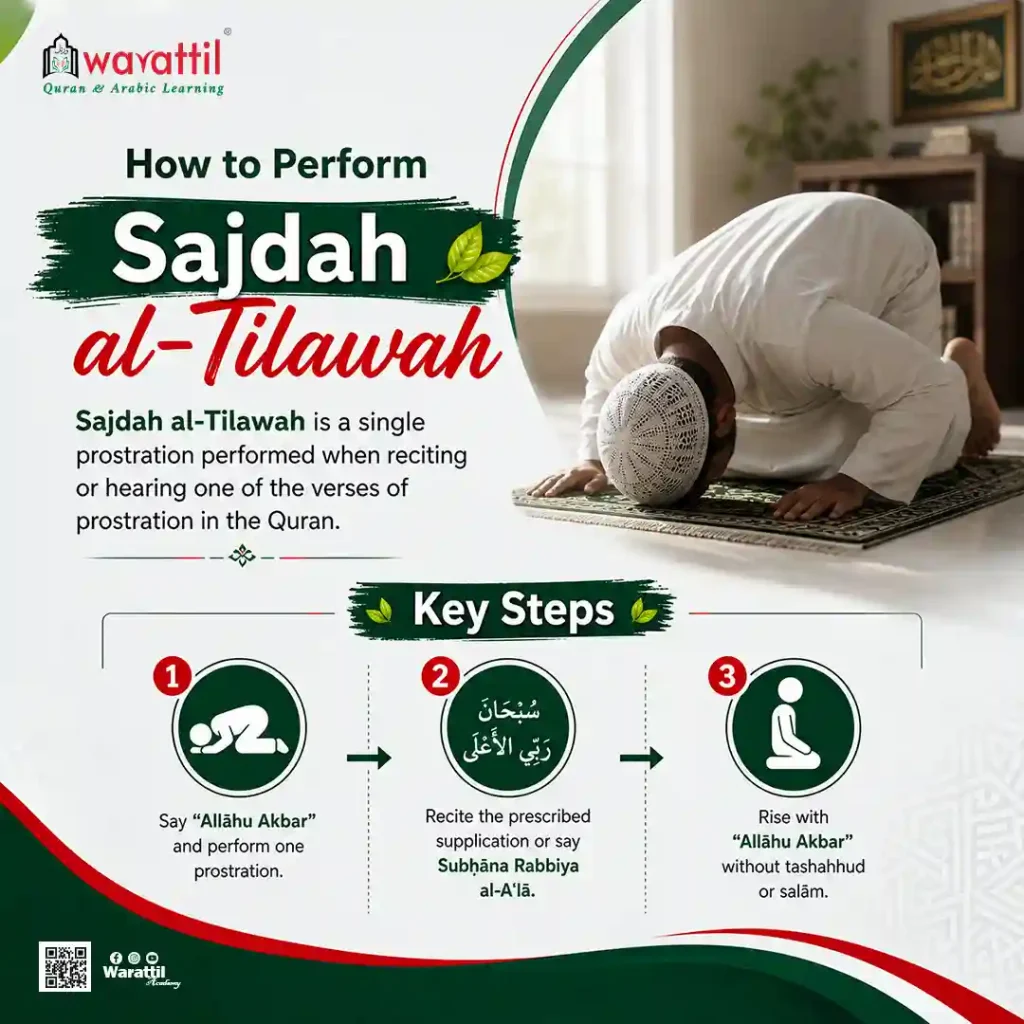
When you reach one of these verses, you perform a single prostration. The requirements are minimal: you face the qiblah, say Allāhu Akbar, go down into prostration once, and then say Allāhu Akbar as you rise. During the prostration itself, you may say the same glorifications you utter in prayer, such as Subḥāna Rabbiya al-Aʿlā, though the scholars also recommend a specific supplication reported from the Prophet: Sajada wajhī lilladhī khalaqahu wa shaqqa samʿahu wa baṣarahu bi ḥawlihi wa quwwatih (“My face has prostrated to the One who created it and fashioned its hearing and sight by His might and power”). There is no tashahhud and no salām at the end; it is a single, self-contained prostration. It does not have the same preconditions as formal prayer – most schools do not require ablution, though performing it in a state of purity is certainly superior. If you are reciting aloud and reach a sajdah, it is sunnah for the listener to join you in prostrating.
Knowing how many sajdahs are in the Quran transforms a passive recitation into an active, embodied engagement with the text. When your forehead touches the ground at these fifteen (or fourteen) moments, you are physically doing what the verse describes – you join the ranks of everything in the heavens and the earth that bows to its Maker. Over the course of a complete khatm, these prostrations are scattered such that they never feel overwhelming. In a typical Ramadan reading schedule, you might encounter one every couple of days, a gentle invitation to break from the flow and press your face to the earth. The more you mark the muṣḥaf with your own small pauses of devotion, the more the Book ceases to be something you simply read and becomes something you enact. That, ultimately, is what the sajdahs are for – to pull the words off the page and into your body, where they belong.

My son feels happy, amazing teachers and staff in wrattil and flexible prices MashaAllah Thank you so much
My daughter started learning in warattil academy and alhamdulilah we are really impressed and have enjoyed learning with wrattil. May Allah reward her sheikh
My teacher Ahmed is very good. He helped me recite and memorize holy Quran
Warattil is the most efficient way of learning Arabic. I like warattil curriculum and excellent teachers to support this learning Thank you so much
I highly recommend warattil Ijazah programs to anyone who wants to learn Quran properly.
Very well organized MashaAllah. I love it and this is a great course if you want to understand the Quran and learn tafsir
Warattil program is the best I have seen. The teacher is really great and is available to answer questions in a clear manner
I think warattil is the best academy in learning Arabic and I recommend Arabic course to anyone
We are so happy with ustad Hussein. He is very patient and comfortable teacher. May Allah the teachers and admin in warattil
Rating 10 mashaAllah and so grateful