Shopping cart
- +1 564-544-6614
- [email protected]
- 24/7 Available


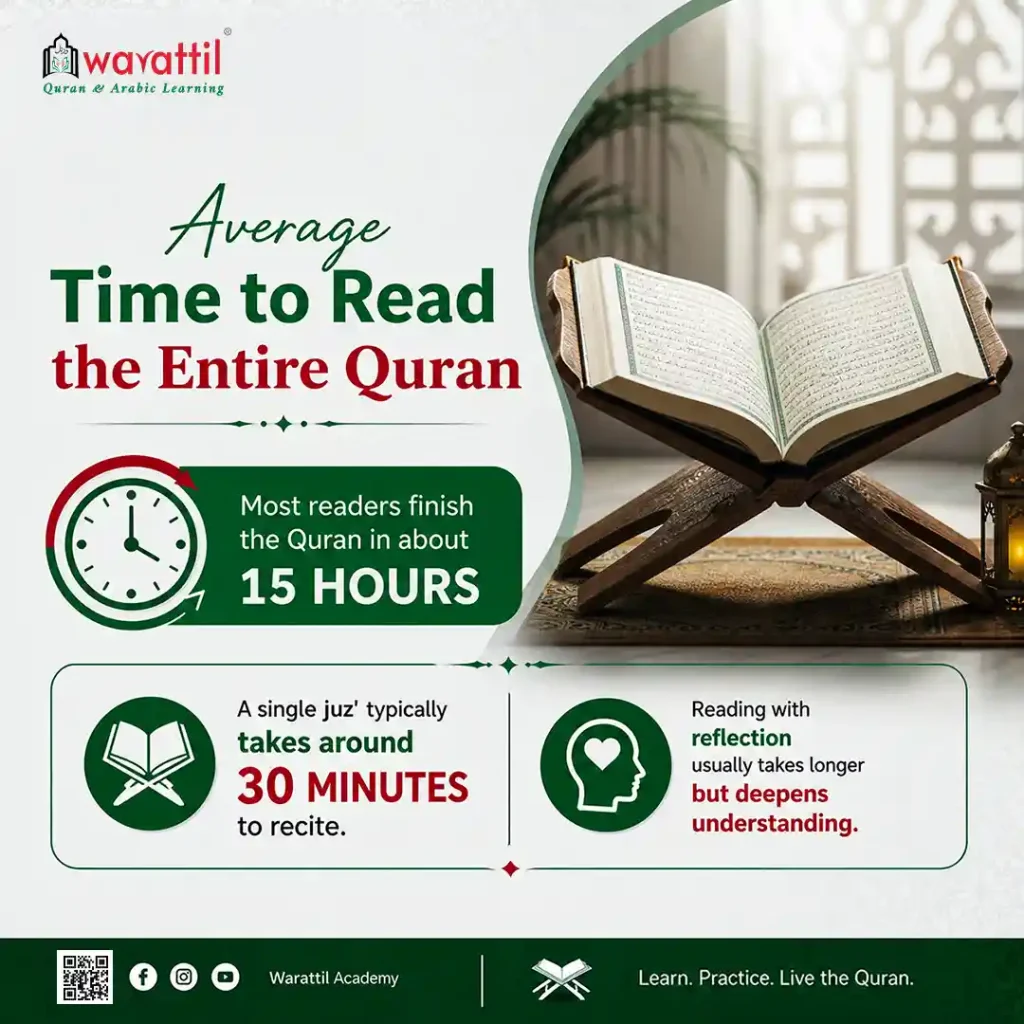
If you have ever asked yourself how long does it take to read the Quran, you are standing at the start of a deeply rewarding journey. The question seems simple, yet the answer shifts depending on your pace, your familiarity with Arabic, and the manner in which you intend to recite. A fluent reciter moving at a steady, moderate speed can complete the entire Book in roughly 15 to 20 hours of actual reading time. That single figure, however, only tells part of the story. To plan a realistic schedule whether you aim to finish in a month, a week, or a single sitting you need a closer look at the length of the Quran, average recitation speeds, and the sacred rhythm that governs how the words are meant to be delivered.
Before you calculate how long it takes to read the Quran for you personally, it helps to know what you are dealing with. The standard Madinah muṣḥaf, the most widely printed edition globally, contains 604 pages – or 20 pages per juz’ across 30 parts. The text consists of about 77,430 words and 6,236 verses. When reciting with proper tajwīd, the Arabic sounds cannot be rushed like a hurried English paragraph; each letter carries its right, and the pauses carry meaning. A practised reciter will comfortably read a single page in about one and a half to two minutes at a measured pace. Do the arithmetic, and you land squarely in that 15-to-20-hour window.
If you are a beginner still navigating the script, your time will naturally stretch. Someone who reads haltingly, sounding out words with care, might take twice as long – perhaps 30 to 40 hours. That is entirely normal. The Quran is not a novel to be skimmed; the whole tradition of tartīl instructs the reader to chant in a slow, distinct manner, as the Qur’an itself commands. Therefore, the number on the clock matters less than the quality of the engagement.
For an intermediate reader who recites daily and is comfortable with the rules of tajwīd, finishing the entire Quran in about 15 hours of cumulative reading is a solid benchmark. Breaking that down, a single juz’ takes roughly 30 minutes at this speed. That is why so many Ramadan programmes are built around the “one juz’ a day” formula – it fits neatly into a manageable half-hour slot after Fajr or before Iftar. A more advanced reciter, such as a hafiz who reviews regularly, can often cover a juz’ in 20 minutes, bringing the total down to around 10 hours. This is the pace you frequently hear during nightly tarāwīḥ prayers, where an entire juz’ is recited in about an hour of prayer, with the imam often reading at a slightly faster yet still precise clip.
At the other end of the spectrum, a reflective reading, where you pause to ponder meanings, look up unfamiliar words, or let a particularly powerful āyah settle in your heart, may require 25 to 30 hours. Many scholars explicitly encourage this slower, more contemplative approach, reminding us that the Prophet ﷺ would recite a single verse and repeat it until dawn.
Plans that revolve around the question how long does it take to read the Quran often aim for a fixed timeframe. The most common goal is thirty days, which demands one juz’ each day. At a moderate pace, that asks for around 30 minutes daily. To finish in one week, you would need to read approximately 86 pages a day, which typically translates to about two and a half hours of recitation each day for a comfortable reader. A three-day plan, occasionally adopted by the extremely dedicated, means reading ten juz’ daily – roughly five hours of recitation split across the day.
Some wonder about finishing the Quran in a single sitting. While physically demanding, it is by no means unheard of, especially during the last ten nights of Ramadan. An uninterrupted recitation at a steady pace will take between 10 and 20 hours, depending on speed. The body and voice need endurance, and many who undertake this break the recitation into cycles with short rests. No minimum time is imposed by Islamic law; the emphasis remains on correct pronunciation and a present heart.
Several variables directly influence the total hours. The foremost is your command of Arabic and tajwīd. A native speaker trained in the rules can glide through the text much faster than a non-Arab who is still decoding the letters. Your purpose of recitation also matters. Are you reading purely for khatm (completion), or are you doing tadabbur (deep reflection)? The former allows a brisker pace; the latter demands pauses. The format of the book can make a minor difference too – a 15-line muṣḥaf pages differently from a 13-line edition, though the word count remains the same. And then there is the environment: reading in a noisy room versus a quiet corner can affect both speed and retention.
Once you move past the curiosity of how long does it take to read the Quran, the more practical step is to build a routine that suits your life. If 30 minutes a day feels too heavy at first, start with a quarter-juz’ in 15 minutes. The companions of the Prophet ﷺ would often divide the Quran into seven parts and finish it weekly, a practice known as al-manzil. You can attach your reading to a particular prayer – a few pages after Ṣubḥ, a few after ʿAṣr – and before you realise it, the Book becomes a steady companion rather than a mountain to climb. The exact number of hours matters far less than the consistency you bring to the text. Every letter you recite carries immense reward, whether you turn the final page on day seven or day seventy.
So, when you consider how long it takes to read the Quran, hold the 15-to-20-hour average as a helpful reference, not a deadline. The Quran was never meant to be finished quickly and put away. It was sent to be lived with, recited in measured tones, and allowed to transform the soul gradually. Make your plan, open the muṣḥaf, and let the hours unfold in a rhythm that draws you closer to its Author.

My son feels happy, amazing teachers and staff in wrattil and flexible prices MashaAllah Thank you so much
My daughter started learning in warattil academy and alhamdulilah we are really impressed and have enjoyed learning with wrattil. May Allah reward her sheikh
My teacher Ahmed is very good. He helped me recite and memorize holy Quran
Warattil is the most efficient way of learning Arabic. I like warattil curriculum and excellent teachers to support this learning Thank you so much
I highly recommend warattil Ijazah programs to anyone who wants to learn Quran properly.
Very well organized MashaAllah. I love it and this is a great course if you want to understand the Quran and learn tafsir
Warattil program is the best I have seen. The teacher is really great and is available to answer questions in a clear manner
I think warattil is the best academy in learning Arabic and I recommend Arabic course to anyone
We are so happy with ustad Hussein. He is very patient and comfortable teacher. May Allah the teachers and admin in warattil
Rating 10 mashaAllah and so grateful