Shopping cart
- +1 564-544-6614
- [email protected]
- 24/7 Available


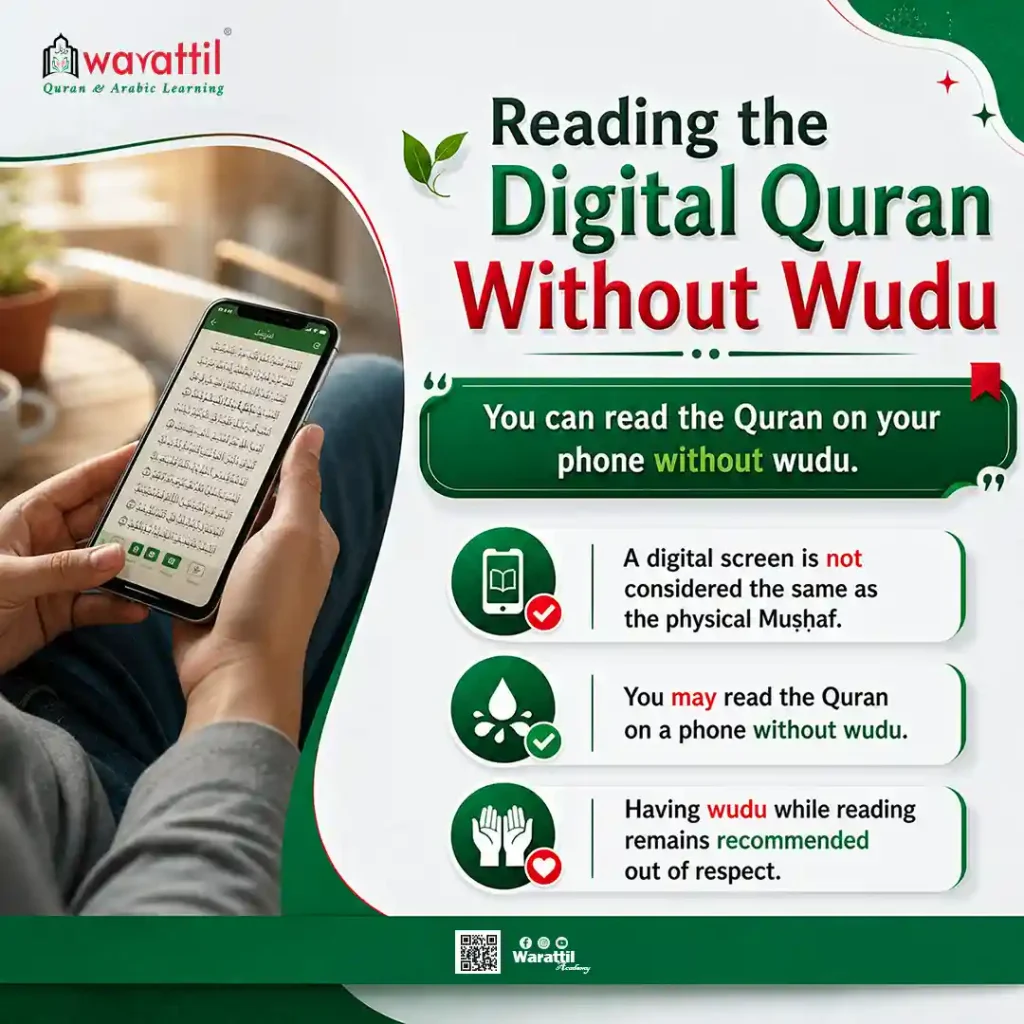
If you have ever been commuting, lying in bed, or simply away from water and felt the urge to recite a familiar surah, you have likely asked yourself can you recite Quran without wudu. The question touches one of the most practical areas of a Muslim’s daily life, and the answer, while clear in its core, does require a careful distinction between different situations. The general position of the majority of scholars is this: reciting the Quran from memory without wudu is perfectly permissible, provided you are in a state of minor ritual impurity. However, touching the physical muṣḥaf without wudu is not allowed according to the four major schools of Sunni law. To understand why these two acts are treated differently, and where the exceptions lie, we need to look at the foundational texts and the reasoning of the jurists.
The most common scenario prompting the question can you recite Quran without wudu is the one in which a person has simply not performed ablution after waking up, after using the restroom, or after passing wind. In this state of minor impurity, the overwhelming scholarly consensus, recorded by the likes of al-Nawawī and Ibn Qudāmah, holds that you may freely recite the Quran from memory. The Prophet ﷺ himself would remember Allah in all states, and there is no authentic report that he prohibited verbal recitation without ablution. The famous ḥadīth in Ṣaḥīḥ Muslim states that ʿĀʾishah found the Prophet ﷺ responding to her greeting of peace while he was in the desert without water, and he then performed tayammum – but he had already recited the name of Allah. This and many similar narrations show that ritual purity is not a precondition for the mere recitation of Quranic words.

What is prohibited in a state of minor impurity, according to the vast majority of scholars, is touching the written muṣḥaf – the physical codex containing the Arabic text. The evidence for this prohibition is the Quranic verse: “None touch it except the purified” (Sūrat al-Wāqiʿah, 56:79). Though the verse directly refers to the Preserved Tablet in the heavens, the scholarly community from the Companions onward understood it to carry a legislative connotation for the earthly Book as well. The well-known letter of the Prophet ﷺ to ʿAmr ibn Ḥazm includes the instruction, “None should touch the Quran except one who is pure.” Supported by the consensus of the Companions, this ruling became firmly established in Islamic law. Therefore, if you are reciting without wudu, you simply keep your hands off the Arabic script. Using a translation, a tafsīr where the commentary outweighs the Quranic text, or a digital application – matters we will return to shortly – changes the equation.
The injunction against touching the muṣḥaf without wudu is something the four imams – Abū Ḥanīfah, Mālik, al-Shāfiʿī, and Aḥmad – all agreed upon. This prohibition is rooted not only in the verse and the ḥadīth mentioned above but also in the deep respect Muslims have always shown to the physical pages of the Revelation. A person in a state of major impurity, such as janābah (post-sexual impurity) or menstruation, is subject to an even stricter ruling. The majority view is that such a person cannot touch the muṣḥaf at all, and they are also prohibited from reciting the Quran until they perform ghusl. The evidence for the prohibition on the menstruating woman and the junub person reciting is a ḥadīth narrated by al-Tirmidhī and others, where the Prophet ﷺ reportedly said, “The menstruating woman and the one in janābah should not recite anything from the Quran.” Although some scholars, including al-Bukhārī and a group of the early traditionists, considered this narration to be weak, the majority of jurists acted upon it out of precaution. The Mālikī school, however, makes a notable exception: they permit a menstruating woman to recite the Quran from memory, particularly if she fears forgetting it, because her state of impurity is prolonged and differs from janābah in its nature.

A minority opinion, associated with scholars such as Ibn ʿAbbās, al-Ṭabarī, Ibn Ḥazm of the Ẓāhirī school, and in more recent times Shaykh al-Albānī, holds that there is no authentic, binding prohibition against a junub person or a menstruating woman reciting the Quran from memory. They point to the absence of a clear Quranic prohibition and the weakness of the ḥadīth relied upon by the majority. Nonetheless, the safer and more widely accepted view is that one should avoid reciting in a state of major impurity except in the case of the menstruating woman according to the Mālikī dispensation.
So when you ask can you recite Quran without wudu while on a bus, at work, or during a study break, the answer is a reassuring yes. Al-Nawawī in al-Majmūʿ states explicitly that it is permissible to recite from memory for a person in minor impurity without any disagreement among the scholars. Ibn Qudāmah in al-Mughnī confirms the same consensus. What they caution, however, is that the etiquettes of recitation encourage a state of purity whenever possible. Many of the pious predecessors would not recite the Quran without wudu as a mark of reverence, but they did not regard it as prohibited. This distinction between the recommended and the obligatory is crucial. You will not be sinful for reciting without wudu; you simply miss out on a higher degree of mindfulness and ritual cleanliness.

There is an additional layer of caution for the one who recites extensively as part of their daily wird. Some scholars argue that if a person makes a regular practice of reciting without wudu, especially when it is easy to perform ablution, they are abandoning a sunnah and showing less than the full veneration the Book deserves. The opinion of the Ḥanafī school, for instance, holds that while it is not ḥarām to recite from memory without wudu, it is makrūh tanzīhī – mildly disliked – if done without a valid excuse, precisely because purity elevates the act of worship. So, while the absolute permissibility stands, a believer who loves the Quran will naturally gravitate towards reciting it in a state of wudu, even if they are not touching the muṣḥaf.
Modern life has made the question can you recite Quran without wudu even more nuanced, because most of us now carry the Book on our smartphones. Does scrolling through a Quran app count as touching the muṣḥaf? The majority of contemporary scholars differentiate between the physical muṣḥaf and the screen that displays verses. The display is not considered a permanent inscription; it is an electronic configuration that changes with a swipe. Therefore, you may handle your phone and touch the screen to read the Quran without wudu. The Mālikī school, known for its strictness regarding touching the physical muṣḥaf without wudu, also permits touching a phone displaying Quranic text for study or recitation, as long as the major part of the device is not the Quran itself. Some scholars, however, do advise that if the Quran app is open and the text is fully visible, it is better to be in a state of wudu out of respect, but this remains a recommendation rather than a legal obligation for most. What they do agree on is that entering a lavatory with a phone that has the Quran open is impermissible, which is a separate issue of etiquette.

When you bring the question can you recite Quran without wudu into your everyday routine, the clarity of Islamic law offers both ease and encouragement. If you are in a state of minor impurity, go ahead and recite your morning adhkār, your surahs after ṣalāh if you are still clean, and any passage you know by heart. If you wish to hold the muṣḥaf and read directly, perform wudu first; it is a simple act that aligns your outward state with the majesty of the words you are about to encounter. If you are junub or on your monthly cycle, you should, according to the majority, refrain from reciting aloud until you have purified yourself, though you may reflect on meanings, listen to recitation, and read translations and commentaries. The Mālikī opinion offers additional flexibility for women who need to maintain their memorisation. In all cases, the underlying principle is not to create hardship. The law recognises different levels of purity and adjusts the ruling accordingly, so that you are never cut off from the Book unnecessarily.
In the end, what matters most is that the Quran remains a living presence on your tongue and in your heart. The minor rulings about purity serve the purpose of preserving the text’s honour without erecting barriers between you and your Lord. So the next time you wonder can you recite Quran without wudu, remember that the door is wide open – and if you are able, performing a quick wudu before you begin will only deepen the experience.

My son feels happy, amazing teachers and staff in wrattil and flexible prices MashaAllah Thank you so much
My daughter started learning in warattil academy and alhamdulilah we are really impressed and have enjoyed learning with wrattil. May Allah reward her sheikh
My teacher Ahmed is very good. He helped me recite and memorize holy Quran
Warattil is the most efficient way of learning Arabic. I like warattil curriculum and excellent teachers to support this learning Thank you so much
I highly recommend warattil Ijazah programs to anyone who wants to learn Quran properly.
Very well organized MashaAllah. I love it and this is a great course if you want to understand the Quran and learn tafsir
Warattil program is the best I have seen. The teacher is really great and is available to answer questions in a clear manner
I think warattil is the best academy in learning Arabic and I recommend Arabic course to anyone
We are so happy with ustad Hussein. He is very patient and comfortable teacher. May Allah the teachers and admin in warattil
Rating 10 mashaAllah and so grateful