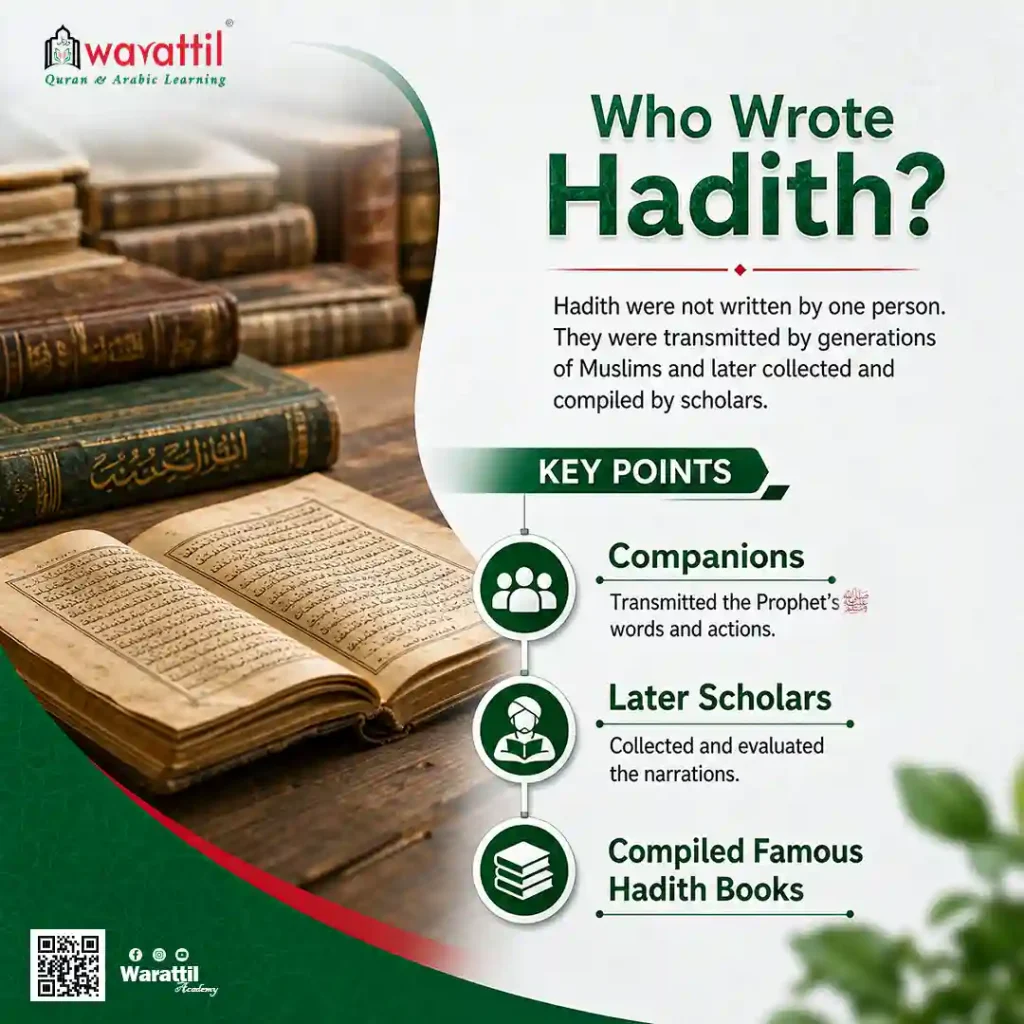
Who wrote Hadith? It is a question that sounds simple, but answering it properly requires understanding how Hadith were transmitted, preserved, evaluated, and eventually compiled into books. Hadith were not written by one person, nor did one scholar create a single book containing every report about Prophet Muhammad ﷺ.
Instead, Hadith developed through a long process of oral transmission, memorization, writing, teaching, collection, comparison, criticism, and compilation. The Prophet’s Companions transmitted reports about his words and actions, later generations learned those reports from them, and eventually scholars collected and organized large numbers of narrations into written works.
Among the most famous scholars associated with Hadith compilation are Imam Malik ibn Anas, Imam Muhammad ibn Isma’il al-Bukhari, Imam Muslim ibn al-Hajjaj, Abu Dawud, al-Tirmidhi, al-Nasa’i, and Ibn Majah.
However, calling any one of these scholars “the person who wrote Hadith” would be misleading. Their role was primarily to collect, evaluate, organize, and compile reports that had already been transmitted through earlier generations.
To understand who wrote Hadith, it is therefore necessary to distinguish between the Prophet who was the subject of the reports, the Companions and later narrators who transmitted them, and the scholars who compiled them into books.
Who actually wrote the Hadith?
There was no single person who wrote all the Hadith.
Hadith literature developed gradually over several generations. A report about something Prophet Muhammad ﷺ said or did could pass from the Prophet to one of his Companions, from that Companion to a Successor, and then through subsequent generations until it reached a later Hadith scholar.
A simplified chain might look like this:
Prophet Muhammad ﷺ → Companion → Successor → later narrator → Hadith scholar
The actual chains were often longer and could contain several narrators.
The chain through which a Hadith was transmitted is called an isnad. The isnad became one of the most important features of classical Hadith scholarship because scholars used it to investigate how a report had been transmitted and who had transmitted it.
This means that the scholar whose name appears on the cover of a Hadith collection was not necessarily the person who originally witnessed the event or heard the statement attributed to the Prophet ﷺ.
For example, Imam al-Bukhari compiled Sahih al-Bukhari, but he did not claim to have personally heard all the reports directly from Prophet Muhammad ﷺ. The reports reached him through chains of earlier narrators. His work involved collecting reports, studying their chains, evaluating their transmitters, and organizing selected material in his collection.
This distinction between transmission and compilation is fundamental to understanding the history of Hadith.
What does “Hadith” mean?
Before discussing who wrote Hadith, it is useful to understand what the word itself means.
The Arabic word hadith (حديث) has a broad linguistic meaning. Depending on context, it can refer to speech, a statement, a report, discourse, or an account.
In Islamic scholarship, however, Hadith commonly refers to reports concerning Prophet Muhammad ﷺ. Such reports can describe his sayings, actions, approvals, characteristics, or other matters connected with his life and teachings.
This technical meaning developed within the scholarly tradition of Hadith studies.
Therefore, when people ask who “wrote Hadith,” they are usually asking about the people who preserved and compiled these reports into written collections.
Did Prophet Muhammad ﷺ write the Hadith?
No major Hadith collection was written by Prophet Muhammad ﷺ himself.
Hadith are reports about the Prophet ﷺ, rather than a book that he personally authored under the title “Hadith.”
During his lifetime, his Companions learned his teachings, observed his actions, remembered his statements, and transmitted what they had witnessed to others.
Some material was also recorded in written form during the early Islamic period. Therefore, it would be inaccurate to present the history as though Hadith remained entirely unwritten until centuries later.
The more accurate description is that Hadith preservation involved both oral and written transmission, followed by increasingly systematic compilation by later scholars.
This distinction is important because a Hadith collection is not the same thing as the original Prophetic statement or event that it reports.
A scholar who compiled a Hadith book was gathering material that had already been transmitted through earlier people.
Who were the first people to transmit Hadith?
The Companions of Prophet Muhammad ﷺ played a central role in the early transmission of Hadith.
They lived during the Prophet’s lifetime and therefore had direct opportunities to hear his teachings, observe his actions, and witness events in which he participated.
Among the Companions well known for transmitting large numbers of reports are:
Abu Hurairah
Aisha
Abdullah ibn Umar
Abdullah ibn Abbas
Jabir ibn Abdullah
Anas ibn Malik
These individuals should not be described as authors of the major Hadith books in the later scholarly sense. Rather, they were among the early transmitters whose reports became part of the chains through which later scholars received Hadith.
For example, when a later compiler included a report narrated from Abu Hurairah, that did not mean Abu Hurairah had authored the later collection. His role was as an early transmitter in the chain.
This distinction helps explain why a Hadith can have a long chain of narrators even though it eventually appears in a book compiled by one particular scholar.
How were Hadith transmitted?
Hadith transmission involved both oral and written methods.
In the early Muslim community, knowledge was transmitted through teachers and students. Students would hear reports from scholars, memorize them, record them, compare different versions, and pass them on to others.
As Islamic scholarship expanded geographically, Hadith scholars traveled extensively to study under recognized teachers and obtain reports from different centers of learning.
The isnad, or chain of transmission, was central to this process.
A simplified example would be:
Prophet Muhammad ﷺ
↓
Companion
↓
Successor
↓
Later narrator
↓
Hadith scholar
Each person in the chain had a role in transmitting the report.
Hadith scholars therefore did not simply collect statements without examining their origins. They developed a detailed scholarly tradition for studying narrators and transmission chains.
What is an isnad?
An isnad is the chain of narrators through whom a Hadith was transmitted.
Suppose a later scholar received a report from his teacher, who received it from another scholar, who received it from a Successor, who received it from a Companion who had heard or witnessed something from the Prophet ﷺ.
The names connecting those people formed the chain of transmission.
Hadith scholars examined these chains carefully. They considered the reliability of narrators, their memory, their reputation, and whether the transmission between individuals was historically possible.
This contributed to the development of Hadith criticism, one of the major disciplines within classical Islamic scholarship.
The existence of these chains is one of the reasons it is inaccurate to say that Imam al-Bukhari or another later scholar simply “wrote the sayings of Muhammad.” Their collections preserved reports that had passed through earlier transmitters.
What is Hadith criticism?
Hadith criticism refers broadly to the scholarly methods used to evaluate Hadith reports.
Scholars examined both the chain of transmission and, depending on the scholarly methodology, the content and circumstances of the report.
The study of narrators became particularly important. Scholars produced biographical works discussing transmitters and their reliability.
This allowed later scholars to distinguish between stronger and weaker reports.
As a result, the Hadith tradition developed classifications concerning authenticity and reliability. Not every report attributed to Prophet Muhammad ﷺ was treated as equally reliable.
This point is important when discussing the question “Who wrote Hadith?”
The scholars who compiled Hadith books were not simply gathering every report they could find and treating all of them identically. Different scholars had different criteria and different purposes for their collections.
Who wrote Sahih al-Bukhari?
One of the most famous names associated with Hadith is Imam Muhammad ibn Isma’il al-Bukhari, commonly known as Imam al-Bukhari.
He compiled Sahih al-Bukhari, one of the most influential Hadith collections in Sunni Islam.
Imam al-Bukhari was born in Bukhara in 194 AH (810 CE). He became a major scholar of Hadith and traveled extensively in pursuit of knowledge.
His travels took him to important centers of Islamic learning, where he studied with scholars and received Hadith through established chains of transmission.
The title Sahih al-Bukhari refers to his collection of reports that he selected according to his scholarly criteria.
Sunnah.com identifies Muhammad ibn Isma’il al-Bukhari as the compiler of the collection and provides biographical information about his study and travels. The Oxford Centre for Islamic Studies likewise describes al-Bukhari’s Sahih as a major work in the development of Hadith verification and scholarship.
Did Imam Bukhari write every Hadith?
No.
This is one of the most important misconceptions to avoid.
Imam al-Bukhari compiled his collection. He did not personally originate the reports attributed to Prophet Muhammad ﷺ.
He received reports through chains of transmission, studied the people involved in those chains, evaluated the material according to his methodology, and selected reports for inclusion.
Therefore, the statement “Bukhari wrote the Hadith” is too broad.
A more accurate statement is:
Imam al-Bukhari compiled and authored a Hadith collection known as Sahih al-Bukhari.
The reports inside the collection had earlier transmission histories.
The distinction between the compiler of a book and the transmitters of its individual reports is essential.
What criteria did Imam Bukhari use?
Imam al-Bukhari applied stringent standards to the reports included in his Sahih.
His methodology involved careful attention to the reliability and memory of narrators and the continuity of transmission.
Traditional accounts of his methodology emphasize the importance of establishing the relationship between narrators in a chain. This reflects the broader concern of Hadith scholars with whether a report could be reliably traced through its transmitters.
The result was a highly selective collection.
This is also why Sahih al-Bukhari should not be described as a complete record of every Hadith that existed.
It was a carefully selected collection based on al-Bukhari’s own scholarly criteria.
Did Imam Bukhari collect all Hadith?
No.
Sahih al-Bukhari is not a collection of every Hadith that existed.
Hadith literature is much broader than one book.
Many other scholars collected Hadith, and numerous reports exist in collections outside Sahih al-Bukhari.
The existence of other Hadith collections demonstrates that the Islamic Hadith tradition cannot be reduced to a single book or compiler.
Therefore, the statement “Hadith means whatever is in Bukhari” would be inaccurate.
Bukhari’s collection is one major work within a much larger Hadith tradition.
Who wrote Sahih Muslim?
Another major Hadith collection is Sahih Muslim, compiled by Imam Muslim ibn al-Hajjaj al-Naysaburi.
Imam Muslim was born in Nishapur in 206 AH (821 CE) and became one of the major scholars of Hadith.
Like al-Bukhari, he traveled to different regions to study Hadith and learn from recognized scholars.
His collection became one of the most important works in Sunni Hadith scholarship.
Sahih al-Bukhari and Sahih Muslim are commonly referred to together as the Sahihayn, meaning “the two Sahih collections.”
However, Imam Muslim did not simply copy al-Bukhari’s work. He had his own methodology for collecting, arranging, and evaluating reports.
Thus, when discussing who wrote Hadith, both scholars should be understood as compilers of major Hadith collections, not as the original authors of the Prophetic reports contained within them.
Were Hadith written down before Imam Bukhari?
Yes.
This is an important historical point.
Hadith did not suddenly become written for the first time when Imam al-Bukhari compiled Sahih al-Bukhari.
Hadith material had been transmitted and recorded before his lifetime.
One famous early example is Al-Muwatta, associated with Imam Malik ibn Anas, who lived approximately from 711 to 795 CE.
Al-Muwatta contains Hadith material along with reports from Companions and Successors and legal material connected with the early Muslim community.
This demonstrates that organized Hadith-related writing existed before the famous third-century Islamic collections.
The history of Hadith compilation was therefore gradual. Scholars across several generations contributed to preserving, arranging, and analyzing transmitted material.
Who was Imam Malik?
Imam Malik ibn Anas was one of the major early scholars associated with Hadith and Islamic law.
He lived in Medina and became particularly influential for his knowledge of the traditions and practices of the people of Medina.
His famous work, Al-Muwatta, is among the earliest surviving major Islamic compilations containing Hadith material.
Unlike a collection focused exclusively on Prophetic reports, Al-Muwatta also includes reports from Companions and Successors and material relevant to Islamic legal practice.
This makes it an important example of how early Islamic scholars organized transmitted knowledge.
The existence of Al-Muwatta also demonstrates why it would be historically incorrect to claim that Imam al-Bukhari was the first person to write down Hadith.
What are the six major Sunni Hadith books?
In Sunni Islamic scholarship, six collections are commonly known as the Kutub al-Sittah, or the Six Books.
They are:
| Hadith Collection |
Compiler |
| Sahih al-Bukhari |
Muhammad ibn Isma’il al-Bukhari |
| Sahih Muslim |
Muslim ibn al-Hajjaj |
| Sunan Abi Dawud |
Abu Dawud Sulayman ibn al-Ash’ath |
| Jami’ al-Tirmidhi |
Muhammad ibn Isa al-Tirmidhi |
| Sunan al-Nasa’i |
Ahmad ibn Shu’ayb al-Nasa’i |
| Sunan Ibn Majah |
Muhammad ibn Yazid ibn Majah |
These collections became particularly influential within Sunni Hadith scholarship.
However, they should not be treated as though they were six versions of the same book.
Each compiler had a particular methodology, arrangement, and purpose.
The two Sahih collections, Sahih al-Bukhari and Sahih Muslim, became particularly prominent for their focus on reports that met their respective criteria for authenticity.
The other collections contain reports of different classifications and are not identical in scope or methodology.
Why are there different Hadith collections?
There are different Hadith collections because scholars approached the enormous body of transmitted material in different ways.
Some focused strongly on reports they considered authentic.
Others included Hadith alongside statements of Companions and Successors.
Some organized reports according to subjects related to Islamic law and practice.
Others arranged them differently for teaching and reference.
For example, Al-Muwatta contains Prophetic Hadith together with reports from early Muslim authorities and legal material.
This variety is not evidence that one scholar necessarily “wrote the Hadith” and another simply copied him.
Rather, it reflects the development of a broad scholarly tradition in which different scholars collected and arranged transmitted reports according to their own methods.
Did Hadith scholars invent the sayings of Prophet Muhammad ﷺ?
A historical explanation should distinguish between inventing a statement and compiling a report about a statement.
A compiler such as Imam al-Bukhari did not claim that he personally originated the words attributed to the Prophet ﷺ.
Instead, the reports came through chains of transmitters.
The purpose of Hadith criticism was partly to determine which reports could be reliably attributed to the Prophet and which could not.
This is why the study of Hadith developed detailed terminology concerning narrators, chains, authenticity, and transmission.
Therefore, it is not historically accurate to describe the major Hadith collectors as authors who simply created the sayings found in their books.
Their role was to preserve and evaluate transmitted material.
What is the difference between a Hadith narrator and a Hadith compiler?
This is one of the most important distinctions for understanding Hadith history.
A Hadith narrator is a person who transmitted a report through a chain.
A Hadith compiler is a scholar who collected and organized reports into a written work.
These roles can occur at different points in the transmission history of the same Hadith.
For example, a report in Sahih al-Bukhari might have passed through several people before reaching Imam al-Bukhari.
The earlier individuals transmitted the report.
Imam al-Bukhari compiled the report into his collection after receiving and evaluating it.
Therefore, the name of the compiler on a Hadith book does not mean that the compiler personally witnessed every event described in the book.
What role did the Companions play in Hadith?
The Companions occupy an important position in the transmission history of Hadith because they lived alongside the Prophet ﷺ.
They could hear his statements directly, observe his conduct, ask questions, and witness how he dealt with different circumstances.
After his death, they taught what they had learned to later generations.
Some Companions became particularly prominent transmitters because they spent significant periods with the Prophet ﷺ or were known for preserving his teachings.
Aisha, for example, became an important source of reports concerning the Prophet’s household life, worship, conduct, and teachings.
Abu Hurairah also became one of the most prolific transmitters of Prophetic reports.
The role of these Companions was therefore foundational to the later development of Hadith literature.
What role did the Successors play?
The Successors (Tabi’un) were the generation of Muslims who met the Companions but did not meet Prophet Muhammad ﷺ.
They inherited knowledge from the Companions and transmitted it to later generations.
This created another important stage in the chain of Hadith transmission.
The process can therefore be viewed broadly as:
Prophet Muhammad ﷺ → Companions → Successors → later generations → Hadith scholars
This does not mean that every Hadith followed exactly the same pattern or that every chain contained the same number of narrators. Individual chains differed.
Nevertheless, the generational transmission of knowledge was a defining feature of the Hadith tradition.
Why did Hadith scholars travel so much?
The geographical expansion of the Muslim world meant that Hadith knowledge became distributed across many cities and regions.
Scholars therefore traveled to meet teachers, hear reports, compare chains, and study different transmissions.
Imam al-Bukhari is particularly famous for his extensive travels in search of Hadith knowledge.
His biographical material records journeys to major centers of learning, including regions associated with Syria, Egypt, Kufa, Basra, and Baghdad.
Travel also allowed scholars to compare reports received from different teachers.
This was important because Hadith scholarship depended heavily on knowledge of individual transmitters and the chains through which reports were passed.
Why were Hadith compiled into books?
Compilation served several purposes.
As generations passed, scholars needed organized ways to preserve the large amount of transmitted material.
Written collections made it easier to teach Hadith, compare reports, study chains, and refer to earlier transmissions.
Compilation also helped scholars arrange reports by subject.
For example, a collection could organize reports relating to prayer, fasting, charity, marriage, commerce, manners, or other aspects of Islamic life.
The process of compilation therefore transformed a large body of transmitted material into structured scholarly works.
But compilation did not mean that the compiler had created the original reports.
What did Imam Bukhari actually write?
Imam al-Bukhari is best known for Sahih al-Bukhari.
The collection is carefully organized and includes repeated reports in different chapters when the compiler considered different aspects of a narration relevant to different topics.
It is therefore not simply a chronological record of everything al-Bukhari encountered.
His work reflects a scholarly process of selection and arrangement.
The Oxford Centre for Islamic Studies describes al-Bukhari’s Sahih as an important work dealing with questions surrounding the verification, meaning, and authority of Hadith.
This helps explain why al-Bukhari is remembered not merely as someone who recorded Hadith, but as one of the major scholars who shaped the discipline of Hadith criticism and compilation.
Is Sahih al-Bukhari the same as the Quran?
No.
The Qur’an and Sahih al-Bukhari are fundamentally different types of Islamic texts.
The Qur’an is the scripture of Islam.
Sahih al-Bukhari is a Hadith collection compiled by Imam al-Bukhari.
Even though Sunni Muslims traditionally regard Sahih al-Bukhari as an exceptionally authoritative Hadith collection, it is not the Qur’an and is not part of the Qur’anic text.
This distinction is essential.
Imam al-Bukhari did not write the Qur’an, and he did not create the entire Hadith tradition.
He compiled one influential collection of Hadith reports that had been transmitted through earlier generations.
Did Imam Muslim copy Bukhari?
It would be too simplistic to describe Sahih Muslim as merely a copy of Sahih al-Bukhari.
Imam Muslim was an independent Hadith scholar who developed and applied his own methodology.
He studied under scholars, traveled to obtain knowledge, and compiled his own collection.
Although Sahih Muslim and Sahih al-Bukhari contain some of the same reports, they are separate works compiled by different scholars.
Both became highly influential in Sunni Hadith scholarship.
This is another reason why the history of Hadith cannot be reduced to a single author.
Are all Hadith equally authentic?
No.
This is an important part of classical Hadith scholarship.
Hadith scholars classified reports according to different levels of reliability.
A report’s classification could depend on its chain of transmission, the reliability of its narrators, continuity of transmission, and other scholarly considerations.
Therefore, it is inaccurate to assume that every report found in every Hadith collection has exactly the same status.
The major collections also differ in their methodologies.
Sahih al-Bukhari and Sahih Muslim are specifically associated with their respective criteria for including reports in their Sahih collections, while other Hadith books contain material with different classifications.
Understanding this distinction is necessary for responsible study of Hadith.
Does “Hadith” mean only Sahih Bukhari and Sahih Muslim?
No.
The word Hadith refers broadly to transmitted reports concerning Prophet Muhammad ﷺ.
Sahih al-Bukhari and Sahih Muslim are two major collections, but they do not constitute the entire Hadith tradition.
There are many other collections, including Al-Muwatta, Sunan Abi Dawud, Jami’ al-Tirmidhi, Sunan al-Nasa’i, and Sunan Ibn Majah, as well as numerous other works.
Hadith scholarship also includes large bodies of biographical and critical literature concerning narrators and chains of transmission.
Therefore, Hadith literature is much broader than any single collection.
Was Hadith preserved only orally?
No.
It is more accurate to say that Hadith preservation involved both oral and written transmission.
The early Muslim community placed great importance on memorization and direct transmission between teachers and students. At the same time, written records and collections also existed.
Over subsequent generations, written compilation became increasingly systematic.
This means that the simplistic claim that “Hadith was completely oral for centuries and only later written down” does not adequately describe the history.
The development was gradual, and oral and written methods interacted throughout the history of Hadith scholarship.
How did Hadith compilation develop over time?
The development can be understood as a gradual historical process.
During the Prophet’s lifetime, the Companions learned and transmitted his teachings.
After his death, the Companions taught later generations.
The Successors and subsequent generations continued transmitting the reports.
Early scholars began recording and organizing Hadith material.
Later scholars produced increasingly comprehensive collections.
By the period of Imam al-Bukhari and Imam Muslim, Hadith scholarship had become a highly developed discipline involving extensive travel, teacher-student networks, written collections, narrator criticism, and detailed examination of transmission chains.
This development explains why there was no single moment when Hadith was “written.”
Instead, the written Hadith tradition grew over generations.
Who wrote Hadith after the Companions?
After the Companions, Hadith transmission continued through the Successors and later scholars.
Over time, scholars began producing increasingly organized works.
Among the important early scholars associated with Hadith compilation was