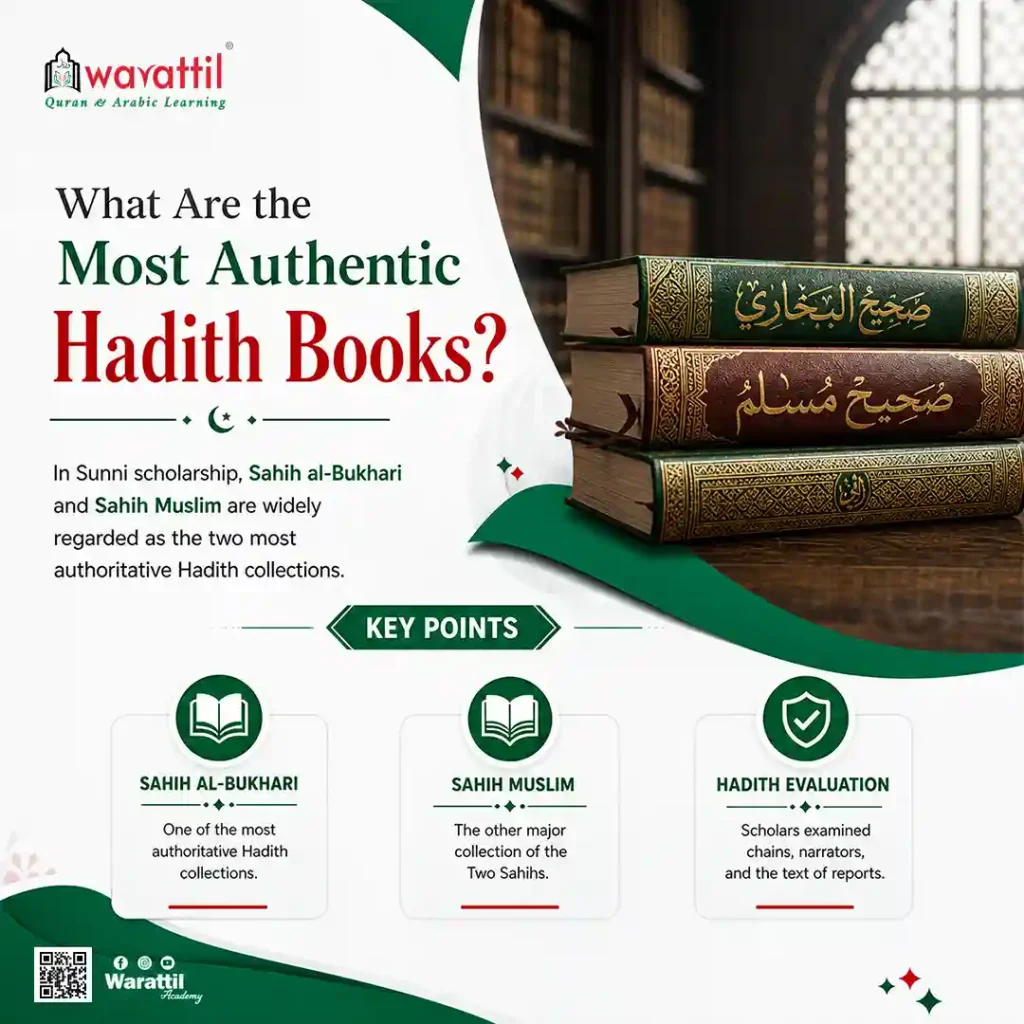
If you are wondering what are the most authentic hadith books, the answer depends on what is meant by “authentic.” In Sunni Islamic scholarship, Sahih al-Bukhari and Sahih Muslim are widely regarded as the two most authoritative hadith collections, and they are commonly known together as al-Sahihayn (the Two Sahihs).
Hadith are reports describing the sayings, actions, approvals, and characteristics of the Prophet Muhammad ﷺ. Over the centuries, Muslim scholars developed detailed methods for examining these reports, including studying the chain of transmission (isnad), the reliability of narrators, continuity of transmission, and the text of the report (matn).
For that reason, it is important to distinguish between a hadith collection and the individual grading of a hadith. Not every major hadith book was compiled with the same criteria, and not every narration found in the broader canonical collections has the same level of authenticity.
What Makes a Hadith Authentic?
Before looking at the major books, it helps to understand how hadith authenticity is assessed.
Classical hadith scholarship places significant importance on the isnad, or chain of narrators. Scholars examined whether narrators were considered trustworthy, whether they possessed adequate accuracy and memory, and whether the chain was connected. The content of a report could also be examined for defects and inconsistencies.
This systematic approach is particularly evident in the introductions and methodologies associated with major hadith scholars. For example, Imam Muslim’s introduction discusses the importance of transmitting reports through trustworthy narrators and the role of examining narrators.
The term sahih generally means “sound” or “authentic” in hadith terminology. However, the classification of a report is a technical judgment made according to established principles of hadith criticism.
1. Sahih al-Bukhari
Sahih al-Bukhari, compiled by Imam Muhammad ibn Isma’il al-Bukhari (d. 256 AH/870 CE), is generally regarded in Sunni Islam as the most authoritative collection of hadith. It is also commonly described as the most authentic hadith collection after the Qur’an within the Sunni tradition.
Imam al-Bukhari was particularly rigorous in selecting narrations for his Sahih. His approach included requirements concerning the reliability and precision of narrators, the continuity of transmission, and the meeting of narrators within a chain.
The collection covers a wide range of subjects, including revelation, faith, knowledge, purification, prayer, fasting, charity, pilgrimage, marriage, business, manners, and other aspects of Islamic life. The collection contains more than 7,500 narrations when repetitions are counted.
Because of its status and rigorous methodology, Sahih al-Bukhari is usually the first book recommended when someone wants to study the most rigorously authenticated Sunni hadith collection.
2. Sahih Muslim
Sahih Muslim, compiled by Imam Muslim ibn al-Hajjaj al-Naysaburi (d. 261 AH/875 CE), is generally regarded as the second of the two most authoritative Sunni hadith collections. Together, Sahih al-Bukhari and Sahih Muslim are known as al-Sahihayn, meaning “the Two Sahihs.”
Imam Muslim also applied rigorous standards when selecting narrations. His methodology placed particular emphasis on reliable transmitters, connected chains, and the examination of reports for defects. His introduction contains discussions concerning narrator reliability and the importance of the isnad.
One feature readers often notice is the way Imam Muslim groups different chains and versions of narrations. This can make it easier to compare related reports and understand how a particular hadith was transmitted.
Sahih Muslim contains roughly 7,500 narrations when repetitions are included and is organized into 57 books in the commonly used digital edition.
Sahih Bukhari vs. Sahih Muslim
Both books occupy an exceptional position in Sunni hadith scholarship. Classical and later Sunni scholars generally place them above the other major Sunni hadith collections in terms of overall authenticity.
That does not mean that the two collections are identical. Imam al-Bukhari and Imam Muslim used their own methods and organizational approaches when compiling their works. As a result, a narration may appear in one collection but not the other.
For students, the key point is that both Sahih al-Bukhari and Sahih Muslim are primary references for rigorously authenticated hadith within Sunni Islam.
3. Sunan Abu Dawud
Sunan Abu Dawud is one of the major Sunni hadith collections and is traditionally included among the Kutub al-Sittah, or “Six Books.” It was compiled by Imam Abu Dawud al-Sijistani.
Unlike Sahih al-Bukhari and Sahih Muslim, Sunan Abu Dawud was not intended to contain only narrations meeting the highest sahih standard. It is particularly important for Islamic legal scholarship because it brings together narrations relevant to questions of jurisprudence and religious practice.
Therefore, the phrase “one of the six books” should not be understood as meaning that every narration in all six collections has exactly the same level of authenticity.
4. Jami’ al-Tirmidhi
Jami’ al-Tirmidhi, compiled by Imam Abu ‘Isa Muhammad al-Tirmidhi, is another major Sunni hadith collection included among the Six Books.
One of its distinctive features is that Imam al-Tirmidhi frequently comments on the status of narrations and discusses how scholars of jurisprudence understood them. The collection therefore provides more than a simple list of reports; it also preserves information about hadith grading and scholarly legal discussion.
This makes Jami’ al-Tirmidhi particularly useful for readers who want to understand how hadith were connected with early Islamic legal reasoning.
However, unlike the titles Sahih al-Bukhari and Sahih Muslim, Jami’ al-Tirmidhi should not be treated as a collection in which every individual narration is necessarily sahih. Its contents include narrations with different classifications.
5. Sunan al-Nasa’i
Sunan al-Nasa’i, compiled by Imam Ahmad ibn Shu’ayb al-Nasa’i, is also traditionally counted among the Six Books of Sunni hadith.
The work is known for its detailed treatment of narrations and its relevance to Islamic jurisprudence. Like the other Sunan collections, it should be approached with attention to the grading of individual narrations rather than assuming that every report has the same level of authenticity.
The Six Books became an important part of the Sunni hadith canon, although their relative status and the grading of individual reports have been discussed by Muslim scholars throughout the history of hadith studies.
6. Sunan Ibn Majah
Sunan Ibn Majah, compiled by Imam Muhammad ibn Yazid Ibn Majah, is traditionally included as the sixth collection in the commonly recognized Sunni Kutub al-Sittah.
It contains narrations covering areas such as worship, transactions, marriage, manners, and other subjects relevant to Islamic life.
However, it is important not to assume that every narration in Sunan Ibn Majah is authentic simply because the book is one of the Six Books. Hadith scholars have identified narrations of different grades within the collection, so individual reports should be evaluated according to hadith scholarship.
What Are the Six Major Sunni Hadith Books?
The six collections commonly known as Kutub al-Sittah are:
- Sahih al-Bukhari
- Sahih Muslim
- Sunan Abu Dawud
- Jami’ al-Tirmidhi
- Sunan al-Nasa’i
- Sunan Ibn Majah
These six works became central to Sunni hadith literature. Academic references also identify these collections as the major canonical Sunni hadith books.
However, the six books should not be understood as six collections containing only authentic narrations. The term “Six Books” describes their canonical status within Sunni hadith scholarship, while the authenticity of individual reports can differ.
Are There Other Important Authentic Hadith Books?
Yes. The six books are not the entirety of classical hadith literature.
Other important works include Al-Muwatta of Imam Malik, Musnad Ahmad ibn Hanbal, and other early and substantial hadith compilations. Scholars have studied these works extensively, and individual narrations within them may have different grades.
This is an important distinction because the reliability of a hadith is not determined solely by whether it appears in one particular famous collection. Hadith scholars may examine the same narration across multiple sources, compare chains of transmission, study narrator biographies, and assess possible defects.
Why Are Bukhari and Muslim Considered So Important?
The special status of Sahih al-Bukhari and Sahih Muslim comes largely from the rigorous standards their compilers applied to the narrations they selected.
Both collections focus on reports that their authors considered authentic according to their respective methodologies. Classical Sunni scholarship subsequently gave these two works a particularly high position. Academic studies of Islamic tradition likewise describe Bukhari and Muslim as the most authoritative of the Six Books.
At the same time, responsible study requires more than simply searching for a quotation in a famous collection. A reader should consider the complete Arabic text, chain of transmission, context, chapter heading, variants of the narration, and the explanations of qualified hadith scholars.
How Should Beginners Study Hadith?
Someone beginning hadith study can start with Sahih al-Bukhari and Sahih Muslim, preferably with a reliable translation and scholarly commentary.
It is also useful to learn basic terminology such as:
- Isnad — the chain of transmitters through whom a report was transmitted.
- Matn — the actual text or content of a hadith.
- Sahih — a technical classification generally meaning sound/authentic.
- Hasan — a technical classification generally meaning good.
- Da’if — a weak report.
- Mawdu’ — a fabricated report.
Understanding these terms helps prevent a common mistake: assuming that every quotation attributed to the Prophet ﷺ has the same level of reliability.
For serious study, readers should also consult recognized hadith commentaries and qualified scholars, particularly when a narration appears to conflict with another report or when its legal implications are significant.
What Are the Most Authentic Hadith Books? A Clear Summary
So, what are the most authentic hadith books?
Within the Sunni Islamic tradition, Sahih al-Bukhari and Sahih Muslim hold the highest status among the major hadith collections in terms of authenticity. They are followed by the other major collections traditionally known as the Six Books: Sunan Abu Dawud, Jami’ al-Tirmidhi, Sunan al-Nasa’i, and Sunan Ibn Majah.
The most important point is that “Six Books” does not mean “six books containing only authentic hadith.” Sahih al-Bukhari and Sahih Muslim were specifically compiled as sahih collections, while the other major collections contain narrations with varying classifications.
For anyone studying the Sunnah, accuracy matters more than simply collecting quotations. Checking the original source, understanding the grading of the narration, and consulting reliable scholarly explanations can provide a much more dependable understanding of hadith literature.
The question what are the most authentic hadith books has a relatively clear answer within mainstream Sunni hadith scholarship: Sahih al-Bukhari and Sahih Muslim are the two foremost collections of rigorously authenticated hadith, while the other four books of the Kutub al-Sittah remain foundational works of Sunni hadith literature.
Hadith study, however, is a detailed scholarly discipline. A famous collection provides an important source, but understanding a narration properly may require examining its chain, wording, context, grading, and scholarly commentary. That approach helps readers distinguish between authentic reports, weaker narrations, and statements that have been incorrectly attributed to the Prophet Muhammad ﷺ.