Shopping cart
- +1 564-544-6614
- [email protected]
- 24/7 Available


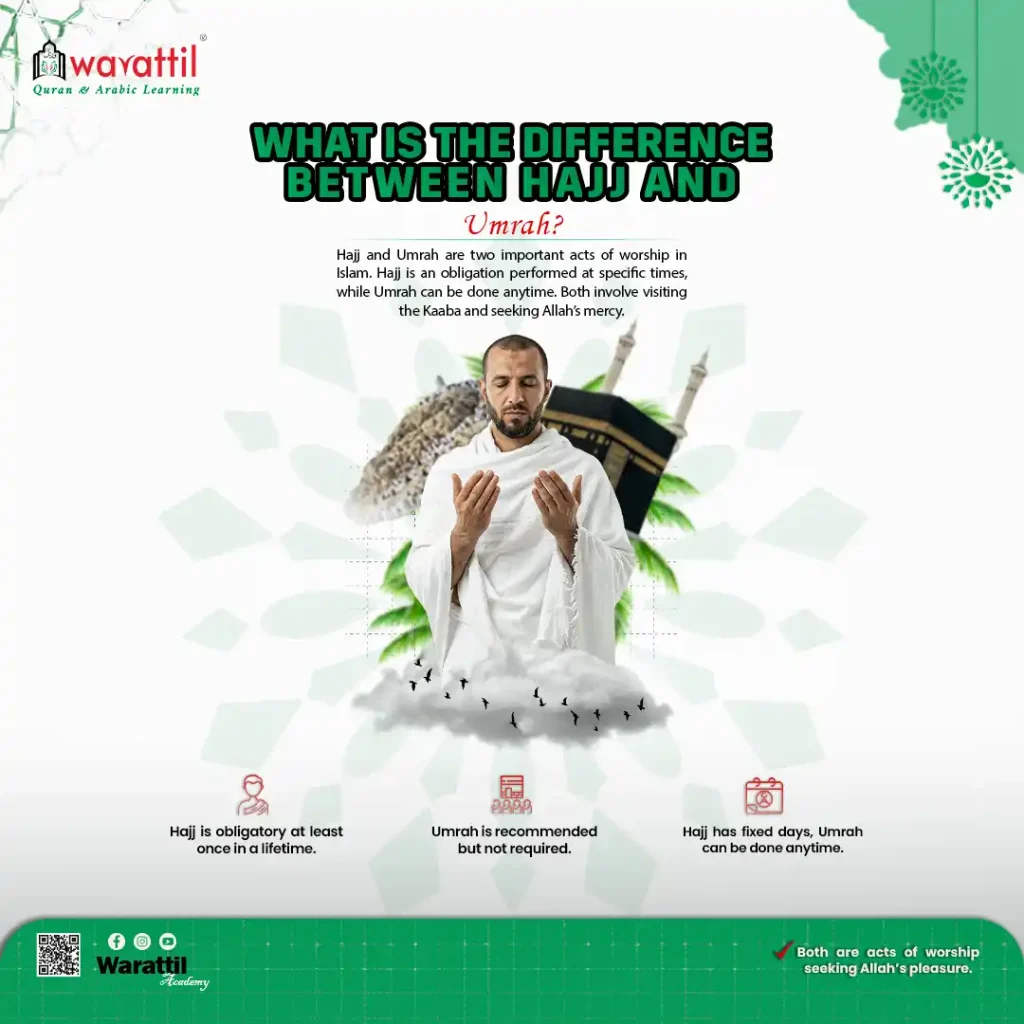
If you have ever asked yourself what is the difference between Hajj and Umrah — you are not alone. Many Muslims and even non‑Muslims find these two sacred pilgrimages confusing, since both involve traveling to Mecca, wearing the Ihram, and performing rituals around the Holy Kaaba. While they do share some common ground, the two are distinct acts of worship in Islam, each carrying its own unique rules, timing, rituals, and spiritual weight.
In the simplest of terms, Hajj is the greater pilgrimage, one of the Five Pillars of Islam while Umrah is the lesser pilgrimage, which is highly recommended but not obligatory. That said, this explanation barely scratches the surface. The differences go much deeper, touching on when each can be performed, how long they take, which rituals are included, and what spiritual rewards they carry.
In this detailed guide, we walk you through every significant distinction between Hajj and Umrah so that you come away with a clear, complete, and accurate understanding of both.
Before diving into the differences, it helps to understand what each pilgrimage actually is and where it stands in the framework of Islamic worship.
Hajj is the fifth and final pillar of Islam. It is an obligatory act of worship that every adult Muslim who is physically capable and financially able must perform at least once in their lifetime.
It takes place during specific days in Dhul Hijjah, the 12th and final month of the Islamic lunar calendar, and involves a series of rituals spread over five to six days.
Umrah is often called the “minor” or “lesser” pilgrimage. It is a Sunnah act meaning it is highly recommended and spiritually rewarding, but not obligatory in the same way Hajj is.
Unlike Hajj, Umrah can be performed at any time of the year, and it typically takes only a few hours to complete once the pilgrim is at the holy sites.
Both pilgrimages require traveling to Makkah al‑Mukarramah (Mecca) in Saudi Arabia, and both involve entering a state of spiritual purity known as Ihram. However, beyond these shared elements, the two diverge quite significantly in terms of scope, rituals, and religious status.
One of the most fundamental differences between Hajj and Umrah lies in their level of obligation within Islamic law (Sharia).
Hajj is Fard — obligatory — for every Muslim who meets the following conditions: they must be an adult (having reached puberty), mentally sound, financially able to afford the journey, and physically healthy enough to undertake it. Allah (SWT) commands this in the Quran:
“And Hajj (pilgrimage to Mecca) to the House is a duty that mankind owes to Allah, those who can afford the expenses.”
— Surah Aal‑Imran (3:97)
This obligation is binding once in a lifetime. Performing Hajj more than once is a virtuous act, but the religious duty is fulfilled with the first performance.
Umrah, on the other hand, is classified as Sunnah Mu’akkadah, a strongly recommended practice that the Prophet Muhammad (Peace Be Upon Him) regularly performed and encouraged. The majority of Islamic scholars hold that Umrah is not obligatory, although some scholars particularly within the Shafi‘i school of thought do consider it Wajib (necessary). Regardless of this scholarly difference, not performing Umrah does not leave a Muslim in a state of sin, unlike neglecting Hajj without a valid excuse.
The timing of each pilgrimage is another clear point of distinction between the two.
Hajj can only be performed during specific days in the Islamic month of Dhul Hijjah. The key dates are the 8th through the 13th of Dhul Hijjah, with the most critical ritual — the Standing at Arafat (Wuquf) taking place on the 9th of Dhul Hijjah. Missing this particular day means the Hajj is invalid, regardless of everything else the pilgrim may have done.
This strict timing means that Hajj happens only once a year, drawing millions of Muslims from around the globe to gather in and around Mecca simultaneously. In recent years, the annual Hajj has seen upwards of 2 million pilgrims participating, making it one of the largest regular human gatherings on Earth.
Umrah, by contrast, can be performed at any time throughout the Islamic year. There is no restricted window. However, many scholars note that Umrah performed during the blessed month of Ramadan carries an especially elevated spiritual reward. The Prophet Muhammad (PBUH) reportedly said that performing Umrah during Ramadan is equivalent in reward to performing Hajj or even performing Hajj with the Prophet himself.
Because of this flexibility, Umrah has grown tremendously in popularity, with millions of pilgrims traveling to Mecca every month of the year, not just during the Hajj season.
There is a very noticeable difference in the time commitment required for each pilgrimage.
Hajj typically spans five to six days, from the 8th to the 12th or 13th of Dhul Hijjah. During these days, pilgrims move between several holy sites including Mina, the plains of Arafat, Muzdalifah, and Mecca itself performing specific rituals at each location on specific days. The movement between sites is structured and sequential, and missing or skipping a rite can render the Hajj incomplete or require an expiation (Dam).
Umrah, on the other hand, is far more compact. An experienced pilgrim can complete all the rituals of Umrah in as little as two to four hours, though many pilgrims take longer to fully absorb the spiritual experience. The brevity of Umrah makes it more accessible, and some Muslims perform it multiple times during a single visit to Saudi Arabia.
This is where the most detailed and important differences between the two pilgrimages emerge. While both share certain rites, Hajj contains several additional rituals that Umrah does not include.
Beyond what Umrah includes, Hajj encompasses a set of additional rites that give it its greater spiritual stature and complexity:
| Aspect | Hajj (Greater Pilgrimage) | Umrah (Lesser Pilgrimage) |
| Religious Status | Fard (Obligatory) – 5th Pillar of Islam | Sunnah – Strongly recommended |
| Timing | Only 8th–13th Dhul Hijjah (Once a year) | Any time of the year (Year-round) |
| Duration | 5 to 6 days | 2 to 4 hours (up to a day) |
| Core Rituals | Ihram, Tawaf, Sa‘i, Arafat, Muzdalifah, Rami, Qurbani, Halq/Taqsir | Ihram, Tawaf, Sa‘i, Halq/Taqsir |
| Standing at Arafat | Mandatory (The core pillar of Hajj) | Not required |
| Stay in Mina | Required | Not required |
| Stoning (Jamarat) | Required | Not required |
| Animal Sacrifice | Required (Qurbani) | Not required |
| Crowd Levels | Millions gather simultaneously | Usually smaller, more manageable crowds |
| Spiritual Reward | Hajj Mabrur = Paradise | Expiation of sins; during Ramadan, it is equivalent to Hajj in reward |
Yes — and in fact, this is how many pilgrims choose to fulfill both acts of worship in a single journey. Islamic scholars have defined three distinct ways in which Hajj can be performed, two of which incorporate Umrah:
For most international pilgrims, Hajj Tamattu is the preferred and recommended option, as it allows them to experience both the spiritual rewards of Umrah and the full obligations of Hajj within a single visit to the holy land.
While any Muslim can aspire to perform both pilgrimages, there are certain conditions particularly for Hajj that must be met before it becomes obligatory.
A Muslim must be: a free person (not enslaved), an adult (having reached the age of puberty), of sound mind, and physically capable of making the journey. Most importantly, they must have the financial means to cover travel costs, accommodation, and living expenses during the pilgrimage as well as enough money to support their dependents back home in their absence.
Those who are seriously ill, medically at risk from travel, or financially unable to afford the journey are not obligated and in the case of Hajj, they may be exempted from the obligation entirely. Women performing either pilgrimage are required to travel with a Mahram (a close male relative who is not permissible for her to marry), though some scholars have differing views on this condition for older women traveling in organized groups.
It is also worth noting that children can perform Umrah and Hajj, but these do not count as the obligatory Hajj they must still perform it again upon reaching adulthood if they are able.
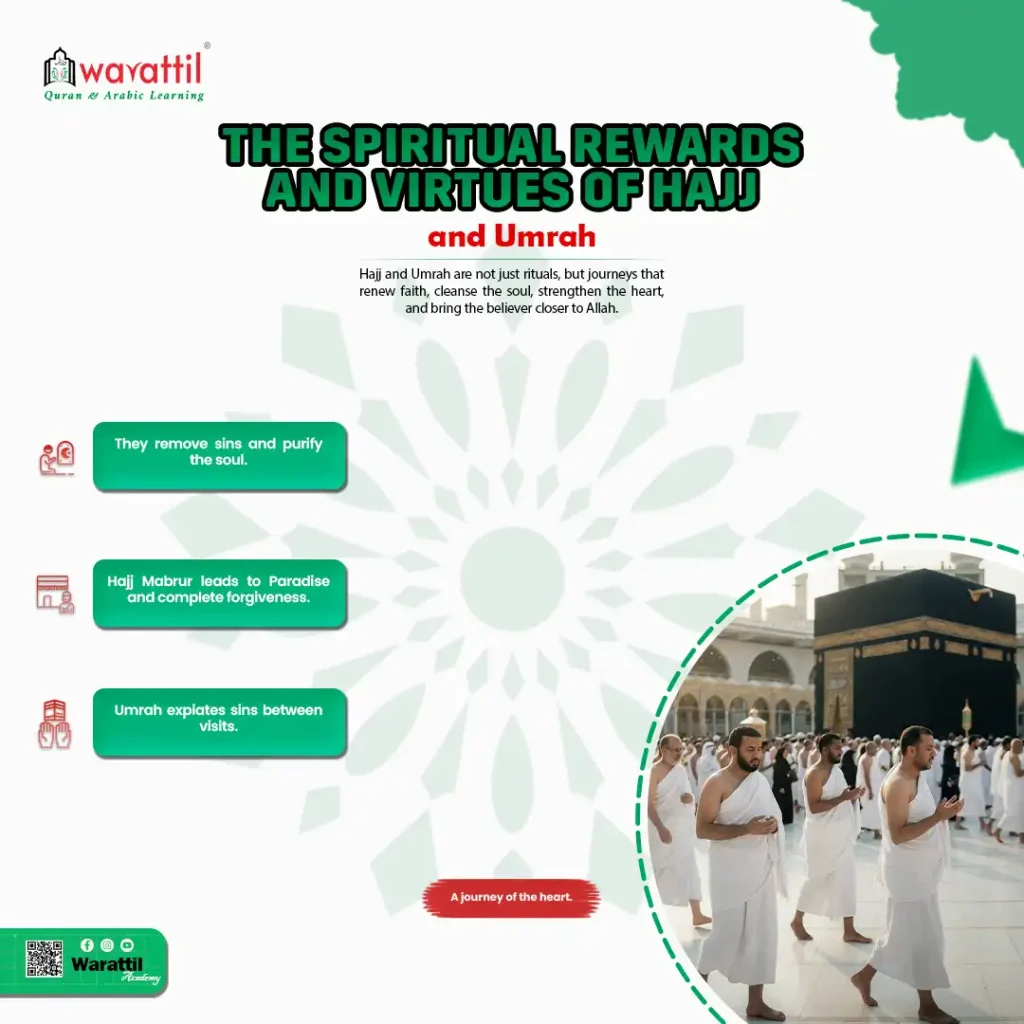
Both Hajj and Umrah are rich in spiritual benefit, and several authentic Hadith (sayings of the Prophet PBUH) highlight their tremendous rewards.
“Perform Hajj and Umrah consecutively, for they remove poverty and sins as the bellows removes impurity from iron.”
— Reported by Ibn Mas‘ud (RA), Sunan al‑Tirmidhi
The Prophet Muhammad (PBUH) described the reward of an accepted Hajj — known as Hajj Mabrur — as nothing less than Paradise itself. A Hajj is considered Mabrur (accepted) when it is performed with sincere intention, in compliance with all its rules, and without major sins. The pilgrim who achieves this returns spiritually cleansed, their past sins forgiven as the day they were born.
As for Umrah, the Prophet (PBUH) said that performing one Umrah after another serves as an expiation for the sins committed between them. Performing Umrah during Ramadan, as mentioned earlier, carries a reward equivalent to Hajj — though scholars clarify that it does not replace the obligatory Hajj.
Both pilgrimages are also seen as opportunities to strengthen one’s relationship with Allah (SWT), to reflect on the legacy of Prophet Ibrahim and his family, and to experience a profound sense of unity with the global Muslim community (Ummah).
To summarize: Hajj is the obligatory greater pilgrimage performed once a year during Dhul Hijjah, spanning five to six days and involving a comprehensive set of rituals including the Standing at Arafat, the stoning of Jamarat, and the animal sacrifice. Umrah is the lesser pilgrimage — voluntary, shorter, and available year‑round — consisting of Ihram, Tawaf, Sa‘i, and trimming of the hair.
Both are profound journeys of the soul. Whether you are preparing for Hajj, planning Umrah, or simply seeking knowledge, may Allah (SWT) bless your intentions and make the sacred journey easy for every believer. Ameen.

My son feels happy, amazing teachers and staff in wrattil and flexible prices MashaAllah Thank you so much
My daughter started learning in warattil academy and alhamdulilah we are really impressed and have enjoyed learning with wrattil. May Allah reward her sheikh
My teacher Ahmed is very good. He helped me recite and memorize holy Quran
Warattil is the most efficient way of learning Arabic. I like warattil curriculum and excellent teachers to support this learning Thank you so much
I highly recommend warattil Ijazah programs to anyone who wants to learn Quran properly.
Very well organized MashaAllah. I love it and this is a great course if you want to understand the Quran and learn tafsir
Warattil program is the best I have seen. The teacher is really great and is available to answer questions in a clear manner
I think warattil is the best academy in learning Arabic and I recommend Arabic course to anyone
We are so happy with ustad Hussein. He is very patient and comfortable teacher. May Allah the teachers and admin in warattil
Rating 10 mashaAllah and so grateful