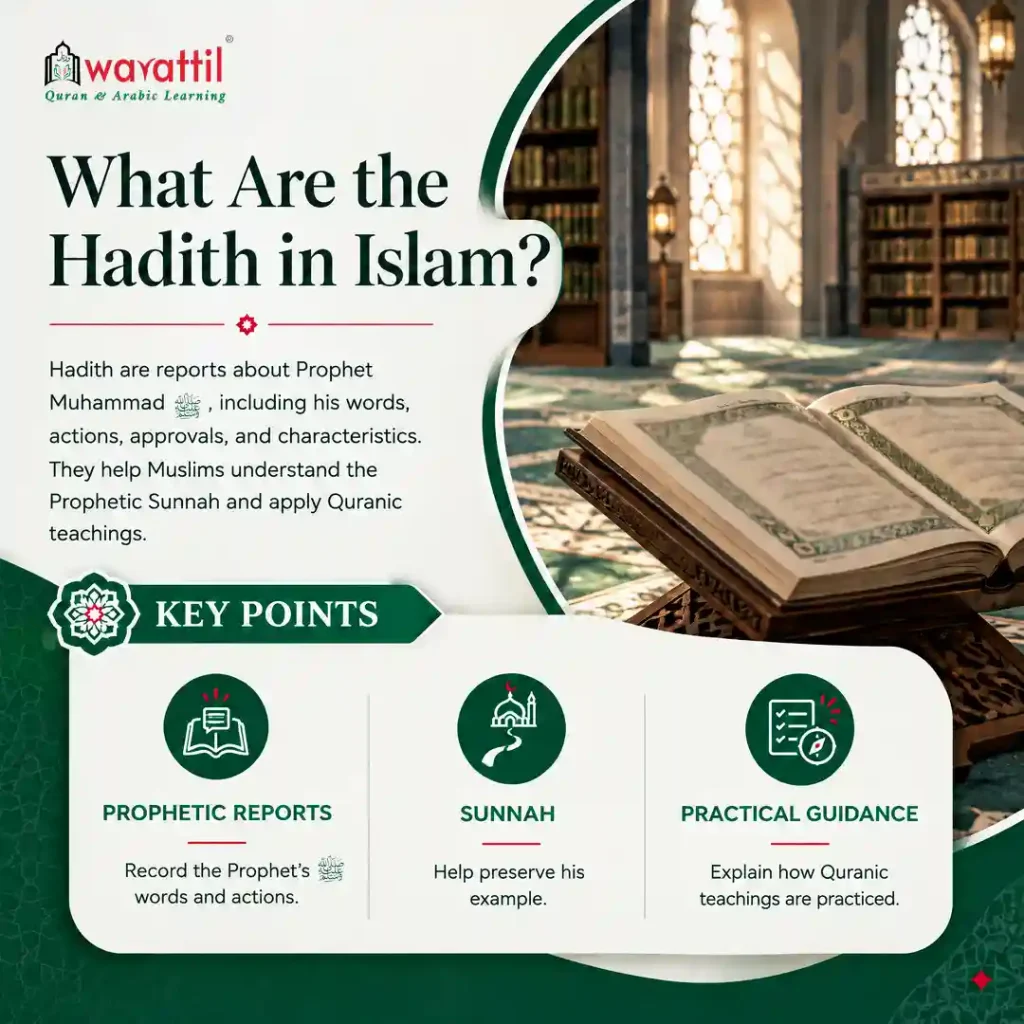
If you are wondering what are the hadith, the simplest answer is that Hadith are reports about the words, actions, approvals, and practices attributed to the Prophet Muhammad ﷺ. Muslims have preserved these reports as an important source for understanding the Prophet’s example, known as the Sunnah, and for understanding many aspects of Islamic belief, worship, ethics, and law.
The Hadith are not the same as the Qur’an. Muslims regard the Qur’an as the revealed word of Allah, while Hadith literature records reports about the Prophet Muhammad ﷺ. Together, the Qur’an and the Prophetic tradition play an important role in Islamic religious life.
However, not every narration found in a Hadith book has the same level of reliability. Muslim scholars developed detailed methods for examining chains of transmission and the content of reports. This is why terms such as Sahih, Hasan, and Da’if are important when studying Hadith.
What Are the Hadith in Islam?
The Arabic word Hadith can refer to a report, narration, or account. In Islamic studies, it generally refers to reports attributed to the Prophet Muhammad ﷺ, particularly reports describing something he said, did, approved, or sometimes described about his characteristics. Oxford Academic defines a Hadith as a report attributed to Muhammad that describes his words and actions and serves as an important source for knowing the Prophetic Sunnah.
For example, a Hadith might describe how the Prophet ﷺ performed a particular act of worship, what he said about good character, how he treated other people, or how he responded to a particular situation.
These reports are important because the Qur’an often provides general principles while the Prophetic tradition gives additional details about how Muslims understand and practice those principles.
The daily prayers provide a simple example. The Qur’an commands Muslims to establish prayer, while the details of how Muslims perform the prayer are largely known through the Prophetic tradition.
What Is the Difference Between Hadith and Sunnah?
Hadith and Sunnah are closely connected, but they are not exactly the same thing.
The Sunnah refers broadly to the way, practice, example, and normative precedent associated with the Prophet Muhammad ﷺ. The Hadith are individual reports that transmit information about that example. Oxford Academic describes Sunnah as the Prophet’s way of life and legal precedent, while Hadith are reports through which his words and actions are transmitted.
A simple way to understand the distinction is:
Sunnah = the Prophetic example or practice.
Hadith = reports that preserve information about that example.
The two terms are often used together because Hadith are one of the principal ways Muslims learn about the Sunnah.
What Does a Hadith Contain?
A traditional Hadith generally has two important components: the isnad and the matn.
The isnad is the chain of people who transmitted the report.
The matn is the actual text or content of the report.
For example, a narration may begin by identifying one person who heard it from another person, who heard it from another narrator, eventually tracing the report back to the Prophet ﷺ. The statement or description being transmitted is the matn.
This structure became extremely important in Islamic scholarship because scholars needed a method for evaluating how a report had been transmitted.
Oxford Academic specifically identifies the isnad and matn as two fundamental components of a Hadith.
Why Is the Isnad Important?
The isnad, or chain of transmission, is one of the defining features of classical Hadith scholarship.
Muslim scholars did not simply collect reports and treat every narration as equally reliable. They investigated the people appearing in transmission chains and developed methods for evaluating narrators and chains.
Questions could include whether narrators were known to have met one another, whether a narrator was considered reliable, and whether the chain contained a break.
This process contributed to the development of a specialized field known as Hadith criticism or ‘ilm al-hadith.
The purpose was not merely to collect as many reports as possible. Scholars also wanted to determine the relative strength of the reports they received.
What Are Sahih, Hasan, and Da’if Hadith?
Not every Hadith has the same level of authenticity.
Among commonly used classifications in Sunni Hadith scholarship are Sahih, Hasan, and Da’if.
Sahih Hadith
Sahih generally means sound or authentic.
A Hadith classified as Sahih has met the relevant criteria established by Hadith scholars for an authentic report. These criteria involve matters such as the continuity of the chain and the reliability and precision of its transmitters, along with examination for serious irregularities or defects.
It is therefore incorrect to assume that every statement attributed to the Prophet ﷺ automatically qualifies as Sahih.
Hasan Hadith
Hasan generally means good.
A Hasan narration is considered acceptable in the relevant Hadith methodology but does not meet all the criteria associated with the highest category of Sahih narration.
The exact technical definitions and how individual scholars apply them can vary.
Da’if Hadith
Da’if means weak.
A weak Hadith has a deficiency affecting its chain or other criteria used in evaluating its reliability.
Importantly, weak does not necessarily mean fabricated. A weak report may have a problem in its transmission that prevents scholars from treating it as an authenticated Prophetic statement.
There are also other classifications used in Hadith studies, so these three terms should not be treated as the complete system of Hadith criticism.
Are All Hadith Authentic?
No.
This is one of the most important things to understand when learning about Hadith.
A Hadith collection can contain narrations with different levels of reliability, depending on the collection and the methodology of its compiler. Even the existence of a narration in a particular book does not automatically mean that every scholar considers that narration authentic.
This is why responsible Islamic scholarship normally considers the source of the narration, its chain, its classification, and relevant scholarly analysis before using it as evidence.
The development of Hadith scholarship was partly driven by the need to distinguish reliable reports from reports that were questionable or fabricated. Oxford Academic notes that Muslim scholars developed the isnad and other methods to evaluate the reliability of transmitted reports.
What Are the Major Hadith Collections?
There are many Hadith collections, and their importance varies among Islamic traditions.
In Sunni Islam, six collections are commonly known as the Kutub al-Sittah, or the Six Books:
- Sahih al-Bukhari
- Sahih Muslim
- Sunan Abi Dawud
- Jami’ al-Tirmidhi
- Sunan al-Nasa’i
- Sunan Ibn Majah
Among these, Sahih al-Bukhari and Sahih Muslim have a particularly prominent status in Sunni scholarship. Encyclopaedia Iranica describes these two collections as the two most authoritative Hadith works in Sunni Islam after the Qur’an.
However, it is important not to present the Sunni Six Books as the universal Hadith canon for all Muslims. Shia Islamic traditions have their own major Hadith collections and scholarly methodologies. The way Hadith are evaluated and which collections receive particular authority can therefore differ between Islamic schools and traditions.
How Were Hadith Preserved?
The preservation of Hadith developed over a long historical period.
During the Prophet’s lifetime and after his death, his Companions transmitted reports about his words and actions. These reports were passed to later generations through networks of teachers, students, and transmitters.
Over time, scholars travelled extensively to collect reports and investigate their chains of transmission. Hadith scholarship subsequently developed into a sophisticated discipline concerned with narrators, chains, textual comparison, and authenticity.
The major Hadith collections were compiled during the early centuries of Islam. Oxford Academic notes that Hadith were recorded and organized gradually and that questions concerning authenticity became an important part of the scholarly tradition.
This history is important because it shows why a Hadith should not simply be understood as a modern quotation copied into a book. Each narration has a transmission history that scholars attempted to investigate.
Why Are Hadith Important in Islam?
Hadith are important because they preserve information about the Prophet Muhammad’s ﷺ teachings and example.
The Qur’an provides the foundation of Islamic belief and guidance, but many practical details of Islamic life are understood through the Prophetic tradition.
Hadith help Muslims understand matters such as:
- prayer and worship,
- fasting,
- charity,
- pilgrimage,
- personal conduct,
- family relationships,
- business ethics,
- manners and character,
- and aspects of Islamic law.
For this reason, Hadith became a major source for Islamic jurisprudence and religious practice. Encyclopaedia Britannica describes Hadith as an important source of religious law and moral guidance, second in authority to the Qur’an in mainstream Islamic understanding.
How Do Scholars Determine Whether a Hadith Is Authentic?
Hadith authentication is more complicated than simply asking whether a narration sounds believable.
Classical scholars examined several aspects of a report.
They considered the continuity of the chain of transmission, the reliability and accuracy of narrators, and whether there were problems or contradictions that could affect the report.
Scholars also developed methods for identifying hidden defects and irregularities in narrations.
This is why Hadith studies developed its own technical terminology and extensive literature.
At the same time, different scholars and schools can reach different conclusions about particular narrations. Therefore, a responsible article should avoid saying that every Hadith scholar has always agreed about every individual report.
What Is the Relationship Between the Qur’an and Hadith?
The Qur’an and Hadith occupy different positions.
The Qur’an is understood by Muslims as the revealed word of Allah given to the Prophet Muhammad ﷺ.
Hadith, by contrast, are reports transmitted from the Prophet ﷺ and preserved through chains of narration.
The Qur’an is therefore not simply another Hadith collection, and Hadith are not considered equivalent to the Qur’an.
Within mainstream Islamic thought, Hadith serve an important role in explaining and applying the Qur’anic message. The Sunnah provides details about the Prophet’s practice and helps Muslims understand how Qur’anic principles were embodied in his life.
Can Hadith Explain the Quran?
Yes, Hadith can provide important explanations and practical examples related to Qur’anic teachings.
For instance, the Qur’an commands Muslims to pray, but the Prophetic tradition provides detailed information about the Prophet’s manner of prayer.
Similarly, the Qur’an establishes broad principles concerning fasting, charity, pilgrimage, family life, and ethical behavior, while the Sunnah provides additional details about how those principles were practiced.
This is one reason Hadith became central to Islamic scholarship.
However, individual Hadith must still be evaluated carefully. A report should not automatically be used to establish a religious claim simply because it appears online or is attributed to the Prophet ﷺ.
What Are Hadith Used For Today?
Hadith continue to be studied by Muslims, scholars, students, researchers, and institutions around the world.
They are used in Islamic jurisprudence, religious education, sermons, ethical discussions, and personal study.
Muslims may consult Hadith to understand how the Prophet ﷺ worshipped, interacted with people, handled disagreements, showed generosity, or demonstrated patience and compassion.
At the same time, serious study requires attention to authenticity, context, interpretation, and differences among Islamic schools.
This is particularly important when a Hadith is quoted in discussions about controversial historical or theological subjects.
What Are the Hadith and Why Do They Matter?
So, what are the hadith?
They are transmitted reports concerning the Prophet Muhammad ﷺ, particularly his words, actions, approvals, and example. They form a major part of the Islamic tradition and are closely connected to the concept of the Sunnah.
Hadith are preserved through transmission chains known as isnad, while the actual content of a report is called the matn. Muslim scholars developed detailed methods for evaluating narrations, leading to classifications such as Sahih, Hasan, and Da’if.
The Hadith tradition also includes numerous collections rather than a single book. Sunni Muslims commonly recognize six major collections, with Sahih al-Bukhari and Sahih Muslim holding a particularly prominent position. Other Islamic traditions have their own Hadith collections and scholarly approaches.
Understanding these distinctions is essential for anyone who wants to study Islam accurately.
The question “what are the hadith” has a straightforward answer, but understanding the Hadith tradition requires more than a simple definition.
Hadith are reports about the Prophet Muhammad ﷺ and form an important part of the Islamic tradition. They help preserve the Prophetic Sunnah and provide Muslims with information about how the Prophet taught, worshipped, behaved, and interacted with others.
At the same time, not every narration has the same level of authenticity. The isnad, matn, reliability of transmitters, continuity of transmission, and other scholarly criteria all matter when evaluating a report.
For anyone studying Islam, this distinction is essential. Rather than treating every quotation attributed to the Prophet ﷺ as automatically authentic, it is better to examine the original source, Hadith classification, scholarly interpretation, and historical context.
That approach provides a more accurate and responsible way to understand the rich Hadith tradition and its continuing role in Islam.
Frequently Asked Questions About Hadith
What are the hadith?
Hadith are reports attributed to the Prophet Muhammad ﷺ that preserve information about his words, actions, approvals, and example. They are an important source for understanding the Sunnah.
Is Hadith the same as the Quran?
No. Muslims regard the Qur’an as the revealed word of Allah, while Hadith are transmitted reports concerning the Prophet Muhammad ﷺ. They have different statuses and functions within Islamic scholarship.
What is the difference between Hadith and Sunnah?
The Sunnah refers broadly to the Prophet’s example, practice, and normative way, while Hadith are reports that transmit information about that example.
Are all Hadith authentic?
No. Hadith have different levels of reliability. Scholars classify reports using categories such as Sahih, Hasan, and Da’if, although terminology and methodology can differ between scholars and traditions.
What is a Sahih Hadith?
Sahih means sound or authentic. It refers to a narration that meets the relevant criteria of authenticity within a particular Hadith methodology.
What is a weak Hadith?
A weak, or Da’if, Hadith has a deficiency affecting its reliability under the relevant Hadith methodology. Weak does not automatically mean that a narration was deliberately fabricated.
What are the Six Books of Hadith?
In Sunni Islam, the Six Books commonly refer to Sahih al-Bukhari, Sahih Muslim, Sunan Abi Dawud, Jami’ al-Tirmidhi, Sunan al-Nasa’i, and Sunan Ibn Majah.
Why are Hadith important?
Hadith preserve information about the Prophet Muhammad’s ﷺ teachings and example. They provide important guidance for understanding Islamic worship, ethics, law, and everyday religious practice.