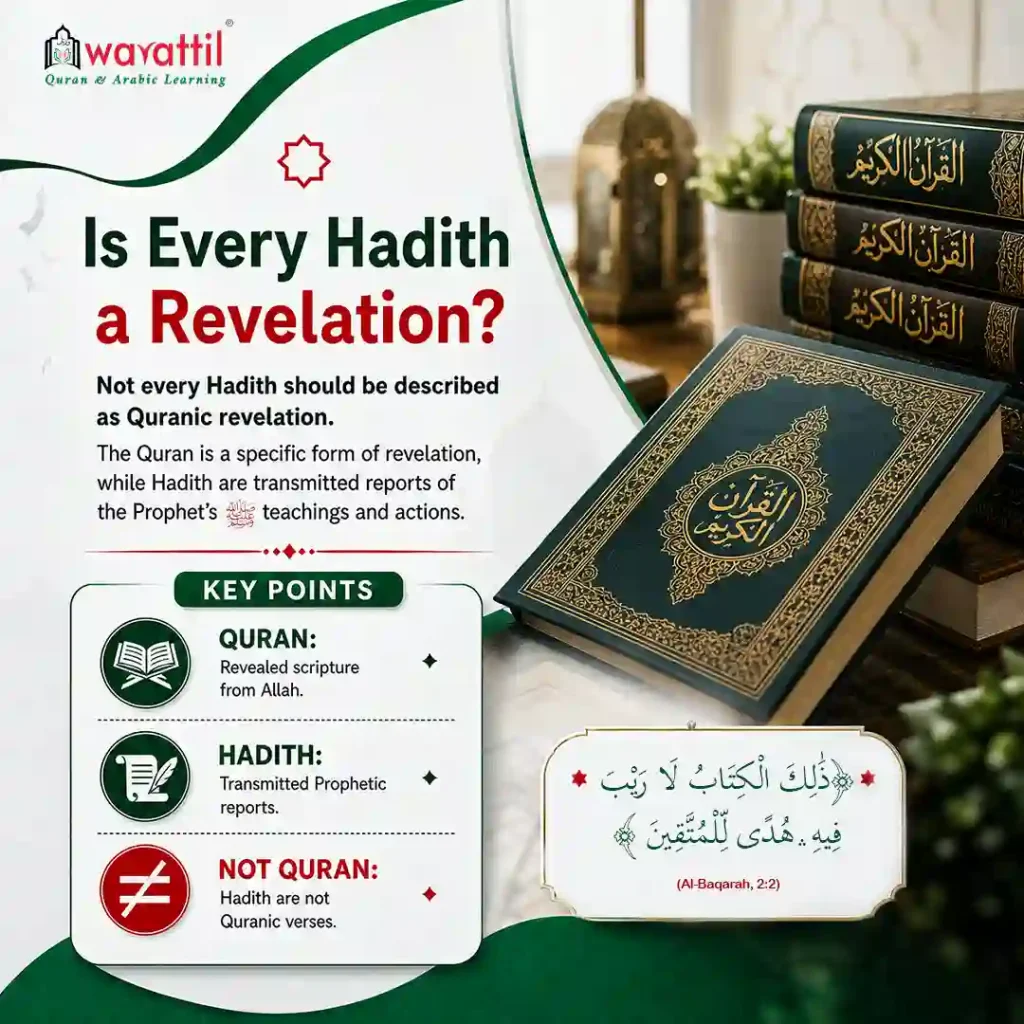
Is the Hadith part of the Quran? No. In Islamic terminology, the Qur’an and Hadith are two distinct sources. The Qur’an is the revealed scripture of Islam, while Hadith refers to reports about the sayings, actions, approvals, and descriptions of the Prophet Muhammad ﷺ. Although both are closely connected to the Prophet’s mission and are important in Islamic studies, they are not the same type of source.
Understanding this distinction is important because the words Qur’an, Hadith, Sunnah, revelation, and Prophetic tradition are sometimes used interchangeably in casual discussions. They have different meanings, however, and treating them as identical can create confusion about Islamic belief and practice.
What Is the Quran?
The Qur’an is the central scripture of Islam. Muslims believe it was revealed by Allah to Prophet Muhammad ﷺ through the angel Jibril (Gabriel) and transmitted to the Muslim community as the Qur’an.
The Qur’an identifies itself as revelation from Allah and repeatedly describes Muhammad ﷺ as the Messenger who received and conveyed it. For example, Qur’an 16:44 states that the Reminder was sent down to the Prophet so that he could explain to people what had been revealed to them.
The Qur’an is therefore treated as a unique form of revelation in Islam. Its Arabic wording is itself regarded as part of the revealed scripture, and Qur’anic verses are recited as part of Muslim worship.
This is one of the fundamental reasons the Qur’an should not be equated with Hadith.
What Is Hadith?
A Hadith is a report describing something attributed to Prophet Muhammad ﷺ. Depending on the particular narration, it may record something he said, did, approved of, or described.
For example, a Hadith may report how the Prophet ﷺ performed a particular act of worship or what he said in response to a question. Hadith literature therefore preserves a substantial amount of information about the Prophet’s life, teachings, and practice.
Hadith collections also contain information about the Qur’an and its interpretation. For example, Sahih Muslim contains reports concerning the Prophet’s interaction with Qur’anic revelation and its recitation.
However, a Hadith is not automatically a Qur’anic verse simply because it records something said by the Prophet ﷺ.
Is the Hadith Part of the Quran?
No. Hadith is not part of the Qur’an.
The Qur’an has its own text, chapters (surahs), and verses (ayahs). Hadith literature is a separate body of transmitted reports.
This distinction can be seen clearly in the way classical Islamic sources identify Qur’anic verses and Prophetic reports separately. A Qur’anic verse is part of the Qur’an itself, whereas a Hadith is transmitted through chains of narrators and is assessed according to the principles of Hadith criticism.
For this reason, saying that “Hadith is part of the Qur’an” is inaccurate.
A more precise statement is that Hadith and Sunnah are closely related to the Qur’an and are used to understand and practice Islam, but they are not part of the Qur’anic text.
Why Do Muslims Study Hadith Alongside the Quran?
The relationship between the Qur’an and Hadith becomes clearer when we consider the Prophet’s role.
The Qur’an instructs believers to follow the Messenger. Qur’an 59:7 says, in its relevant context, that what the Messenger gives should be taken and what he forbids should be avoided.
Similarly, Qur’an 16:44 describes the Prophet as explaining what had been revealed to people.
This means that the Prophet ﷺ was not merely someone who delivered the Qur’anic text. According to mainstream Islamic understanding, his teachings and example also played an important role in showing Muslims how the Qur’anic message was to be understood and practiced.
Consider prayer as an example. The Qur’an commands Muslims to establish prayer, but the detailed practical form of the daily prayers is known through the Prophetic tradition. Reports about the Prophet’s prayer are therefore studied to understand how Muslims traditionally performed the worship commanded by the Qur’an.
The same relationship can be seen in other areas of Islamic practice, including fasting, pilgrimage, charity, personal conduct, and many aspects of worship.
What Is the Difference Between the Quran and Hadith?
The Qur’an and Hadith differ in several important ways.
1. Their status and form are different
The Qur’an is the revealed scripture of Islam. Hadith consists of transmitted reports about the Prophet ﷺ.
The distinction is particularly important because the Qur’an is not simply a collection of Prophetic statements. It is regarded by Muslims as the direct revealed scripture whose wording is itself sacred.
Hadith, on the other hand, records what was transmitted from the Prophet through narrators.
2. Their transmission is assessed differently
Qur’anic transmission and Hadith transmission have different historical and methodological characteristics.
Hadith scholars developed detailed methods for examining narrators and chains of transmission. As a result, Hadith reports are traditionally classified into categories such as sahih (sound/authentic), hasan (good), and da’if (weak), depending on the relevant criteria and scholarly methodology.
This is one reason it is incorrect to treat every statement attributed to the Prophet ﷺ as automatically authentic.
Major Hadith collections contain reports that scholars have evaluated using these methods. For example, Sahih Muslim identifies individual narrations and their chains of transmission, allowing readers and scholars to examine how a report was transmitted.
3. The Qur’an is recited as scripture
The Qur’an has a distinctive role in Muslim worship. Its verses are recited in the formal prayer, while Hadith reports are not recited as Qur’anic scripture.
A Muslim may quote a Hadith during teaching, study, or discussion, but doing so does not make the Hadith part of the Qur’an.
Is Every Hadith a Revelation?
This question requires more care.
Islamic scholarship distinguishes between the Qur’an and other forms of guidance associated with the Prophet ﷺ. Some scholars discuss certain Prophetic teachings in relation to divine guidance or revelation, while also maintaining that such teachings are not part of the Qur’an.
Qur’an 53:3–4 states that the Prophet does not speak from his own inclination and that what follows is revelation revealed.
However, this passage should not be used to make the simplistic claim that every individual Hadith is literally Qur’anic revelation. Hadith reports vary in authenticity, subject matter, and transmission, and Islamic scholars have discussed the scope and meaning of such verses in detail.
The safest distinction is therefore this: the Qur’an is a specific form of revelation and is the revealed scripture of Islam; Hadith is the transmitted record of Prophetic teachings and reports. Some Prophetic teachings may be understood as divinely guided, but they are still not Qur’anic verses.
How Does the Sunnah Relate to Hadith?
The terms Sunnah and Hadith are closely related but are not exactly identical.
The Sunnah generally refers to the way, practice, teachings, and example of the Prophet Muhammad ﷺ. Hadith are individual reports through which much of that Prophetic tradition has been transmitted and documented.
In simple terms, the Sunnah is the Prophetic example, while Hadith are among the principal textual reports through which that example is known.
The distinction becomes useful when studying Islamic law and theology because scholars do not simply collect Hadith without examination. They consider the authenticity of reports, their meanings, their contexts, and how they relate to other evidence.
Does the Quran Tell Muslims to Follow the Prophet?
Yes. The Qur’an contains several passages directing believers to obey and follow the Messenger.
For example, Qur’an 59:7 instructs believers to accept what the Messenger gives them and refrain from what he prohibits.
Qur’an 16:44 also describes the Prophet’s role in explaining what had been revealed.
These verses help explain why the Prophetic tradition became so important in Islamic scholarship. Muslims traditionally understand the Prophet ﷺ not only as the recipient and messenger of the Qur’an but also as the person who demonstrated its teachings through his words and actions.
Why Can’t Hadith Simply Be Added to the Quran?
Because the Qur’an has a defined textual identity.
A Hadith may explain a Qur’anic verse, provide additional information, or describe how the Prophet ﷺ applied a Qur’anic principle. But an explanation or Prophetic report does not become part of the Qur’anic text simply because it helps Muslims understand the Qur’an.
For example, Qur’an 16:44 speaks of the Prophet explaining what had been revealed. This relationship is better understood as Qur’an and Prophetic explanation, rather than treating the explanation itself as another part of the Qur’an.
This distinction has been maintained throughout Islamic scholarship.
Are Hadith Important If They Are Not Part of the Quran?
Yes. In mainstream Sunni and Shi’a Islamic traditions, Prophetic reports and traditions have an important role in understanding Islam, although the specific Hadith collections, methodologies, and evaluations differ between traditions.
Hadith can provide information about the Prophet’s teachings, conduct, worship, interactions, and explanations of religious matters.
At the same time, the fact that Hadith are important does not mean that every report has equal authority or authenticity. This is why Hadith scholarship developed systems for evaluating chains of transmission and narrators.
A responsible approach to Hadith therefore involves asking which narration is being cited, where it is recorded, how it was transmitted, and how scholars have evaluated it.
Quran vs. Hadith: A Simple Comparison
| Feature |
Quran |
Hadith |
| What is it? |
The revealed scripture of Islam |
Reports about the Prophet Muhammad ﷺ |
| Content |
Divine revelation forming the Qur’anic text |
Sayings, actions, approvals, and descriptions attributed to the Prophet |
| Structure |
Surahs and verses |
Individual narrations collected in Hadith works |
| Role |
Primary scripture of Islam |
Important source for understanding Prophetic teachings and practice |
| Recited in formal prayer |
Yes |
No |
| Authentication |
Qur’anic transmission has a distinct history and status |
Individual reports are evaluated through Hadith methodology |
| Part of the Qur’an? |
Yes |
No |
A Common Misunderstanding About Quran and Hadith
One common misunderstanding is that because Muslims follow Hadith, Hadith must therefore be another section of the Qur’an.
That conclusion does not follow.
The Qur’an itself establishes the Prophet’s role as Messenger and describes his role in explaining the revealed message. At the same time, the Qur’an remains a distinct scripture, while Hadith literature preserves reports about the Prophet ﷺ.
Another misunderstanding is the opposite idea that Hadith has no relevance because it is not part of the Qur’an. Traditional Islamic scholarship does not make that assumption. Instead, it examines the relationship between the Qur’an, the Prophetic Sunnah, and the authenticity of individual reports.
Final Answer: Is the Hadith Part of the Quran?
No, Hadith is not part of the Quran.
The Qur’an is the revealed scripture of Islam, while Hadith consists of reports concerning the sayings, actions, approvals, and descriptions of Prophet Muhammad ﷺ. They are distinct categories, even though they are closely connected.
The Qur’an provides the foundational revelation, while the Prophetic tradition helps Muslims understand how the Prophet ﷺ taught and practiced that message. Qur’an 16:44 describes the Prophet’s role in explaining what had been revealed, while Qur’an 59:7 emphasizes following what the Messenger gives and avoiding what he forbids.
Therefore, the most accurate way to understand the relationship is not to say that Hadith is part of the Qur’an. Rather, the Qur’an and Hadith are distinct sources that have different statuses and functions within Islamic tradition.