Shopping cart
- +1 564-544-6614
- [email protected]
- 24/7 Available


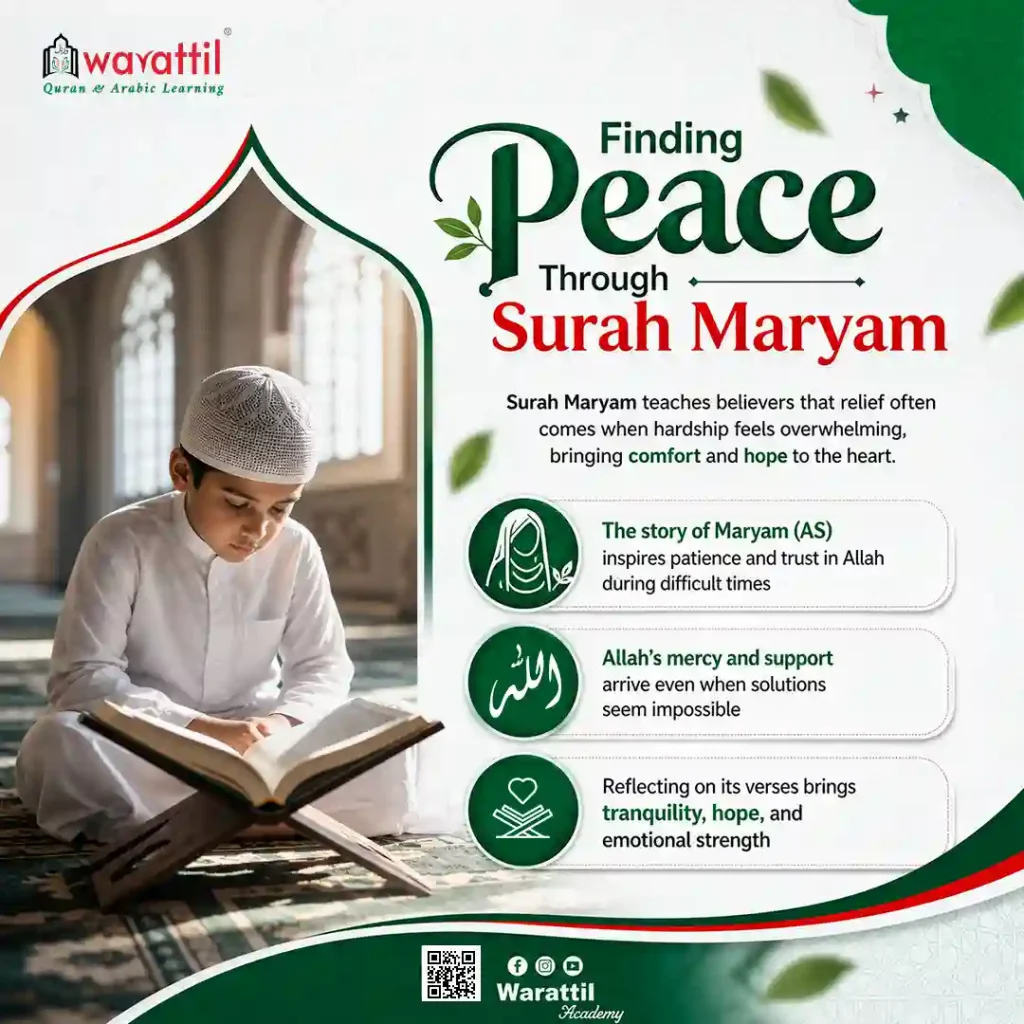
Among the chapters of the Qur’an, there exists a surah that speaks directly to the bruised spirit, the one longing for a miracle, and the heart weighed down by isolation. The Surah Maryam benefits unfold like a healing balm precisely because this chapter does not speak in abstract theology; it tells stories of very human struggles met with very divine interventions. When a believer sits with this surah, they encounter a recurring pattern—anxiety met with sakeenah, barrenness met with the gift of a child, and solitude met with the direct address of the Most Merciful. One does not simply read Surah Maryam; one enters a sanctuary where the impossible becomes a divine promise.
To grasp the Surah Maryam benefits, one must first understand its historical context. Revealed in Mecca during a period of intense persecution, this surah was sent to comfort a Prophet and a fledgling community facing crushing opposition. The timing was deliberate. When the Quraysh mocked the concept of resurrection and ridiculed the believers for their poverty and powerlessness, these verses descended with stories of miraculous births—a reassurance that the One who creates from nothing can certainly restore from nothing.
The chapter’s rhythmic structure performs a function beyond aesthetics. Its opening letters, Kaf, Ha, Ya, ‘Ayn, Sad, establish a cadence that linguists have described as carrying a phonetic quality of gentle lamentation followed by hope. The surah derives its name from the Virgin Mary, the only woman mentioned by name in the Qur’an, and her story occupies a central position. This was not incidental. By naming a chapter after a woman whose virtue was slandered and whose pregnancy defied human logic, Allah delivered a direct message: honor is divinely conferred, not socially negotiated. The Meccan believers, ridiculed and isolated, could see themselves mirrored in Maryam’s dignified solitude.
Perhaps the most frequently sought Surah Maryam benefits concerns the longing for a child. The chapter presents not one but two narratives of miraculous births—the birth of Yahya to the elderly Zakariyya and the virgin birth of Isa to Maryam. In both cases, the supplicants faced biological impossibility. Zakariyya’s bones had weakened, and his hair had greyed, yet he made a whispered, secretive call to his Lord. The response came with a divine promise: Yahya, a name never before used for any human being, signifying a life that would revive the hearts of the faithful.
This narrative serves as a profound ruqyah—a spiritual remedy—for couples navigating the emotional terrain of infertility. The lesson encoded here refuses cynicism. Zakariyya did not receive his son in his youth; he received him when every material indicator pointed to impossibility. The surah teaches that the door of divine response never closes, and the specific supplication Rabbi la tadharni fardan wa anta khayrul-waritheen “My Lord, do not leave me alone, and You are the best of inheritors” becomes a powerful invocation for those seeking righteous offspring. It reframes the wait not as divine neglect but as a period of preparation for a gift that will be unique in its blessing.
Surah Maryam consists of 98 verses and was revealed in Makkah. It focuses on the stories of Prophet Zakariyya (AS), Maryam (AS), Prophet Isa (AS), Prophet Ibrahim (AS), Prophet Musa (AS), and other noble prophets.
The Surah emphasizes several important Islamic themes, including:
These themes contribute significantly to the spiritual value and benefits associated with reciting and studying Surah Maryam.
One of the most significant Surah Maryam benefits is its ability to strengthen a believer’s faith. The chapter repeatedly demonstrates that Allah has complete control over all affairs.
The story of Prophet Zakariyya (AS) is a powerful example. Despite his old age and his wife’s inability to conceive, Allah answered his sincere prayer and blessed him with Prophet Yahya (John, peace be upon him). This teaches believers that no situation is impossible for Allah.
By reflecting on these stories, Muslims develop greater confidence in Allah’s wisdom, power, and mercy.
Life often presents challenges that test a person’s patience and trust in Allah. Surah Maryam offers valuable guidance during such moments.
Maryam (AS) faced immense hardship when she was chosen to miraculously give birth to Prophet Isa (AS). Despite the fear and uncertainty she experienced, Allah supported and protected her.
Her story teaches Muslims that difficulties are often accompanied by divine assistance. Reading and reflecting on these verses can help believers remain patient and hopeful when facing personal trials.
Trust in Allah, known as Tawakkul, is a central theme throughout Surah Maryam.
The prophets mentioned in this chapter relied entirely on Allah’s guidance and support. They faced rejection, loneliness, and difficult circumstances, yet they remained steadfast in their faith.
Regular recitation of Surah Maryam encourages believers to place their trust in Allah rather than becoming overwhelmed by worldly concerns. This mindset can bring inner peace and spiritual stability.
Another important aspect of the Surah Maryam benefits is the wisdom gained from studying the lives of the prophets.
Each story contains valuable lessons:
His story teaches persistence in prayer and hope in Allah’s mercy.
Her example demonstrates purity, devotion, and unwavering trust in Allah.
His dialogue with his father highlights wisdom, patience, and respectful communication.
His account illustrates leadership, courage, and obedience to Allah.
These examples provide practical guidance for Muslims seeking to strengthen their character and relationship with Allah.
Another dimension of the surah’s power lies in its capacity to cultivate tranquility. The passage where Maryam retreats to a place of seclusion while in the throes of labor pains is deeply instructive. Humanly speaking, she was alone, without a midwife, without shelter, and without resources. The pain drove her to declare, “Would that I had died before this.” Yet in that precise moment of despair, the divine voice called from beneath her: “Do not grieve; your Lord has provided beneath you a stream.”
This verse carries immense therapeutic value for those battling depression or overwhelming anxiety. The command alla tahzani “do not grieve” is not a dismissal of pain; it is a promise of proximate relief. The stream appeared where none existed, and ripe dates fell from a barren palm tree. The Surah Maryam benefits extend here to the psychological realm: it recalibrates the believer’s perception of crisis. What appeared to be abandonment was actually the immediate prelude to supernatural provision. Regular recitation of this surah, particularly with reflection upon this scene, installs a mental reflex that searches for the hidden stream beneath every trial.
The surah also functions as a theological shield, correcting distortions that crept into previous scriptures. The narrative concerning Isa (Jesus) is delivered with meticulous precision to negate both extremes: the claim that he is a deity and the slander that his mother was unchaste. When the infant speaks from the cradle, declaring Inni ‘abdullah—”Indeed, I am the servant of Allah”—the surah dismantles trinitarian doctrine using the testimony of the one most affected by the claim.
For the Muslim living in a society where theological boundaries are constantly tested, internalizing these verses fortifies conviction without fostering arrogance. The surah presents Ibrahim’s gentle discourse with his idol-worshipping father as a model of dawah—firm in truth yet soft in manner. The repeated phrase ya abati—”O my father”—demonstrates that theological disagreement never justifies the severing of kinship ties or the abandonment of respectful address. This balance is one of the less discussed but profoundly practical Surah Maryam benefits, shaping the believer’s conduct in interfaith and intrafamily dialogues with a rare combination of clarity and compassion.
One of the most beautiful passages in the surah is the divine statement: “Indeed, those who have believed and done righteous deeds the Most Merciful will appoint for them affection.” This verse, often recited by those who feel socially alienated or misunderstood, carries a specific promise. It declares that love among people is not a purely human phenomenon; it is a divine creation. Allah places wudd a deep, affectionate love into the hearts of others for the sincere believer.
This directly counters the narrative of isolation. A believer may be marginalized by the powerful or scorned by the majority, but the One who controls all hearts can turn the tide of public sentiment. The Surah Maryam benefits include this social dimension, where recitation and righteous action combine to attract an affection that needs no publicity machinery or social maneuvering. It is a quiet, divinely orchestrated acceptance that settles in the hearts of those who matter.
The practical application of this knowledge demands consistency. The scholars of the past recognized a specific affinity between Surah Maryam and the needs of expectant mothers or those desiring pregnancy, recommending its frequent recitation with a present, petitioning heart. However, its scope extends far beyond. Reciting it on a Friday, as some traditions indicate, or incorporating it into the morning or evening litanies, creates a rhythm where the heart is periodically bathed in the themes of miraculous provision and divine mercy.
One should not read these verses hastily. The stories demand a slow, contemplative engagement where the reader pauses at the supplications of Zakariyya, the lament of Maryam, and the firmness of Ibrahim. The semantic field of mercy—Ar-Rahman, rahmah, wudd—permeates the surah so thoroughly that a sincere recitation becomes a direct exposure to a divine attribute. For the grieving, the anxious, the hopeful parent, and the lonely worshipper, the Surah Maryam benefits offer what no worldly remedy can: a direct narrative from the Divine about how He rescues those who have no one to turn to but Him.

My son feels happy, amazing teachers and staff in wrattil and flexible prices MashaAllah Thank you so much
My daughter started learning in warattil academy and alhamdulilah we are really impressed and have enjoyed learning with wrattil. May Allah reward her sheikh
My teacher Ahmed is very good. He helped me recite and memorize holy Quran
Warattil is the most efficient way of learning Arabic. I like warattil curriculum and excellent teachers to support this learning Thank you so much
I highly recommend warattil Ijazah programs to anyone who wants to learn Quran properly.
Very well organized MashaAllah. I love it and this is a great course if you want to understand the Quran and learn tafsir
Warattil program is the best I have seen. The teacher is really great and is available to answer questions in a clear manner
I think warattil is the best academy in learning Arabic and I recommend Arabic course to anyone
We are so happy with ustad Hussein. He is very patient and comfortable teacher. May Allah the teachers and admin in warattil
Rating 10 mashaAllah and so grateful