Shopping cart
- +1 564-544-6614
- [email protected]
- 24/7 Available


There exists a profound tradition in the life of a believer, a nightly ritual that takes only a few moments but yields immeasurable rewards. The recitation of the final two verses of Surah Al-Baqarah stands as a divinely ordained practice, and understanding the Surah Baqarah last 2 ayat benefits opens a door to a fortified spiritual life. These are not merely words to be read; they are a comprehensive shield tailored for the human soul until the break of dawn. When a believer internalizes this, a nightly habit transforms into an unbreachable fortress.
To genuinely appreciate the magnitude of these verses, one must journey back to the night of Al-Isra’ wal-Mi’raj. The conversation between the Divine and His Messenger during that celestial ascent is deeply revealing. When the Prophet Muhammad (peace be upon him) reached Sidrat al-Muntaha, he was granted three concluding verses of Surah Al-Baqarah. In a narration recorded in Sahih Muslim, we are told that Allah responded to the Prophet’s supplication with a divine bestowal: “I have given them to you and your nation.”
The significance here cannot be overstated. While the rest of the Surah was revealed in Medina, these specific verses—beginning with Amanar-Rasulu—descended in a heavenly realm, underscoring their exceptional status. The concept of “sufficiency” (kifāyah) is central here. Reading them at night is not just an act of worship; it is a divine transaction where protection against harm is guaranteed without the need for other safeguards. The believer essentially places a lock on their evening, with the key held by divine mercy.
Why do these specific verses carry such weight? A careful examination of their linguistic structure reveals a complete manifesto of faith and reliance.
The first part, Amanar-Rasulu bima unzila ilayhi mir-Rabbihi wal-mu’minun, establishes a firm foundation. It signifies a complete, unhesitating acceptance of the revelation. Unlike a shaky belief that questions and doubts, this verse declares a state of settled conviction, where the heart is at rest with its Lord. This isn’t just the belief of the Prophet; it is the collective, echoing faith of the entire community, aligning them directly with the divine message.
The latter segment contains perhaps some of the most hopeful supplications in the Qur’an. The words Rabbana la tu’akhidhna in-nasina aw akhta’na translate to a heartfelt cry: “Our Lord, do not impose blame upon us if we have forgotten or erred.” Human nature is fragile and intrinsically prone to slips in memory and intention. This verse acknowledges that fragility and petitions for a forgiveness that covers unintentional faults. It continues to ask that no burden be placed upon us like those placed on previous nations, acknowledging that spiritual growth requires a yoke that fits the human capacity for endurance.
The most frequently cited Surah Baqarah last 2 ayat benefits is protection from evil, and the prophetic narrations are explicit on this matter. The hadith stating “Whoever recites the last two verses of Surat al-Baqarah at night, they will suffice him” is a concrete promise. The Arabic term used, kafatāhu, derives from the root meaning “to be enough” or “to protect.” This renders other spiritual protections superfluous for that night.
What exactly does this shield repel? It acts as a warding against the whispers of Satan (waswasah), those invisible seeds of doubt and anxiety planted in the quiet hours. It also serves as a deterrent against material harm. The consensus among classical scholars, including Ibn al-Qayyim, extends this protection to a broad spectrum of nocturnal dangers—whether from malicious spirits, envy, or unexpected calamities. One isn’t merely sleeping; one is sleeping within a sanctified perimeter defined by divine speech.
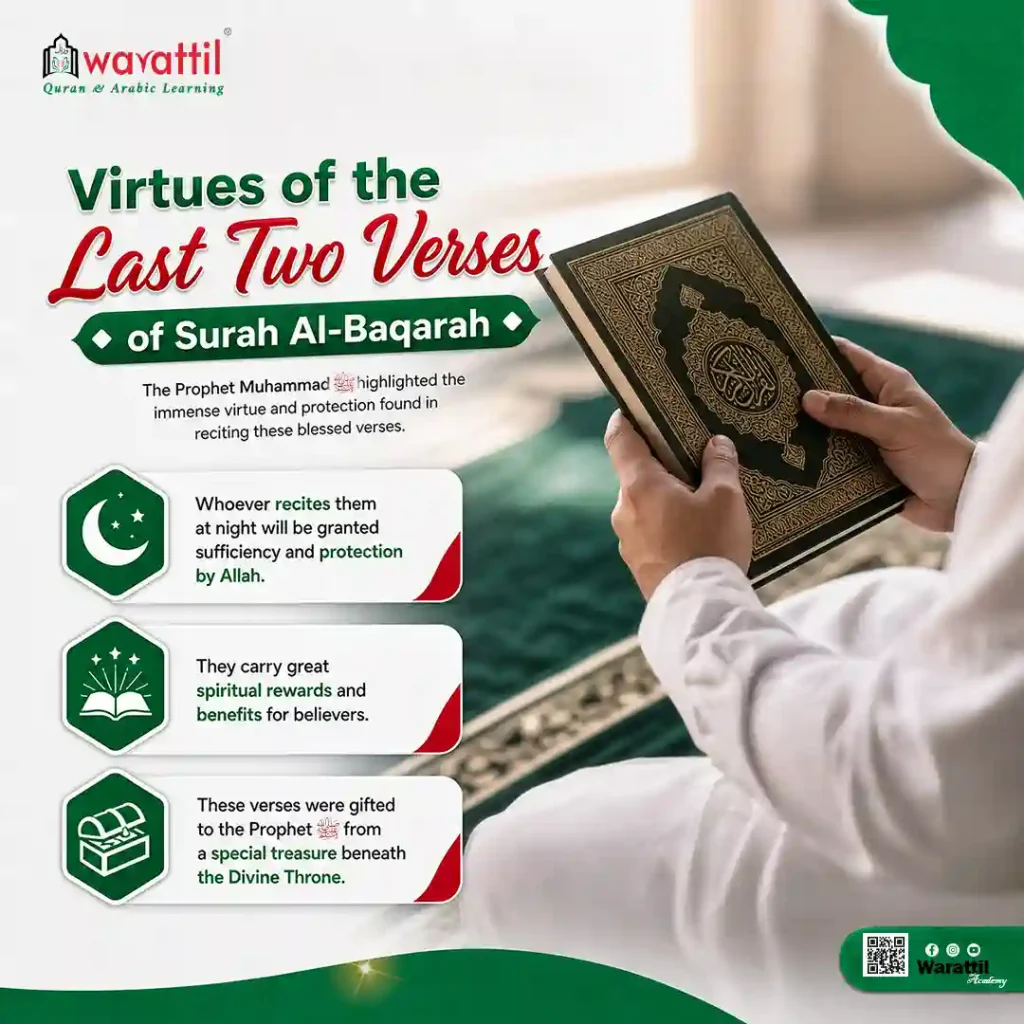
One of the most well-known narrations regarding these verses is reported in Sahih al-Bukhari and Sahih Muslim. The Prophet Muhammad ﷺ said:
“Whoever recites the last two verses of Surah Al-Baqarah at night, they will suffice him.”
Islamic scholars have explained that “suffice him” may refer to protection, spiritual benefit, reward, or relief from harm according to Allah’s will.
Another authentic narration mentions that these verses were gifted to the Prophet ﷺ from a special treasure beneath the Divine Throne, highlighting their unique status.
Among the most cited benefits is protection during the night. Because the Prophet ﷺ specifically recommended reciting these verses before sleeping, many scholars consider them a means of seeking Allah’s protection until morning.
Muslims across the world include these ayat in their nightly remembrance routine as part of their spiritual protection.
The verses begin with a declaration of faith by the Messenger and the believers. They reinforce the core principles of Islam, including belief in Allah, His angels, His revelations, and His messengers.
Regular recitation helps strengthen a Muslim’s connection with these foundational beliefs.
The last ayah contains several beautiful supplications asking Allah for forgiveness, mercy, and assistance. These requests reflect humility and complete dependence upon Allah.
Believers often turn to these verses when seeking spiritual comfort and closeness to their Creator.
One of the most comforting statements in the Quran appears in these verses:
“Allah does not burden a soul beyond what it can bear.”
This reminder provides hope and reassurance during personal struggles, hardships, and challenges.
The concluding supplications teach believers to place their trust in Allah. They seek His help against difficulties and ask for strength in moments of weakness.
This message remains relevant for Muslims facing personal, financial, emotional, or spiritual challenges.
Many Muslims make it a habit to recite the final two verses after prayers or before sleeping. This practice is rooted in the authentic teachings of the Prophet ﷺ and serves as a daily reminder of faith and reliance upon Allah.
Unlike cultural practices that may vary from region to region, the recommendation to recite these verses comes directly from authentic hadith sources, making it a well-established Sunnah practice.
Beyond physical protection, the spiritual nourishment within these verses lies in their articulation of divine pedagogy. The supplication Rabbana wa la tuhammilna ma la taqata lana bih translates to “Our Lord, and do not place upon us that which we have no ability to bear.” Here, the believer acknowledges their limited capacity and seeks a divine standard of accountability that prioritizes mercy over strict justice.
This aligns with the famous Hadith Qudsi where Allah declares, “I am as My servant thinks I am.” By reciting these verses, one actively exercises a positive assumption about the Creator—that He will Pardon, Forgive, and have Mercy. The subsequent plea, Wa’fu anna, waghfir lana, warhamna, is a three-tiered request for the erasure of sin, the covering of faults, and the bestowal of active mercy. This culminates in the final, victorious declaration: Anta Mawlana fansurna ‘alal-qawmil-kafirin—a reliance on a Divine Ally against the forces of disbelief, both external and internal.
Making these verses a fixture of one’s night routine bridges the mundane with the sacred. In a world saturated with digital noise before bedtime, replacing screen time with this recitation actively cleanses the mental state. One practical approach is to combine the recitation with the evening adhkar. The rhythm of the verses, with their melodic and solemn cadence, naturally slows the heartbeat and directs focus away from financial stress or social anxiety, fixing it squarely on the Sustainer.
The act of reciting slowly, contemplating each plea as it passes the lips, transforms an ordinary bedroom into a sanctuary. It is an act that demands nothing physically strenuous, yet the spiritual returns are exponential. The Surah Baqarah last 2 ayat benefits encapsulate a complete cycle: creedal affirmation in the day’s end, a request for nocturnal protection, and a profound hope for a merciful reckoning. For the one seeking a guardian that never sleeps, the solution has been placed directly onto the tongue, sufficient for all things until the sun rises again.

My son feels happy, amazing teachers and staff in wrattil and flexible prices MashaAllah Thank you so much
My daughter started learning in warattil academy and alhamdulilah we are really impressed and have enjoyed learning with wrattil. May Allah reward her sheikh
My teacher Ahmed is very good. He helped me recite and memorize holy Quran
Warattil is the most efficient way of learning Arabic. I like warattil curriculum and excellent teachers to support this learning Thank you so much
I highly recommend warattil Ijazah programs to anyone who wants to learn Quran properly.
Very well organized MashaAllah. I love it and this is a great course if you want to understand the Quran and learn tafsir
Warattil program is the best I have seen. The teacher is really great and is available to answer questions in a clear manner
I think warattil is the best academy in learning Arabic and I recommend Arabic course to anyone
We are so happy with ustad Hussein. He is very patient and comfortable teacher. May Allah the teachers and admin in warattil
Rating 10 mashaAllah and so grateful