Shopping cart
- +1 564-544-6614
- [email protected]
- 24/7 Available


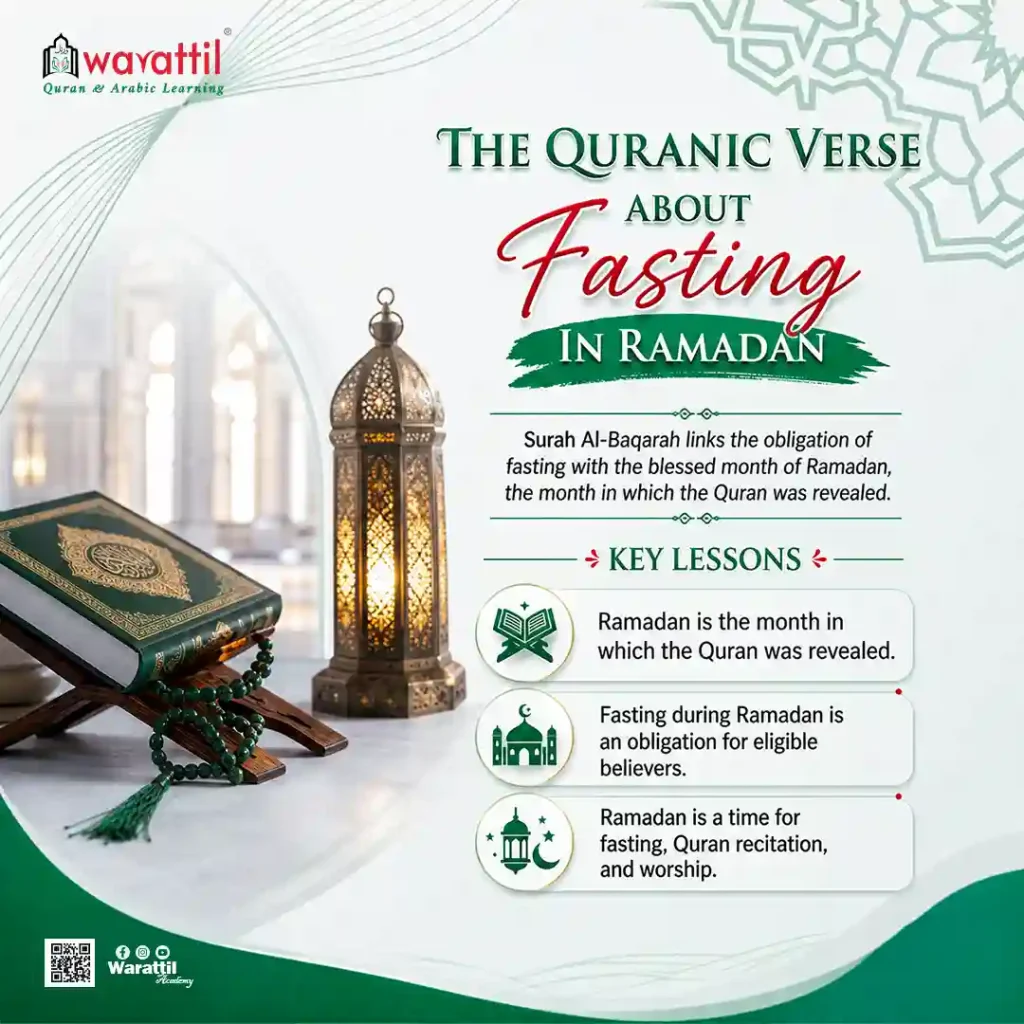
The fasting ayat in Quran provides clear guidance about the obligation, purpose, and practice of fasting in Islam. The main Quranic verses about Ramadan fasting appear in Surah Al-Baqarah, particularly verses 183 to 187. Together, these ayats explain why fasting was prescribed, who may receive an exemption, why Ramadan holds a special place in Islam, and when the daily fast begins and ends.
In Arabic, fasting is known as sawm or siyam. Although abstaining from food and drink is a central part of the Ramadan fast, the Quran connects fasting with a much deeper spiritual objective: taqwa, commonly understood as mindfulness or consciousness of Allah.
Understanding the Quran verses about fasting in their proper context therefore gives us a broader picture of this important act of worship. Fasting is connected not only with abstinence but also with spiritual discipline, gratitude, guidance, and obedience to Allah.
The primary Quranic command concerning fasting appears in Surah Al-Baqarah 2:183:
“O believers! Fasting is prescribed for you—as it was for those before you—so perhaps you will become mindful of Allah.”
Surah Al-Baqarah, 2:183
This ayah establishes fasting as a prescribed act of worship for believers. It also states that fasting had been prescribed for communities before them, showing that the practice of fasting has a broader religious history.
However, perhaps the most significant part of this fasting ayat is its statement about purpose. The verse concludes by connecting fasting with taqwa.
Taqwa carries a rich meaning that cannot always be expressed by a single English word. Depending on the translation and context, it may be rendered as God-consciousness, mindfulness of Allah, piety, or awareness that leads a person to guard against wrongdoing.
Therefore, the Quran presents fasting as more than physical abstinence. The discipline involved in fasting is closely connected to a believer’s spiritual awareness and relationship with Allah.
The next verse continues the discussion:
“Fast a prescribed number of days.”
Surah Al-Baqarah, 2:184
This statement makes an important point. The obligation of Ramadan fasting is not presented as an endless hardship. It applies to a defined period.
The verse then discusses circumstances involving illness and travel. Those who are ill or travelling are addressed with a provision for making up the missed days later.
This demonstrates an important principle within the Quranic guidance on fasting. The command to fast exists alongside consideration for genuine circumstances in which fasting may become difficult.
The verse also discusses compensation involving feeding a person in need in particular circumstances. The detailed application of these rulings has been discussed extensively in Islamic jurisprudence, so individuals with specific circumstances should consult reliable scholars rather than relying on a short quotation from a verse alone.
What remains clear from the passage is that fasting is treated as a serious act of worship while genuine human limitations are also recognised.
Surah Al-Baqarah 2:185 directly identifies Ramadan as the month of fasting and connects it with the revelation of the Quran:
“Ramaḍân is the month in which the Quran was revealed as a guide for humanity with clear proofs of guidance and the decisive authority.”
Surah Al-Baqarah, 2:185
The verse then instructs those who are present during the month to fast.
This connection between Ramadan and the Quran is central to understanding the spiritual character of the month. Ramadan is not significant merely because Muslims abstain from food and drink during daylight hours. It is also the month closely associated with the revelation of the Quran as guidance for humanity.
For this reason, Quran recitation, reflection, prayer, charity, and other acts of worship hold a particularly important place in the religious life of many Muslims during Ramadan.
The fasting ayat in Quran therefore presents Ramadan as a month in which fasting and divine guidance are closely connected.
One of the most meaningful statements within the Quranic verses about Ramadan appears in the same passage:
“Allah intends ease for you, not hardship.”
Surah Al-Baqarah, 2:185
These words appear in the context of the fasting regulations and the provisions made for those who are ill or travelling.
This does not mean that every religious responsibility must always feel physically effortless. Fasting itself naturally involves discipline and temporary discomfort. Rather, the passage shows that Islamic obligations are not intended to impose unnecessary hardship without consideration for legitimate circumstances.
The verse instructs believers to complete the prescribed number of fasting days and glorify Allah for His guidance. It then connects the experience with gratitude.
Therefore, the Quranic framework surrounding Ramadan brings together several important ideas: worship, discipline, accommodation, guidance, and thankfulness.

When the fasting verses in Surah Al-Baqarah are read together, the purpose of fasting becomes clearer.
The first major purpose mentioned is taqwa. By willingly giving up things that are normally permissible for a defined period, a fasting person practises self-restraint and obedience.
A second important theme is gratitude. Surah Al-Baqarah 2:185 concludes with the hope that believers may become grateful after completing the prescribed period and recognising Allah’s guidance.
Fasting can also remind a person not to take ordinary blessings for granted. Food and water are part of everyday life, yet temporarily abstaining from them can deepen one’s awareness of these blessings.
However, the Quranic purpose of fasting should not be reduced to a single personal benefit. At its foundation, fasting is an act of worship performed in obedience to Allah, with the Quran explicitly connecting it to taqwa and gratitude.
Immediately after the verses discussing Ramadan, the Quran presents a deeply meaningful ayah about calling upon Allah.
Surah Al-Baqarah 2:186 explains that when Allah’s servants ask about Him, He is near and responds to the call of the one who calls upon Him.
The placement of this verse within the wider passage on Ramadan is particularly meaningful for readers reflecting on the spiritual dimensions of fasting. It draws attention to a direct relationship between worshippers and their Creator.
Fasting can create opportunities for greater reflection and devotion. During Ramadan, many Muslims devote additional time to dua, Quran recitation, remembrance of Allah, and prayer.
At the same time, the verse itself carries a universal message that extends beyond Ramadan: believers are encouraged to call upon Allah and respond faithfully to His guidance.

Surah Al-Baqarah 2:187 provides important practical guidance about the daily Ramadan fast.
The verse permits eating and drinking during the night and establishes the beginning and ending points of the fasting period. It instructs believers to eat and drink until the light of dawn becomes distinguishable and then complete the fast until night.
In practical Islamic observance, the daily fast therefore runs from true dawn, associated with the beginning of Fajr, until sunset.
This ayah is important because it establishes the Quranic foundation for the timing of the daily fast. Muslims commonly eat a pre-dawn meal known as suhoor before the fasting period begins and break the fast at sunset with iftar.
The same verse also addresses marital intimacy during the nights of Ramadan and discusses restrictions connected with i’tikaf, the devotional practice of remaining in a mosque for worship.
Together, these instructions provide a clear framework for the boundaries of the daily fast.
The relationship between fasting and taqwa deserves particular attention because it is stated directly in the first major fasting ayat in Quran.
A person who fasts knows that food and drink may be available, yet chooses to abstain because of a religious commitment. This creates a form of discipline that often takes place away from the observation of other people.
As a result, fasting has a strongly personal dimension. The outward act is visible, but sincerity ultimately concerns the individual’s intention and awareness of Allah.
This helps explain why fasting is closely associated with self-control and spiritual discipline. The fasting person is encouraged to become more conscious of actions, words, and intentions rather than viewing the fast simply as a period without food.
The physical practice supports a larger spiritual objective: developing greater awareness of Allah and living accordingly.

Although Surah Al-Baqarah contains the main verses about Ramadan fasting, fasting is mentioned elsewhere in the Quran in different contexts.
For example, Surah Al-Ahzab 33:35 mentions fasting men and fasting women among believers whose qualities and acts of devotion are praised.
Fasting also appears in several Quranic passages as part of particular forms of expiation or religious obligation. These include passages related to certain broken oaths and other specific circumstances.
These references demonstrate that fasting has a place in Islamic practice beyond the annual Ramadan fast. However, each passage has its own legal and religious context and should not be treated as interchangeable with the general command to fast during Ramadan.
For readers specifically searching for the central Ramadan fasting verses, Surah Al-Baqarah 2:183–187 remains the essential passage to study.
The Quranic discussion of fasting is remarkably concise, yet it brings together practical rulings and profound spiritual lessons.
Fasting is prescribed with the goal of developing taqwa. Ramadan is identified as the month associated with the revelation of the Quran. Genuine difficulties are acknowledged through provisions for illness and travel. The fasting period is clearly defined, while gratitude and guidance remain central themes throughout the passage.
This combination is important because it prevents fasting from being understood as nothing more than physical deprivation.
A person may complete the physical requirements of a fast, but the Quran encourages a deeper transformation involving mindfulness, gratitude, obedience, and greater awareness of divine guidance.
Individual Quran verses are frequently shared online as short quotations. While these quotations can be useful, reading the complete passage provides a much clearer understanding.
For example, Quran 2:183 introduces the obligation and spiritual objective of fasting. The following verses explain the prescribed period, discuss legitimate exemptions, identify Ramadan, and establish the daily boundaries of the fast.
Reading Surah Al-Baqarah 2:183–187 as a connected passage therefore gives readers a more complete understanding than reading any single verse in isolation.
It is also important to remember that English translations represent attempts to communicate the meaning of the original Arabic Quran. Different reliable translations may use slightly different English wording.
For detailed questions about Islamic rulings, particularly concerning illness, travel, pregnancy, age, chronic medical conditions, missed fasts, and compensation, qualified religious scholars should be consulted because individual circumstances and jurisprudential interpretations may differ.
The fasting ayat in Quran reveals that Ramadan fasting carries both practical requirements and profound spiritual meaning. Surah Al-Baqarah 2:183 establishes fasting as a prescribed act of worship and connects it directly with the development of taqwa.
The following verses explain that fasting takes place over a prescribed number of days, identify Ramadan as the month associated with the revelation of the Quran, provide allowances for illness and travel, and establish the daily fasting period from dawn until night.
Taken together, these Quranic verses present fasting as an act of worship shaped by discipline, gratitude, guidance, and mindfulness of Allah.
For anyone seeking to understand what the Quran says about fasting, Surah Al-Baqarah 2:183–187 provides the essential starting point. Reading these ayats together, rather than as isolated quotations, allows their practical guidance and spiritual message to be understood more fully.
The main verse prescribing fasting is Surah Al-Baqarah 2:183. It states that fasting has been prescribed for believers as it was prescribed for those before them, with the stated purpose that they may develop taqwa or greater mindfulness of Allah.
The principal passage about Ramadan fasting is Surah Al-Baqarah 2:183–187. These verses discuss the obligation and purpose of fasting, Ramadan, provisions relating to illness and travel, and the daily fasting period.
Surah Al-Baqarah 2:183 directly connects fasting with developing taqwa. The surrounding passage also connects Ramadan with guidance, gratitude, and obedience to Allah.
Surah Al-Baqarah 2:185 identifies Ramadan as the month in which the Quran was revealed and instructs those who are present during the month to fast.
Surah Al-Baqarah 2:184–185 provides that those who are ill or travelling may make up an equal number of missed fasting days later. Specific situations can involve additional legal details, so individual cases should be considered according to reliable Islamic scholarship.
Surah Al-Baqarah 2:187 establishes the daily fasting period from dawn until night. In Islamic practice, the Ramadan fast begins at true dawn, associated with Fajr, and ends at sunset.
The Quran explicitly identifies developing taqwa as a purpose of fasting in Surah Al-Baqarah 2:183. Fasting encourages self-restraint, obedience, and greater consciousness of Allah, making its purpose both spiritual and practical.

My son feels happy, amazing teachers and staff in wrattil and flexible prices MashaAllah Thank you so much
My daughter started learning in warattil academy and alhamdulilah we are really impressed and have enjoyed learning with wrattil. May Allah reward her sheikh
My teacher Ahmed is very good. He helped me recite and memorize holy Quran
Warattil is the most efficient way of learning Arabic. I like warattil curriculum and excellent teachers to support this learning Thank you so much
I highly recommend warattil Ijazah programs to anyone who wants to learn Quran properly.
Very well organized MashaAllah. I love it and this is a great course if you want to understand the Quran and learn tafsir
Warattil program is the best I have seen. The teacher is really great and is available to answer questions in a clear manner
I think warattil is the best academy in learning Arabic and I recommend Arabic course to anyone
We are so happy with ustad Hussein. He is very patient and comfortable teacher. May Allah the teachers and admin in warattil
Rating 10 mashaAllah and so grateful