Shopping cart
- +1 564-544-6614
- [email protected]
- 24/7 Available


The beautiful ayats of Quran have a remarkable ability to speak to the human heart through messages of hope, mercy, patience, gratitude, and faith. For Muslims, the Quran is far more than a book to be read; it is divine guidance that encourages believers to reflect, remember Allah, and live with purpose.
Some Quranic verses offer comfort during difficult times, while others remind us of Allah’s mercy, the beauty of His creation, and the importance of trusting His wisdom. A single ayah can carry layers of meaning that become increasingly meaningful as a person reflects on its context and message.
Below, we explore some of the most beautiful and meaningful Quran verses and the lessons they offer for everyday life.
The beauty of Quranic verses is not limited to their wording. Their deeper significance comes from the guidance, wisdom, and spiritual lessons they contain.
The Quran addresses many experiences that are familiar to human beings: fear and hope, difficulty and relief, mistakes and forgiveness, gratitude and uncertainty. It repeatedly encourages people to reflect, develop patience, place their trust in Allah, and remain conscious of His guidance.
This is why the same ayah may feel especially meaningful at different stages of life. A verse about patience may offer strength during hardship, while an ayah about mercy may inspire hope after a person has made mistakes.
For those reading a translation, it is also important to remember that translations represent an interpretation of the meaning of the original Arabic. Wording can therefore differ between reliable English translations, although the central message remains recognizable.
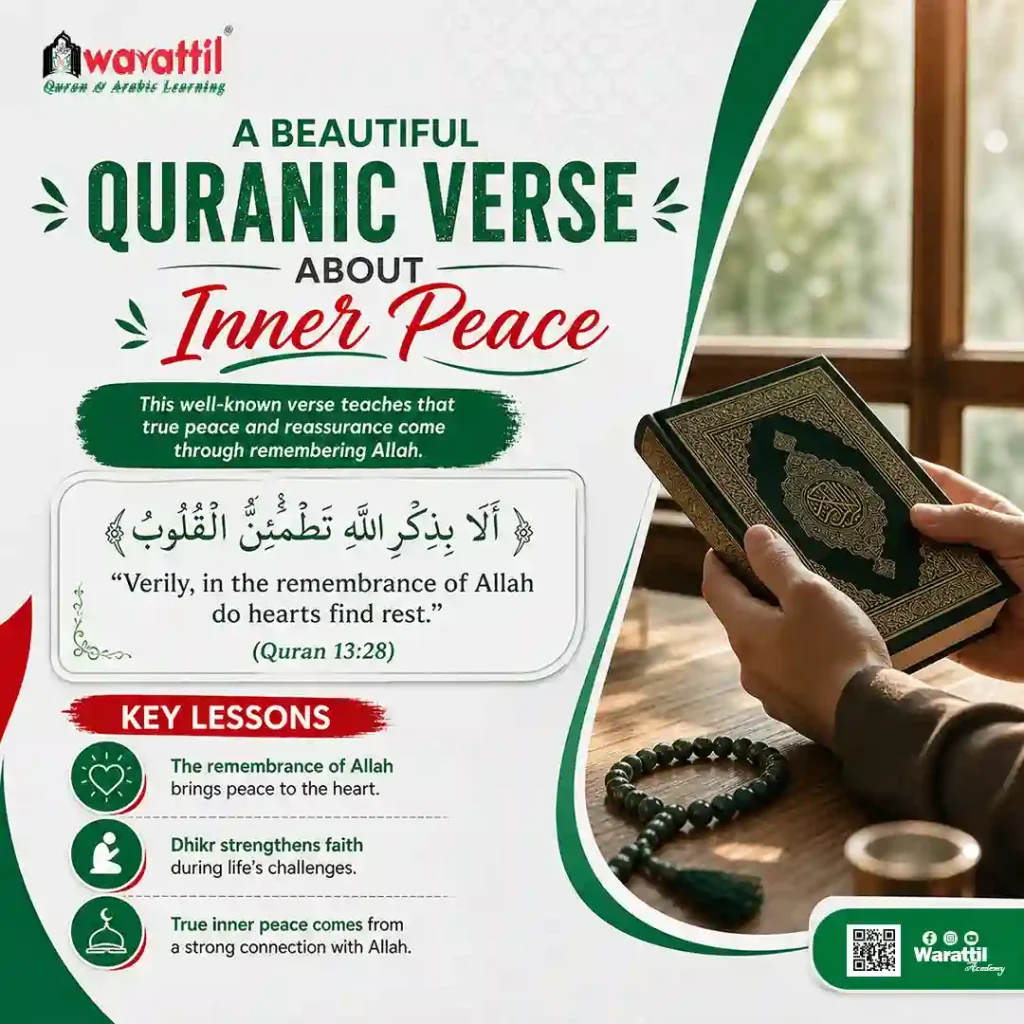
One of the most comforting Quranic passages about spiritual peace appears in Surah Ar-Ra’d:
“Surely in the remembrance of Allah do hearts find comfort.”
Surah Ar-Ra’d, 13:28
This ayah connects remembrance of Allah with reassurance of the heart. Life can bring uncertainty, pressure, and circumstances that cannot always be controlled. The verse redirects attention toward something deeper: maintaining a connection with the Creator.
Remembering Allah, or dhikr, can include prayer, Quran recitation, supplication, and sincere reflection. The verse does not suggest that believers will never experience difficulty. Rather, it teaches that faith and remembrance can provide spiritual grounding even when external circumstances remain challenging.
For many Muslims, this is among the most beautiful ayats of Quran because its message is simple yet profound: lasting spiritual reassurance is closely connected to remembering Allah.

Surah Ash-Sharh contains one of the Quran’s most widely remembered messages about difficult times:
“So, surely with hardship comes ease. Surely with that hardship comes more ease.”
Surah Ash-Sharh, 94:5–6
The repetition gives this message particular emphasis. Hardship is a reality of life, but hardship is not presented as the entire story.
These verses encourage patience and hope. A difficult period may feel overwhelming while a person is experiencing it, yet circumstances can change in unexpected ways. Relief may come through a solution, personal growth, support from others, or opportunities that were previously unseen.
The verses should not be reduced to the idea that every problem will disappear immediately. Instead, they encourage believers not to view hardship as a permanent condition without possibility of relief.
This message makes Surah Ash-Sharh especially meaningful for anyone seeking Quran verses about hope, patience, and resilience.
Among the most hopeful verses in the Quran is Surah Az-Zumar 39:53. It addresses those who have wronged themselves and warns them against losing hope in Allah’s mercy.
The verse begins with the powerful message:
“Do not lose hope in Allah’s mercy.”
Surah Az-Zumar, 39:53
The wider verse speaks about Allah’s forgiveness and describes Him as the All-Forgiving and Most Merciful.
This ayah carries an important spiritual lesson: a person’s past mistakes should not become a reason to abandon hope or sincere repentance. Islam places great importance on turning back to Allah, acknowledging wrongdoing, and seeking forgiveness.
At the same time, the verse is best understood alongside the Quran’s broader teachings about sincere repentance and personal responsibility. Hope in divine mercy is not an excuse to continue knowingly doing wrong. Instead, it provides a reason to return to the right path.
For believers who feel discouraged by their mistakes, this is one of the most reassuring Quranic verses about forgiveness and mercy.

The final verse of Surah Al-Baqarah contains another frequently quoted Quranic message:
“Allah does not require of any soul more than what it can afford.”
Surah Al-Baqarah, 2:286
This verse appears within a broader passage about responsibility, accountability, prayer, and seeking Allah’s help.
It is sometimes quoted as though it means that people should never feel overwhelmed. That interpretation can oversimplify its meaning. The verse is more accurately connected to Allah’s justice and the responsibilities He places upon human beings.
The broader message can still offer considerable reassurance. Believers are reminded that Allah knows human limitations completely. They can therefore seek His help, forgiveness, and guidance while doing their best to meet their responsibilities.
The rest of the ayah includes a beautiful supplication asking Allah not to hold people accountable for forgetfulness or mistakes and asking Him for forgiveness, mercy, and support.
Surah Al-Hadid contains the well-known words:
“And He is with you wherever you are.”
Surah Al-Hadid, 57:4
To understand this statement correctly, it is important to consider the complete verse. The passage describes Allah’s creation of the heavens and the earth and His complete knowledge of everything that happens.
The verse concludes by affirming that Allah sees what people do.
Therefore, the ayah should not be understood as describing physical presence. In mainstream Islamic understanding, it points to Allah’s complete knowledge, awareness, and watchfulness.
This meaning can inspire both comfort and responsibility. A believer is never outside Allah’s knowledge, whether experiencing a private difficulty or making a decision that no other person sees.
Few Quranic verses are as instantly recognizable as the repeated question in Surah Ar-Rahman:
“Then which of your Lord’s favours will you both deny?”
Surah Ar-Rahman, 55:13
This verse is repeated throughout the surah, creating a powerful rhythm of reflection. The chapter draws attention to numerous signs and blessings, including creation, balance, natural phenomena, and divine generosity.
The repeated question encourages the reader to stop and consider blessings that may otherwise be overlooked.
Gratitude in the Quran is not simply about saying thank you when life is comfortable. It involves recognizing blessings, understanding their source, and responding to them responsibly.
Surah Ar-Rahman therefore offers a powerful reminder that reflection on Allah’s blessings can transform how people view ordinary aspects of life.

Surah Al-A’raf contains a short but deeply meaningful statement about divine mercy:
“My mercy encompasses everything.”
Surah Al-A’raf, 7:156
This verse highlights the vastness of Allah’s mercy while its broader context also discusses accountability and righteousness.
The Quran repeatedly brings hope and responsibility together. Divine mercy gives believers a reason to return to Allah, while faith encourages them to live with sincerity, gratitude, and awareness of their actions.
This balance is essential when reading Quranic verses about mercy. The message is neither hopelessness nor carelessness. Instead, believers are encouraged to seek Allah’s mercy while striving to live according to His guidance.
Surah At-Talaq contains a powerful statement about reliance upon Allah:
“And whoever puts their trust in Allah, then He alone is sufficient for them.”
Surah At-Talaq, 65:3
The Islamic concept of tawakkul, or reliance upon Allah, does not mean abandoning effort. A person takes reasonable action, fulfills responsibilities, and then places the outcome in Allah’s hands.
This principle can be especially meaningful when the future feels uncertain. Human beings can plan carefully, but they cannot control every result.
Trust in Allah therefore creates a balance between effort and acceptance. Believers are encouraged to act responsibly without believing that everything depends entirely upon their own power.
The Quran directly connects gratitude with an increase in blessings:
“If you are grateful, I will certainly give you more.”
Surah Ibrahim, 14:7
Gratitude can change the way people understand what they already possess. It encourages attention to blessings that are easily taken for granted, including health, knowledge, relationships, opportunities, and everyday provisions.
From a Quranic perspective, gratitude is expressed through both recognition and action. A person acknowledges blessings from Allah and seeks to use those blessings in beneficial ways.
This makes gratitude more than a temporary emotion. It becomes an attitude that influences how a believer approaches daily life.
Another deeply meaningful verse appears in Surah Al-An’am:
“Not even a leaf falls without His knowledge.”
Surah Al-An’am, 6:59
The complete verse presents a much broader picture of Allah’s perfect knowledge. Nothing in creation escapes His awareness.
For believers, this can be a profound reminder during moments when life seems confusing or uncertain. Human understanding is naturally limited. People see only part of a situation, whereas Allah’s knowledge encompasses what is visible and hidden.
This ayah therefore encourages humility. It reminds readers that human knowledge has boundaries and that complete knowledge belongs to Allah alone.
When we examine these beautiful ayats of Quran together, several recurring themes become clear. The Quran repeatedly calls people toward hope without denying hardship, encourages trust without discouraging effort, and speaks about mercy alongside personal responsibility.
Its verses also encourage reflection on creation, gratitude for blessings, patience during trials, sincere repentance, and remembrance of Allah.
These interconnected themes explain why Quranic verses can remain relevant across very different circumstances. A person experiencing uncertainty may connect with verses about tawakkul, while someone reflecting on blessings may be drawn to Surah Ar-Rahman.
The Quran addresses the inner spiritual life while also guiding how people think, act, and relate to the world around them.
Reading a memorable verse is valuable, but understanding its context can make the experience much more meaningful.
When encountering an ayah, readers can examine the verses immediately before and after it. Consulting a reliable translation and recognized tafsir, or Quranic commentary, can also help explain historical context, language, and interpretation.
This is particularly important with verses frequently shared as short quotations. A brief excerpt may carry a beautiful message, but its full context often reveals additional meaning that cannot be captured in a single sentence.
Regular reflection, known as tadabbur, encourages readers to consider what a verse teaches and how its guidance may influence their character and choices.
The beautiful ayats of Quran offer enduring messages about faith, mercy, hope, gratitude, patience, and reliance upon Allah. Their beauty is found not only in their language but also in the depth of guidance they provide.
Surah Ar-Ra’d reminds believers that hearts find reassurance through the remembrance of Allah. Surah Ash-Sharh connects hardship with ease. Surah Az-Zumar warns against despairing of divine mercy, while Surah Ar-Rahman repeatedly calls people to recognize the blessings surrounding them.
Yet every Quranic ayah deserves more than being treated as an inspirational quotation. Reading verses within their context and studying reliable explanations can lead to a deeper and more accurate understanding of their message.
For anyone searching for peace, wisdom, or spiritual direction, these beautiful Quran verses provide a meaningful starting point for further reading and reflection.
Many readers find Quran 13:28, 94:5–6, 39:53, 2:286, 55:13, and 65:3 particularly meaningful. These verses address remembrance of Allah, hardship and ease, forgiveness, responsibility, gratitude, and trust in Allah. The choice of a “beautiful” ayah is naturally personal, as different verses may resonate with people in different circumstances.
Surah Ar-Ra’d 13:28 is one of the best-known verses about reassurance of the heart. It teaches that hearts find comfort and reassurance through the remembrance of Allah.
Surah Ash-Sharh 94:5–6 is frequently remembered during hardship because it repeatedly connects difficulty with ease. Surah Az-Zumar 39:53 also offers a powerful message of hope by telling those who have wronged themselves not to despair of Allah’s mercy.
Surah At-Talaq 65:3 teaches that whoever relies upon Allah will find Him sufficient. The verse is often associated with tawakkul, the Islamic principle of relying upon Allah while taking appropriate action and fulfilling one’s responsibilities.
Quran 2:286 states that Allah does not burden or require a soul beyond its capacity. In its broader context, the verse addresses responsibility and accountability and concludes with supplications for forgiveness, mercy, and divine assistance.
Reading an ayah in context helps readers understand its intended message more accurately. The surrounding verses and reliable tafsir can provide important information about the subject, circumstances, and deeper meaning of a passage that may not be obvious from a short quotation alone.

My son feels happy, amazing teachers and staff in wrattil and flexible prices MashaAllah Thank you so much
My daughter started learning in warattil academy and alhamdulilah we are really impressed and have enjoyed learning with wrattil. May Allah reward her sheikh
My teacher Ahmed is very good. He helped me recite and memorize holy Quran
Warattil is the most efficient way of learning Arabic. I like warattil curriculum and excellent teachers to support this learning Thank you so much
I highly recommend warattil Ijazah programs to anyone who wants to learn Quran properly.
Very well organized MashaAllah. I love it and this is a great course if you want to understand the Quran and learn tafsir
Warattil program is the best I have seen. The teacher is really great and is available to answer questions in a clear manner
I think warattil is the best academy in learning Arabic and I recommend Arabic course to anyone
We are so happy with ustad Hussein. He is very patient and comfortable teacher. May Allah the teachers and admin in warattil
Rating 10 mashaAllah and so grateful