Shopping cart
- +1 564-544-6614
- [email protected]
- 24/7 Available


The benefits of Surah Waqiah have been spoken of by scholars, passed down through generations, and rooted in authentic hadith yet many Muslims today remain unaware of what this remarkable surah truly offers.
Surah Waqiah is the 56th chapter of the Holy Quran. It contains 96 verses and belongs to the Makki surahs those revealed in Makkah before the Prophet’s migration to Madinah. The name “Al-Waqiah” translates to “The Inevitable Event” or “The Great Event,” referring to the Day of Judgement and the certainty of what is to come for every soul.
Unlike many other chapters, Surah Waqiah is unique in how it addresses both the spiritual and the material dimensions of a believer’s life. It speaks of the three categories of people on the Day of Judgement, describes the rewards of paradise with vivid detail, and serves as a powerful reminder of Allah’s authority over all provision. For this reason, its recitation has been strongly encouraged by the Prophet Muhammad (ﷺ) himself.
One of the most widely cited hadiths in connection with this surah comes from Ibn Masud (RA), a close companion of the Prophet (ﷺ). It is reported that the Prophet (ﷺ) said:
“Whoever recites Surah Waqiah every night will never be afflicted by poverty.”
— Ibn Masud (RA), as recorded by Ibn Asakir and Al-Bayhaqi
Ibn Masud (RA) himself used to instruct his daughters to recite this surah every night. This alone tells us something important a companion who lived closely with the Prophet (ﷺ), who memorised the Quran and understood its teachings deeply, considered this surah significant enough to make it a nightly practice in his own household.
Scholars note that the connection between this surah and rizq (provision) is not coincidental. The surah itself repeatedly references Allah’s power to create, to provide, and to withhold reminding the reader that all sustenance ultimately comes from Him alone. Reciting it is therefore an act of acknowledging that dependence and turning the heart toward its true Provider.
Few connections in hadith literature are as widely discussed and as frequently misunderstood as the one between Surah Waqiah and rizq. The Arabic word rizq goes beyond its common translation of “provision” or “sustenance.” It encompasses everything that Allah has allotted for a person: food, wealth, health, knowledge, time, and even the relationships one is blessed with. Understanding this broader meaning is essential before we can truly appreciate what the Prophet (ﷺ) was pointing toward when he spoke about this surah.
The most well-known hadith connecting Surah Waqiah to rizq comes from Abdullah ibn Masud (RA), one of the most learned and trusted companions of the Prophet (ﷺ). He is reported to have narrated that the Messenger of Allah (ﷺ) said:
“Whoever recites Surah Waqiah every night will never be afflicted by poverty.”
Narrated by Abdullah ibn Masud (RA) · Recorded by Ibn Asakir and Al-Bayhaqi in Shu’ab al-Iman
This narration has been recorded in several classical hadith compilations, most notably by Al-Bayhaqi in his work Shu’ab al-Iman (The Branches of Faith) and by Ibn Asakir in his Tarikh Dimashq. The fact that two major hadith scholars of the 11th and 12th centuries separately preserved this narration speaks to the degree of attention it received within the scholarly tradition.
What makes this narration particularly notable is not only its content, but who transmitted it. Ibn Masud (RA) was not just any companion. He was among the first people to recite the Quran publicly in Makkah, he was described by the Prophet (ﷺ) as one whose recitation pleases Allah, and he was considered one of the four companions from whom the Quran should be learned.
When a man of this standing narrates something and then instructs his own household to act upon it, the Islamic scholarly tradition has always treated that as significant evidence of the narration’s weight.
Beyond the narration itself, there is a companion report (athar) that Ibn Masud (RA) used to instruct his daughters specifically to recite Surah Waqiah every night. This report has been cited by scholars such as Al-Mundhiri in Al-Targhib wal-Tarhib as supporting evidence for the surah’s virtue.
The significance of this practice should not be understated. In the early Muslim community, the companions were not in the habit of directing their families toward specific acts of worship unless they had firm reason to do so — whether from direct prophetic instruction or from their own deeply held conviction in its merit. For Ibn Masud to have made this a household practice points to how seriously he held the connection between this surah and the protection of one’s provision.
Scholarly note
The companion report about Ibn Masud’s daughters is recorded separately from the prophetic hadith. Scholars distinguish between the two but consider the companion’s personal practice as corroborating evidence for the surah’s emphasis on rizq.
A second narration, also attributed to the Prophet (ﷺ) and recorded by Ibn Asakir, states:
“Teach Surah Waqiah to your women, for indeed it is the Surah of Wealth.”
Recorded by Ibn Asakir · Discussed by Al-Mundhiri in Al-Targhib wal-Tarhib
This narration uses the phrase “Suratul Ghina” the Surah of Wealth or Richness. Scholars have offered different interpretations of what “wealth” means here. Some hold that it refers literally to material provision. Others, including later commentators from the Hanafi and Shafi’i schools, suggest it refers to spiritual richness the wealth of the heart that comes from remembrance of Allah, contentment (qana’ah), and detachment from the excessive love of dunya (worldly life). Both interpretations are considered valid, and they are not mutually exclusive.

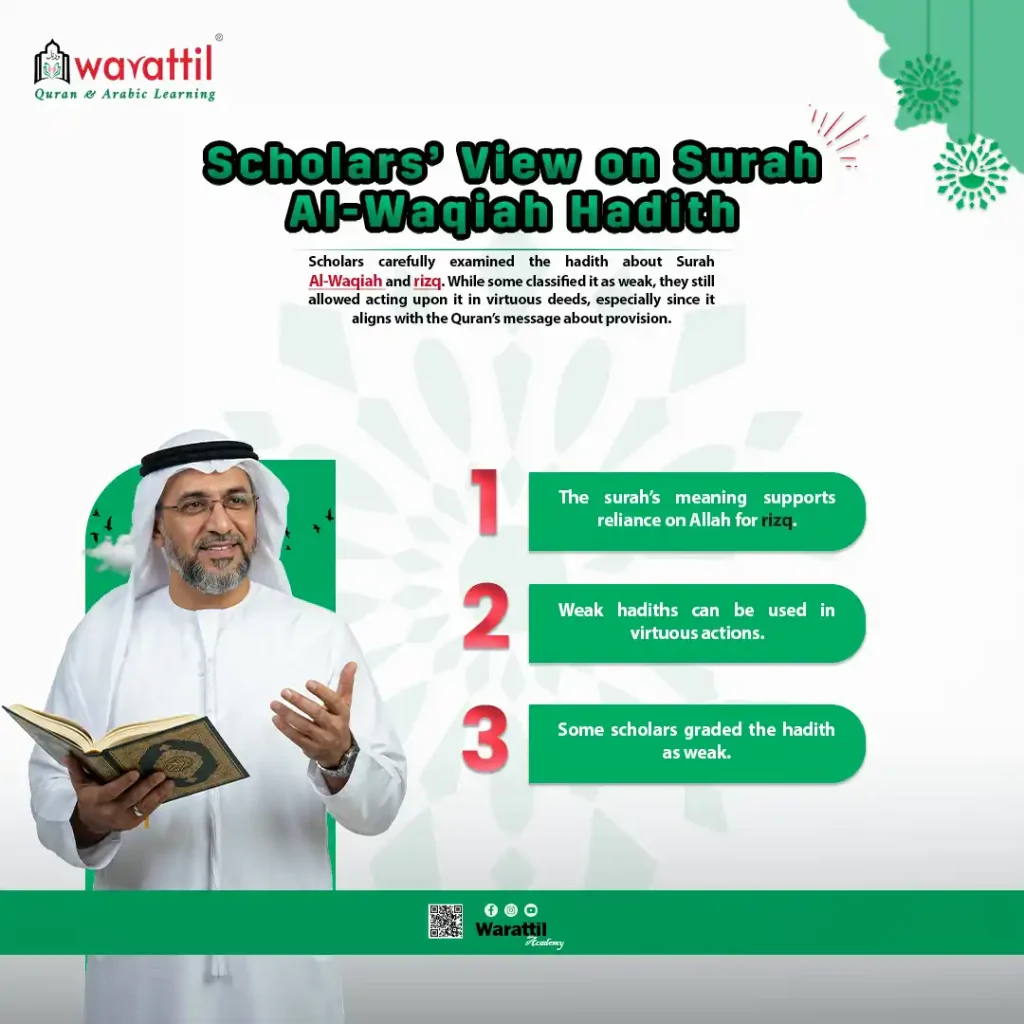
It is important to engage with the hadith sciences (Ilm al-Hadith) honestly here, as that is part of what makes Islamic scholarship credible. The primary narration from Ibn Masud has been graded as da’if (weak) by some hadith specialists due to a gap or weakness in its chain of transmission (isnad). However, several important points need to be understood alongside that assessment.
First, al-Suyuti and al-Mundhiri both discussed this hadith and considered its meaning to be supported by the general Quranic and hadith emphasis on the Quran as a source of barakah and provision. Second, the overwhelming consensus among classical scholars including Imam Ahmad ibn Hanbal, Imam al-Nawawi, and Ibn Hajar al-Asqalani permits acting upon weak hadiths in matters of fada’il al-a’mal (virtuous deeds), so long as the weakness is not severe and the action itself does not contradict a stronger ruling. Since reciting the Quran at night is already an unquestionably virtuous and encouraged act in Islam, the weak hadith here serves only to specify a particular surah within an already-sound practice.
Third, and perhaps most importantly, the content of Surah Waqiah itself aligns with the hadith’s message. The surah repeatedly returns to the theme of Allah’s exclusive ownership and distribution of all provision the rain that causes crops to grow, the fire that warms the believer, the water that sustains life. These are not coincidental themes. They are the surah’s theological core, and they directly relate to why its recitation has been associated with an increase in trust toward Allah regarding one’s rizq.
One of the most compelling arguments for the surah’s connection to rizq does not come from hadith at all it comes from the surah’s own content. Verses 63 to 74 of Surah Waqiah pose a sequence of rhetorical questions that are, in essence, a direct address on the subject of provision:
Do you see the seed you sow? Is it you who makes it grow, or are We the grower?
Do you see the water you drink? Is it you who sent it down from the clouds, or are We the sender?
Do you see the fire you kindle? Is it you who produced its tree, or are We the producer?
Surah Waqiah, verses 63–72 (meaning)
These verses are not abstract theological statements. They are a direct dismantling of the human tendency to attribute provision to one’s own effort, intelligence, or planning. The surah is, in this sense, a cure for the anxiety that arises when a person begins to believe that their rizq depends entirely on themselves. And it is precisely that anxiety the fear of poverty, the attachment to financial security that the Prophet (ﷺ) was addressing when he recommended this surah for nightly recitation.
When you place the hadith narrations alongside the surah’s internal content, a coherent picture emerges. The Prophet (ﷺ) was not prescribing a ritual divorced from meaning. He was directing the believer toward a surah that when recited with reflection actively reshapes how one thinks about wealth, provision, and dependency. Poverty, in this framework, is not merely the absence of money. It is a state of heart one that forgets its true Provider. And the regular recitation of Surah Waqiah is, at its core, a protection against that forgetfulness.
Beyond the narration about protection from poverty, the surah carries multiple layers of spiritual benefit that deserve attention individually.
The Prophet (ﷺ) is reported to have said: “Teach Surah Waqiah to your women, for indeed it is the Surah of Wealth.” (Ibn Asakir). Whether this refers to material or spiritual richness or both scholars generally agree that regular recitation of any portion of the Quran strengthens one’s connection to the divine and increases barakah (blessing) in one’s affairs.
Surah Waqiah divides humanity on the Day of Judgement into three groups: the forerunners (As-Sabiqun), the companions of the right (Ashab ul-Yameen), and the companions of the left (Ashab ul-Shimaal). Reading this regularly keeps the believer grounded in the awareness that this life is temporary and that every action is being recorded. This awareness, known as muraqabah in Islamic spirituality, naturally encourages righteous behaviour over time.
The detailed descriptions of paradise and hellfire in this surah serve as a spiritual anchor. When a person recites these verses with reflection and understanding, the excessive attachment to worldly pleasures tends to loosen. This is one reason why classical scholars recommended reciting Surah Waqiah during times of financial anxiety not merely as a ritual, but as a means of reorienting the heart toward reliance on Allah rather than on wealth itself.
The surah ends with a powerful declaration: “So glorify the name of your Lord, the Most Great.” This closing verse is considered one of the most comprehensive glorifications in the Quran. Reciting the surah in full, therefore, earns the believer not just the reward of reciting Quranic verses it ends in an act of pure tasbih (glorification) directed at Allah.
Based on the hadith literature, the recommended time for reciting this surah is at night specifically after Isha prayer or before sleeping. This is consistent with the narration from Ibn Masud (RA), which specifies “every night” as the frequency.
There is no obligatory method prescribed for its recitation beyond the general rules that apply to all Quranic recitation: purity (tahara), proper pronunciation (tajweed where possible), and mindfulness of the meaning. Reciting it with understanding even in translation for those who do not yet know Arabic is encouraged by contemporary scholars, as comprehension deepens the impact of the words on the heart.
Some scholars also recommend reciting it during times of financial hardship or when feeling spiritually disconnected. The recitation is not a “substitute” for practical effort and work Islam strongly emphasises tawakkul (trust in Allah) alongside taking necessary means but it is a spiritual companion to that effort, a reminder that the source of all provision lies beyond human hands.
It is worth being honest about what the hadith literature says and how scholars have evaluated it. The narration about Surah Waqiah and poverty has been classified by some scholars as weak (da’if) in its chain of transmission, while others, including al-Mundhiri, considered its meaning to be sound and supported by other evidence. The majority of scholars accept acting upon weak hadiths in matters of virtue and voluntary worship and reciting the Quran regularly is, without question, one of the most virtuous acts a Muslim can perform.
This means that the encouragement to recite Surah Waqiah is not based on superstition or unfounded tradition. It is grounded in a serious body of Islamic scholarship that spans over fourteen centuries scholars who were meticulous about distinguishing authentic narrations from fabricated ones.
Surah Waqiah is approximately one page and a half in the standard Uthmani mushaf. For most readers, a clear recitation takes between five to eight minutes. Given how modest a time commitment that is, building a nightly habit around it is entirely achievable.
A practical approach would be to attach the recitation to an existing habit for example, reciting it immediately after the Isha prayer before you leave your prayer mat. Habit researchers often call this “habit stacking,” and it has proven to be one of the most effective ways of introducing new religious practices into a busy routine. Over weeks and months, the recitation begins to feel less like a task and more like a natural part of winding down the day.
For those learning the surah from scratch, starting with the first few verses daily and gradually progressing is better than rushing through it without focus. The goal is not speed it is presence and consistency.
The benefits of Surah Waqiah extend well beyond what a short article can capture. At its heart, this is a surah that asks the reader to lift their gaze away from the uncertainties of provision and the anxieties of daily life, and toward the One who created everything and holds every matter in His hands.
Whether you are facing financial difficulty, seeking more barakah in your life, or simply looking to deepen your connection with the Quran, Surah Waqiah offers a meaningful starting point. The Prophet (ﷺ) did not merely recite the Quran he lived by it, and he encouraged those around him to make specific chapters a part of their daily rhythm. This surah was one of them.
Make it yours too.

My son feels happy, amazing teachers and staff in wrattil and flexible prices MashaAllah Thank you so much
My daughter started learning in warattil academy and alhamdulilah we are really impressed and have enjoyed learning with wrattil. May Allah reward her sheikh
My teacher Ahmed is very good. He helped me recite and memorize holy Quran
Warattil is the most efficient way of learning Arabic. I like warattil curriculum and excellent teachers to support this learning Thank you so much
I highly recommend warattil Ijazah programs to anyone who wants to learn Quran properly.
Very well organized MashaAllah. I love it and this is a great course if you want to understand the Quran and learn tafsir
Warattil program is the best I have seen. The teacher is really great and is available to answer questions in a clear manner
I think warattil is the best academy in learning Arabic and I recommend Arabic course to anyone
We are so happy with ustad Hussein. He is very patient and comfortable teacher. May Allah the teachers and admin in warattil
Rating 10 mashaAllah and so grateful