Are hadiths in the Quran? No. Hadith reports and Hadith collections are not part of the Qur’anic text. The Qur’an and Hadith are distinct sources in Islamic tradition, although they are closely connected through the role of Prophet Muhammad ﷺ.
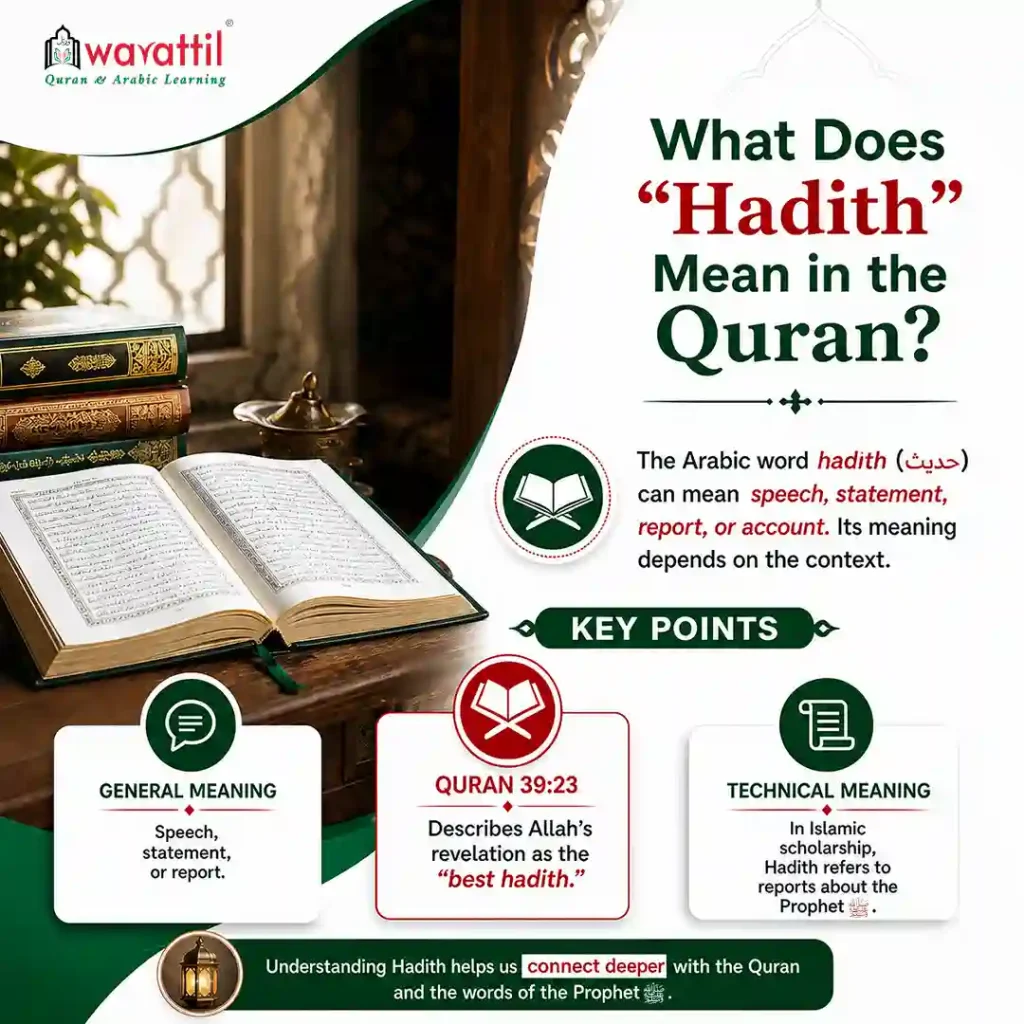
The confusion often comes from the fact that the Arabic word hadith (حديث) does appear in the Qur’an. However, the word does not always refer to the technical meaning of “Hadith” that Muslims use when discussing reports about the Prophet ﷺ. In Qur’anic Arabic, hadith can refer to speech, discourse, a statement, or a report. For example, Qur’an 39:23 describes the revelation as “the best hadith” in several English translations.
Understanding this distinction makes the relationship between the Qur’an, Hadith, and Sunnah much clearer.
Are Hadiths in the Quran as part of its text?
No. Hadith reports are not verses of the Qur’an, and Hadith collections are not chapters or sections of the Qur’an.
The Qur’an is the revelation given by Allah to Prophet Muhammad ﷺ. It is the scripture of Islam and consists of its own distinct text.
Hadith, in contrast, refers to reports transmitted from the Prophet ﷺ. These reports may describe his words, actions, approvals, or other aspects of his life. Muslim scholars subsequently developed methods for evaluating these reports, including examining chains of transmission and the reliability of narrators.
This distinction can be seen clearly in the relationship between the Qur’an and collections such as Sahih al-Bukhari. For example, Sahih al-Bukhari 4 records a report from Jabir ibn Abdullah describing an event associated with the continuation of revelation and the revelation of verses from Surah al-Muddaththir. The report itself is not a Qur’anic verse; it is a Hadith describing an event related to the Qur’an’s revelation.
Therefore, if the question is whether books such as Sahih al-Bukhari and Sahih Muslim are contained within the Qur’an, the answer is no.
Why do people ask, “Are Hadiths in the Quran?”
The question usually arises because the Qur’an places considerable emphasis on the Messenger’s role.
The Qur’an does not describe Prophet Muhammad ﷺ only as someone who recited revelation. It also instructs believers to obey him.
Qur’an 4:80 states:
“Whoever obeys the Messenger has truly obeyed Allah.”
The verse directly connects obedience to the Messenger with obedience to Allah.
Likewise, Qur’an 24:54 instructs believers to obey Allah and the Messenger and states that obeying him leads to guidance.
These verses help explain why the Prophet’s teachings and example became an important part of Islamic scholarship. They do not, however, mean that Hadith reports are part of the Qur’anic text.
Does the Quran mention Hadith?
Yes, the word hadith occurs in the Qur’an. But the meaning must be understood from the context in which the word is used.
In Qur’an 39:23, Allah says:
“Allah has sent down the best hadith…”
Here, the verse is referring to the revelation itself. The Arabic word hadith therefore cannot be understood exclusively as referring to the later technical category of Prophetic Hadith reports.
The word also appears in Qur’an 45:6. In that verse, the word is translated in different ways, including “statement,” “fact,” “exposition,” and “announcement,” depending on the translation.
This is why simply seeing the word hadith in the Qur’an does not mean that the Qur’an contains the Hadith collections.
The linguistic meaning of the Arabic word and its later technical meaning in Hadith scholarship should not be confused.
What is the difference between the Quran and Hadith?
The difference becomes clearer when each term is considered separately.
The Quran
The Qur’an is the revealed scripture of Islam. Muslims believe it was revealed by Allah to Prophet Muhammad ﷺ and that its Qur’anic wording is revelation.
The Qur’an is therefore a distinct body of scripture rather than a collection of reports about the Prophet.
Hadith
A Hadith is a transmitted report concerning Prophet Muhammad ﷺ. Such a report may describe something he said, did, approved of, or something reported about him.
Hadith reports are therefore not the same textual category as Qur’anic verses.
Another important point is that not every report attributed to the Prophet is automatically authentic. Muslim Hadith scholars developed methods for examining narrations and classifying them according to their reliability. This is why Islamic scholarship distinguishes between different grades of Hadith.
Sunnah
The term Sunnah is closely related to Hadith but is not exactly synonymous with it.
The Sunnah refers to the Prophet’s established way, teachings, practices, and example. Hadith reports are among the principal means through which those teachings and practices are transmitted and studied.
This distinction matters because “Hadith” refers primarily to reports, whereas “Sunnah” refers to the Prophetic example and way of life represented through those reports and other transmitted evidence.
Does the Quran tell Muslims to follow the Prophet?
Yes. Several Qur’anic passages establish the importance of obeying the Messenger.
Qur’an 4:80 says:
“Whoever obeys the Messenger has truly obeyed Allah.”
Qur’an 24:54 similarly says:
“Obey Allah and obey the Messenger.”
The same verse then states that those who obey the Messenger will be rightly guided.
These verses provide a clear Qur’anic basis for the importance of following the Messenger ﷺ. They do not state that Hadith books are part of the Qur’an. Rather, they establish the Messenger’s authority and role within the religious life of Muslims.
Does the Quran say that the Prophet explained revelation?
Yes. Qur’an 16:44 is particularly relevant to this question.
The verse says that Allah sent down the Reminder to the Prophet ﷺ “so that you may explain to people what has been revealed for them.”
This verse presents the Prophet as someone who explains what was revealed to the people.
That role is important when considering the relationship between the Qur’an and the Sunnah. The Qur’an provides the revealed message, while the Prophet ﷺ taught and demonstrated how that message was understood and practiced.
Hadith literature later became an important means through which Muslims studied reports concerning his teachings, statements, and actions.
What does the Quran say about following the Messenger?
Another frequently discussed verse is Qur’an 59:7.
The verse occurs in the context of property distributed by the Messenger from the people of the towns. Within that context, it says:
“Whatever the Messenger gives you, take it. And whatever he forbids you from, leave it.”
The immediate context should not be ignored. The verse discusses the distribution of wealth and property, so it should not be presented as though the surrounding subject matter does not exist.
At the same time, the verse explicitly instructs believers to accept what the Messenger gives them and refrain from what he forbids. This is one of the Qur’anic passages discussed in Islamic scholarship when considering the authority of the Messenger.
Does the Quran contain every Hadith?
No.
The Qur’an is not a compilation of every statement attributed to Prophet Muhammad ﷺ. Hadith reports belong to a separate transmitted literature.
A useful example is the beginning of revelation described in Sahih al-Bukhari 4. The narration reports Jabir ibn Abdullah describing an event involving the Prophet ﷺ and the Angel who had previously come to him at Hira. The report then mentions the revelation of verses from Surah al-Muddaththir.
This narration is not itself a Qur’anic verse. Instead, it is a Hadith report describing an event connected with the revelation.
This illustrates an important difference: the Qur’an contains the revealed verses, while Hadith can preserve reports about events, teachings, and circumstances surrounding the Prophet’s mission.
Are the Prophet’s sayings the same as the Quran?
No.
A Qur’anic verse and a Hadith report are not treated as the same type of text.
The Qur’an is the revealed scripture. A Hadith is a transmitted report about the Prophet ﷺ.
This distinction does not mean that Hadith are irrelevant. In mainstream Islamic scholarship, authentic Prophetic teachings have an important role in understanding and practicing Islam. However, that authority does not make Hadith reports Qur’anic verses.
This is why a Hadith cannot simply be added to the Qur’an, and a Qur’anic verse should not be classified merely as a Hadith.
Why are Hadith important if the Quran is the main scripture?
The Qur’an contains the foundational teachings of Islam, but the Prophet ﷺ also demonstrated how those teachings were practiced.
For example, the Qur’an commands believers to establish prayer. The practical details of the Prophet’s prayer are not presented as one complete procedural manual within a single Qur’anic passage. Reports about his practice therefore became important for Muslims seeking to understand how he performed acts of worship.
More broadly, the Qur’an establishes the Messenger’s role, while Hadith preserve reports through which later generations can study aspects of his teachings and practice.
Qur’an 16:44 is particularly relevant because it describes the Prophet’s role in explaining what had been revealed.
Contemporary Islamic scholarship also discusses the Qur’an and Sunnah together as foundational sources and examines the role of Hadith in understanding the Qur’an and Islamic law.
What does “Hadith” mean in the Quran?
The Arabic word ḥadīth (حديث) has a broader meaning than the technical term “Hadith” used in Islamic scholarship.
Depending on context, it can refer to speech, a statement, discourse, a report, or an account.
This is particularly important when reading verses such as Qur’an 39:23. The verse describes Allah’s revelation as “the best hadith.”
Therefore, the presence of the word hadith in the Qur’an does not mean that the Hadith collections known today are contained within it.
The same word can have different meanings depending on context, just as many words in English have both general and specialized meanings.
Is the Quran enough to understand Islam without Hadith?
This question needs to be approached carefully because different Muslim communities and scholars have different views concerning the authority and interpretation of Hadith.
In mainstream Sunni Islamic scholarship, the Qur’an and authentic Sunnah are treated as foundational sources, and Hadith are an important means of accessing the Prophet’s teachings and practice. The Qur’an itself repeatedly commands obedience to the Messenger and describes his role in explaining revelation.
At the same time, this does not mean that every narration attributed to the Prophet ﷺ is automatically accepted as authentic. Hadith scholarship developed methods for evaluating reports, including their chains of transmission and the reliability of narrators.
For that reason, it is more accurate to distinguish among the three concepts:
Qur’an: the revealed scripture.
Hadith: transmitted reports concerning the Prophet ﷺ.
Sunnah: the Prophet’s established teachings, practices, and example.
They are closely related, but they are not identical.
Does the Quran contain references to the Prophet’s Sunnah?
The Qur’an does not contain a separate book called the Sunnah inside its text. However, it establishes the Prophet’s role and instructs believers to obey him.
Qur’an 4:80 states that whoever obeys the Messenger has obeyed Allah. Qur’an 24:54 commands believers to obey Allah and the Messenger and says that obedience to him leads to guidance.
Qur’an 16:44 also describes the Prophet as explaining what had been revealed to people.
These passages help explain why the Prophet’s teachings and example occupy an important place in Islamic scholarship.
A common misunderstanding about Hadith and the Quran
One of the most common sources of confusion is treating these two statements as though they mean the same thing:
“The word Hadith appears in the Quran.”
and
“Hadith are contained in the Quran.”
They are not the same statement.
The word hadith does occur in the Qur’an, including in Qur’an 39:23, where the revelation is described as the “best hadith.”
But this does not mean that Hadith reports or Hadith collections are part of the Qur’anic text.
The technical meaning of Hadith in Islamic scholarship refers to transmitted reports concerning the Prophet ﷺ. Those reports were preserved and evaluated through a separate scholarly tradition.
Quran and Hadith: How should they be understood together?
The relationship can be summarized without treating the two sources as identical.
The Qur’an is the revealed scripture.
The Prophet Muhammad ﷺ conveyed the revelation and, according to Qur’an 16:44, was given the role of explaining what had been revealed.
The Sunnah refers to the Prophet’s teachings and example.
Hadith are transmitted reports through which Muslims study his statements, actions, approvals, and other aspects of his life.
Because individual Hadith reports differ in reliability, responsible study requires examining the authenticity and scholarly classification of individual narrations rather than assuming that every report attributed to the Prophet is equally reliable.
Final Answer: Are Hadiths in the Quran?
So, are hadiths in the Quran?
No. Hadith reports and Hadith collections are not part of the Qur’anic text. The Qur’an and Hadith are distinct sources.
However, there is an important qualification. The Arabic word hadith does occur in the Qur’an and can carry meanings such as speech, statement, discourse, or report. Qur’an 39:23, for example, describes the revelation as “the best hadith.”
The Qur’an also establishes the importance of the Prophet ﷺ. It says that obeying the Messenger is obedience to Allah (4:80), commands believers to obey Allah and the Messenger (24:54), and describes the Prophet as explaining what had been revealed (16:44).
Therefore, the most accurate conclusion is:
The word “Hadith” appears in the Quran, but Hadith reports and Hadith collections are not part of the Quranic text.
The Qur’an is the revealed scripture, while Hadith preserve reports about the teachings, statements, actions, and example of Prophet Muhammad ﷺ. Understanding this distinction helps readers study Islamic sources more accurately and avoid confusing the Qur’an with the broader Hadith literature.