Shopping cart
- +1 564-544-6614
- [email protected]
- 24/7 Available


A famous Quran ayat often remains in a person’s memory because of its powerful message, frequent recitation, or importance within Islamic teachings. Throughout the Quran, certain verses are especially well known among Muslims because they address universal themes such as faith, mercy, patience, hope, gratitude, inner peace, and trust in Allah.
Some Quranic verses provide reassurance during difficult periods. Others encourage people to remember Allah, seek forgiveness, recognize His blessings, or reflect on the purpose of human life. Their significance, however, extends far beyond their popularity. Every ayah belongs to a wider context, and understanding that context helps readers appreciate its message more accurately.
In this article, we explore several famous Quran ayats in Arabic alongside their English meanings and discuss the lessons they offer. Since translations can vary, the English text should be understood as a translation of the meaning rather than the Quran itself, which was revealed in Arabic.
There is no official ranking that determines which Quranic verse is the most famous. Nevertheless, some ayats have become particularly familiar because they are frequently recited, memorized, taught, and discussed across Muslim communities.
Their enduring significance often comes from the depth of their messages. A short verse can address a profound human experience, whether that involves facing hardship, searching for reassurance, seeking forgiveness, expressing gratitude, or considering the purpose of life.
At the same time, the Quran should not be approached merely as a collection of inspirational quotations. Each ayah belongs to a larger revelation. Reading the surrounding verses and consulting reliable tafsir, or Quranic commentary, can provide a fuller understanding of its meaning.
The following well-known Quran verses provide a starting point for exploring some of these important themes.
Surah Al-Baqarah, 2:255
Arabic:
اللَّهُ لَا إِلَٰهَ إِلَّا هُوَ الْحَيُّ الْقَيُّومُ ۚ لَا تَأْخُذُهُ سِنَةٌ وَلَا نَوْمٌ ۚ لَهُ مَا فِي السَّمَاوَاتِ وَمَا فِي الْأَرْضِ ۗ مَنْ ذَا الَّذِي يَشْفَعُ عِنْدَهُ إِلَّا بِإِذْنِهِ ۚ يَعْلَمُ مَا بَيْنَ أَيْدِيهِمْ وَمَا خَلْفَهُمْ ۖ وَلَا يُحِيطُونَ بِشَيْءٍ مِنْ عِلْمِهِ إِلَّا بِمَا شَاءَ ۚ وَسِعَ كُرْسِيُّهُ السَّمَاوَاتِ وَالْأَرْضَ ۖ وَلَا يَئُودُهُ حِفْظُهُمَا ۚ وَهُوَ الْعَلِيُّ الْعَظِيمُ
Meaning: Allah—there is no deity worthy of worship except Him, the Ever-Living, the Sustainer of all. Neither drowsiness nor sleep overtakes Him. Everything in the heavens and the earth belongs to Him. No one can intercede with Him except by His permission. His knowledge encompasses all, and His authority extends over the heavens and the earth. He is the Most High, the Most Great.
Ayat al-Kursi, commonly known as the Verse of the Throne, is among the most widely recognized verses of the Quran. Its central subject is the greatness, uniqueness, knowledge, and absolute authority of Allah.
The verse presents a powerful contrast between the limitations of creation and the perfection of the Creator. Human beings experience tiredness and possess limited knowledge, whereas Allah is described as the Ever-Living and the Sustainer of all existence.
Ayat al-Kursi also emphasizes that everything in the heavens and the earth belongs to Allah. Nothing exists beyond His knowledge or authority. For readers searching for a famous Quran ayat about the greatness of Allah, this is one of the most significant verses to study.
Surah Ar-Ra’d, 13:28
Arabic:
الَّذِينَ آمَنُوا وَتَطْمَئِنُّ قُلُوبُهُمْ بِذِكْرِ اللَّهِ ۗ أَلَا بِذِكْرِ اللَّهِ تَطْمَئِنُّ الْقُلُوبُ
Meaning: Those who believe and whose hearts find reassurance in the remembrance of Allah. Surely, in the remembrance of Allah do hearts find reassurance.
This well-known Quran verse connects spiritual reassurance with the remembrance of Allah, known as dhikr.
Human life naturally includes periods of uncertainty and difficulty. Circumstances cannot always be controlled, and answers may not always come immediately. This ayah directs believers toward maintaining their connection with Allah during such moments.
Remembrance can take different forms, including prayer, Quran recitation, supplication, and sincere reflection.
The verse should not be understood as suggesting that believers will never experience sadness or difficulty. Instead, it highlights the spiritual reassurance that can come through remembering Allah and maintaining faith during changing circumstances.
Surah Ash-Sharh, 94:5–6
Arabic:
فَإِنَّ مَعَ الْعُسْرِ يُسْرًا
إِنَّ مَعَ الْعُسْرِ يُسْرًا
Meaning: Indeed, with hardship comes ease. Indeed, with hardship comes ease.
These two short verses are among the most frequently remembered Quranic passages during difficult times. Their repeated message places hardship within a broader perspective.
The Quran does not deny the reality of difficulty. Instead, these verses remind readers that hardship does not exist without the possibility and presence of ease.
This message can encourage patience and hope. Circumstances may change, unexpected opportunities may emerge, and relief may arrive in forms that were not previously visible.
However, these verses should not be reduced to a promise that every difficulty will disappear immediately. Their deeper message encourages believers to maintain hope and avoid viewing their present circumstances as the entire story.
Surah Az-Zumar, 39:53
Arabic:
قُلْ يَا عِبَادِيَ الَّذِينَ أَسْرَفُوا عَلَىٰ أَنْفُسِهِمْ لَا تَقْنَطُوا مِنْ رَحْمَةِ اللَّهِ ۚ إِنَّ اللَّهَ يَغْفِرُ الذُّنُوبَ جَمِيعًا ۚ إِنَّهُ هُوَ الْغَفُورُ الرَّحِيمُ
Meaning: Say, “O My servants who have exceeded the limits against themselves, do not despair of Allah’s mercy. Indeed, Allah forgives all sins. He is truly the All-Forgiving, the Most Merciful.”
Surah Az-Zumar 39:53 contains one of the Quran’s most powerful messages about hope and divine mercy.
The verse addresses people who have wronged themselves and directly tells them not to lose hope in Allah’s mercy. Its message can be particularly meaningful for those who believe their past mistakes have placed forgiveness beyond their reach.
However, the surrounding context is important. The following verse calls people to return to their Lord. Therefore, the hope expressed in this famous Quran ayat is closely connected with sincere repentance and returning to Allah.
The verse does not remove personal responsibility. Instead, it teaches that wrongdoing should not become a reason to abandon hope in forgiveness.
Surah Al-Baqarah, 2:286
Arabic excerpt:
لَا يُكَلِّفُ اللَّهُ نَفْسًا إِلَّا وُسْعَهَا
Meaning: Allah does not require of any soul more than it can bear.
This statement forms the opening part of Quran 2:286, the final verse of Surah Al-Baqarah.
It is frequently quoted during challenging periods, although understanding its wider context is important. The complete verse discusses responsibility and accountability before concluding with a meaningful supplication asking Allah for forgiveness, mercy, and support.
The statement should not necessarily be interpreted as meaning that a person will never feel overwhelmed. Rather, it emphasizes Allah’s justice and His complete knowledge of human capacity and responsibility.
Reading the complete ayah can therefore provide a more comprehensive understanding than reading this famous excerpt by itself.

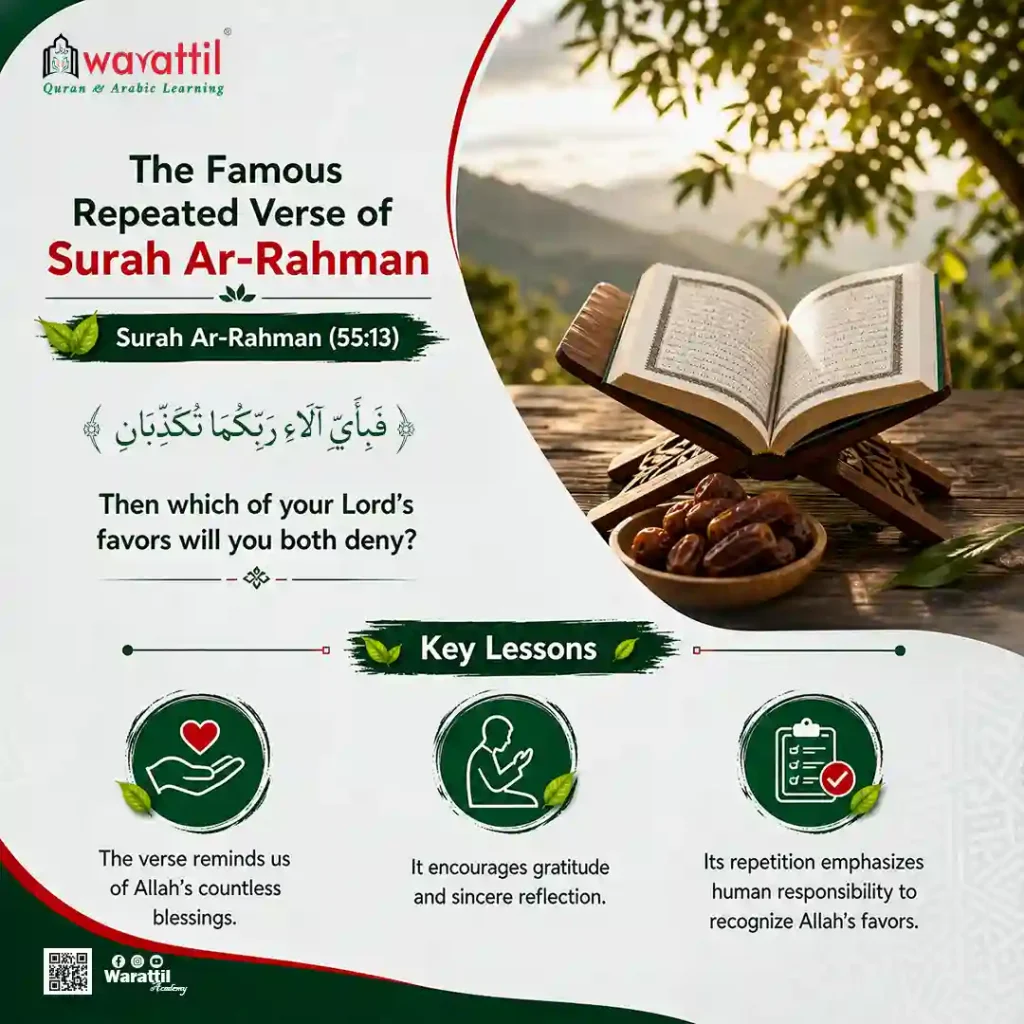
Surah Ar-Rahman, 55:13
Arabic:
فَبِأَيِّ آلَاءِ رَبِّكُمَا تُكَذِّبَانِ
Meaning: Then which of your Lord’s favors will you both deny?
This recognizable question appears repeatedly throughout Surah Ar-Rahman, creating one of the Quran’s most memorable recurring passages.
The surah draws attention to numerous signs, blessings, and realities. The repeated question encourages its audience to reflect rather than overlook the favors and signs of Allah.
Its message is closely connected with gratitude. People can easily become accustomed to everyday blessings and eventually stop recognizing their significance.
By repeatedly asking which favors can be denied, Surah Ar-Rahman encourages sustained reflection on divine blessings and human responsibility.
Surah At-Talaq, 65:3
Arabic excerpt:
وَمَنْ يَتَوَكَّلْ عَلَى اللَّهِ فَهُوَ حَسْبُهُ
Meaning: Whoever puts their trust in Allah, He is sufficient for them.
This famous passage is closely associated with tawakkul, the Islamic concept of relying upon Allah.
Tawakkul should not be confused with avoiding responsibility or refusing to take action. A person can work toward a goal, make careful decisions, and take reasonable precautions while recognizing that the final outcome remains beyond complete human control.
This creates a balance between effort and trust.
The verse can therefore provide valuable perspective during uncertain situations. Believers are encouraged to fulfill their responsibilities while ultimately placing their trust in Allah.
Surah Ibrahim, 14:7
Arabic excerpt:
لَئِنْ شَكَرْتُمْ لَأَزِيدَنَّكُمْ
Meaning: If you are grateful, I will certainly give you more.
This widely quoted passage from Surah Ibrahim emphasizes the importance of gratitude.
In the Quranic understanding, gratitude involves more than simply expressing appreciation verbally. It also includes recognizing blessings and responding to them appropriately.
Knowledge, health, opportunities, relationships, and material resources can all be viewed as blessings carrying responsibilities. Appreciating these gifts can influence how a person uses them.
This famous Quran ayat therefore encourages believers to recognize what they have rather than focusing entirely on what they lack.
Surah Adh-Dhariyat, 51:56
Arabic:
وَمَا خَلَقْتُ الْجِنَّ وَالْإِنْسَ إِلَّا لِيَعْبُدُونِ
Meaning: I did not create jinn and humans except to worship Me.
This verse provides an important foundation for understanding the purpose of human and jinn creation from an Islamic perspective.
The Arabic concept of ibadah, commonly translated as worship, carries a broad meaning. It certainly includes established acts of worship such as prayer and fasting, but a believer’s relationship with Allah also influences wider aspects of life.
Honesty, responsibility, ethical conduct, and sincere intentions can all be shaped by a commitment to living according to divine guidance.
The ayah therefore presents worship as central to the fundamental purpose for which humans and jinn were created.
Surah Al-An’am, 6:59
Arabic excerpt:
وَمَا تَسْقُطُ مِنْ وَرَقَةٍ إِلَّا يَعْلَمُهَا
Meaning: Not even a leaf falls without His knowledge.
This short passage comes from a much longer verse describing the completeness of Allah’s knowledge.
The imagery is particularly powerful because a falling leaf may appear insignificant from a human perspective. Yet the verse states that even such an event does not occur outside Allah’s knowledge.
Human knowledge will always remain limited. People may understand part of a situation while remaining unaware of countless other factors.
This ayah therefore encourages humility and reminds believers of the difference between limited human understanding and complete divine knowledge.
Surah Al-Hujurat, 49:13
Arabic:
يَا أَيُّهَا النَّاسُ إِنَّا خَلَقْنَاكُمْ مِنْ ذَكَرٍ وَأُنْثَىٰ وَجَعَلْنَاكُمْ شُعُوبًا وَقَبَائِلَ لِتَعَارَفُوا ۚ إِنَّ أَكْرَمَكُمْ عِنْدَ اللَّهِ أَتْقَاكُمْ ۚ إِنَّ اللَّهَ عَلِيمٌ خَبِيرٌ
Meaning: O humanity, We created you from a male and a female and made you into peoples and tribes so that you may know one another. Surely, the most honored of you in the sight of Allah is the most mindful of Him. Allah is truly All-Knowing, All-Aware.
This verse addresses humanity broadly and provides an important Quranic perspective on human diversity.
The existence of different peoples and tribes is acknowledged, while moral and spiritual worth is not based on ethnicity, nationality, wealth, or social status.
Instead, the verse identifies taqwa as the standard of honor before Allah.
This famous Quran ayat encourages mutual recognition while challenging ideas of superiority based solely on worldly identity or social background.
Surah Al-Ma’idah, 5:32
Arabic excerpt:
مَنْ قَتَلَ نَفْسًا بِغَيْرِ نَفْسٍ أَوْ فَسَادٍ فِي الْأَرْضِ فَكَأَنَّمَا قَتَلَ النَّاسَ جَمِيعًا وَمَنْ أَحْيَاهَا فَكَأَنَّمَا أَحْيَا النَّاسَ جَمِيعًا
Meaning: Whoever takes a life unjustly, as described in the verse, it is as though they had killed all humanity; and whoever saves a life, it is as though they had saved all humanity.
This is one of the most frequently quoted Quranic passages concerning the seriousness of taking life and the significance of preserving it.
However, context is particularly important when discussing this verse. Quran 5:32 introduces this statement in relation to what was prescribed for the Children of Israel. The verse also includes specific wording concerning killing and corruption in the land.
Therefore, although the quoted passage communicates a powerful moral message about the value of life, its original context should not be removed when explaining its meaning.
Many famous Quran ayats are shared online as short quotations. While these quotations may introduce readers to valuable Quranic teachings, an isolated sentence cannot always communicate everything contained within the original passage.
The surrounding verses may explain who is being addressed, what circumstances are being discussed, and how a particular statement connects with the broader subject.
For example, Quran 39:53 is widely quoted for its message about Allah’s mercy. However, the following verse also calls people to return to their Lord. Similarly, the frequently quoted opening statement of Quran 2:286 belongs to a much longer verse concerning responsibility, accountability, and supplication.
A responsible approach to Quran study therefore involves reading beyond isolated quotations whenever possible.
Reliable translations can help non-Arabic readers understand the general meaning, while recognized tafsir can provide deeper linguistic, historical, and interpretive context.
When these well-known Quran ayats are considered together, several important themes become clear.
The Quran encourages remembrance of Allah, hope during hardship, sincere repentance, gratitude for blessings, and trust in divine wisdom. It also addresses human responsibility, the purpose of worship, human diversity, the value of life, and the limitations of human knowledge.
Importantly, these themes often work together.
Trust in Allah does not eliminate the need for responsible action. Hope in Allah’s mercy does not remove the importance of repentance. Gratitude is not limited to words but can influence how blessings are used.
This balance gives many famous Quran verses their enduring relevance and depth.
Reading a famous verse can be a valuable starting point, but deeper reflection often requires examining the complete passage.
Readers can begin by reading the verses immediately before and after the ayah. Comparing reputable translations can also help reveal how different translators communicate important Arabic terms.
For a deeper understanding, recognized tafsir can provide valuable explanations of language, historical background, and scholarly interpretation.
This process of thoughtful reflection is often associated with tadabbur. Rather than reading the Quran only as isolated words, readers are encouraged to think carefully about its guidance and consider how its teachings relate to faith, character, decisions, and everyday conduct.
A famous Quran ayat may become widely recognized because of its powerful message, frequent recitation, or deep spiritual significance. Ayat al-Kursi describes Allah’s greatness and authority. Surah Ar-Ra’d connects remembrance of Allah with reassurance, while Surah Ash-Sharh delivers a memorable message about hardship and ease.
Other well-known Quran verses address forgiveness, gratitude, trust in Allah, human diversity, the purpose of life, and divine knowledge.
However, the value of these verses goes far beyond their popularity. Every Quranic ayah belongs to a broader context and deserves thoughtful reading.
For anyone beginning to explore famous Quran ayats in Arabic and English, these verses offer meaningful starting points. Reading the complete passages and studying reliable explanations can provide a deeper understanding of the guidance they contain.
There is no official ranking identifying one verse as the most famous Quran ayat. However, Ayat al-Kursi, Surah Al-Baqarah 2:255, is among the best-known and frequently recited verses of the Quran.
Ayat al-Kursi is verse 255 of Surah Al-Baqarah. It describes Allah’s uniqueness, eternal life, complete knowledge, authority, and sovereignty over the heavens and the earth.
Surah Ash-Sharh 94:5–6 contains the repeated message that with hardship comes ease. These verses are widely remembered for their message of hope during difficult circumstances.
Surah Ar-Ra’d 13:28 teaches that hearts find reassurance through the remembrance of Allah. It is among the most frequently quoted Quran verses concerning spiritual comfort and remembrance.
Surah Az-Zumar 39:53 tells those who have wronged themselves not to despair of Allah’s mercy. Its surrounding context also emphasizes returning to Allah in repentance.
Surah At-Talaq 65:3 contains the well-known statement that whoever relies upon Allah will find Him sufficient. This teaching is closely connected with the Islamic concept of tawakkul.
Some widely quoted Quranic statements form only part of a longer ayah. Marking them as excerpts makes it clear that the displayed Arabic is not the complete verse and helps readers understand that additional context exists.
The Quran was revealed in Arabic. English translations represent scholarly efforts to communicate its meanings, and translators may choose different words for particular Arabic expressions. As a result, the wording can vary between reputable translations while conveying broadly similar meanings.

My son feels happy, amazing teachers and staff in wrattil and flexible prices MashaAllah Thank you so much
My daughter started learning in warattil academy and alhamdulilah we are really impressed and have enjoyed learning with wrattil. May Allah reward her sheikh
My teacher Ahmed is very good. He helped me recite and memorize holy Quran
Warattil is the most efficient way of learning Arabic. I like warattil curriculum and excellent teachers to support this learning Thank you so much
I highly recommend warattil Ijazah programs to anyone who wants to learn Quran properly.
Very well organized MashaAllah. I love it and this is a great course if you want to understand the Quran and learn tafsir
Warattil program is the best I have seen. The teacher is really great and is available to answer questions in a clear manner
I think warattil is the best academy in learning Arabic and I recommend Arabic course to anyone
We are so happy with ustad Hussein. He is very patient and comfortable teacher. May Allah the teachers and admin in warattil
Rating 10 mashaAllah and so grateful