Shopping cart
- +1 564-544-6614
- [email protected]
- 24/7 Available


Searching for the best Quran ayat often begins with a desire to find guidance, comfort, hope, or a deeper connection with Allah. The Quran contains verses that address almost every part of the human experience, from hardship and uncertainty to gratitude, patience, forgiveness, and trust in Allah.
However, describing one particular verse as the single “best” ayat can be misleading. Every verse of the Quran has its place and significance within the revelation. What people usually mean when they search for the best Quran ayat is that they are looking for meaningful verses that speak to their present circumstances.
Below are some of the most powerful and widely cherished Quranic verses, presented with their Arabic text, English meaning, and a brief reflection on their message.
Life inevitably brings periods of difficulty. During such moments, the Quran reminds believers that hardship is not the whole story.
Arabic:
فَإِنَّ مَعَ ٱلْعُسْرِ يُسْرًا
إِنَّ مَعَ ٱلْعُسْرِ يُسْرًا
Meaning:
“So, surely with hardship comes ease. Surely with that hardship comes more ease.”
These verses offer one of the Quran’s most memorable messages of hope. Notice that the verse says ease is with hardship. The message encourages believers to recognise that difficult circumstances do not remove the possibility of relief, growth, or divine help.
For someone facing uncertainty, disappointment, or a challenging period, these verses can serve as a reminder to remain patient and hopeful.

Arabic:
لَا يُكَلِّفُ ٱللَّهُ نَفْسًا إِلَّا وُسْعَهَا
Meaning:
“Allah does not require of any soul more than what it can afford.”
This well-known Quran ayat appears at the beginning of the final verse of Surah Al-Baqarah. The complete verse continues with a profound supplication asking Allah for forgiveness, mercy, and support.
The verse reminds believers that Allah knows the capacity and circumstances of every individual. It encourages patience and reliance upon Him while also acknowledging human limitations.
When responsibilities feel overwhelming, this ayat can encourage a person to approach challenges with faith, prayer, and steady effort rather than hopelessness.
Arabic:
أَلَا بِذِكْرِ ٱللَّهِ تَطْمَئِنُّ ٱلْقُلُوبُ
Meaning:
“Surely in the remembrance of Allah do hearts find comfort.”
People often search for peace through achievements, possessions, entertainment, or the approval of others. While many things can bring temporary happiness, this Quranic verse directs believers towards a deeper source of spiritual reassurance: the remembrance of Allah.
Dhikr, prayer, Quran recitation, and sincere reflection can all help a Muslim maintain a conscious relationship with Allah. The verse does not suggest that believers will never experience sadness or difficulty. Rather, it teaches that remembrance of Allah provides an important source of spiritual comfort and stability.
Arabic:
لَا تَقْنَطُوا۟ مِن رَّحْمَةِ ٱللَّهِ ۚ إِنَّ ٱللَّهَ يَغْفِرُ ٱلذُّنُوبَ جَمِيعًا
Meaning:
“Do not lose hope in Allah’s mercy, for Allah certainly forgives all sins.”
This is one of the most hopeful verses in the Quran. In its full context, the verse addresses those who have transgressed against themselves and calls them not to despair of Allah’s mercy.
Its message is especially important for anyone who feels that past mistakes have placed forgiveness beyond reach. Islam teaches the importance of sincere repentance, and this verse powerfully emphasises the vastness of divine mercy.
The lesson is clear: a person should not allow past mistakes to become a reason for abandoning the path back to Allah.
Arabic:
وَمَن يَتَوَكَّلْ عَلَى ٱللَّهِ فَهُوَ حَسْبُهُۥٓ
Meaning:
“And whoever puts their trust in Allah, then He alone is sufficient for them.”
Tawakkul, or trust in Allah, is a central concept in Islamic spirituality. However, trusting Allah does not mean abandoning responsibility or refusing to make an effort. A believer takes reasonable action while ultimately recognising that outcomes remain under Allah’s control.
This ayat can be particularly meaningful when the future seems uncertain. It encourages believers to fulfil their responsibilities without allowing fear of the unknown to dominate their hearts.
Arabic:
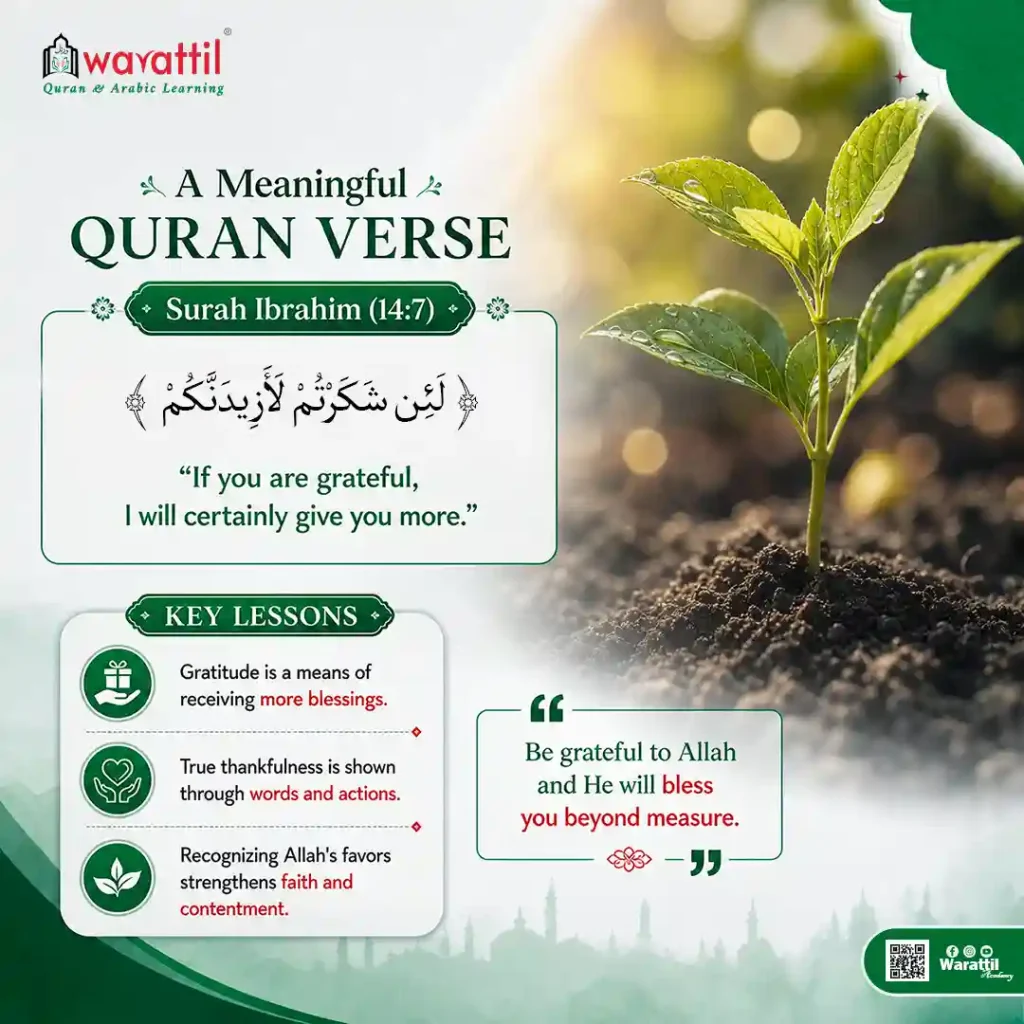
لَئِن شَكَرْتُمْ لَأَزِيدَنَّكُمْ
Meaning:
“If you are grateful, I will certainly give you more.”
Gratitude is a recurring theme throughout the Quran. This verse teaches believers to recognise the blessings already present in their lives rather than constantly focusing only on what they lack.
True gratitude is more than simply saying “Alhamdulillah.” It can also be demonstrated by using one’s blessings responsibly and recognising Allah as their ultimate source.
Practising gratitude can change how a person views everyday life. Health, family, knowledge, opportunities, time, and even seemingly ordinary moments can become reminders of blessings that are easily overlooked.
Arabic:
فَٱذْكُرُونِىٓ أَذْكُرْكُمْ وَٱشْكُرُوا۟ لِى وَلَا تَكْفُرُونِ
Meaning:
“Remember Me; I will remember you. And thank Me, and never be ungrateful.”
This beautiful Quran verse brings remembrance and gratitude together. Believers are encouraged to remember Allah and acknowledge His blessings.
The ayat also demonstrates that faith is not limited to occasional religious moments. Remembering Allah can influence daily decisions, personal conduct, relationships, and the way a person responds to both blessings and difficulties.
For Muslims seeking to strengthen their relationship with Allah, this verse offers a simple but profound direction: remember Him and remain grateful.

Arabic:
إِنَّ أَكْرَمَكُمْ عِندَ ٱللَّهِ أَتْقَىٰكُمْ
Meaning:
“Surely the most noble of you in the sight of Allah is the most righteous among you.”
The wider verse explains that humanity was created from a male and a female and made into peoples and tribes so that people may know one another.
This Quranic teaching challenges the idea that race, nationality, tribe, or social background makes one person inherently superior to another. According to the verse, the true measure of honour before Allah is taqwa, commonly understood as God-consciousness or righteousness.
It remains a powerful reminder of human dignity, humility, and the importance of judging personal worth by character and righteousness rather than worldly status.
Arabic:
فَإِنِّى قَرِيبٌ ۖ أُجِيبُ دَعْوَةَ ٱلدَّاعِ إِذَا دَعَانِ
Meaning:
“I am truly near. I respond to one’s prayer when they call upon Me.”
This verse appears in a passage discussing Ramadan and directly addresses the relationship between Allah and those who call upon Him.
Its message is deeply personal. A person does not need social status, wealth, or worldly influence to make dua. The door of supplication remains open to those who sincerely call upon Allah.
For believers, this ayat can provide reassurance during both good and difficult times. Dua is not merely a practice for moments of crisis; it is an important part of maintaining a continuous relationship with Allah.
Arabic:
مَا وَدَّعَكَ رَبُّكَ وَمَا قَلَىٰ
Meaning:
“Your Lord has not abandoned you, nor has He become hateful of you.”
Surah Ad-Duha was revealed in a specific context addressing Prophet Muhammad ﷺ, and its verses should be understood with that context in mind. Nevertheless, Muslims often find broader encouragement in the surah’s themes of divine care, gratitude, and concern for those in need.
The surah later reminds the Prophet ﷺ of previous blessings and instructs him to care for the orphan and the person who asks for help.
Therefore, its message is not only one of reassurance. It also connects gratitude for Allah’s blessings with responsibility and compassion towards others.
The Quran contains guidance for different circumstances, so the verse that feels most relevant may depend on what you are experiencing. Someone facing hardship may reflect on Surah Ash-Sharh, while a person seeking forgiveness may find particular comfort in Surah Az-Zumar 39:53.
However, reading isolated verses should not replace understanding their wider context. Reading the verses before and after an ayat, consulting reliable translations, and studying recognised tafsir can provide a fuller understanding of its meaning.
This approach is especially important when Quranic verses discuss Islamic law, historical events, or specific circumstances surrounding revelation. Context protects readers from assigning meanings to verses that the text itself does not support.
For Muslims, the Quran is far more than a collection of inspirational quotations. It is regarded as divine revelation and a source of guidance for faith, worship, character, relationships, and moral responsibility.
Its verses address universal human experiences, including fear, hope, gratitude, loss, patience, forgiveness, justice, and mercy. As circumstances change, a familiar ayat may reveal a lesson that a reader had not previously considered.
This is one reason regular Quran reading and reflection hold such an important place in Muslim life. A person may read the same passage many times, yet understand its relevance differently as knowledge and life experience develop.
There is no need to reduce the Quran to a competition for the single best Quran ayat. Different verses offer guidance for different moments, and every ayat belongs to the wider message and context of the Quran.
Verses such as Quran 94:5–6 remind believers of ease alongside hardship, Quran 13:28 speaks about finding comfort in the remembrance of Allah, and Quran 39:53 warns against losing hope in divine mercy. Together with many other beautiful Quran verses, they encourage faith, patience, gratitude, repentance, and trust in Allah.
The most meaningful way to benefit from these verses is not simply to collect or share them. Read them in context, reflect on their meaning, consult reliable tafsir when deeper explanation is needed, and consider how their teachings can shape everyday actions.
In this way, the search for the best Quran ayat can become something more valuable: an opportunity to build a deeper and more thoughtful relationship with the Quran.
Quran 94:5–6 is frequently remembered during difficult periods because it states that with hardship comes ease. Quran 2:286 is also meaningful to many believers because it teaches that Allah does not burden a soul beyond its capacity.
Quran 39:53 is one of the Quran’s clearest messages against despair. It tells those who have transgressed against themselves not to lose hope in Allah’s mercy.
Quran 13:28 states that hearts find comfort through the remembrance of Allah. It is widely reflected upon by Muslims seeking spiritual peace and a stronger connection with their Creator.
Quran 65:3 teaches that whoever places their trust in Allah will find Him sufficient. The concept of tawakkul encourages believers to make responsible efforts while trusting Allah regarding the ultimate outcome.
Context helps readers understand what a verse addresses and how it relates to surrounding passages. Reliable translations and recognised tafsir can also provide important linguistic, historical, and interpretive explanations.

My son feels happy, amazing teachers and staff in wrattil and flexible prices MashaAllah Thank you so much
My daughter started learning in warattil academy and alhamdulilah we are really impressed and have enjoyed learning with wrattil. May Allah reward her sheikh
My teacher Ahmed is very good. He helped me recite and memorize holy Quran
Warattil is the most efficient way of learning Arabic. I like warattil curriculum and excellent teachers to support this learning Thank you so much
I highly recommend warattil Ijazah programs to anyone who wants to learn Quran properly.
Very well organized MashaAllah. I love it and this is a great course if you want to understand the Quran and learn tafsir
Warattil program is the best I have seen. The teacher is really great and is available to answer questions in a clear manner
I think warattil is the best academy in learning Arabic and I recommend Arabic course to anyone
We are so happy with ustad Hussein. He is very patient and comfortable teacher. May Allah the teachers and admin in warattil
Rating 10 mashaAllah and so grateful