Shopping cart
- +1 564-544-6614
- [email protected]
- 24/7 Available


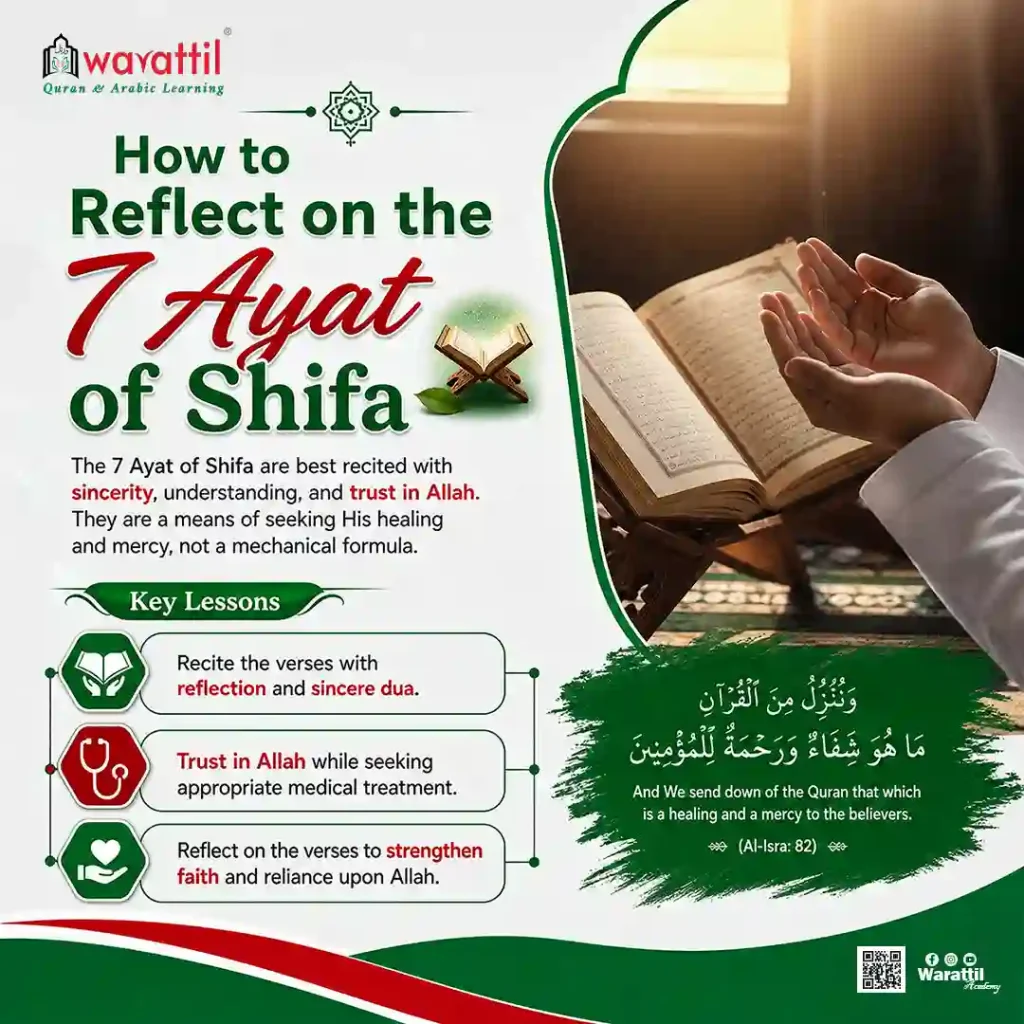
The 7 Ayat of Shifa in the Quran are commonly recited by Muslims seeking comfort, spiritual strength, and healing through the words of Allah. The Arabic word shifa (شفاء) means healing or cure, and the Quran uses the concept of healing in several important contexts. Some verses speak directly about healing the heart, while others refer to physical illness, honey as a source of healing, or the Quran itself as guidance and mercy.
It is important, however, to understand the term accurately. The Quran does not formally identify a specific collection under the title “7 Ayat of Shifa.” Traditionally, six Quranic verses are often grouped together because they contain words derived from shifa and directly mention healing. Some commonly circulated lists add Surah Al-Fatihah as the seventh selection because of its well-known connection with ruqyah and healing in the Islamic tradition.
Therefore, the expression 7 Ayat of Shifa in the Quran is best understood as a popular devotional collection rather than an officially named group of seven verses within the Quran itself.
The Arabic word shifa refers to healing, cure, or recovery. In the Quran, however, healing is broader than physical recovery alone. It can also refer to the healing of the heart from doubt, spiritual confusion, distress, and other inner struggles.
The Quran presents Allah as the ultimate source of healing. At the same time, Islam does not require believers to reject practical means of treatment. Seeking appropriate medical care and making dua are not contradictory. A Muslim can turn to Allah in prayer while also consulting qualified healthcare professionals and following suitable treatment.
This balanced understanding is essential when reading the Ayat of Shifa. These verses should inspire faith, hope, reflection, and reliance upon Allah without being used to make unsupported promises that reciting a particular verse will automatically cure every medical condition.
The following passages are widely associated with the theme of shifa. The first selection, Surah Al-Fatihah, is commonly included because of its traditional use in ruqyah, while the remaining six contain direct Quranic references to healing.
Arabic:
بِسْمِ اللَّهِ الرَّحْمَٰنِ الرَّحِيمِ
الْحَمْدُ لِلَّهِ رَبِّ الْعَالَمِينَ
الرَّحْمَٰنِ الرَّحِيمِ
مَالِكِ يَوْمِ الدِّينِ
إِيَّاكَ نَعْبُدُ وَإِيَّاكَ نَسْتَعِينُ
اهْدِنَا الصِّرَاطَ الْمُسْتَقِيمَ
صِرَاطَ الَّذِينَ أَنْعَمْتَ عَلَيْهِمْ غَيْرِ الْمَغْضُوبِ عَلَيْهِمْ وَلَا الضَّالِّينَ
Meaning:
Surah Al-Fatihah begins by praising Allah as the Lord of all worlds and the Most Merciful. It then expresses complete worship and dependence upon Him before asking for guidance to the straight path.
Surah Al-Fatihah does not contain the word shifa. Nevertheless, it holds a special place in discussions of Quranic healing because it has been used as a form of ruqyah in the Islamic tradition. Its message also captures some of the central foundations of a believer’s relationship with Allah: worship, dependence, mercy, and guidance.
When included among the 7 Ayat of Shifa in the Quran, Al-Fatihah should therefore be understood as an additional healing passage rather than one of the six verses that explicitly use the language of shifa.
Arabic:
قَاتِلُوهُمْ يُعَذِّبْهُمُ اللَّهُ بِأَيْدِيكُمْ وَيُخْزِهِمْ وَيَنْصُرْكُمْ عَلَيْهِمْ وَيَشْفِ صُدُورَ قَوْمٍ مُؤْمِنِينَ
Meaning:
In its original context, this verse addresses conflict and speaks of Allah bringing relief and healing to the hearts of the believers.
The phrase “wa yashfi sudura qawmin mu’mineen” refers to the healing or soothing of believing hearts. This demonstrates that the Quranic concept of healing is not limited to physical illness. Emotional pain and inner distress can also require comfort and restoration.
Context is especially important when reading this verse. It should not be separated from the historical passage in which it appears and presented as though the entire verse were simply a general medical prescription.
Arabic:
يَا أَيُّهَا النَّاسُ قَدْ جَاءَتْكُمْ مَوْعِظَةٌ مِنْ رَبِّكُمْ وَشِفَاءٌ لِمَا فِي الصُّدُورِ وَهُدًى وَرَحْمَةٌ لِلْمُؤْمِنِينَ
Meaning:
This verse describes what has come from Allah as instruction, healing for what is within the hearts, guidance, and mercy for believers.
Among the Ayat of Shifa, this is one of the clearest references to spiritual and inward healing. The expression “what is within the hearts” points towards the inner condition of a person.
The Quran guides people towards truth while addressing spiritual problems such as doubt and confusion. For believers, its teachings can provide direction and a stronger connection with Allah.
This verse also connects four powerful ideas: instruction, healing, guidance, and mercy. Healing in the Quran is therefore closely connected with understanding and living according to divine guidance.
Arabic:
ثُمَّ كُلِي مِنْ كُلِّ الثَّمَرَاتِ فَاسْلُكِي سُبُلَ رَبِّكِ ذُلُلًا يَخْرُجُ مِنْ بُطُونِهَا شَرَابٌ مُخْتَلِفٌ أَلْوَانُهُ فِيهِ شِفَاءٌ لِلنَّاسِ إِنَّ فِي ذَٰلِكَ لَآيَةً لِقَوْمٍ يَتَفَكَّرُونَ
Meaning:
The verse describes how bees produce a drink of different colours in which there is healing for people. It concludes by calling this a sign for those who reflect.
This Ayah of Shifa is different from several others because the immediate subject is honey. The verse draws attention to the remarkable creation of bees and the beneficial substance they produce.
However, the verse should not be interpreted as a guarantee that honey alone can cure every disease. Its medical usefulness depends on the condition and circumstances. The central Quranic message also encourages reflection upon Allah’s signs in creation.
Arabic:
وَنُنَزِّلُ مِنَ الْقُرْآنِ مَا هُوَ شِفَاءٌ وَرَحْمَةٌ لِلْمُؤْمِنِينَ وَلَا يَزِيدُ الظَّالِمِينَ إِلَّا خَسَارًا
Meaning:
This verse describes what Allah sends down from the Quran as healing and mercy for believers, while those who persist in wrongdoing only increase in loss.
This is one of the most frequently referenced Quranic verses about healing. It establishes a direct relationship between the Quran, shifa, and mercy.
The Quran brings spiritual guidance that can transform a person’s beliefs, character, priorities, and relationship with Allah. Its healing influence should therefore not be reduced to simply repeating words without understanding. Recitation is deeply important, but reflection and sincere engagement with the Quranic message are also central to experiencing its guidance.
Arabic:
وَإِذَا مَرِضْتُ فَهُوَ يَشْفِينِ
Meaning:
“And when I am ill, it is He who heals me.”
This short but powerful statement comes from Prophet Ibrahim’s words about Allah. It expresses one of the fundamental Islamic beliefs concerning healing: ultimate recovery comes by Allah’s will.
At the same time, trusting Allah does not mean abandoning available treatment. Medicine, healthcare professionals, healthy practices, and other permissible treatments can all be understood as means through which recovery may occur.
For someone facing illness, this verse can serve as a meaningful reminder of reliance upon Allah while pursuing responsible care.
Arabic:
وَلَوْ جَعَلْنَاهُ قُرْآنًا أَعْجَمِيًّا لَقَالُوا لَوْلَا فُصِّلَتْ آيَاتُهُ أَأَعْجَمِيٌّ وَعَرَبِيٌّ قُلْ هُوَ لِلَّذِينَ آمَنُوا هُدًى وَشِفَاءٌ وَالَّذِينَ لَا يُؤْمِنُونَ فِي آذَانِهِمْ وَقْرٌ وَهُوَ عَلَيْهِمْ عَمًى أُولَٰئِكَ يُنَادَوْنَ مِنْ مَكَانٍ بَعِيدٍ
Meaning:
The verse explains that, for those who believe, the Quran is guidance and healing. It also contrasts their response with that of people who refuse to believe and remain unreceptive to its message.
The connection between guidance and healing is particularly significant. The Quran does not merely provide emotional reassurance; it teaches principles that shape belief, worship, morality, patience, gratitude, and everyday conduct.
For this reason, Quranic healing involves more than recitation alone. Listening attentively, understanding the message, reflecting upon it, and trying to live according to its guidance are all important parts of developing a meaningful relationship with the Quran.
These verses are associated with healing because they contain direct references to shifa or closely related forms of the Arabic root connected with healing. They address several dimensions of the concept.
Surah At-Tawbah speaks about the soothing or healing of believers’ hearts. Surah Yunus presents divine guidance as healing for what lies within the heart. Surah An-Nahl mentions healing in connection with honey. Surah Al-Isra describes the Quran as healing and mercy. Surah Ash-Shu’ara declares that Allah is the One who ultimately heals the sick. Surah Fussilat describes the Quran as guidance and healing for believers.
Surah Al-Fatihah is commonly added as a seventh selection because of its established importance in ruqyah. This explains why readers may encounter both the terms six Ayat of Shifa and 7 Ayat of Shifa in the Quran in different sources.
Spiritual Healing and Physical Healing in the Quran
Understanding the distinction between spiritual and physical healing helps readers avoid exaggerating the meaning of these verses.
Several Ayat of Shifa clearly focus on the heart, faith, guidance, and spiritual wellbeing. Surah Yunus 10:57, for example, specifically describes healing for what is within the hearts. Other verses, such as Surah An-Nahl 16:69, discuss a substance with healing benefits, while Surah Ash-Shu’ara 26:80 refers more broadly to Allah as the ultimate healer during illness.
Therefore, it would be inaccurate to claim that every Ayat of Shifa specifically promises a physical cure for every disease. The Quran’s discussion of shifa is richer and broader, covering spiritual restoration, guidance, mercy, inner comfort, and healing by Allah’s will.
A Muslim may recite Quranic verses as part of personal worship, dua, remembrance of Allah, and permissible ruqyah. However, the purpose should not be reduced to treating the verses as a mechanical formula.
Reading with understanding can make the experience more meaningful. A person can study the translation, consider the context of each verse, and reflect on what it teaches about Allah, faith, patience, guidance, and reliance upon Him.
When someone is physically unwell, Quran recitation and dua may accompany appropriate medical care. Serious or persistent health concerns should be assessed by qualified healthcare professionals rather than relying solely on self-treatment.
The 7 Ayat of Shifa in the Quran offer several important lessons about the Islamic understanding of healing. First, they remind believers that Allah is ultimately the source of healing. Second, they show that human beings need more than physical wellbeing; hearts also need guidance, mercy, and spiritual restoration.
These verses further encourage believers to recognise Allah’s signs in revelation and creation. The reference to honey demonstrates the benefits found within the natural world, while the verses concerning the Quran emphasise the transformative power of divine guidance.
Above all, the Ayat of Shifa encourage a balanced relationship between faith and responsible action. A believer may pray for recovery, recite the Quran, seek beneficial treatment, and place trust in Allah regarding the outcome.
The 7 Ayat of Shifa in the Quran bring together profound Quranic teachings about healing, guidance, mercy, and reliance upon Allah. Although the Quran does not officially designate a collection of exactly seven verses by this name, the passages commonly associated with Ayat of Shifa provide valuable opportunities for recitation and reflection.
Together, they show that the Quranic understanding of healing extends beyond the body. Hearts require guidance, people need mercy, and those experiencing illness naturally seek hope and recovery. At the centre of these teachings is the recognition that Allah is the ultimate source of healing.
By reading these verses in their proper context, reflecting on their meanings, making sincere dua, and taking responsible practical steps when facing illness, Muslims can approach the subject of shifa with both faith and understanding.
The term commonly refers to a devotional collection associated with healing. Six frequently cited verses are At-Tawbah 9:14, Yunus 10:57, An-Nahl 16:69, Al-Isra 17:82, Ash-Shu’ara 26:80, and Fussilat 41:44. Some lists include Surah Al-Fatihah as a seventh selection because of its traditional association with ruqyah.
No. The Quran does not contain a passage that formally labels a fixed group as the “seven Ayat of Shifa.” The name is commonly used for verses gathered together around the Quranic theme of healing.
Surah Ash-Shu’ara 26:80 contains Prophet Ibrahim’s declaration that when he becomes ill, Allah is the One who heals him. The verse expresses reliance upon Allah as the ultimate source of recovery.
Several verses connect the Quran or divine revelation with healing. Surah Al-Isra 17:82 describes what is revealed from the Quran as healing and mercy for believers, while Surah Fussilat 41:44 describes it as guidance and healing for those who believe.
Yes. Surah An-Nahl 16:69 describes the substance produced by bees and states that there is healing in it for people. The verse also presents this as a sign for people who reflect.
Quranic recitation and dua can be important parts of a Muslim’s spiritual life, but they should not be presented as substitutes for necessary professional medical care. A person can seek treatment while simultaneously praying to Allah and placing trust in Him.

My son feels happy, amazing teachers and staff in wrattil and flexible prices MashaAllah Thank you so much
My daughter started learning in warattil academy and alhamdulilah we are really impressed and have enjoyed learning with wrattil. May Allah reward her sheikh
My teacher Ahmed is very good. He helped me recite and memorize holy Quran
Warattil is the most efficient way of learning Arabic. I like warattil curriculum and excellent teachers to support this learning Thank you so much
I highly recommend warattil Ijazah programs to anyone who wants to learn Quran properly.
Very well organized MashaAllah. I love it and this is a great course if you want to understand the Quran and learn tafsir
Warattil program is the best I have seen. The teacher is really great and is available to answer questions in a clear manner
I think warattil is the best academy in learning Arabic and I recommend Arabic course to anyone
We are so happy with ustad Hussein. He is very patient and comfortable teacher. May Allah the teachers and admin in warattil
Rating 10 mashaAllah and so grateful