Shopping cart
- +1 564-544-6614
- [email protected]
- 24/7 Available



Have you ever wondered why Muslims say “MashaAllah” when they admire something beautiful? It is directly connected to one of the most well-known yet often misunderstood concepts in Islamic belief what is Nazar in Islam. Also known as the evil eye or Al-‘Ayn in Arabic, Nazar refers to the real and spiritually recognized harm that can occur when someone gazes at another person, their possession, or even themselves with feelings of envy, jealousy, or excessive admiration.
Nazar in Islam is not a myth, a superstition, or a cultural invention. It is a concept firmly rooted in the Quran and the authentic Sunnah of the Prophet Muhammad ﷺ. Islamic scholars across centuries have unanimously confirmed its reality. Understanding Nazar from an Islamic perspective is important for every Muslim not to become fearful or obsessive about it, but to seek the right protection that Allah has prescribed.
In this comprehensive guide, we will cover everything you need to know about Nazar in Islam: its meaning, Quranic and Hadith evidence, common signs, who is most vulnerable, how to protect yourself and your family, and the authentic Islamic remedies.
The word Nazar (نَظَر) in Arabic literally means “to look” or “a gaze.” In Islamic context, Nazar refers to the harmful effect that results from an envious, jealous, or intensely admiring gaze directed at a person, animal, object, or even oneself. This negative energy, transmitted through the eyes, is believed to cause misfortune, illness, loss, or distress to the person or thing being gazed upon.
Nazar is also referred to as:
Islam acknowledges Nazar as a real spiritual phenomenon not a product of imagination. It operates by the will and decree of Allah (subhanahu wa ta’ala), meaning that while the gaze of an envious person can be a cause of harm, true harm and protection ultimately come from Allah alone.
One of the clearest Quranic references to Nazar in Islam comes from Surah Al-Falaq (Chapter 113), where Allah commands the believers:
“Say: I seek refuge with the Lord of the daybreak… and from the evil of an envier when he envies.” — (Quran 113:1–5)
The last verse of Surah Al-Falaq directly acknowledges the harm of envy and the evil eye, and Allah instructs believers to seek His protection from it.
Another powerful indirect reference is found in Surah Yusuf (Chapter 12), where Prophet Ya’qub (peace be upon him) advised his sons before they entered Egypt:
“O my sons, do not enter from one gate but enter from different gates.” — (Quran 12:67)
Islamic scholars such as Imam Qurtubi, Imam Razi, and Imam Nasafi have explained that Prophet Ya’qub gave this advice because his sons were all handsome, strong, and visibly blessed. He feared that the people of Egypt would look at them with envy, potentially causing them harm through Nazar. This incident in the Quran confirms that taking precautions against the evil eye is an acceptable and even wise practice.
The Sunnah of Prophet Muhammad ﷺ provides even more direct and explicit confirmation of Nazar’s reality. Several authentic Hadiths address this topic clearly:
All major Islamic scholars from the Ahl al-Sunnah wal-Jama’ah are unanimous that the evil eye (Nazar) is a confirmed and established reality in Islam.
Nazar works through a force that originates from the eyes of an envious or even an admiring person. This force, by Allah’s permission, can affect the recipient negatively. Importantly:
The great scholar Ibn al-Qayyim (rahimahullah) described Nazar beautifully: “The evil eye is an arrow, shot by the one who is jealous, hitting the victim sometimes and missing sometimes. If the victim is unprotected, the arrow will hit. But if the victim is protected by the remembrance of Allah (adhkar), the arrow may be turned back to the one who shot it.”
Islam does not encourage jumping to conclusions or blaming every misfortune on Nazar. However, Islamic scholars have described some common signs that may suggest a person has been affected. These signs should be considered alongside consulting a doctor, since many symptoms have natural medical explanations.
Possible signs of Nazar include:
It is important to note: Islam does not encourage attributing every problem to Nazar. The balanced Islamic approach is to seek medical treatment first, and if no cause is found, to consider spiritual remedies alongside continued medical care.
According to Islamic teachings and scholarly opinions, some people and things are more susceptible to Nazar:
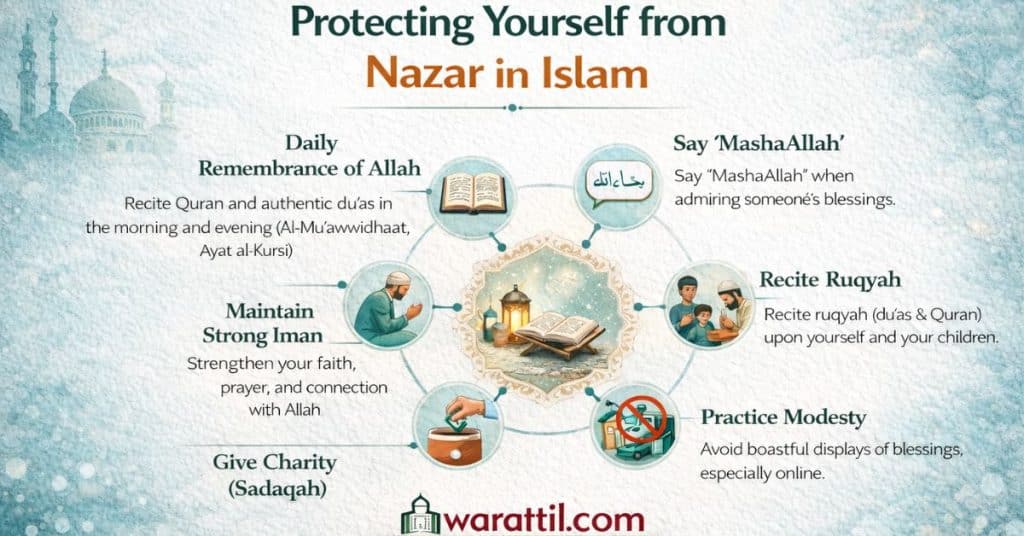
Allah in His infinite mercy has not left believers without protection. The Quran and Sunnah provide clear, authentic, and powerful means of protection from Nazar in Islam.
The Prophet ﷺ prescribed specific morning and evening supplications (adhkar) that serve as a daily spiritual shield. Among the most powerful are:
When you see something you like, a child, a person, a home, wealth, a skill always say “MashaAllah” or “Barakallahu feek/feeki.” This acknowledges Allah’s role in the blessing and removes the harmful potential of the admiring gaze.
Ruqyah is the practice of reciting specific Quranic verses and prophetic duas for healing and protection. Parents should regularly recite protective prayers and blow gently on their children, especially young ones who cannot yet recite themselves.
The Prophet ﷺ used to recite: “A’udhu bikalimatillahi at-tammati min kulli shaytanin wa hammatin wa min kulli ‘aynin lammah” — “I seek refuge in the perfect words of Allah from every devil, every harmful creature, and every evil eye.” (Sahih Bukhari)
One of the best preventive measures against Nazar is modesty in displaying one’s blessings. This does not mean hiding your blessings entirely, but avoiding boastful displays of wealth, beauty, achievements, or children especially on public platforms like social media.
A heart connected to Allah, practicing regular prayer (salah), seeking forgiveness (istighfar), and maintaining a consistent relationship with the Quran, is surrounded by spiritual protection. Faith itself is a fortress.
Regular acts of charity are highly recommended in Islam as a means of warding off harm and purifying one’s blessings.
If you believe you or someone close to you has been affected by Nazar, Islam provides specific, authentic remedies:
Islam teaches moderation in all things, and this applies to Nazar as well. There are two extremes that Muslims must avoid:
Rejecting Nazar Entirely: Dismissing the evil eye as pure superstition is incorrect, as it contradicts clear Quranic verses and authentic Hadith.
Blaming Everything on Nazar: Attributing every sickness, failure, or misfortune to the evil eye without evidence is also incorrect. Not every problem is caused by Nazar. Islam encourages using reason, medicine, and rational thinking alongside spiritual practices.
The correct Islamic stance is to acknowledge Nazar as real, take prescribed spiritual precautions, seek medical help when needed, and place full trust (tawakkul) in Allah knowing that nothing can harm or benefit without His permission.
Many cultures use blue glass beads, Hamsa hands, and other talismans as protection against the evil eye. From a strict Islamic theological perspective, relying on such objects for protection is not permitted in Islam. Islamic scholars warn that attributing protective power to physical objects rather than to Allah can border on shirk (associating partners with Allah), which is among the gravest sins in Islam.
The blue nazar bead and the Hamsa are cultural traditions, not Islamic ones. While some may use them merely as decorative items, believers should ensure that their heart’s reliance is placed solely on Allah and the Quranic and Prophetic means He has prescribed.
In today’s digital age, the risk of Nazar has increased significantly. Social media exposes our blessings, our children, homes, vehicles, health, and achievements to thousands or even millions of eyes, many of which may carry envy. The Prophet ﷺ advised modesty and protection of blessings long before social media existed, and these teachings are especially relevant today.
Practical steps for Muslims in the digital age:
Understanding Nazar in Islam is an essential part of a Muslim’s spiritual awareness. It is a reminder that we live in a world where both seen and unseen forces exist, all operating under the will and power of Allah. By learning about Nazar, taking authentic Islamic precautions, and placing our complete trust in Allah, we can protect ourselves, our families, and our blessings while remaining grounded in a balanced, faith-centered perspective.
May Allah protect us all from the evil eye, from envy, and from all unseen harms. Ameen.

My son feels happy, amazing teachers and staff in wrattil and flexible prices MashaAllah Thank you so much
My daughter started learning in warattil academy and alhamdulilah we are really impressed and have enjoyed learning with wrattil. May Allah reward her sheikh
My teacher Ahmed is very good. He helped me recite and memorize holy Quran
Warattil is the most efficient way of learning Arabic. I like warattil curriculum and excellent teachers to support this learning Thank you so much
I highly recommend warattil Ijazah programs to anyone who wants to learn Quran properly.
Very well organized MashaAllah. I love it and this is a great course if you want to understand the Quran and learn tafsir
Warattil program is the best I have seen. The teacher is really great and is available to answer questions in a clear manner
I think warattil is the best academy in learning Arabic and I recommend Arabic course to anyone
We are so happy with ustad Hussein. He is very patient and comfortable teacher. May Allah the teachers and admin in warattil
Rating 10 mashaAllah and so grateful