Shopping cart
- +1 564-544-6614
- [email protected]
- 24/7 Available


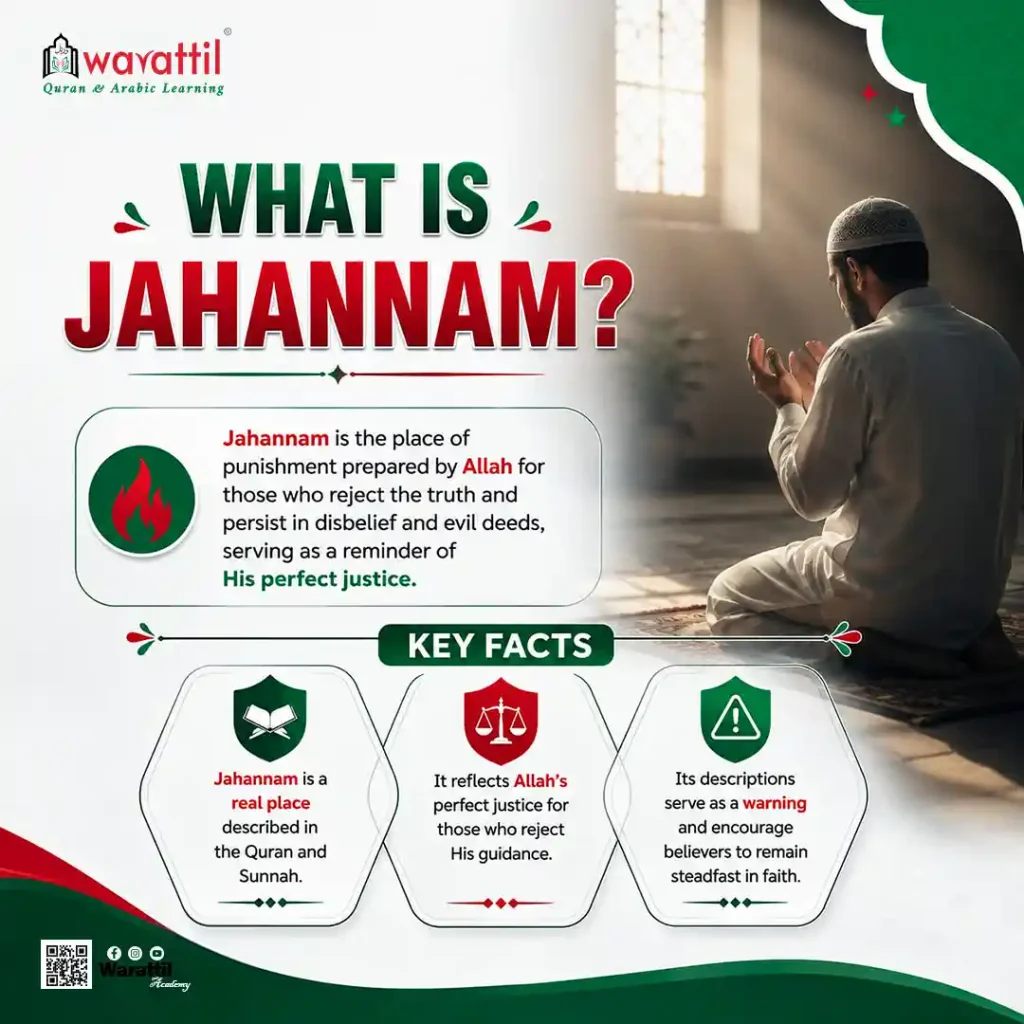
For believers, the concept of the afterlife is central to faith. While the promise of Paradise inspires hope and devotion, the reality of Hell serves as a powerful reminder of divine justice. But what is Jahannam exactly? In Islamic theology, it is not merely a metaphor or a state of mind; it is a real, terrifying place of punishment prepared for those who reject the truth and commit evil deeds. The Quran and the teachings of the Prophet Muhammad (peace be upon him) provide vivid and detailed descriptions of this abode, underscoring its significance as a warning to humanity.
The Quran uses multiple names for Hell, each highlighting a different aspect of its nature and torment. Understanding these names provides a deeper insight into what is Jahannam.
These are not separate places but different names for the same reality, each revealing a unique characteristic of its punishment.
The Quran informs us that Jahannam has seven gates, each assigned to a specific category of sinners. As Allah states: “And verily, Hell is the promised abode for them all. It has seven gates: to each of those gates is a specific class of sinners assigned” (Quran 15:43-44).
Some scholars interpret these gates as corresponding to different levels of Hell. These levels, arranged from the least severe to the most severe, are named: Jahannam, Laza, Hutamah, Sa’ir, Saqar, Jahim, and Hawiyah. This hierarchy indicates that the severity of punishment will be commensurate with the gravity of one’s sins.
The descriptions of Jahannam in Islamic sources are profound and serve as a stark warning. It is a place of unrelenting pain and sorrow, where its inhabitants will never experience even a moment of peace. The fire itself is unlike any fire in this world. It was fanned for a thousand years until it became red, then white, and finally black, making it a fire of unimaginable intensity. Its depth is so immense that if a giant rock were dropped from its edge, it would take seventy years to reach the bottom.
The torment extends to what the denizens of Hell consume. Their food is not nourishing but only increases their suffering. They will eat from the Zaqqum, a horrifying tree that emerges from the depths of Hell. Their drink will consist of the discharges of dirty wounds, blood, and pus. This is a punishment that provides no relief or sustenance.
A crucial aspect of understanding what is Jahannam is its eternal nature for those who reject faith. The majority of Islamic scholars maintain that Hell is eternal and its torment everlasting for the disbelievers. Numerous verses in the Quran affirm this, stating that they will “dwell therein forever” (Quran 4:168-169) and will “never leave of the Fire” (Quran 2:167).
Ultimately, Jahannam is not a place of arbitrary cruelty. Its existence is a testament to Allah’s perfect justice and sovereignty. It stands as a definitive warning to all of humanity, emphasising the critical choice between faith and disbelief, righteousness and iniquity. For the believer, it is a reminder to remain steadfast in worship and to seek Allah’s mercy and protection from this terrible fate.

My son feels happy, amazing teachers and staff in wrattil and flexible prices MashaAllah Thank you so much
My daughter started learning in warattil academy and alhamdulilah we are really impressed and have enjoyed learning with wrattil. May Allah reward her sheikh
My teacher Ahmed is very good. He helped me recite and memorize holy Quran
Warattil is the most efficient way of learning Arabic. I like warattil curriculum and excellent teachers to support this learning Thank you so much
I highly recommend warattil Ijazah programs to anyone who wants to learn Quran properly.
Very well organized MashaAllah. I love it and this is a great course if you want to understand the Quran and learn tafsir
Warattil program is the best I have seen. The teacher is really great and is available to answer questions in a clear manner
I think warattil is the best academy in learning Arabic and I recommend Arabic course to anyone
We are so happy with ustad Hussein. He is very patient and comfortable teacher. May Allah the teachers and admin in warattil
Rating 10 mashaAllah and so grateful