Shopping cart
- +1 564-544-6614
- [email protected]
- 24/7 Available


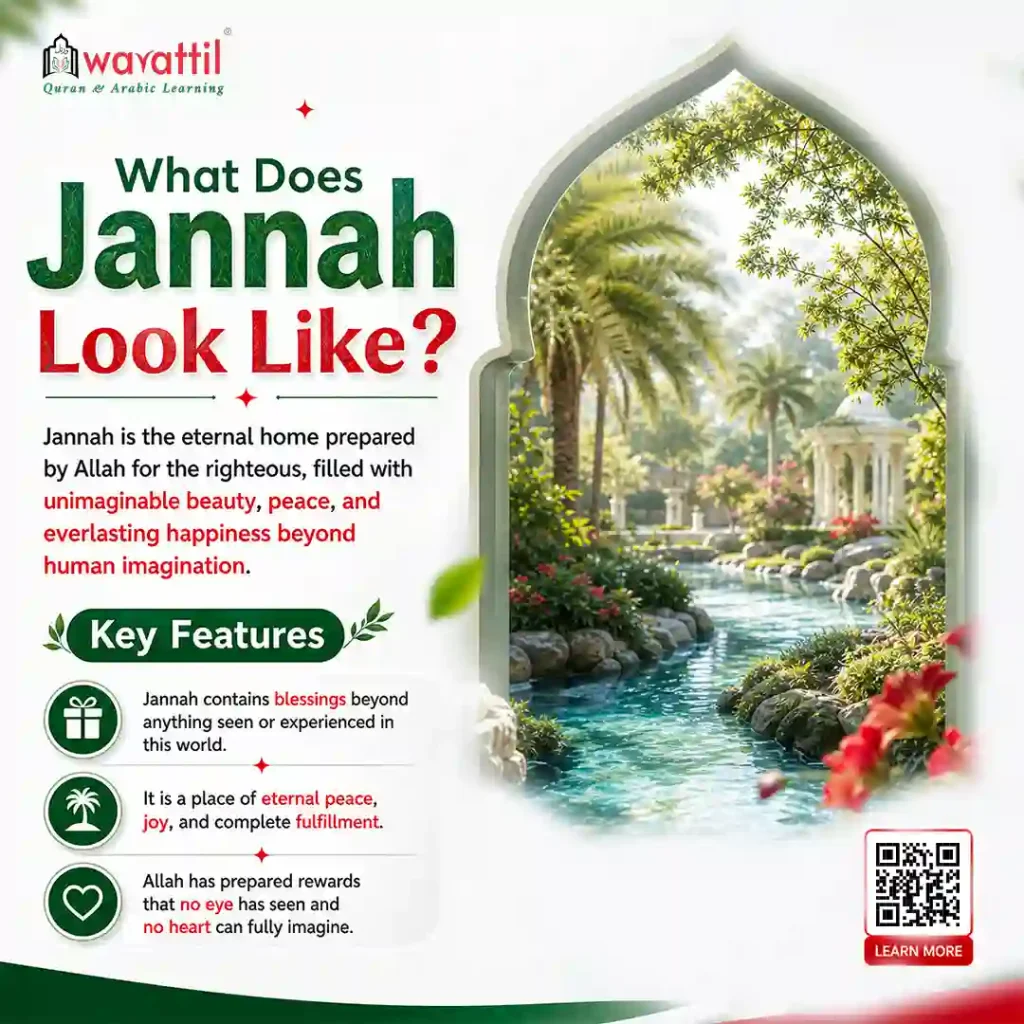
For centuries, believers have pondered the same profound question: what does Jannah look like? The answer, woven through the sacred texts of the Quran and the teachings of Prophet Muhammad (peace be upon him), paints a picture of unparalleled beauty and eternal bliss. Jannah, often translated as Paradise or the Garden, is not merely a place but a state of ultimate fulfilment—a reward prepared for those who live righteously. Its description, however, transcends the limitations of human imagination, for it contains what “no eye has seen, no ear has heard, and no human heart has ever perceived”.
To truly grasp the majesty of Jannah, one must look beyond the material wonders of this world. It is a realm where the very fabric of existence is elevated to a level of perfection that our earthly senses cannot fully comprehend. Let us explore the vivid, authentic descriptions provided by Islamic scholarship to understand the eternal home that awaits the faithful.
When considering what does Jannah look like, the very ground beneath one’s feet offers a striking contrast to the dust and soil of our world. According to authentic traditions, the ground of Paradise will be composed of saffron, and the sand will be made of precious pebbles and rubies. This is not a barren landscape but a terrain that exudes the most exquisite fragrances.
The renowned scholar Ibn al-Qayyim further elaborated, stating that the soil of Jannah is made of musk and saffron. Imagine walking on a ground that is not only visually stunning, with the shimmer of rubies, but also fills the air with a perfume more enchanting than any scent known to humanity. This foundational element sets the stage for a paradise that appeals to all the senses in ways we can only begin to imagine.
The architecture of Jannah is as magnificent as its landscape. The palaces and dwellings are constructed from bricks of gold and silver, with the cement between them being made of strong, fragrant musk. The sheer scale of these structures is beyond comprehension; the thickness of the carpets within these palaces is said to be equivalent to a journey of 500 years.
Furthermore, the buildings are adorned with jewels and pearls. The dwellings are not just places to reside but are grand, sprawling estates. It is narrated that even the lowest-ranking person in Jannah will have a kingdom, palaces, and gardens that would take a thousand years to traverse. This emphasises that the reward is not a one-size-fits-all abode but a vast, personal paradise tailored to the believer’s rank and deeds.
A recurring theme in the Quranic description of Jannah is that of “Gardens beneath which rivers flow”. This imagery is central to understanding what does Jannah look like. It is a place of dense, luxuriant foliage with perpetual shade, where the trees are abundant and their shade never fades.
The rivers of Jannah are especially remarkable. They are not ordinary streams but four distinct rivers, as mentioned in the Quran: rivers of clear water that never putrefy, rivers of milk whose taste never changes, rivers of pure honey, and rivers of wine that is delicious and does not intoxicate. These rivers flow from the roots of the Sidrat al-Muntaha (the Lote Tree of the Utmost Boundary). They are sources of purification, drink, and recreation, beautified by pearls and musk.
The inhabitants of Jannah will be as perfect as their surroundings. Those who enter Paradise will do so in a state of physical perfection. They will be beardless, with fair complexions and curly hair, their eyes lined with kohl, and they will be of the age of thirty-three years. They will be in the form of their father, Adam (peace be upon him), with a height of sixty cubits (approximately 90 feet) and a width of seven cubits.
Moreover, there will be no negative emotions such as anger, pride, or jealousy within Jannah. The dwellers will experience pure joy and peace. Upon eating and drinking, there will be no need to relieve oneself; instead, digestion will be facilitated through perspiration and a gentle passing of wind. This paints a picture of a life free from the physical and emotional burdens we face in this world.
While the physical descriptions of Jannah are awe-inspiring, the greatest reward for its inhabitants is far more profound. The ultimate bliss is not the rivers of honey or the palaces of gold, but the eternal pleasure and satisfaction of Allah (Ridwan). The Quran states that the “Ridhwaan of Allah Ta’ala is the greatest”. This divine pleasure surpasses all other joys, making it the true treasure of Paradise.
To witness the Face of Allah and to hear His announcement of eternal pleasure is the pinnacle of what awaits the believers. This spiritual elevation is the final and most beautiful answer to the question, what does Jannah look like? It is a place where the soul finds its ultimate purpose and rest in the presence of its Creator.
In conclusion, Jannah is a realm of unimaginable splendour, from its saffron ground and golden palaces to its eternal gardens and pure rivers. Yet, its true essence lies in the perfect peace and divine pleasure that await the righteous. It is a promise of a life where every desire is fulfilled, and the soul finds its eternal home.

My son feels happy, amazing teachers and staff in wrattil and flexible prices MashaAllah Thank you so much
My daughter started learning in warattil academy and alhamdulilah we are really impressed and have enjoyed learning with wrattil. May Allah reward her sheikh
My teacher Ahmed is very good. He helped me recite and memorize holy Quran
Warattil is the most efficient way of learning Arabic. I like warattil curriculum and excellent teachers to support this learning Thank you so much
I highly recommend warattil Ijazah programs to anyone who wants to learn Quran properly.
Very well organized MashaAllah. I love it and this is a great course if you want to understand the Quran and learn tafsir
Warattil program is the best I have seen. The teacher is really great and is available to answer questions in a clear manner
I think warattil is the best academy in learning Arabic and I recommend Arabic course to anyone
We are so happy with ustad Hussein. He is very patient and comfortable teacher. May Allah the teachers and admin in warattil
Rating 10 mashaAllah and so grateful