Shopping cart
- +1 564-544-6614
- [email protected]
- 24/7 Available


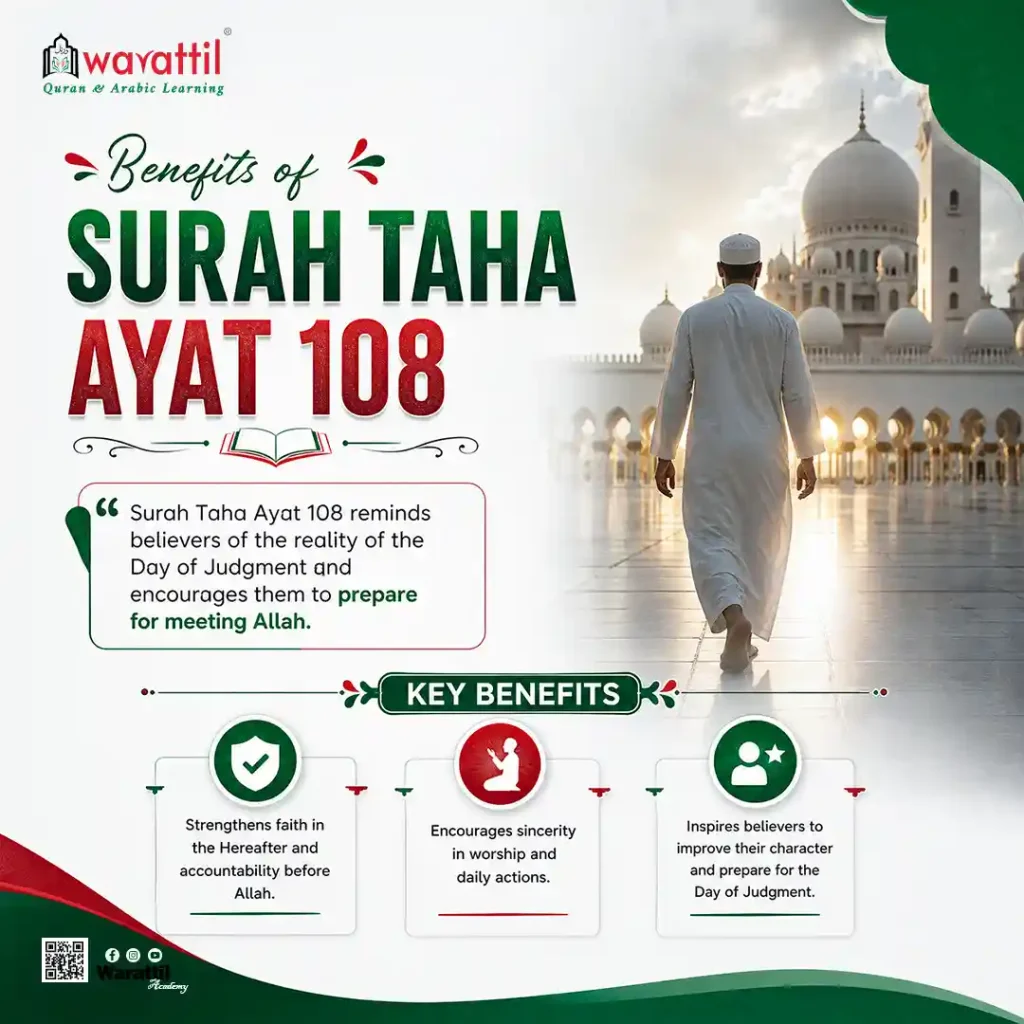
There are verses in the Quran that paint scenes of such overwhelming magnitude they recalibrate the human perspective on life. The 108th verse of Surah Taha is one such revelation. It delivers a snapshot of the Day of Judgement so vivid that the reader can almost hear the silence it describes. The central surah taha ayat 108 benefits revolve around a profound realignment of fear and hope. It instructs the soul on the nature of absolute submission, not through complex theology, but through the imagery of a cosmos holding its breath.
Engaging with this specific verse allows the believer to extract a unique spiritual confidence. It dismantles the illusion of noisy, chaotic independence and replaces it with the serenity of divine order. We find within this text a direct link to the intercessory role of the Prophet Muhammad (peace be upon him) and a stark warning that transforms how we view our daily words. The benefit is not just in recitation but in absorbing the terrifying calm of a universe where every false authority collapses.

Surah Taha Ayat 108 states that on the Day of Resurrection, people will follow the caller without any ability to turn away, and their voices will be lowered in humility before Allah. The verse paints a vivid picture of humanity standing before its Creator, fully aware of His power and justice.
This verse forms part of a broader passage describing the events of the Last Day. It reminds believers that every individual will ultimately return to Allah and be held accountable for their actions.
Because of its powerful message, many Muslims reflect upon this verse to strengthen their awareness of the Hereafter and their relationship with Allah.
One of the most important surah taha ayat 108 benefits is its ability to reinforce belief in the Day of Judgment.
The Quran repeatedly emphasizes that life in this world is temporary and that every person will stand before Allah. This verse presents that reality in a direct and memorable way.
When believers reflect on this message, they are encouraged to:
Faith becomes stronger when a person remembers that every action has consequences and that Allah’s judgment is perfect and just.

Modern life often distracts people from deeper spiritual reflection. Surah Taha Ayat 108 encourages believers to think beyond temporary concerns and focus on eternal realities.
The image of humanity gathered before Allah creates a sense of awareness that can inspire positive change. A believer who regularly reflects on this verse may become more conscious of their actions, words, and intentions.
This heightened awareness helps cultivate sincerity and a stronger commitment to Islamic values.
A central lesson within this verse is Allah’s complete authority over creation.
On the Day of Judgment, no person will possess independent power or influence. Every individual will respond to Allah’s command and stand before Him in humility.
This reminder encourages Muslims to place their trust in Allah rather than relying solely on worldly status, wealth, or achievements. It teaches that true success comes through obedience to Allah and preparation for the life to come.
Accountability is one of the key themes of the Quran, and this verse highlights that principle clearly.
Knowing that every person will return to Allah encourages self-reflection and personal responsibility. Believers are reminded to evaluate their actions regularly and seek forgiveness for their mistakes.
This understanding can lead to:
A person who remembers the Hereafter is more likely to make ethical and responsible choices.
Acts of worship become more meaningful when they are performed with awareness of Allah’s presence.
The verse motivates believers to seek Allah’s forgiveness and strive for continuous improvement.
To grasp the depth of the verse, we must first visualize the landscape it sketches. Allah says: “On that Day, they will follow the Caller without any deviation, and voices will be hushed before the Most Merciful, so you will hear nothing but a whisper.” The syntax itself signals a break from the mortal experience of sound. The psychological weight of this scene is immense. In our current world, arrogance is often expressed by raising the voice; on that day, even the tyrants will be identifiable only by a subdued shuffle.
This is one of the foundational surah taha ayat 108 benefits—it serves as a deterrent against the ego. When you internalise that all voices will be brought low before Ar-Rahman, the desire to shout over others in worldly disputes begins to feel absurdly short-sighted. The verse describes a universal cessation of noise. Scholars of exegesis note that the phrase “hushed” here implies a forced silence born of awe, not a voluntary quietness. It demonstrates that the magnificence of the Throne strips creation of its pretension. The benefit for the modern reader is a restored sense of reverence, a trait often corroded by the cynicism of daily life.
A significant layer of meaning attached to this verse is the identity of “the Caller.” Many commentators point to the belief that the Caller is the Prophet Muhammad (peace be upon him), stationed at the praiseworthy rank (Al-Maqam Al-Mahmud). He will summon humanity towards the plain of judgement. However, the verse also leaves room for the meaning that the Caller is the angel Israfil, blowing the horn. In either interpretation, the infallible obedience described is a benefit for those who answer the call of the Prophet in this life.
Connecting with the specific surah taha ayat 108 benefits means anchoring your hope in the intercession of the Messenger. When a believer recites and reflects upon this, the relationship with the Prophet deepens beyond historical respect into a vital, eschatological necessity. You are reading about the moment your guide will lead you. The “benefit” manifests as a calming certainty: the chaos of judgement will not be navigated alone. Furthermore, the “whisper” (hams) that remains is interpreted as the sound of footsteps or the murmur of permissible intercession. This teaches that even on a day of absolute justice, mercy whispers quietly, a truth that should inspire a believer to never despair of divine compassion.
While the setting is the Hereafter, the practical output of this verse is firmly rooted in the present. Reciting Surah Taha ayat 108 with contemplation conditions the heart to detach from noise. We live in an era of constant digital clamour, where silence is a luxury. This text prescribes a mental state where silence is not empty but filled with divine presence. By regularly revisiting the scene, you programme your subconscious to seek the quiet word over the chaotic argument.
Another tangible aspect of the surah taha ayat 108 benefits is the removal of the fear of people. If you truly believe that all voices will be humbled before the Creator, the criticism of fallible humans loses its crippling power. This verse builds internal resilience. It places the oppressor and the oppressed on a level field of dust, both silent before a higher power. When you hold this image in your head during times of stress—visualising the plains of resurrection where no voice dares to rise in defiance—your current conflicts shrink to their true size. The verse acts as a daily reality check, ensuring that your fear of the Most Merciful overshadows your fear of creation.

My son feels happy, amazing teachers and staff in wrattil and flexible prices MashaAllah Thank you so much
My daughter started learning in warattil academy and alhamdulilah we are really impressed and have enjoyed learning with wrattil. May Allah reward her sheikh
My teacher Ahmed is very good. He helped me recite and memorize holy Quran
Warattil is the most efficient way of learning Arabic. I like warattil curriculum and excellent teachers to support this learning Thank you so much
I highly recommend warattil Ijazah programs to anyone who wants to learn Quran properly.
Very well organized MashaAllah. I love it and this is a great course if you want to understand the Quran and learn tafsir
Warattil program is the best I have seen. The teacher is really great and is available to answer questions in a clear manner
I think warattil is the best academy in learning Arabic and I recommend Arabic course to anyone
We are so happy with ustad Hussein. He is very patient and comfortable teacher. May Allah the teachers and admin in warattil
Rating 10 mashaAllah and so grateful