Shopping cart
- +1 564-544-6614
- [email protected]
- 24/7 Available


Sickness, whether of the body or the soul, is an undeniable part of the human experience. It visits every home, touches every life, and reminds us of our complete dependence on the One who never falls ill. In these moments of vulnerability, believers are not left without a lifeline. The Prophet Muhammad ﷺ taught his followers specific, powerful words to seek healing directly from Allah Almighty. This article sets out the most powerful dua for shifa as recorded in the authentic hadith literature, complete with the Arabic text, transliteration, and clear guidance on how to incorporate these supplications into your life.
Before turning to the words of supplication, it is worth reflecting on how Islam frames the entire experience of illness. Sickness is never understood as a random misfortune or a sign of divine displeasure. Rather, the Qur’an and the Sunnah teach that it serves as a means of purification. The Prophet ﷺ said, “No fatigue, nor disease, nor sorrow, nor sadness, nor hurt, nor distress befalls a Muslim, even if it were the prick he receives from a thorn, but that Allah expiates some of his sins for that” (Sahih al-Bukhari 5641). This profound statement reframes illness entirely: what feels like a burden is, in reality, a means by which sins are forgiven and spiritual ranks are elevated.
At the same time, Islam does not instruct believers to passively accept suffering without seeking relief. The Prophet ﷺ actively sought treatment and encouraged his companions to do the same, famously stating, “There is no disease that Allah has created, except that He also has created its remedy” (Sahih al-Bukhari 5678). The most powerful remedy of all, however, is the sincere supplication that flows from a heart fully aware that only Allah can grant shifa.
Among the many supplications taught by the Prophet ﷺ, one dua stands out as the most comprehensive and frequently cited. It is narrated in Sahih al-Bukhari (5743) and Sahih Muslim (2191) that the Messenger of Allah ﷺ would recite this supplication when visiting the sick or when a sick person was brought before him:
Arabic:
اللَّهُمَّ رَبَّ النَّاسِ، أَذْهِبِ الْبَأْسَ، وَاشْفِ أَنْتَ الشَّافِي، لَا شِفَاءَ إِلَّا شِفَاؤُكَ، شِفَاءً لَا يُغَادِرُ سَقَمًا
Transliteration:
Allāhumma Rabban-nās, adhhib il-ba’s, wa-shfi Antash-Shāfī, lā shifā’a illā shifā’uka, shifā’an lā yughādiru saqaman
Translation:
“O Allah, Lord of mankind, remove the hardship and grant healing, for You are the Healer. There is no healing except Your healing — a healing that leaves behind no trace of illness.”
This supplication is considered by the scholars to be the most powerful dua for shifa for several reasons. First, it opens by addressing Allah as the Rabb — the Lord, Sustainer, and Cherisher — of all mankind, acknowledging His absolute authority over every soul. Second, it contains a direct plea to remove the affliction (ba’s), which encompasses physical pain, emotional distress, and spiritual turmoil. Third, and most significantly, it affirms the central Islamic belief that healing comes only from Allah: Antash-Shāfī — You, and You alone, are the Healer. The supplication does not merely ask for relief; it asks for a cure so complete that no trace of the illness remains. When recited with presence of heart and firm certainty in Allah’s power, this dua becomes an immensely powerful means of seeking shifa.

The sunnah method of using this dua is beautifully simple. When visiting someone who is ill, the Prophet ﷺ would place his right hand upon the sick person and recite these words. When the illness was his own, he would place his hand upon the area of pain and recite. The physical act of placing the hand on the afflicted area, combined with the verbal supplication, embodies the Islamic approach of combining spiritual and practical means of healing. Imam al-Nawawi, in his commentary on Sahih Muslim, notes that this gathering of the heart, the hand, and the tongue creates a state of complete reliance upon Allah, which is precisely when divine assistance descends.
There is a second supplication that the Prophet ﷺ specifically recommended for those who are ill, and the hadith regarding it carries a remarkable promise. He ﷺ said, “Whoever visits a sick person whose time of death has not yet come and recites the following supplication seven times in his presence, Allah will cure him of that illness.” The narration is recorded by Abu Dawud and at-Tirmidhi, who graded it as sound.
Arabic:
أَسْأَلُ اللَّهَ الْعَظِيمَ، رَبَّ الْعَرْشِ الْعَظِيمِ، أَنْ يَشْفِيَكَ
Transliteration:
As’alullāhal-‘Adhīm, Rabbal-‘Arshil-‘Adhīm, an yashfiyak
Translation:
“I ask Allah, the Supreme, Lord of the Mighty Throne, to cure you.”
When the sick person is a female, the final word yashfiyak becomes yashfiyaki. If you are making the supplication for yourself, the word changes to yashfiyani. The scholars emphasize that the condition for this promise — “whose time of death has not yet come” — reminds us that while we supplicate earnestly, we also submit to Allah’s decree. Healing is in His hands, and sometimes the greater shifa is the purification of the soul as it prepares to meet its Lord.
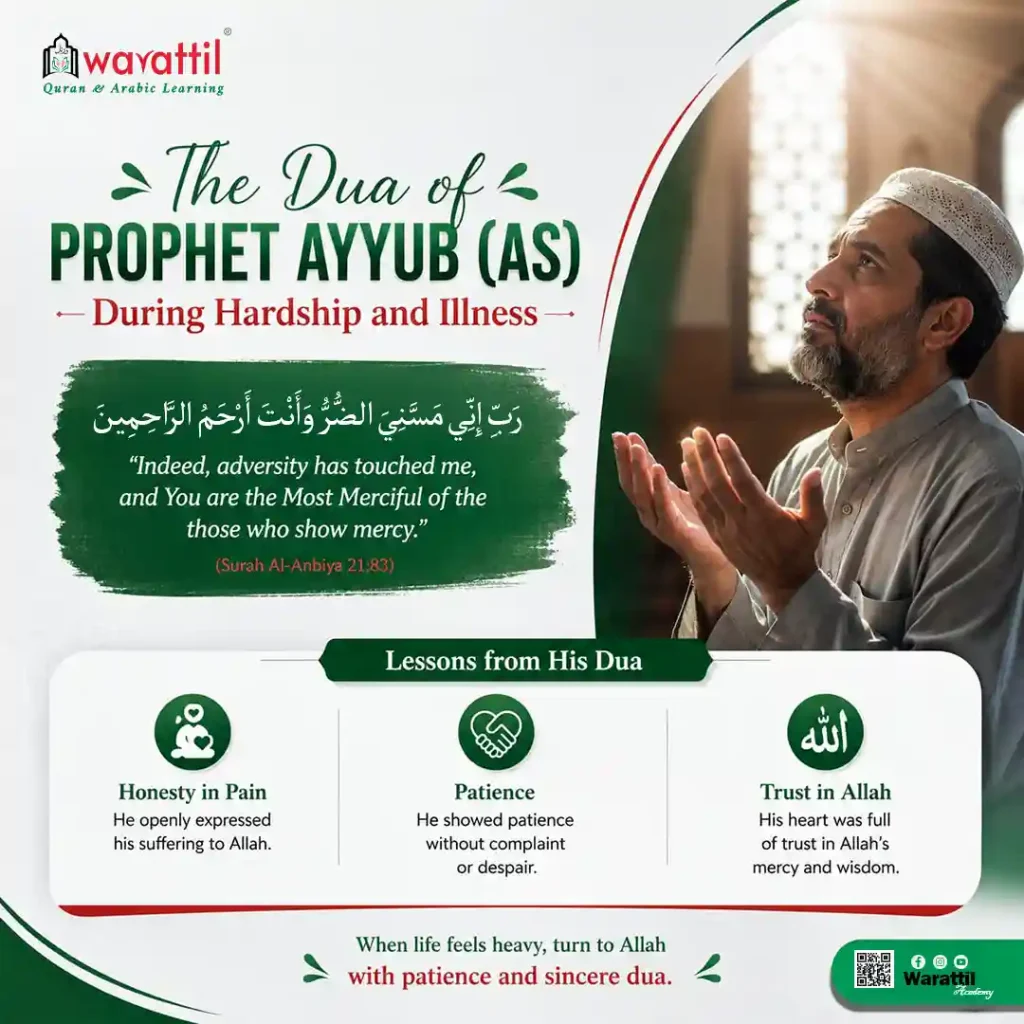
One of the most moving supplications in the Qur’an is the dua of Prophet Ayyub (Job), peace be upon him, who endured years of severe illness, the loss of his children, and the abandonment of his community. His supplication, preserved in Surah Al-Anbiya (21:83), is a model of dignified petition:
Arabic:
رَبِّ إِنِّي مَسَّنِيَ الضُّرُّ وَأَنْتَ أَرْحَمُ الرَّاحِمِينَ
Transliteration:
Rabbi innī massaniya ad-durru wa Anta arhamu ar-rāhimīn
Translation:
“My Lord, adversity has touched me, and You are the Most Merciful of the merciful.”
Notice what this dua does not contain. Prophet Ayyub does not complain, nor does he demand a cure. He simply states his condition — harm has touched him — and then immediately turns to praising Allah as the Most Merciful. The response from Allah was immediate and profound: “So We responded to him and removed what afflicted him of adversity” (Qur’an 21:84). This dua is particularly recommended for those enduring prolonged or severe illness, as it combines honest acknowledgment of suffering with absolute trust in divine mercy.
The Qur’an itself is described by Allah as a source of shifa. In Surah Al-Isra (17:82), He says: “And We send down of the Qur’an that which is healing and mercy for the believers.” The scholars have identified six specific verses, often referred to as Ayat ash-Shifa (the Verses of Healing), that carry particular potency. These are:
Reciting these verses over oneself or a sick person, or even over water which is then drunk, is a practice firmly rooted in the sunnah. Surah Al-Fatihah, which the Prophet ﷺ referred to as a ruqyah (spiritual healing), should also be recited seven times and blown upon the sick.
The power of any dua is multiplied when accompanied by certain conditions. The scholars outline several practical steps that a believer should take when seeking shifa:
It is necessary to address a common misunderstanding. The shifa that comes from the Qur’an is accessed through recitation, sincere supplication, and the blowing of breath — not through hanging verses around the neck, wearing charms, or tying threads. The majority of scholars, including the scholars of the Standing Committee in Saudi Arabia, have clarified that written amulets (ta’wiz) containing Quranic verses are, at minimum, a matter of scholarly disagreement, and wearing them carries the risk of falling into practices that have no basis in the Shariah. The safest and most authentic path is the one demonstrated by the Prophet ﷺ himself: recitation, blowing, and sincere dua.
Sickness is a trial, but it is also an opportunity — an opportunity to draw closer to Allah, to have one’s sins forgiven, and to experience the power of sincere supplication. The most powerful dua for shifa is the one taught by the Prophet ﷺ himself, recited with presence of heart and firm certainty that Allah is indeed ash-Shāfī, the Healer. Couple this dua with the Quranic verses of healing, regular sadaqah, and the necessary medical treatment, and you have followed the Prophetic prescription in its entirety. May Allah Almighty grant complete shifa to all those who are ill, ease every difficulty, and grant us all the wellbeing of body and soul in this life and the next. Ameen.

My son feels happy, amazing teachers and staff in wrattil and flexible prices MashaAllah Thank you so much
My daughter started learning in warattil academy and alhamdulilah we are really impressed and have enjoyed learning with wrattil. May Allah reward her sheikh
My teacher Ahmed is very good. He helped me recite and memorize holy Quran
Warattil is the most efficient way of learning Arabic. I like warattil curriculum and excellent teachers to support this learning Thank you so much
I highly recommend warattil Ijazah programs to anyone who wants to learn Quran properly.
Very well organized MashaAllah. I love it and this is a great course if you want to understand the Quran and learn tafsir
Warattil program is the best I have seen. The teacher is really great and is available to answer questions in a clear manner
I think warattil is the best academy in learning Arabic and I recommend Arabic course to anyone
We are so happy with ustad Hussein. He is very patient and comfortable teacher. May Allah the teachers and admin in warattil
Rating 10 mashaAllah and so grateful