Shopping cart
- +1 564-544-6614
- [email protected]
- 24/7 Available


Many Muslims are keen to recite the Holy Quran daily, striving to improve their recitation and master the rules of Tajweed, and perhaps even memorizing numerous chapters and verses. However, a fundamental question remains in the minds of many: Do we truly understand what we read?
Allah Almighty revealed the Holy Quran in clear Arabic, making its language an integral part of its miraculous nature and eloquence. While translations are important in conveying meaning, they remain incapable of fully capturing the linguistic precision and rhetorical richness inherent in Arabic words within their Quranic context. Hence the importance of learn arabic for quran, not merely as an abstract linguistic discipline, but as a practical and spiritual path to understanding Allah’s word as it was revealed.
Language is not simply a means of communication; it is the vessel and essence of meaning. The meanings of the Holy Quran are built upon the precision of its wording, the choice of its phrasing, and the arrangement of its words, all of which are fully revealed only through the Arabic language itself. When a Muslim learn arabic for quran, he:
Linguistic understanding opens the door to contemplation, and contemplation is the true purpose of the Quran’s revelation.
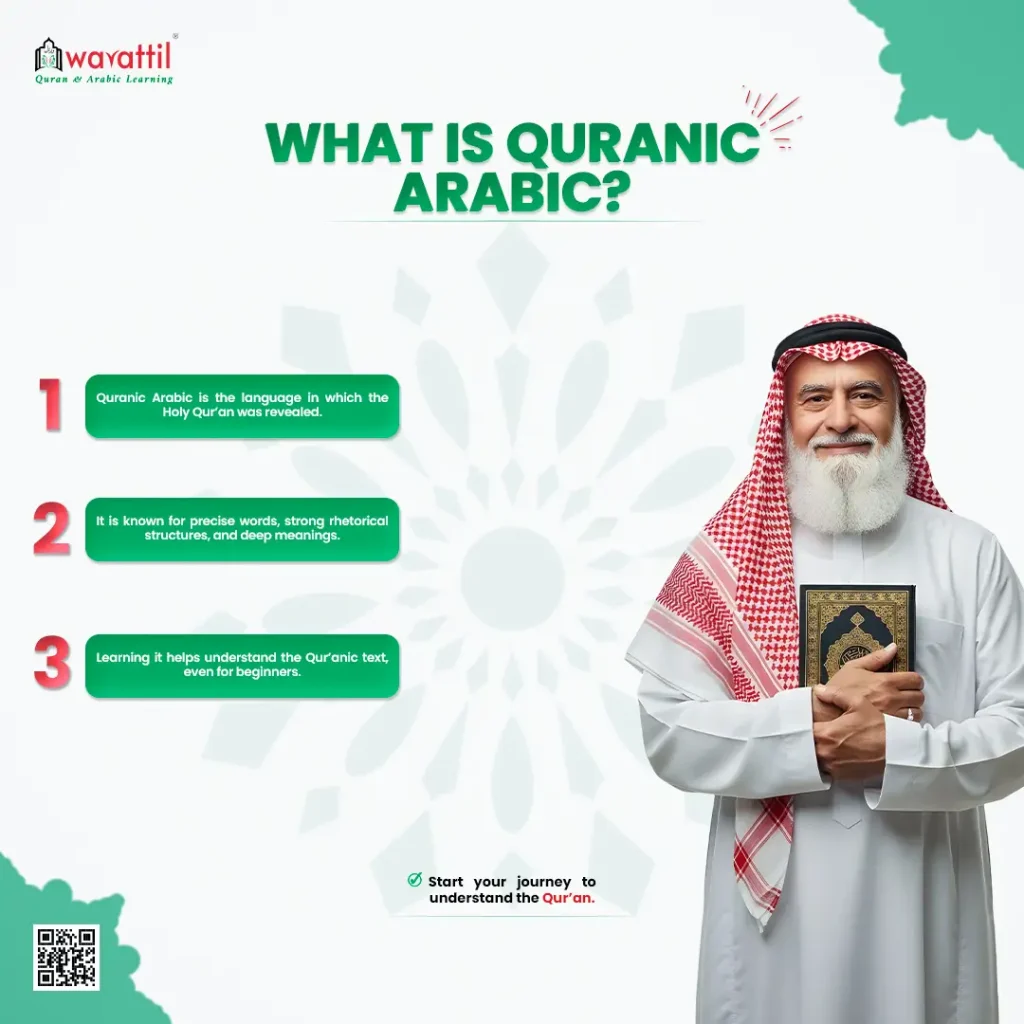
Quranic Arabic is the language in which the Holy Quran was revealed, and it represents the highest degree of eloquence and clarity in the Arabic language. Although it shares a fundamental basis with Modern Standard Arabic, it differs in several aspects, including:
It is important to clarify that learn arabic for quran does not necessarily mean learning all of Arabic with its various branches and sciences. Rather, it focuses on what specifically serves to understand the Quranic text, making it accessible even to beginners.
learn arabic for quran has a clear impact on a Muslim’s religious and intellectual life. Among its most prominent benefits are:
Starting from scratch does not mean weakness; rather, it is the natural starting point for every learner. More important than the starting level is the correct learning methodology, based on gradual progression and clarity.
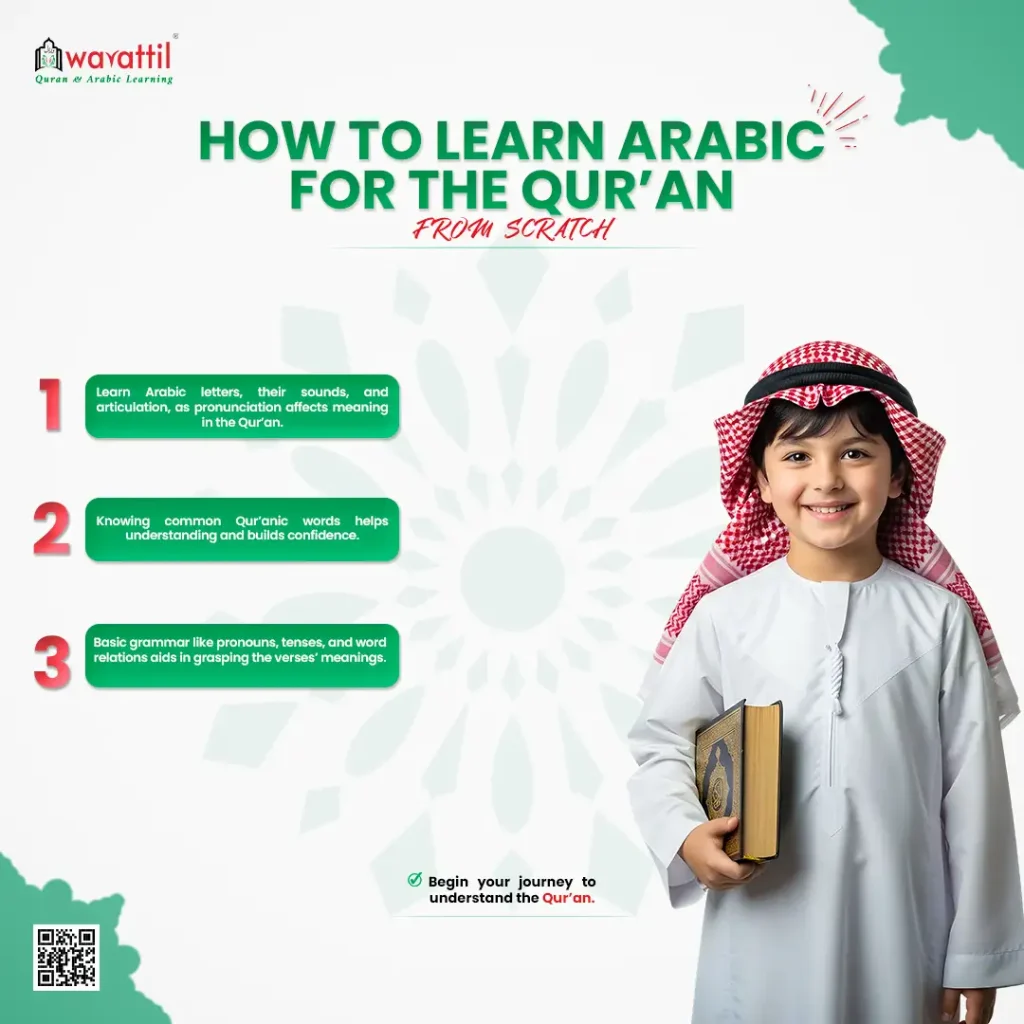
The Arabic letters are the foundation upon which everything else is built. In this stage, the learner learns:
This aspect is very important because an error in pronunciation can change the meaning, which is extremely sensitive when reading the Holy Quran.
The Holy Quran contains a large number of recurring words, and learning this vocabulary is a pivotal step in the journey of understanding. Knowing the meanings of words:
With continued practice, the reader begins to recognize words automatically while reciting.
The learner of Arabic for the Quran does not need to delve into complex grammatical details. It suffices to learn the basics that facilitate understanding, such as:
These simple rules open a wide door to understanding the general and precise meaning of the verses.
Application is the stage where knowledge transforms into true understanding. In this stage:
Here, the learner begins to feel that the Quran is no longer just a text to be recited, but a discourse to be understood and pondered.
learn arabic for quran online has become an effective option for many who wish to learn Arabic for the Quran, especially those who are short on time or geographically distant. However, success in this path depends on choosing the right program, which:
A good curriculum is one that considers the learner’s nature and primary goal.
Warattil Academy is based on a clear vision for teaching Arabic: the primary goal is not memorizing grammar rules or linguistic terms, but rather achieving a conscious understanding of the meanings of the Holy Quran. Therefore, the curriculum is designed to serve this specific objective, taking into account the learner’s level and their actual needs.
The learning journey begins from scratch, without assuming any prior knowledge of Arabic. The progression from one stage to the next is gradual and well-planned. Emphasis is placed on directly connecting the language to the Quran, ensuring that the learner does not feel disconnected from their primary goal. Every grammatical rule and every new vocabulary word is applied within real Quranic verses.
Furthermore, the explanations are presented in a simple and clear style, avoiding academic complexity that might deter beginners. Practical repetition and continuous application are emphasized, which helps solidify understanding and transform knowledge into a genuine skill over time.
It is impossible to define a fixed timeframe that suits all learners, as it varies depending on several factors, such as the level of commitment, the number of weekly learning hours, and the nature of the curriculum. However, a realistic picture of the expected stages of progress can be provided.
In the first few months, the learner begins to familiarize themselves with the basic letters and words and acquires the ability to understand some frequently used Quranic vocabulary. Then, with continued practice, they begin to grasp the general meaning of short verses and connect words to their context.
With time and perseverance, this gradual understanding transforms into a deeper ability to comprehend meanings, especially when reading commentaries. The most important thing in this journey is not speed, but consistency, because learning Arabic for Quranic understanding is a cumulative process that bears fruit with patience and perseverance.
One of the most important factors that accelerates the learning process is allocating a fixed daily time, even if it is short, because consistency is more important than the number of hours. It is also advisable to focus on the most frequently used Quranic words, as they open the door to understanding a large number of verses.
It is also preferable to link learning with daily recitation, so that studying is not separate from the Quran, but rather an integral part of interacting with it. It is also beneficial not to move from one stage to another before ensuring a good understanding, as linguistic development depends on cumulative learning.
Finally, the intention must always be present, for learning Arabic to understand the Quran is an act of worship, and every effort exerted on this path will be rewarded and bear fruit.
Learning arabic for quranis not a short-term project, but rather a spiritual and intellectual journey that extends over time. It is a journey that begins with a letter, then a word, then a meaning, until the learner reaches a stage where they feel the Quran addressing them directly in their native language.
Every step on this path, no matter how simple it may seem, draws the heart closer to the Book of Allah and opens new doors to contemplation and reverence. Whoever is sincere in seeking understanding, Allah will facilitate their path and bless their knowledge and work.
The best approach is to follow a gradual method that focuses specifically on Quranic Arabic, combining vocabulary learning, understanding basic grammar rules, and direct practical application to Quranic verses.
Yes, you can. Quranic Arabic doesn’t require mastering all branches of the Arabic language or speaking it fluently; rather, it focuses solely on what serves the understanding of the Quranic text.
It varies from person to person, but with consistent commitment, real progress can be observed within a few months, and understanding deepens with continued practice.
Yes, Quranic Arabic is more eloquent and precise, and it differs from the spoken Arabic used in everyday life. Therefore, it is learned using a specific method.
Absolutely, beginners can learn online successfully, provided they choose a program designed for them that starts from the very beginning and relies on gradual progression and clear explanations.

My son feels happy, amazing teachers and staff in wrattil and flexible prices MashaAllah Thank you so much
My daughter started learning in warattil academy and alhamdulilah we are really impressed and have enjoyed learning with wrattil. May Allah reward her sheikh
My teacher Ahmed is very good. He helped me recite and memorize holy Quran
Warattil is the most efficient way of learning Arabic. I like warattil curriculum and excellent teachers to support this learning Thank you so much
I highly recommend warattil Ijazah programs to anyone who wants to learn Quran properly.
Very well organized MashaAllah. I love it and this is a great course if you want to understand the Quran and learn tafsir
Warattil program is the best I have seen. The teacher is really great and is available to answer questions in a clear manner
I think warattil is the best academy in learning Arabic and I recommend Arabic course to anyone
We are so happy with ustad Hussein. He is very patient and comfortable teacher. May Allah the teachers and admin in warattil
Rating 10 mashaAllah and so grateful