Shopping cart
- +1 564-544-6614
- [email protected]
- 24/7 Available


Among the many voluntary acts of worship in Islam, few carry the profound promises associated with Salat ul Tasbeeh. Often referred to as the Prayer of Glorification, it is a special nafl (supererogatory) prayer distinguished by the extensive recitation of a particular tasbih a declaration of the glory, praise, and greatness of Allah. If you have ever wondered how to pray Salat ul Tasbeeh, this guide will walk you through its method, its scholarly standing, and the immense spiritual rewards attached to it.
The foundation of this prayer lies in a well‑known hadith. The Prophet Muhammad ﷺ, out of his profound love and concern for his family, taught this prayer to his uncle, Abbas ibn Abdul Muttalib (may Allah be pleased with him). He presented it not as a burdensome duty, but as a precious gift. The Prophet ﷺ said to him:
“O Abbas! O my uncle! Shall I not give you a gift? Shall I not show you something by means of which Allah will forgive your sins, the first and the last of them, the past and recent, the unintentional and the intentional, the small and huge, the secret and open?”
He then taught him the method of Salat ul Tasbeeh. The Prophet ﷺ further advised that this prayer should be offered daily, if possible. If one cannot manage that, then once every Friday, or once a month, or once a year, or at least once in a lifetime.
The virtues mentioned are extraordinary: a comprehensive forgiveness for all types of sins. It is this immense promise that has led countless believers throughout history to incorporate this prayer into their regular worship, especially during the blessed nights of Ramadan or on other auspicious occasions.
The essence of Salat ul Tasbeeh is a specific phrase of remembrance that is repeated 300 times over the course of four rak‘ahs. The tasbih is:
سُبْحَانَ اللهِ وَالْحَمْدُ لِلَّهِ وَلَا إِلَهَ إِلَّا اللهُ وَاللهُ أَكْبَرُ
Subhaanallaahi walhamdu lillaahi walaa ilaaha illallaahu wallaahu akbar
“Glory be to Allah, and all praise is for Allah, and there is no god but Allah, and Allah is the Greatest.”
Some narrations also permit adding “La Hawla wala Quwwata illa billahil Aliyyil Azeem” (There is no power and no might except with Allah, the Most High, the Supreme) at the end of the above tasbih.
The prayer consists of four rak‘ahs, performed either with one salam (closing salutation) at the end, or with two salams after every two rak‘ahs. Both methods are considered valid, though the majority of scholars prefer the four‑rak‘ah format with a single salam.
The tasbih is recited 75 times in each rak‘ah, making a total of 300. The distribution across the postures of a single rak‘ah is meticulously detailed in the hadith.
Begin the prayer with the Takbeer (“Allahu Akbar”) and the opening supplication (Thana).
The total for these eight positions is 15 + 10 + 10 + 10 + 10 + 10 + 10 + 10 = 75.
You will repeat the exact same procedure for the second, third, and fourth rak‘ahs. The only difference is that in the third and fourth rak‘ahs, you will only recite Surah al‑Fatihah (without an additional surah) before proceeding to ruku, and you will, of course, recite the Tashahhud in the sitting position of the second and fourth rak‘ahs.
Complete the prayer with the Tasleem (“Assalamu alaikum wa rahmatullah”) to the right and left.

Given the high number of repetitions, it is easy to lose count. The scholars have provided practical advice to help maintain concentration:
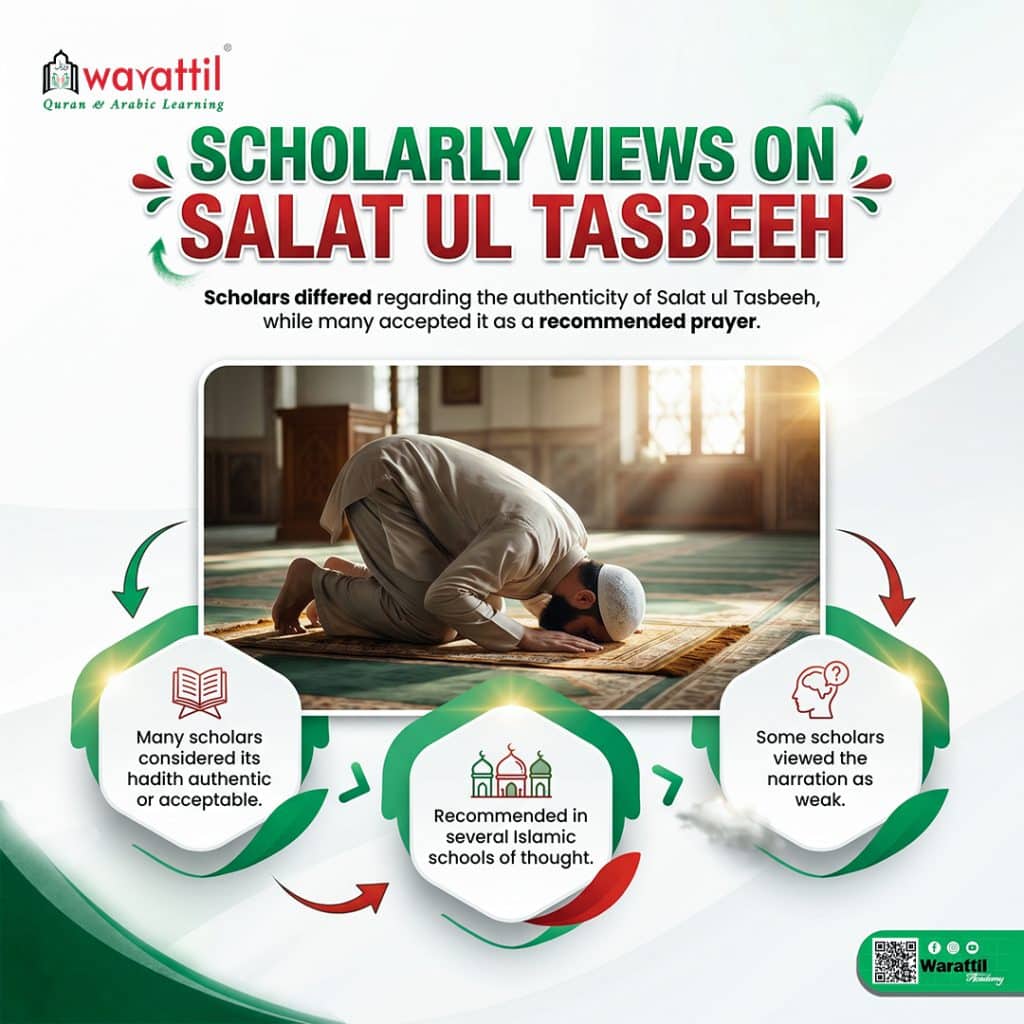
It is important to address the scholarly discourse surrounding this prayer, as it has been a subject of debate among hadith scholars and jurists.
On one side, a significant number of eminent hadith masters including Imam al‑Tirmidhi, Imam al‑Bayhaqi, Hafiz ibn Hajar al‑Asqalani, Imam al‑Nawawi, and many others have classified the hadith of Salat ul Tasbeeh as authentic (sahih) or sound (hasan). Hafiz ibn Hajar, for instance, after a detailed analysis, concluded that it is either sahih or hasan, not weak. The practice was also upheld by early pious figures like Abdullah ibn al‑Mubarak. The jurists of the Hanafi, Shafi‘i, and Maliki schools have generally considered it a recommended (mustahabb) prayer.
On the other hand, a respected minority of scholars, including Imam Ahmad ibn Hanbal (in the most famous opinion from him) and later scholars like Ibn Taymiyyah, did not consider the hadith authentic and thus did not view the prayer as an established sunnah. Some even classified its chains as weak or fabricated.
This divergence is a natural part of Islamic scholarship, stemming from different methodologies in authenticating hadith. The position held by the majority of classical scholars across the Hanafi, Shafi‘i, and Maliki schools is that the prayer is permissible and meritorious to perform. A person who chooses to pray it does so on the basis of this widely‑held scholarly acceptance, while a person who does not is following a minority but valid scholarly view. Neither position should be a source of discord among Muslims.
There is no specific du‘a that is exclusively prescribed for after Salat ul Tasbeeh. However, one can make any heartfelt supplication, raising their hands and asking Allah for forgiveness, mercy, and any other need. It is recommended to begin any du‘a by praising Allah and sending blessings upon the Prophet ﷺ. A general du‘a for forgiveness that aligns with the prayer’s purpose is:
“O Allah, I ask You for forgiveness and well‑being in my religious and my worldly affairs. O Allah, conceal my faults, calm my fears, and protect me from before me and behind me, from my right and my left, and from above me, and I seek refuge in You from being taken unaware from beneath me.”
Learning how to pray Salat ul Tasbeeh is more than just mastering a sequence of movements and numbers. It is about embracing a profound act of devotion taught by the Prophet ﷺ as a gift of mercy for his Ummah. The prayer invites the worshipper into a state of intense remembrance, where the tongue, heart, and limbs are all engaged in the glorification of Allah. Whether you pray it once in a lifetime or once a day, performing it with presence of heart and a sincere desire for forgiveness can be a transformative spiritual experience.
May Allah accept all our acts of worship, forgive our shortcomings, and grant us the sincerity to seek His mercy through every prayer He has taught us.

My son feels happy, amazing teachers and staff in wrattil and flexible prices MashaAllah Thank you so much
My daughter started learning in warattil academy and alhamdulilah we are really impressed and have enjoyed learning with wrattil. May Allah reward her sheikh
My teacher Ahmed is very good. He helped me recite and memorize holy Quran
Warattil is the most efficient way of learning Arabic. I like warattil curriculum and excellent teachers to support this learning Thank you so much
I highly recommend warattil Ijazah programs to anyone who wants to learn Quran properly.
Very well organized MashaAllah. I love it and this is a great course if you want to understand the Quran and learn tafsir
Warattil program is the best I have seen. The teacher is really great and is available to answer questions in a clear manner
I think warattil is the best academy in learning Arabic and I recommend Arabic course to anyone
We are so happy with ustad Hussein. He is very patient and comfortable teacher. May Allah the teachers and admin in warattil
Rating 10 mashaAllah and so grateful