Shopping cart
- +1 564-544-6614
- [email protected]
- 24/7 Available


If you are wondering how to get ijazah in Quran, the answer begins with understanding that an Ijazah is more than a course certificate. In the traditional Quranic learning system, an Ijazah is an authorization granted by a qualified teacher after the student has demonstrated accurate recitation or memorization according to a particular transmission. The process is built around direct learning, correction, and a chain of transmission known as a sanad.
For that reason, earning an Ijazah usually requires patience and sustained study. You first need a strong foundation in Quran reading and Tajweed, then you study with an appropriately qualified teacher and demonstrate that you can recite according to the standard being taught. The exact requirements can differ depending on the type of Ijazah, recitation tradition, and teacher.
The Arabic word Ijazah generally means permission or authorization. In Quranic studies, it refers to a teacher’s authorization for a student to transmit or teach a particular Quranic recitation after the teacher has verified the student’s proficiency.
The concept is closely connected to sanad, the chain through which a teacher’s Quranic recitation was transmitted from earlier teachers. Traditional Quran instruction therefore places considerable importance on learning directly from qualified reciters rather than relying only on books or recorded lessons.
An important point is that not every Quran certificate is an Ijazah. A certificate showing that someone completed a Tajweed course may demonstrate that the student studied Tajweed, but it does not automatically constitute an Ijazah with a connected chain of transmission.
Likewise, being a Hafiz and having an Ijazah are not necessarily the same achievement. A person may memorize the entire Quran without receiving an Ijazah, while an Ijazah may be granted according to a particular recitation or scope determined by the qualified teacher.
There is no single worldwide curriculum that every teacher or institution must follow. However, the traditional path generally involves several important stages.
Before pursuing an Ijazah, you need to be able to read the Quran accurately. This includes correct pronunciation of Arabic letters, understanding the basic rules of Tajweed, and developing fluency in recitation.
If your pronunciation or Tajweed still needs significant improvement, it is better to address those weaknesses before beginning an Ijazah program. An Ijazah is intended to verify a high level of proficiency, so trying to rush into the process can create unnecessary difficulties.
Tajweed involves areas such as makharij al-huruf (points of articulation), characteristics of letters, rules of madd, ghunnah, qalqalah, ikhfa, idgham, and appropriate stopping and starting. The goal is not simply to memorize terminology but to apply the rules correctly while reciting.
The term “Quran Ijazah” can refer to different forms of authorization. Therefore, you should determine your objective before choosing a teacher.
One common route is an Ijazah in Quranic recitation, where the student demonstrates accurate recitation of the Quran according to a particular riwayah or recitation tradition. Another route is an Ijazah connected with Hifz, where the student recites the Quran from memory.
There are also advanced pathways involving the recognized canonical qira’at. These are specialized fields and require study with teachers qualified in the relevant recitation. The recognized recitations have their own transmission traditions, so a student should not assume that an Ijazah in one recitation automatically authorizes them in every other recitation.
For many students, beginning with a single established recitation is the most practical approach.
Choosing the right teacher is one of the most important parts of the process.
A teacher who grants an Ijazah should have appropriate authorization in the recitation they are teaching. You should be able to ask about the teacher’s own Ijazah, their teachers, the recitation or riwayah in which they are authorized, and what scope of authorization they can grant.
This is important because an Ijazah is connected to the teacher who grants it. A teacher cannot simply create an authentic traditional chain by issuing a certificate. The value of the sanad depends on the actual transmission and authorization behind it.
Before enrolling, ask clear questions such as:
A credible teacher should be comfortable explaining these matters.
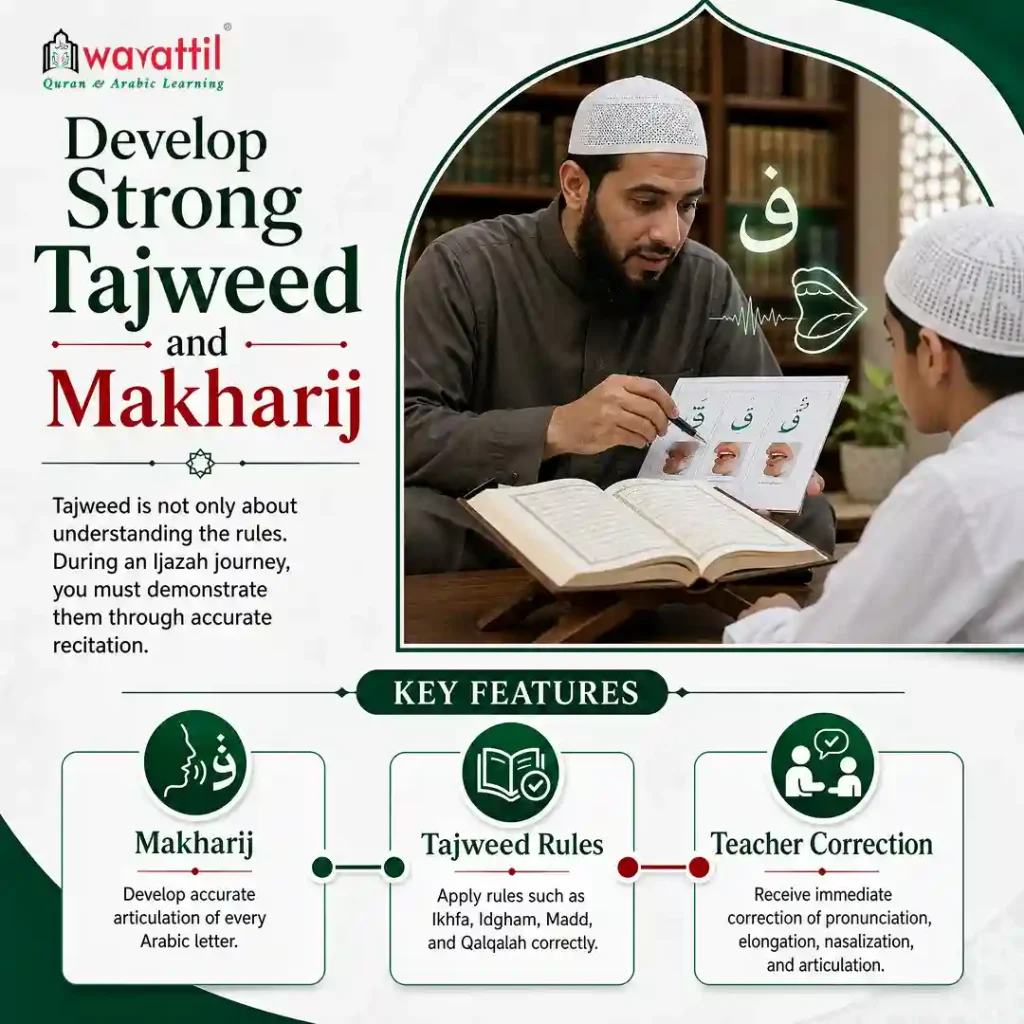
Tajweed is not merely a theoretical subject in an Ijazah journey. You need to demonstrate it through actual recitation.
Your teacher may correct subtle mistakes in pronunciation, elongation, nasalization, articulation, stopping, and other aspects of recitation. These corrections are one of the reasons direct teacher-student instruction remains central to traditional Quranic transmission.
For example, knowing the definition of ikhfa is different from consistently applying it correctly while reading. An experienced teacher can hear mistakes that a student may not notice independently and correct them immediately.
This is also why regular practice matters. Your goal should be to make accurate recitation consistent rather than correct only when you are concentrating intensely.
For many traditional Ijazah pathways, the student must recite the required scope of the Quran directly to the certifying teacher.
The precise method varies. Some Ijazah programs require a complete recitation, while particular forms of authorization can have different conditions. Islamic scholarly sources also recognize that there are different types of Ijazah and that the conditions are not identical in every case.
For a full recitation Ijazah, the student may read from the Mushaf while the teacher listens and corrects the recitation. For a Hifz-based Ijazah, the student recites from memory.
The important principle is that the teacher must have sufficient opportunity to verify the student’s accuracy according to the requirements of that particular Ijazah.
Once your teacher believes your recitation has reached the required standard, you may undergo a final assessment.
There is no universal Ijazah examination format. Some institutions use formal oral examinations, while individual teachers may assess the student through the student’s complete recitation and ongoing performance. For example, established Ijazah programs may combine recitation assessment with practical and theoretical Tajweed evaluation.
The assessment may consider:
Your teacher determines whether you have reached the level required for authorization.
If you successfully meet the teacher’s requirements, the teacher may grant you the Ijazah.
The documentation can identify the student, the teacher, the recitation or narration covered, and the relevant chain of transmission. The exact wording and format depend on the teacher and institution.
The sanad is particularly significant because it identifies the chain of teachers through which the recitation was transmitted. In traditional terminology, it connects the student’s authorization to the teacher’s own transmission.
You should keep the original documentation safely and maintain a clear record of what you were authorized to transmit.
This question does not have one answer for every type of Ijazah.
For a Hifz Ijazah, complete memorization is naturally fundamental because the student is being assessed on recitation from memory. Some traditional sources describe full memorization and mastery as requirements for the type of Ijazah they are discussing.
However, Ijazah terminology is not completely uniform across all teachers and traditions. Some programs distinguish between an Ijazah for recitation from the Mushaf and an Ijazah for memorized recitation.
Therefore, do not rely on a general statement that “everyone must be a Hafiz” or “you never need Hifz.” Instead, ask the certifying teacher what the specific Ijazah requires.
Online Quran learning has made it possible for students to study with teachers who live in different countries. However, the quality and structure of online programs vary significantly.
An online program should not be judged simply by whether it provides a certificate. If your goal is a traditional Quran Ijazah, investigate who the certifying teacher is, what their authorization covers, how recitation is assessed, and how the sanad is documented.
Live, direct recitation is particularly important because Quranic pronunciation and Tajweed require listening and correction. A recorded course can be useful for learning concepts, but watching lessons alone does not replace individualized assessment by a qualified teacher.
Some established programs use online assessment and structured oral instruction, while others may have additional prerequisites before students enter their Ijazah track.
There is no fixed number of months or years required for every student.
Your timeline depends on your current recitation level, Tajweed proficiency, memorization, the type of Ijazah you pursue, how frequently you study, and the standards of your teacher.
Someone who already has excellent Tajweed and consistent Quran recitation may progress more quickly than a student who needs to rebuild pronunciation and fluency. A student pursuing an advanced Qira’at pathway will generally face a different level of study from someone pursuing a single recitation.
For this reason, be cautious about programs that promise a traditional Ijazah in an unrealistically short period without first assessing your ability.
A good program should make its academic and religious standards clear rather than focusing only on the certificate.
Look for a teacher or institution that can clearly explain its curriculum, assessment process, recitation tradition, and authorization. Ideally, you should have an opportunity to speak with the teacher before making a long-term commitment.
You should also consider the teacher’s teaching style. Ijazah study can involve a substantial amount of individual correction, so you need someone who is patient, precise, and willing to explain your mistakes rather than simply moving you through lessons.
Most importantly, verify the teacher’s own credentials. A program using the word “Ijazah” does not automatically mean that its certificate has the same traditional meaning used by qualified Quran teachers.
One common mistake is choosing a program because it promises a certificate quickly. An Ijazah is intended to represent verified proficiency, so the quality of the learning process matters more than the speed of completion.
Another mistake is assuming that a general Tajweed certificate is the same as an Ijazah. They may represent different levels of study and authorization.
Students should also avoid choosing a teacher without asking about their own Ijazah and sanad. If a teacher cannot clearly explain their authorization, it is reasonable to investigate further before beginning the program.
Finally, do not treat Ijazah as the end of Quran study. Receiving authorization carries responsibility. Continuing to review your recitation, maintain Tajweed, and learn from qualified scholars can help you preserve the standard you worked to achieve.
For a serious Quran student, an Ijazah can provide a structured pathway toward advanced mastery of recitation and teaching.
It can also connect the student to a longstanding tradition of teacher-to-student transmission. Rather than studying Quranic recitation only through written material, the student receives direct correction from someone who has themselves studied through an established chain.
For those who intend to teach Quran, an Ijazah can also demonstrate that a qualified teacher has assessed their recitation and authorized them within a particular scope. However, an Ijazah should not be treated as a substitute for good teaching practice, ongoing study, or personal character.
If you are serious about learning how to get ijazah in Quran, focus first on becoming an accurate and disciplined Quran reciter rather than simply obtaining a certificate. Build your Tajweed foundation, study under a qualified teacher, practice consistently, complete the required recitation, and understand exactly what your Ijazah authorizes you to transmit.
The process can take time, but that is part of its purpose. An Ijazah represents a teacher’s trust in a student’s ability to preserve and transmit a particular Quranic recitation accurately. Choosing the right teacher and understanding the specific requirements of your chosen pathway will help you approach the journey with both confidence and responsibility.
There is no shortcut that guarantees an authentic Ijazah. The most practical route is to strengthen your Tajweed, choose a qualified teacher, study consistently, complete the required recitation, and satisfy the teacher’s assessment standards.
It depends on the type of Ijazah. A Hifz Ijazah requires memorization, while some recitation pathways may involve reading from the Mushaf. Always confirm the requirements with the teacher granting the authorization.
No. A Tajweed certificate may show that you completed a course or passed an assessment, whereas an Ijazah traditionally represents authorization from a qualified teacher within a specific Quranic transmission.
Yes. Women can and historically have participated in Quranic transmission and scholarship. The important issue is the qualifications of the teacher and the requirements of the specific Ijazah pathway.
Some institutions and teachers offer structured online Quran and Ijazah programs. Before enrolling, verify that the program includes direct instruction and assessment by a suitably qualified teacher and clearly explains the sanad and scope of the authorization.
No. An authorization is normally connected to the particular recitation, narration, or scope for which it was granted. Different Qira’at require their own specialized study and authorization.

My son feels happy, amazing teachers and staff in wrattil and flexible prices MashaAllah Thank you so much
My daughter started learning in warattil academy and alhamdulilah we are really impressed and have enjoyed learning with wrattil. May Allah reward her sheikh
My teacher Ahmed is very good. He helped me recite and memorize holy Quran
Warattil is the most efficient way of learning Arabic. I like warattil curriculum and excellent teachers to support this learning Thank you so much
I highly recommend warattil Ijazah programs to anyone who wants to learn Quran properly.
Very well organized MashaAllah. I love it and this is a great course if you want to understand the Quran and learn tafsir
Warattil program is the best I have seen. The teacher is really great and is available to answer questions in a clear manner
I think warattil is the best academy in learning Arabic and I recommend Arabic course to anyone
We are so happy with ustad Hussein. He is very patient and comfortable teacher. May Allah the teachers and admin in warattil
Rating 10 mashaAllah and so grateful