Shopping cart
- +1 564-544-6614
- [email protected]
- 24/7 Available


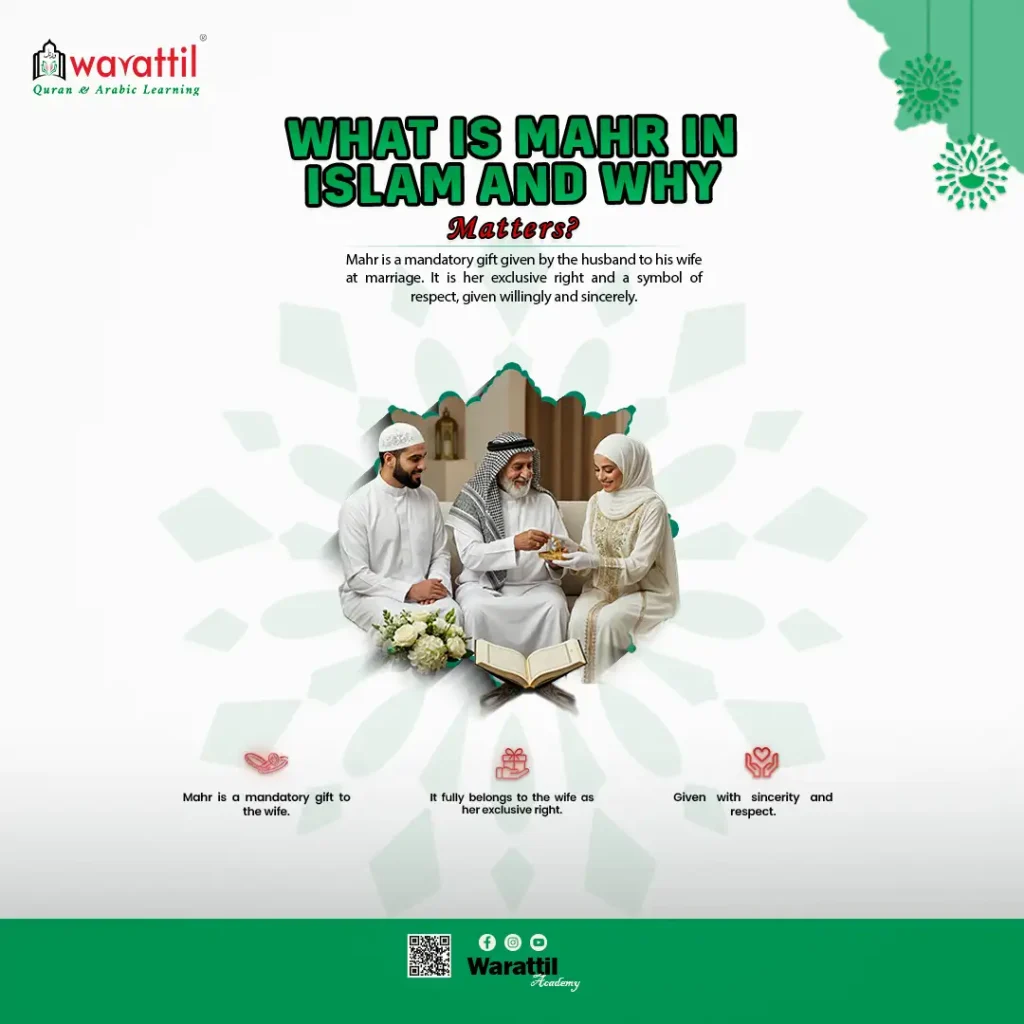
When two families come together to arrange a Nikah, one of the most important yet often misunderstood obligations is the mahr. Knowing how to calculate mahr in Islam is not just a legal formality; it is an act of worship, a right of the wife, and a condition that holds the marriage contract together. Yet so many couples either skip it carelessly or fix an amount without truly understanding what Islam says about it.
This guide breaks the entire concept down from its definition and ruling to how you actually arrive at a fair and Islamically sound figure.
Mahr (also spelled mehr or meher) is the mandatory gift or payment that a husband is obligated to give his wife upon marriage. It is not a bride price paid to the family, nor is it a dowry brought by the wife from her home. The mahr belongs exclusively to the wife — she has full ownership and can spend it however she wishes.
Allah mentions this directly in the Quran:
“And give the women their mahr as a free gift.” — (Surah An-Nisa, 4:4)
The word used here — nihlah — means a gift given willingly and sincerely, not reluctantly or under social pressure. This single verse sets the entire tone of how mahr should be approached.
Yes, mahr is wajib (obligatory) in Islam. The majority of scholars from the Hanafi, Maliki, Shafi’i, and Hanbali schools of thought all agree on this. A marriage without mahr is still considered valid in most scholarly opinions, but the obligation to pay it remains on the husband regardless. Skipping the discussion of mahr does not cancel the husband’s duty; it simply means a mahr al-mithl (equivalent mahr) becomes automatically due.
So the question is never whether to pay mahr — the question is always how much and in what form.
Before getting into the calculation, it helps to understand that mahr comes in two broad types:
This is the mahr that is mutually agreed upon and clearly stated during the Nikah contract. Both the husband and wife (or her guardian on her behalf) agree on a specific amount or item. This is the preferred and most common type.
If no mahr was specified at the time of Nikah or if the specified amount was later found to be invalid then mahr al-mithl applies. This is calculated based on what women of similar status in the bride’s family (like her sisters, paternal aunts, or cousins of equal standing) received as mahr. It acts as a default standard rooted in social justice.
Within the specified mahr, there is another important distinction:
Now we get to the core of this guide. Calculating mahr in Islam involves several considerations working together.
Scholars differ on the minimum:
For practical purposes in South Asia and Bangladesh, the Hanafi position is widely followed. You can check silver rates daily and multiply by 30.618 grams to find the absolute minimum.
Example Calculation: If silver is priced at USD 1.10 per gram today
Minimum Mahr = 30.618 × 1.10 = USD 33.68 (approximately)
This is the floor, not the recommendation.
Islam strongly encourages going beyond the minimum. The Quran and Sunnah both emphasize that mahr should reflect honor and dignity. The Prophet (ﷺ) reportedly gave his wives and daughters meaningful amounts of mahr. When Sayyiduna Ali (RA) married Sayyidah Fatimah (RA), the mahr was her armor (dir’) something of real value.
To calculate a suitable amount, consider:
While mahr is the wife’s right, Islam does not demand that a man cripple himself financially to pay it. The Prophet (ﷺ) said:
“The best of mahrs is the one that is most affordable.” — (Abu Dawud)
A fair mahr is one the husband can genuinely fulfill — either immediately or over a reasonable time. Fixing an astronomically high amount that neither party ever intends to be paid is considered by many scholars to be against the spirit of the contract.
Mahr does not have to be cash. It can be:
The key condition is that the item must be: halal, known, deliverable, and of real value.
The agreed mahr must be clearly stated in the Nikah contract. In Bangladesh and many other countries, the Kazi registers this in the Kabinnama (marriage registration document). Both the prompt and deferred portions should be written explicitly with conditions if any.

It is worth pausing here to address some widespread errors that often creep into Muslim weddings:
Some families fix mahr at USD 1 or USD 5 without any real consideration for its purpose.
While the marriage may technically remain valid, this reflects a serious misunderstanding of the wife’s rights in Islam.
Mahr is not symbolic it is a meaningful financial right, meant to honor and protect the bride.
Mahr belongs exclusively to the wife.
Any cultural practice that interferes with this is a clear violation of Islamic principles.
Sometimes families agree on a large deferred amount (e.g., USD 50,000 or more) with an unspoken understanding that it will never be paid.
This creates a dangerous situation:
If it is written, it should be real and payable.
This is one of the most harmful cultural confusions.
Islam does not obligate women to bring anything into marriage.
The financial responsibility lies on the husband, not the bride.
Yes — and this is entirely her choice. If the wife voluntarily and willingly forgives part or all of the mahr without any pressure, that is permissible and even praised in the Quran:
“But if they give up willingly to you anything of it, then take it in satisfaction and ease.” — (Surah An-Nisa, 4:4)
The crucial word here is willingly. No family, husband, or cultural pressure can legally strip a woman of her right to mahr. If she forgives it under pressure, the mahr still remains due on the husband.
This depends on whether the marriage was consummated:
This structure shows how Islam has built financial protection for women at every stage of the marriage.
Understanding how to calculate mahr in Islam is essential for every couple before Nikah. It is not just a symbolic number it represents:
The process is simple:
That’s how this beautiful Islamic obligation is honored properly.
Q: Can mahr be paid in installments?
Yes, as long as both parties agree and the terms are clearly stated in the contract.
Q: Is a very high mahr better in Islam?
Not necessarily. Islam encourages a mahr that is meaningful but not burdensome. The Prophet (ﷺ) warned against making mahr a source of hardship.
Q: Does mahr have to be paid before the wedding night?
The prompt portion (mahr muajjal) should ideally be paid before or at the time of Nikah. The wife may refuse to consummate the marriage until she receives it — and this is her legal Islamic right.
Q: Can gold jewelry be counted as mahr?
Absolutely, as long as the weight and value are clearly agreed upon.

My son feels happy, amazing teachers and staff in wrattil and flexible prices MashaAllah Thank you so much
My daughter started learning in warattil academy and alhamdulilah we are really impressed and have enjoyed learning with wrattil. May Allah reward her sheikh
My teacher Ahmed is very good. He helped me recite and memorize holy Quran
Warattil is the most efficient way of learning Arabic. I like warattil curriculum and excellent teachers to support this learning Thank you so much
I highly recommend warattil Ijazah programs to anyone who wants to learn Quran properly.
Very well organized MashaAllah. I love it and this is a great course if you want to understand the Quran and learn tafsir
Warattil program is the best I have seen. The teacher is really great and is available to answer questions in a clear manner
I think warattil is the best academy in learning Arabic and I recommend Arabic course to anyone
We are so happy with ustad Hussein. He is very patient and comfortable teacher. May Allah the teachers and admin in warattil
Rating 10 mashaAllah and so grateful