Shopping cart
- +1 564-544-6614
- [email protected]
- 24/7 Available


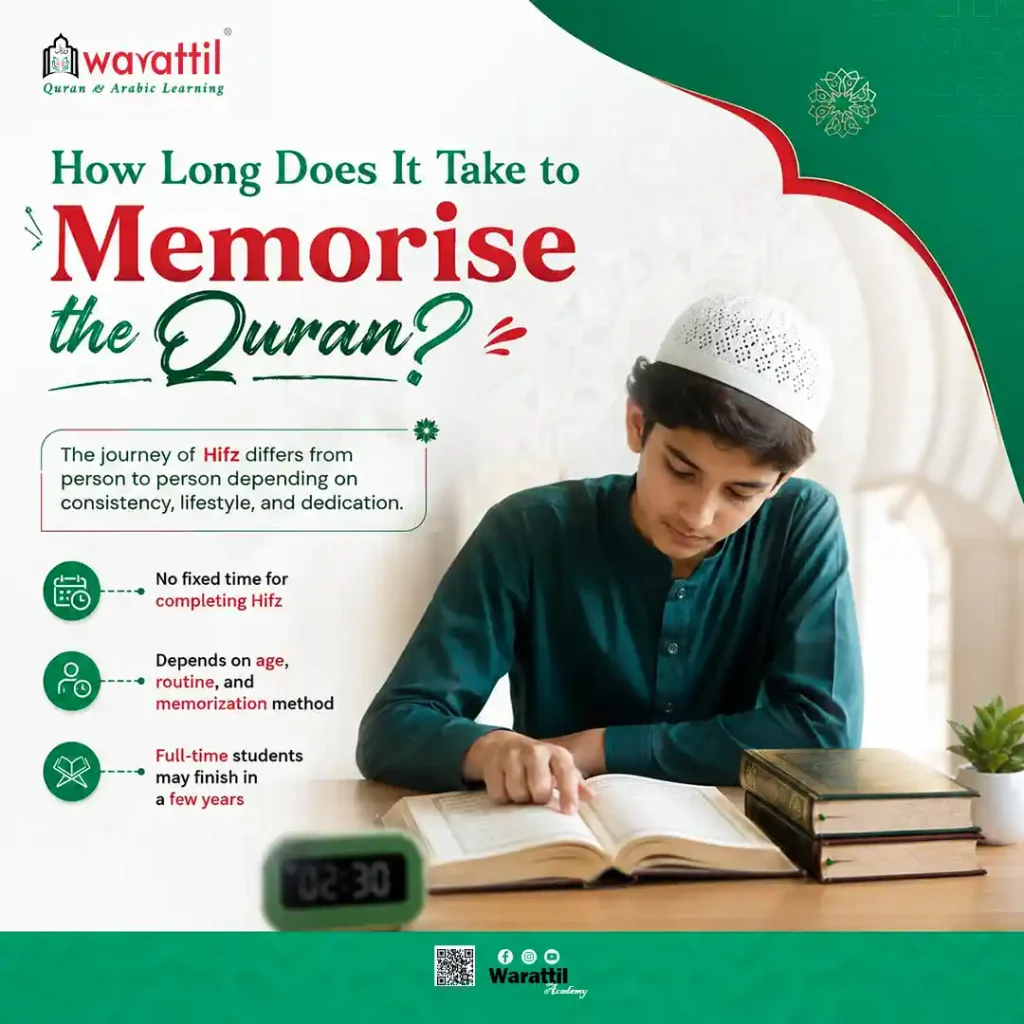
Few questions stir the heart of a believer as much as this one: how long does it take to memorise the Quran? You may have heard of a child who completed Hifz in two years, or a busy professional who took seven. The truth is that there is no single, fixed answer. The time required to commit the entire Quran to memory depends on a web of personal factors: your age, your daily routine, the method you follow, and, most importantly, the consistency you bring to the task. What follows is a realistic, research‑grounded look at the journey, drawn from the experiences of teachers, students, and institutes around the world.
Before talking about years and months, it is worth pausing to appreciate the scale of the undertaking. The Quran contains 114 surahs, over 6,000 verses, and roughly 80,000 words. In the standard Madani Mushaf, this translates to about 604 pages of carefully structured Arabic text. Memorising it is not merely a feat of memory; it is a spiritual discipline that has been practised continuously since the time of the Prophet Muhammad (peace be upon him). Teachers in traditional settings often describe the process as taking “three or four years” for a full‑time young student, though exceptional individuals have finished in far less time. Modern online academies and part‑time programmes extend that range considerably, reflecting the realities of life outside a full‑time madrasa.
Children who begin between the ages of seven and ten often possess a natural memory plasticity that allows them to absorb large portions of text rapidly. In a specialised environment, a child of this age can complete Hifz in two to three years with consistent effort. Adults, who must balance memorisation with work, family, and other responsibilities, usually need four to five years or longer, though their discipline and understanding can sometimes compensate for a slightly slower pace. Age is not a barrier, but it is a factor that shapes the rhythm of the journey.
The single most powerful lever you can pull is the number of hours you dedicate each day. Full‑time students who immerse themselves for six to eight hours daily can complete the Quran in as little as one and a half to three years. Those who manage four to six hours a day, perhaps in a formal Hifz school, typically finish within two to four years. Part‑time learners who carve out one to two hours each day alongside school or employment usually require five to seven years, and sometimes up to ten if the pace is very gradual. The table below offers a concise overview.
| Daily New Memorisation | Pace Description | Estimated Completion |
| 2–3 pages | Fast, intensive | 10–12 months |
| 1 page | Moderate, steady | 2–2.5 years |
| Half a page | Slow but sustainable | 4–5 years |
| A few verses | Part‑time, light | 6+ years |
No discussion of how long it take to memorise the Quran can ignore revision. Memorisation without review is like pouring water into a leaky vessel. Most experienced teachers insist that for every hour spent on new memorisation, two hours should be devoted to revising older portions. Without this discipline, a student can reach the end of the Quran only to discover that the beginning has faded. In practice, successful Huffaz typically spend 60–70% of their daily session on revision and only 30–40% on new material. A student who rushes through the pages but neglects this balance will take longer in the long run, because forgotten portions must be re‑memorised.
The guidance of a skilled teacher cannot be overstated. A teacher corrects Tajweed errors before they become ingrained, assigns realistic daily targets, and provides the accountability that keeps a student moving forward. Traditional methods such as the Ottoman system, the 3‑T method (Talaqqi, Tikrar, Tasm’i), and structured three‑session daily routines all rest on the same principle: separate sessions for new memorisation, recent revision, and long‑term consolidation produce far better retention than a single, unfocused sitting.

A calm, distraction‑free environment accelerates memorisation. Many teachers recommend the early morning hours after Fajr prayer, when the mind is quiet and the world has not yet intruded. Limiting screen time, maintaining a regular sleep schedule, and surrounding oneself with a supportive community all contribute to a faster and more joyful journey. Equally, spiritual sincerity and the intention to draw close to Allah transforms the effort from a mental exercise into an act of worship that carries its own ease.
To make these numbers concrete, consider a typical daily schedule used by students aiming for a three‑year completion:
| Time | Activity | Purpose |
| Pre‑Fajr | Warm‑up revision of yesterday’s page. | Solidifies recent memory. |
| After Fajr | New memorization (Sabaq) – 5‑10 verses. | Core new material. |
| Mid‑morning | Tajweed review or teacher session. | Accuracy and correction. |
| After Asr | Recent revision (Sabqi) – last 7 days’ portions. | Prevents short‑term forgetting. |
| After Isha | Old revision (Manzil) – previously completed sections. | Maintains long‑term retention. |
This structure, which requires roughly 60–75 minutes of focused work spread across the day, respects both the brain’s consolidation cycles and the demands of a busy life.
When someone asks how long does it take to memorise the Quran, the question itself points to something deeper than a timetable. The Quran is not a textbook to be conquered by speed; it is the speech of Allah, and it settles only in a heart that is prepared to receive it. Some students finish in a year; others take a decade. What matters is not the speed but the firmness of the memorisation and the transformation of the soul that accompanies it. As the Prophet ﷺ said, “The best among you are those who learn the Quran and teach it.” Whether your path is two years or seven, every verse you commit to memory is a light that you carry forward, and that is a triumph no calendar can measure.

My son feels happy, amazing teachers and staff in wrattil and flexible prices MashaAllah Thank you so much
My daughter started learning in warattil academy and alhamdulilah we are really impressed and have enjoyed learning with wrattil. May Allah reward her sheikh
My teacher Ahmed is very good. He helped me recite and memorize holy Quran
Warattil is the most efficient way of learning Arabic. I like warattil curriculum and excellent teachers to support this learning Thank you so much
I highly recommend warattil Ijazah programs to anyone who wants to learn Quran properly.
Very well organized MashaAllah. I love it and this is a great course if you want to understand the Quran and learn tafsir
Warattil program is the best I have seen. The teacher is really great and is available to answer questions in a clear manner
I think warattil is the best academy in learning Arabic and I recommend Arabic course to anyone
We are so happy with ustad Hussein. He is very patient and comfortable teacher. May Allah the teachers and admin in warattil
Rating 10 mashaAllah and so grateful