Shopping cart
- +1 564-544-6614
- [email protected]
- 24/7 Available


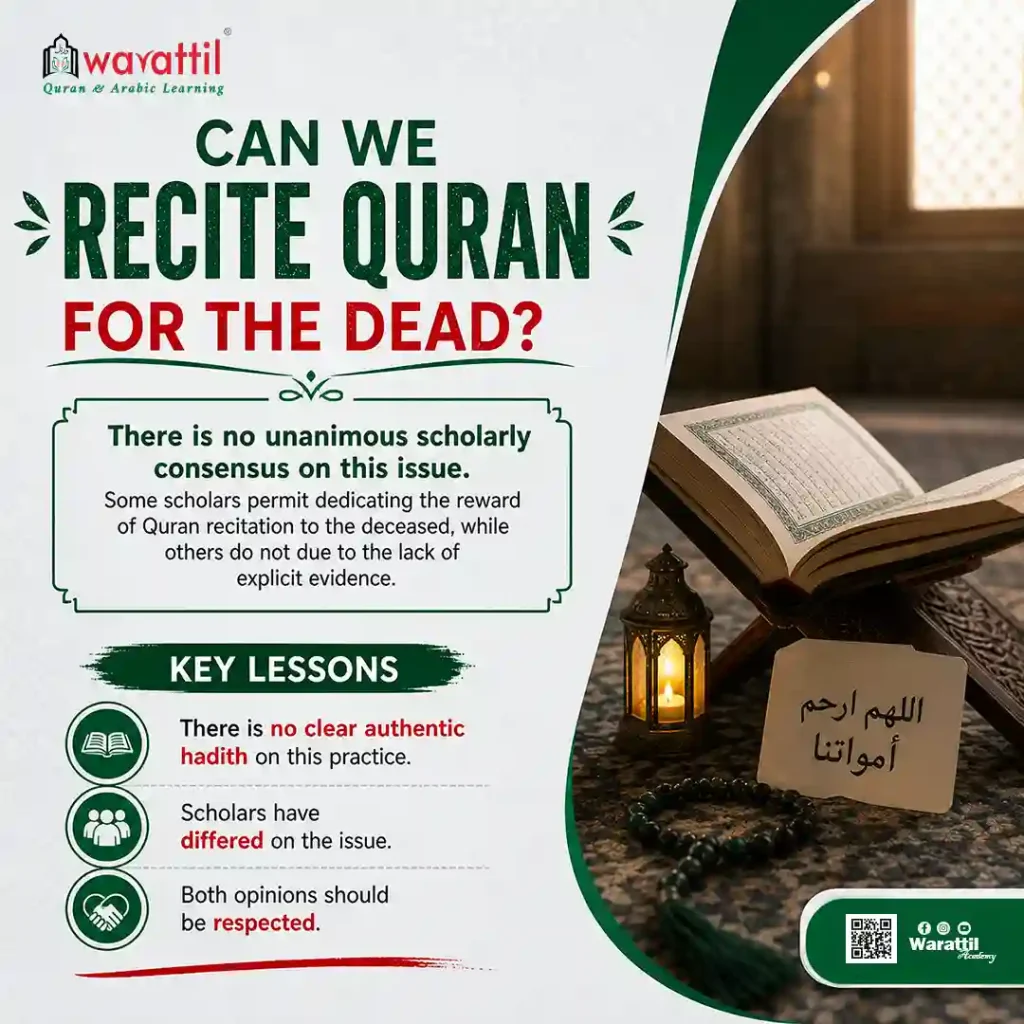
Can we recite Quran for the dead? This is one of the most frequently asked questions among Muslims, especially after the passing of a loved one. Many families gather to recite the Quran, hoping that the reward reaches the deceased, while others believe this practice is not supported by authentic Islamic evidence.
The reason for these different views is that Islamic scholars have held differing opinions on this issue for centuries. Their conclusions are based on how they interpret the Quran, authentic Hadith, and the principles of Islamic jurisprudence (Fiqh). Because respected scholars have reached different conclusions, this should be discussed with fairness and based on authentic sources rather than cultural practices or personal preferences.
This article explains what the Quran and Sunnah say, why scholars differ, and what Muslims can confidently do for those who have passed away.
The short answer is there is no unanimous scholarly consensus.
There is no authentic Hadith in which the Prophet Muhammad ﷺ explicitly instructed Muslims to recite the Quran specifically for a deceased person and dedicate its reward to them.
However, many classical scholars—including scholars from the Hanafi and Hanbali schools, and many later scholars from the Shafi’i and Maliki traditions—held that the reward of Quran recitation may reach the deceased if the reciter asks Allah to grant its reward to them. They based this on broader principles regarding acts of worship whose reward can be gifted to another person.
Other scholars, including many from the early Shafi’i school and scholars such as Imam al-Nawawi in his earlier discussions, argued that acts of worship should only be performed in the ways specifically established by authentic evidence, and therefore they did not recommend dedicating Quran recitation to the deceased without clear textual proof.
Because both positions are represented within mainstream Sunni scholarship, Muslims should respect the scholarly differences and avoid declaring the other opinion invalid. (Islam Q&A, IslamWeb)
The disagreement does not arise from the Quran itself but from how scholars interpret the available evidence.
One group of scholars argues that worship is based on revealed guidance, so new acts of worship or new ways of performing them require authentic evidence from the Prophet ﷺ.
The other group argues that if the reward of charity, Hajj, and supplication can benefit the deceased—as clearly established in authentic Hadith—then Allah may also allow the reward of Quran recitation to reach them when sincerely dedicated through du’a.
This difference is rooted in legal methodology rather than disagreement over the importance of the Quran.
The Quran does not specifically address the question of reciting the Quran for someone who has died.
However, one verse frequently discussed is:
“And that there is not for man except that [good] for which he strives.”
(Quran 53:39)
Some scholars understand this verse to mean that every person receives the reward of their own deeds unless authentic evidence establishes an exception.
Other scholars explain that authentic Hadith already show that some acts performed by others—such as charity and supplication—can benefit the deceased. Therefore, they argue that Allah may also accept the gifting of Quran recitation.
Because both interpretations exist among qualified scholars, neither should be presented as the only accepted Islamic view.
Authentic Hadith About Benefiting the Dead
Although there is no explicit Hadith commanding Quran recitation for the deceased, authentic narrations clearly establish that certain deeds benefit those who have passed away.
The Prophet Muhammad ﷺ encouraged believers to make sincere du’a for deceased Muslims.
He said that when praying over the deceased, believers should make sincere supplication for them.
This is one of the most authentic and universally accepted ways to benefit someone after death.
A man asked the Prophet ﷺ whether his deceased mother would benefit if he gave charity on her behalf.
The Prophet ﷺ replied:
“Yes.”
This Hadith is recorded in Sahih al-Bukhari and Sahih Muslim.
Authentic Hadith also establish that Hajj and Umrah may be performed on behalf of someone who passed away before completing their obligation.
These narrations demonstrate that some acts of worship performed by the living can benefit the deceased.
This is the central point of scholarly discussion.
Many scholars—including numerous Hanafi and Hanbali jurists—believed that if Muslims may gift the reward of charity and other good deeds, then Quran recitation may also be gifted to the deceased through sincere du’a asking Allah to accept it.
Other respected scholars disagreed because they did not find explicit evidence from the Prophet ﷺ or his Companions regularly dedicating Quran recitation to deceased individuals.
As a result, both positions continue to exist within mainstream Islamic scholarship.
Rather than treating the issue as one with a single definitive answer, Muslims are encouraged to follow qualified scholarship they trust while respecting differing opinions.
There are authentic reports showing that the Companions frequently:
However, there is no authentic report showing that the Prophet ﷺ regularly instructed his Companions to gather specifically for Quran recitation dedicated to the deceased.
This absence of evidence is one reason some scholars chose not to recommend the practice as a Sunnah.
Despite the scholarly disagreement regarding Quran recitation, there are several actions that all major scholars agree benefit the deceased.
These include:
These actions are supported by authentic evidence and are accepted across the major schools of Islamic jurisprudence.
One misunderstanding is that reciting the Quran for the deceased is either unquestionably obligatory or unquestionably forbidden.
Neither statement reflects the full scholarly discussion.
Another misunderstanding is that cultural customs automatically represent Islamic teachings. Some communities have traditions surrounding gatherings after death that developed over time. These customs should be distinguished from practices clearly established by authentic evidence.
Islam encourages believers to seek knowledge from reliable scholars and authentic sources rather than relying solely on inherited customs.
So, can we recite Quran for the dead?
The answer depends on the scholarly opinion one follows. While no authentic Hadith explicitly commands this practice, many respected scholars have concluded that Allah may allow the reward of Quran recitation to reach the deceased when it is sincerely dedicated through du’a. Other scholars prefer limiting acts of worship to those explicitly established by the Prophet ﷺ and therefore do not recommend dedicating Quran recitation to the deceased.
What all scholars agree upon is even more important: supplication, charity, paying debts, and fulfilling religious obligations on behalf of the deceased are authentic and beneficial acts supported by clear evidence.
When dealing with matters where qualified scholars have differed, Muslims should approach the issue with humility, respect for legitimate scholarly opinions, and a commitment to authentic Islamic sources.
Yes, many respected scholars permit dedicating the reward of Quran recitation to the deceased, while other equally respected scholars do not recommend it because they find no explicit textual evidence. Both opinions exist within Sunni scholarship.
No. There is no authentic Hadith in which the Prophet Muhammad ﷺ explicitly instructed Muslims to recite the Quran specifically for a deceased person and dedicate its reward.
The strongest evidence supports making sincere du’a, giving charity on their behalf, paying their debts, and performing acts clearly established in authentic Hadith.
No. Classical and contemporary scholars continue to hold different opinions based on their interpretation of the Quran, Hadith, and principles of Islamic law.

My son feels happy, amazing teachers and staff in wrattil and flexible prices MashaAllah Thank you so much
My daughter started learning in warattil academy and alhamdulilah we are really impressed and have enjoyed learning with wrattil. May Allah reward her sheikh
My teacher Ahmed is very good. He helped me recite and memorize holy Quran
Warattil is the most efficient way of learning Arabic. I like warattil curriculum and excellent teachers to support this learning Thank you so much
I highly recommend warattil Ijazah programs to anyone who wants to learn Quran properly.
Very well organized MashaAllah. I love it and this is a great course if you want to understand the Quran and learn tafsir
Warattil program is the best I have seen. The teacher is really great and is available to answer questions in a clear manner
I think warattil is the best academy in learning Arabic and I recommend Arabic course to anyone
We are so happy with ustad Hussein. He is very patient and comfortable teacher. May Allah the teachers and admin in warattil
Rating 10 mashaAllah and so grateful