Shopping cart
- +1 564-544-6614
- [email protected]
- 24/7 Available


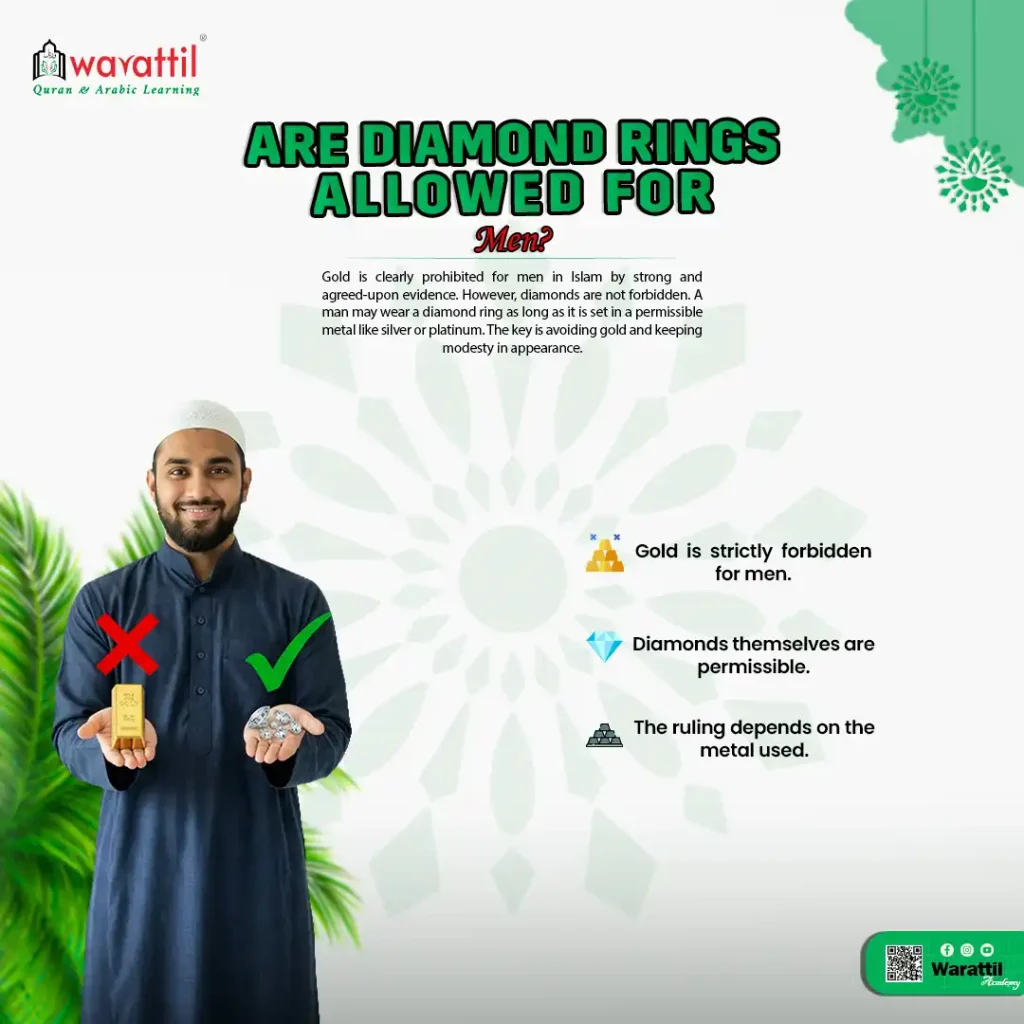
The question of whether men can wear diamonds in Islam comes up far more often than many people expect particularly among young Muslim men navigating wedding rings, professional accessories, and personal style.
The short answer is: yes, men can wear diamonds in Islam, but there are clear conditions attached to that permission. The diamond gemstone itself is not the problem. What matters and what Islam actually regulates is the metal in which the diamond is set, the style of jewellery it is placed in, and the intention behind wearing it.
This is not a trivial or unclear matter in Islamic scholarship. Multiple scholars from across different schools of thought have addressed it, and the general consensus is consistent. However, because people often confuse the ruling on gold with the ruling on gemstones, there is a great deal of unnecessary confusion surrounding this topic. This guide breaks it all down clearly, using authentic sources from the Quran, Sunnah, and recognised Islamic scholars.
Before getting into diamonds specifically, it is important to understand the foundation of all jewellery-related rulings for men in Islam and that foundation rests on the prohibition of gold.
“Gold and silk have been made lawful for the females of my Ummah and forbidden for the males.”
— Prophet Muhammad ﷺ | Sunan an-Nasa’i 5144, Sunan Abi Dawud 4057, Sunan Ibn Majah 3595 (Hasan)
This is not a matter of cultural preference or scholarly disagreement. All four major schools of Islamic law agree that gold is haram (forbidden) for men whether it is worn as a ring, chain, bracelet, watch, or any other form. Imam al-Nawawi, one of the most respected scholars in the Shafi’i tradition, stated in Al-Majmu’ that this prohibition is established by mass-transmitted hadiths and represents a matter of scholarly consensus (ijma’).
Another widely cited hadith reinforces this strongly. When the Prophet ﷺ saw a man wearing a gold ring, he removed it from the man’s hand and said:
“Would one of you deliberately take a burning coal and place it on his hand?”
— Prophet Muhammad ﷺ | Sahih Muslim, Hadith 2090
The companion, out of deep respect and obedience, never wore that ring again. This hadith is often referenced to show just how seriously the Prophet ﷺ treated this prohibition it was not a gentle suggestion but a firm directive.
Scholars explain that the wisdom behind this prohibition includes preserving modesty and humility in men, avoiding the imitation of feminine adornment, preventing arrogance and pride through excessive display of wealth, and maintaining clear distinctions between the genders in matters of dress and appearance.
Here is where the matter becomes clearer. Diamonds are not gold. They are precious stones that carry no independent prohibition in Islamic texts. The Quran does not forbid gemstones for men, and there is no authentic hadith that specifically prohibits a man from wearing a diamond.
Sheikh Ahmad Kutty, a senior Islamic scholar at the Islamic Institute of Toronto, stated: “Men are allowed to wear stones in their rings provided the stones do not fall under the category of unnecessary wastage.”
Islam Q&A, one of the most referenced fatwa portals globally, states clearly: “It is permissible for a man to wear rings and watches that contain precious metals or stones other than gold such as diamonds, because the basic principle is that they are permissible, and there is no evidence to suggest that they are not allowed.”
Similarly, IslamWeb’s fatwa states plainly: “The things made of platinum or diamonds are lawful for men.”
So, to be direct: a diamond ring set in silver, platinum, titanium, or stainless steel is permissible for a Muslim man to wear. The diamond itself is not the issue it never was. The issue is always about the metal, the jewellery type, and the intention.

While all four major schools of Islamic jurisprudence agree on the gold prohibition, their positions on other metals and gemstones vary in nuance. Here is a summarised breakdown:
Only a silver ring is definitively permitted for men. Rings made of other materials including stones or gemstones are generally considered impermissible. Some scholars within this school discourage diamond rings for men due to their association with ornamentation.
Gemstones set in non-gold metals are generally permitted for men as a ring. Gold in any form is prohibited, and even trace amounts are considered discouraged (makruh). Avoiding doubtful matters is strongly encouraged.
Rings set in silver or permissible metals including those with precious stones are allowed for men. Gold is completely prohibited in any amount or form. The Nawawi-authored Al-Majmu’ supports permissibility of non-gold rings with stones.
Permissible metals and gemstones are allowed for men in the form of a ring. Gold including gold-plated items is forbidden. Designs that imitate women’s jewellery are impermissible regardless of the material used.
The key takeaway is that the majority position across the four madhabs permits diamond rings for men when set in halal metals. The Hanafi caution is worth noting, particularly for those who follow that school, but even within the Hanafi tradition, scholarly opinions differ on this nuance.
Even when a diamond ring is technically permissible, Islamic ethics do not operate on a simple halal/haram binary. There are several important conditions that must be considered:
| Condition | Ruling | Explanation |
| Metal Choice | Required | Metal must not be gold. Silver, platinum, titanium, and stainless steel are permitted. Gold in any form is haram (forbidden) for men. |
| Design Style | Required | Must be masculine. The ring must not imitate feminine jewelry—avoid delicate, ornate, or overly decorative patterns. |
| Intent & Humility | Required | No arrogance (Kibr). Wearing a diamond to display superiority or wealth renders the act sinful, even if the item is otherwise permissible. |
| Financial Moderation | Required | No extravagance (Israf). Excessive spending while others suffer is discouraged; the Quran condemns wastefulness (Al-Isra 17:27). |
| Placement | Preferred | Worn on the hand only. Rings are generally the only jewelry permitted for men—avoid bracelets, necklaces, or earrings. |
| Adherence to Sunnah | Recommended | Simple silver is best. While diamonds are permitted, a plain silver ring follows the Sunnah tradition and is considered preferable by many scholars. |
It is not enough to simply say “diamonds are fine.” There are specific jewellery types that are impermissible for Muslim men regardless of whether they contain diamonds or not.
Necklaces are considered women’s jewellery across Islamic scholarship. A man wearing a diamond necklace falls under the prohibition of imitating women (tashabbuh bil-nisa).
Bracelets are unanimously considered a form of feminine adornment. All four madhabs agree they are impermissible for men, regardless of material.
Earrings are clearly forbidden for men. Wearing them involves imitating women and, in most forms, also contains gold — making it doubly impermissible.
No matter how beautiful or culturally significant the ring, if the setting is gold, it is haram. This applies to yellow gold, white gold, and rose gold.
In Islam, intention is at the heart of every act. The Prophet ﷺ taught: “Actions are judged by intentions.” This principle applies to wearing jewellery just as it applies to prayer, charity, or fasting.
A Muslim man who wears a modest diamond ring in a permissible metal perhaps as a wedding band or out of personal preference without any desire to show off or imitate women is in a very different position from someone who deliberately selects the most expensive diamond available to signal wealth and status to others.
SeekersGuidance notes, based on Nawawi’s Al-Majmu’: “It is also impermissible to wear a diamond ring out of pride or to show off, as this can break the hearts of the poor and goes against the humble example set by the Prophet ﷺ and his Companions.” The same source recommends a plain silver ring as the best practice, following the Sunnah directly.
This does not mean that wearing a diamond ring is inherently a sign of arrogance. Many Muslim men wear simple, elegant rings containing modest gemstones without any trace of vanity. The key is awareness — being conscious of why you are wearing something and ensuring it reflects the humility that Islam encourages in all aspects of life.
Whether you decide to wear a diamond ring or not, it is useful to know what your permissible options are when it comes to jewellery and accessories in Islam:
The most highly recommended option. The Prophet ﷺ himself wore a silver ring, making it a direct Sunnah practice. Plain or with a modest stone, it is fully halal.
Platinum is explicitly mentioned as halal for men by multiple scholars and fatwa bodies. A platinum band with a diamond is entirely permissible.
Modern, masculine, and fully halal. Stainless steel and titanium rings are excellent choices that involve no scholarly controversy whatsoever.
For accessories beyond rings such as watch straps or wristbands for functional use leather and wood remain permissible natural materials.
The question of whether men can wear diamonds in Islam has a clear and well-supported answer: yes, with conditions. Diamonds as gemstones are not prohibited by the Quran or authentic Sunnah. The real rules are about the metal (no gold, ever), the jewellery style (no feminine items like necklaces or bracelets), and the intention (no arrogance or extravagance).
A modest diamond ring set in silver, platinum, or titanium falls well within what is permissible for a Muslim man, according to the majority of scholars across multiple madhabs. Those who follow the Hanafi school should note the more conservative position and consult a trusted Hanafi scholar if they are unsure about their specific situation.
What Islam ultimately asks of us in jewellery as in all things is not rigid restriction for its own sake, but a conscious awareness of how our choices reflect our faith, our humility, and our relationship with Allah. A simple silver ring in the Sunnah tradition remains the highest recommendation. But a thoughtfully chosen, modest diamond ring in a permissible setting is, by the scholarship of the deen, entirely within the bounds of what Allah has made lawful.
1.Can Muslim men wear diamond wedding rings?
Yes, as long as the band is a halal metal (silver, platinum, titanium). Gold settings are strictly haram for men.
2.Are diamonds haram for men?
No. Islamic prohibitions apply to gold and silk, not gemstones. Scholars confirm diamonds are permissible in non-gold settings.
3.Are lab-grown diamonds halal?
Yes. They are physically identical to mined diamonds. Their lower cost can also help avoid israf (extravagance).
4.Does the size or style matter?
Yes. The design must be masculine. Additionally, wearing a large diamond to show off or feel superior (kibr) is considered sinful.
5.What is the best metal to use?
Silver is the most recommended as it follows the Sunnah. However, platinum and titanium are also fully permissible.

My son feels happy, amazing teachers and staff in wrattil and flexible prices MashaAllah Thank you so much
My daughter started learning in warattil academy and alhamdulilah we are really impressed and have enjoyed learning with wrattil. May Allah reward her sheikh
My teacher Ahmed is very good. He helped me recite and memorize holy Quran
Warattil is the most efficient way of learning Arabic. I like warattil curriculum and excellent teachers to support this learning Thank you so much
I highly recommend warattil Ijazah programs to anyone who wants to learn Quran properly.
Very well organized MashaAllah. I love it and this is a great course if you want to understand the Quran and learn tafsir
Warattil program is the best I have seen. The teacher is really great and is available to answer questions in a clear manner
I think warattil is the best academy in learning Arabic and I recommend Arabic course to anyone
We are so happy with ustad Hussein. He is very patient and comfortable teacher. May Allah the teachers and admin in warattil
Rating 10 mashaAllah and so grateful