Shopping cart
- +1 564-544-6614
- [email protected]
- 24/7 Available


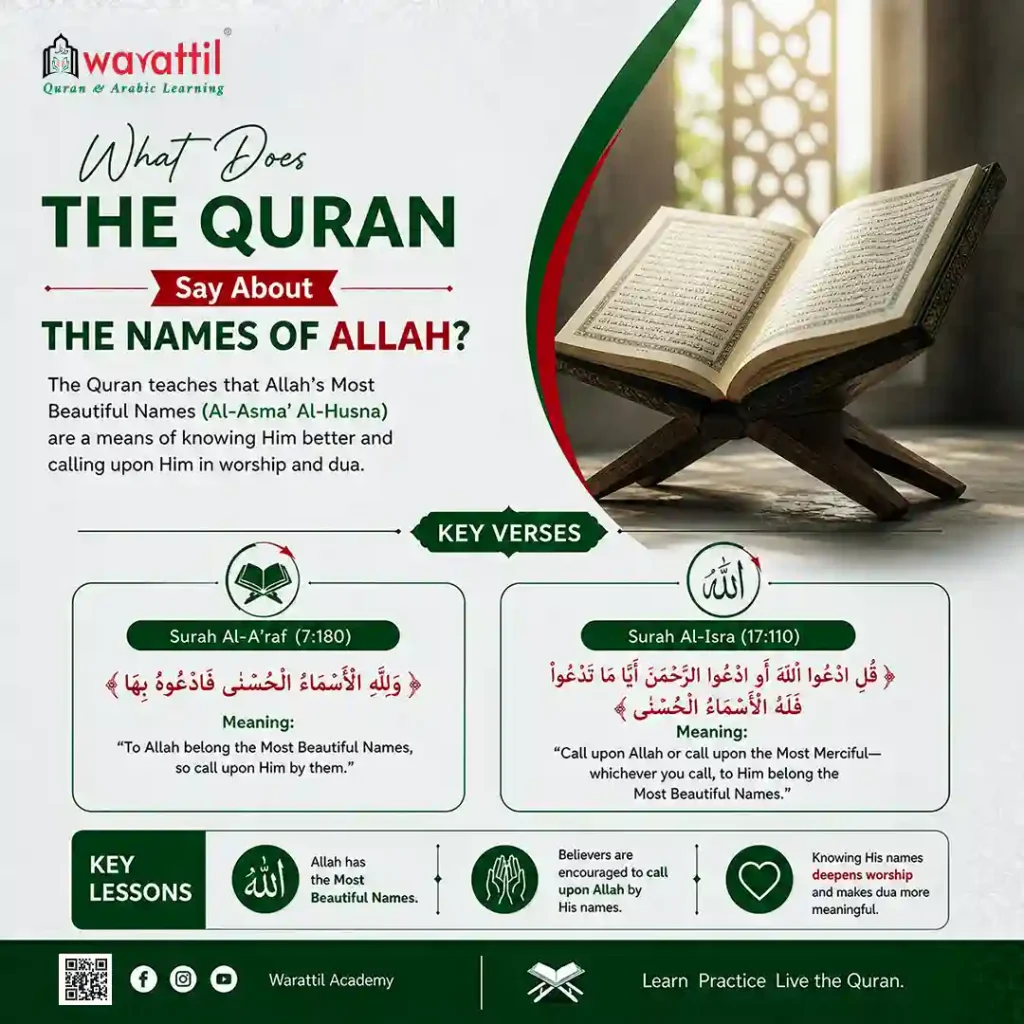
The Allah names in Quran ayat reveal profound truths about who Allah is and help believers understand His mercy, knowledge, power, wisdom, and authority. Throughout the Quran, Allah introduces Himself through beautiful names and divine attributes that deepen a Muslim’s understanding of faith and worship.
Names such as Ar-Rahman (The Most Compassionate), Ar-Rahim (The Most Merciful), Al-Malik (The King), Al-Quddus (The Most Holy), Al-Hayy (The Ever-Living), and Al-Qayyum (The All-Sustaining) appear in important Quranic passages.
The Quran refers to Allah’s names as Al-Asma al-Husna, meaning “the Most Beautiful Names.” Rather than treating these names as a simple list to memorise, Muslims can study the Quranic verses in which they appear and reflect on what each name teaches about Allah.
One of the clearest references to the beautiful names of Allah appears in Surah Al-A’raf:
Arabic:
وَلِلَّهِ الْأَسْمَاءُ الْحُسْنَىٰ فَادْعُوهُ بِهَا
Meaning:
“To Allah belong the Most Beautiful Names, so call upon Him by them.”
Reference: Surah Al-A’raf, 7:180
This verse establishes an important connection between knowing Allah’s names and worshipping Him. Muslims are encouraged to call upon Allah by His beautiful names.
For example, a believer seeking mercy may call upon Allah as Ar-Rahman and Ar-Rahim, while someone asking for forgiveness may call upon Him as Al-Ghafur, the All-Forgiving. In this way, learning the divine names can make a person’s understanding of dua more meaningful.
Another important verse appears in Surah Al-Isra:
Arabic:
قُلِ ادْعُوا اللَّهَ أَوِ ادْعُوا الرَّحْمَٰنَ أَيًّا مَا تَدْعُوا فَلَهُ الْأَسْمَاءُ الْحُسْنَىٰ
Meaning:
The verse teaches that whether people call upon Allah or call upon Ar-Rahman, to Him belong the Most Beautiful Names.
Reference: Surah Al-Isra, 17:110
These Quranic passages form an important foundation for understanding the names and attributes of Allah in Islam.

Among the most remarkable passages containing several names of Allah are the final verses of Surah Al-Hashr. Verses 22–24 bring together numerous divine names and attributes in a powerful description of Allah.
Arabic:
هُوَ اللَّهُ الَّذِي لَا إِلَٰهَ إِلَّا هُوَ عَالِمُ الْغَيْبِ وَالشَّهَادَةِ هُوَ الرَّحْمَٰنُ الرَّحِيمُ
Meaning:
The verse declares that Allah alone is worthy of worship. He knows what is unseen and what is witnessed, and He is Ar-Rahman, the Most Compassionate, and Ar-Rahim, the Most Merciful.
Several important descriptions of Allah appear here.
Ar-Rahman (الرَّحْمَٰن) means the Most Compassionate or Entirely Merciful.
Ar-Rahim (الرَّحِيم) means the Most Merciful.
The verse also describes Allah as the Knower of the unseen and the witnessed. Nothing hidden or visible lies outside His knowledge.
The pairing of Ar-Rahman and Ar-Rahim appears frequently in Islamic worship, most notably in the phrase Bismillahir-Rahmanir-Rahim. Together, these names continually remind believers of the central place of divine mercy.
Arabic:
هُوَ اللَّهُ الَّذِي لَا إِلَٰهَ إِلَّا هُوَ الْمَلِكُ الْقُدُّوسُ السَّلَامُ الْمُؤْمِنُ الْمُهَيْمِنُ الْعَزِيزُ الْجَبَّارُ الْمُتَكَبِّرُ سُبْحَانَ اللَّهِ عَمَّا يُشْرِكُونَ
This verse contains a remarkable collection of Allah’s beautiful names:
Al-Malik (الْمَلِكُ) – The King or Sovereign
Allah possesses complete sovereignty and authority over creation. His rule is not temporary or limited by the conditions that affect human authority.
Al-Quddus (الْقُدُّوسُ) – The Most Holy or Most Pure
This name expresses Allah’s absolute perfection and freedom from every deficiency.
As-Salam (السَّلَامُ) – The Source of Peace and Perfection
The name points to Allah’s perfection and His freedom from imperfection. It is also closely associated with peace and security.
Al-Mu’min (الْمُؤْمِنُ) – The Granter of Security
Translations and scholarly explanations may express the meaning of this name in slightly different ways, including the Granter of Security and the Giver of Faith.
Al-Muhaymin (الْمُهَيْمِنُ) – The Supreme Overseer
Allah watches over His creation with complete knowledge and authority. Nothing escapes His awareness.
Al-Aziz (الْعَزِيزُ) – The Almighty
This name expresses perfect might, honour, and power.
Al-Jabbar (الْجَبَّارُ) – The Compeller
The Arabic name carries meanings connected with irresistible authority and supreme power. English translations vary because no single English word captures every shade of the original Arabic meaning.
Al-Mutakabbir (الْمُتَكَبِّرُ) – The Supremely Great
True and absolute greatness belongs to Allah alone. Unlike human arrogance, which comes from an exaggerated view of oneself, Allah’s greatness is perfect and completely true.
Arabic:
هُوَ اللَّهُ الْخَالِقُ الْبَارِئُ الْمُصَوِّرُ لَهُ الْأَسْمَاءُ الْحُسْنَىٰ يُسَبِّحُ لَهُ مَا فِي السَّمَاوَاتِ وَالْأَرْضِ وَهُوَ الْعَزِيزُ الْحَكِيمُ
This verse highlights Allah as the Creator and describes three names closely connected with creation.
Al-Khaliq (الْخَالِقُ) – The Creator
Everything in creation ultimately exists by Allah’s will and creative power.
Al-Bari’ (الْبَارِئُ) – The Originator
This name expresses Allah’s unique power to bring creation into existence according to His wisdom.
Al-Musawwir (الْمُصَوِّرُ) – The Fashioner
Allah gives His creation its forms and distinctive characteristics.
The verse concludes with two further names: Al-Aziz, the Almighty, and Al-Hakim, the All-Wise.
Together, Surah Al-Hashr 59:22–24 provides one of the Quran’s richest passages for studying the names and attributes of Allah.
Ayat al-Kursi, Surah Al-Baqarah 2:255, is another important verse for understanding Allah’s names and attributes.
Arabic:
اللَّهُ لَا إِلَٰهَ إِلَّا هُوَ الْحَيُّ الْقَيُّومُ
The verse begins by declaring that no one is worthy of worship except Allah and then introduces two significant names.
Al-Hayy (الْحَيُّ) means the Ever-Living. Allah’s life is perfect and eternal. Unlike created beings, His existence is not dependent upon anyone or anything.
Al-Qayyum (الْقَيُّومُ) describes Allah as the One who is self-sustaining and who sustains creation.
Ayat al-Kursi continues by describing Allah’s perfect knowledge, authority, and power. Neither drowsiness nor sleep overtakes Him, and everything in the heavens and earth belongs to Him.
The verse concludes:
Arabic:
وَهُوَ الْعَلِيُّ الْعَظِيمُ
Here we find two more beautiful names.
Al-Aliyy (الْعَلِيُّ) – The Most High
Al-Azim (الْعَظِيمُ) – The Magnificent or Greatest
Therefore, Ayat al-Kursi presents several important divine names while also explaining the attributes connected with Allah’s knowledge, life, authority, and greatness.
The opening chapter of the Quran introduces believers to several essential names and descriptions of Allah.
It begins:
Arabic:
بِسْمِ اللَّهِ الرَّحْمَٰنِ الرَّحِيمِ
The names Ar-Rahman and Ar-Rahim immediately place divine mercy at the beginning of the chapter.
The next verse says:
Arabic:
الْحَمْدُ لِلَّهِ رَبِّ الْعَالَمِينَ
Allah is described as Rabb al-‘Alamin, the Lord of all worlds.
Later, the chapter says:
Arabic:
مَالِكِ يَوْمِ الدِّينِ
Allah is described as the Master or Sovereign of the Day of Judgment.
These verses establish fundamental truths about the relationship between Allah and His creation. He is merciful, He is the Lord who sustains creation, and ultimate judgment belongs to Him.
Surah Al-Ikhlas is a short chapter, yet it provides one of the clearest Quranic descriptions of Allah’s absolute oneness and uniqueness.
Arabic:
قُلْ هُوَ اللَّهُ أَحَدٌ
اللَّهُ الصَّمَدُ
لَمْ يَلِدْ وَلَمْ يُولَدْ
وَلَمْ يَكُنْ لَهُ كُفُوًا أَحَدٌ
The chapter declares that Allah is Ahad, One and unique, and As-Samad, a name whose rich Arabic meaning conveys complete self-sufficiency and the One upon whom creation depends.
The remainder of the Surah rejects the idea that Allah has offspring, was born, or has any equal.
This is central to the Quranic teaching of Tawhid, the absolute oneness of Allah. The names and attributes of Allah must therefore be understood in a way that preserves His uniqueness and does not compare Him with His creation.

Among the most frequently recognised names of Allah are Ar-Rahman and Ar-Rahim. Both names are connected with divine mercy, although scholars have discussed nuances in their meanings.
These names appear together in the opening of Surah Al-Fatihah:
الرَّحْمَٰنِ الرَّحِيمِ
They also appear together in Surah Al-Hashr 59:22.
The Quran’s repeated emphasis on these names reminds believers that mercy is fundamental to understanding their relationship with Allah. At the same time, the Quran also speaks of Allah’s justice, knowledge, wisdom, and authority, providing a balanced understanding of His divine attributes.
The Quran frequently connects Allah’s forgiveness with His mercy.
One example appears in Surah Az-Zumar 39:53, where those who have wronged themselves are told not to lose hope in Allah’s mercy. The verse declares that Allah forgives sins and describes Him as Al-Ghafur, the All-Forgiving, and Ar-Rahim, the Most Merciful.
The message is one of hope and encourages sincere return to Allah. However, verses about forgiveness should be understood alongside the broader Quranic teachings about repentance, faith, and personal responsibility.
Knowing Allah as Al-Ghafur can encourage a believer to seek forgiveness rather than fall into despair after making mistakes.
Al-Alim (الْعَلِيمُ) means the All-Knowing. The name and related descriptions of Allah’s complete knowledge appear throughout the Quran.
Allah’s knowledge is not limited by time, distance, or human perception. The Quran repeatedly teaches that He knows what people reveal and what they conceal.
This understanding has practical importance for believers. It reminds them that sincere intentions are known to Allah even when other people cannot see them. At the same time, it encourages personal accountability because hidden actions are not outside divine knowledge.
The name Al-Hakim (الْحَكِيمُ) is commonly translated as the All-Wise. It appears in numerous Quranic passages and is often paired with other divine names.
For example, Surah Al-Hashr 59:24 concludes by describing Allah as Al-Aziz, Al-Hakim — the Almighty, the All-Wise.
The combination is significant. Allah’s power is accompanied by perfect wisdom. From an Islamic perspective, His actions and commands are not based on ignorance or limitation.
Reflecting on Al-Hakim can strengthen a believer’s understanding that divine wisdom extends beyond the limits of human knowledge.
Studying Allah names in Quran ayat is more meaningful when the names are understood within their Quranic context. Each name teaches something about Allah and can deepen a believer’s understanding of worship.
Learning Ar-Rahman encourages reflection on divine compassion. Understanding Al-Ghafur reminds believers of forgiveness. Al-Alim teaches that Allah’s knowledge is complete, while Al-Hakim points towards perfect wisdom. Al-Khaliq directs attention towards creation, and Al-Malik reminds believers of Allah’s ultimate sovereignty.
For this reason, memorising the names can be valuable, but understanding their meanings and the verses in which they appear provides a deeper foundation for reflection.
No. The Quran does not contain one verse that presents a numbered list of all 99 names of Allah.
The Quran clearly states that Allah possesses Al-Asma al-Husna, the Most Beautiful Names, and numerous divine names appear throughout its chapters. The well-known Islamic tradition concerning 99 names is connected with authentic hadith reports.
However, discussions exist among scholars regarding the identification of a single definitive enumerated list of exactly 99 names. For this reason, it is more accurate to distinguish between the Quranic statement that Allah possesses the Most Beautiful Names and later compiled lists that gather particular names from the Quran and Sunnah.
This distinction helps readers approach the subject with greater accuracy.
A useful approach is to study each divine name together with the verse in which it appears. Context often reveals important aspects of its meaning that a simple English translation cannot fully communicate.
For instance, studying Al-Hayy and Al-Qayyum within Ayat al-Kursi reveals their relationship with Allah’s eternal life, complete independence, knowledge, and sustaining power. Similarly, reading the final verses of Surah Al-Hashr together provides a broader picture of Allah’s mercy, sovereignty, holiness, power, creativity, and wisdom.
Readers should also remember that Arabic words often carry layers of meaning that cannot always be represented by a single English word. Consulting reliable Quran translations and recognised tafsir can therefore provide a fuller understanding.
Exploring Allah names in Quran ayat offers a meaningful way to develop a deeper understanding of Islamic belief. The Quran introduces Allah through names that express His mercy, knowledge, wisdom, power, forgiveness, sovereignty, and perfection.
Passages such as the final verses of Surah Al-Hashr bring many beautiful names together, while Ayat al-Kursi presents profound descriptions of Allah’s eternal life, sustaining power, knowledge, and greatness. Surah Al-Ikhlas, meanwhile, expresses the foundation of Tawhid by declaring Allah’s absolute oneness and uniqueness.
Learning these names should go beyond memorisation. By studying their meanings, reading the Quranic passages in context, and reflecting on the attributes they express, believers can gain a richer understanding of Allah and a more thoughtful connection with the Quran.
The names and attributes of Allah appear throughout the Quran. Some particularly notable passages include Surah Al-Hashr 59:22–24, Ayat al-Kursi in Surah Al-Baqarah 2:255, Surah Al-Ikhlas, and Surah Al-Fatihah.
Surah Al-Hashr 59:22–24 contains a notable concentration of divine names, including Ar-Rahman, Ar-Rahim, Al-Malik, Al-Quddus, As-Salam, Al-Mu’min, Al-Muhaymin, Al-Aziz, Al-Jabbar, Al-Mutakabbir, Al-Khaliq, Al-Bari’, Al-Musawwir, and Al-Hakim.
Al-Asma al-Husna means “the Most Beautiful Names.” The Quran states that the Most Beautiful Names belong to Allah and instructs believers to call upon Him by them.
Ayat al-Kursi explicitly includes names such as Al-Hayy and Al-Qayyum near its beginning and Al-Aliyy and Al-Azim at its conclusion. The verse also describes Allah’s complete knowledge, sovereignty, and power.
Surah Al-Ikhlas describes Allah as Ahad, meaning One and uniquely One, and As-Samad, commonly understood in relation to Allah’s absolute self-sufficiency and the dependence of creation upon Him. The chapter strongly affirms Allah’s uniqueness and incomparability.
Many well-known names of Allah are found directly in the Quran. However, the Quran does not provide a single numbered verse or chapter listing exactly 99 names. The well-known concept of 99 names is also rooted in hadith literature.

My son feels happy, amazing teachers and staff in wrattil and flexible prices MashaAllah Thank you so much
My daughter started learning in warattil academy and alhamdulilah we are really impressed and have enjoyed learning with wrattil. May Allah reward her sheikh
My teacher Ahmed is very good. He helped me recite and memorize holy Quran
Warattil is the most efficient way of learning Arabic. I like warattil curriculum and excellent teachers to support this learning Thank you so much
I highly recommend warattil Ijazah programs to anyone who wants to learn Quran properly.
Very well organized MashaAllah. I love it and this is a great course if you want to understand the Quran and learn tafsir
Warattil program is the best I have seen. The teacher is really great and is available to answer questions in a clear manner
I think warattil is the best academy in learning Arabic and I recommend Arabic course to anyone
We are so happy with ustad Hussein. He is very patient and comfortable teacher. May Allah the teachers and admin in warattil
Rating 10 mashaAllah and so grateful