Shopping cart
- +1 564-544-6614
- [email protected]
- 24/7 Available


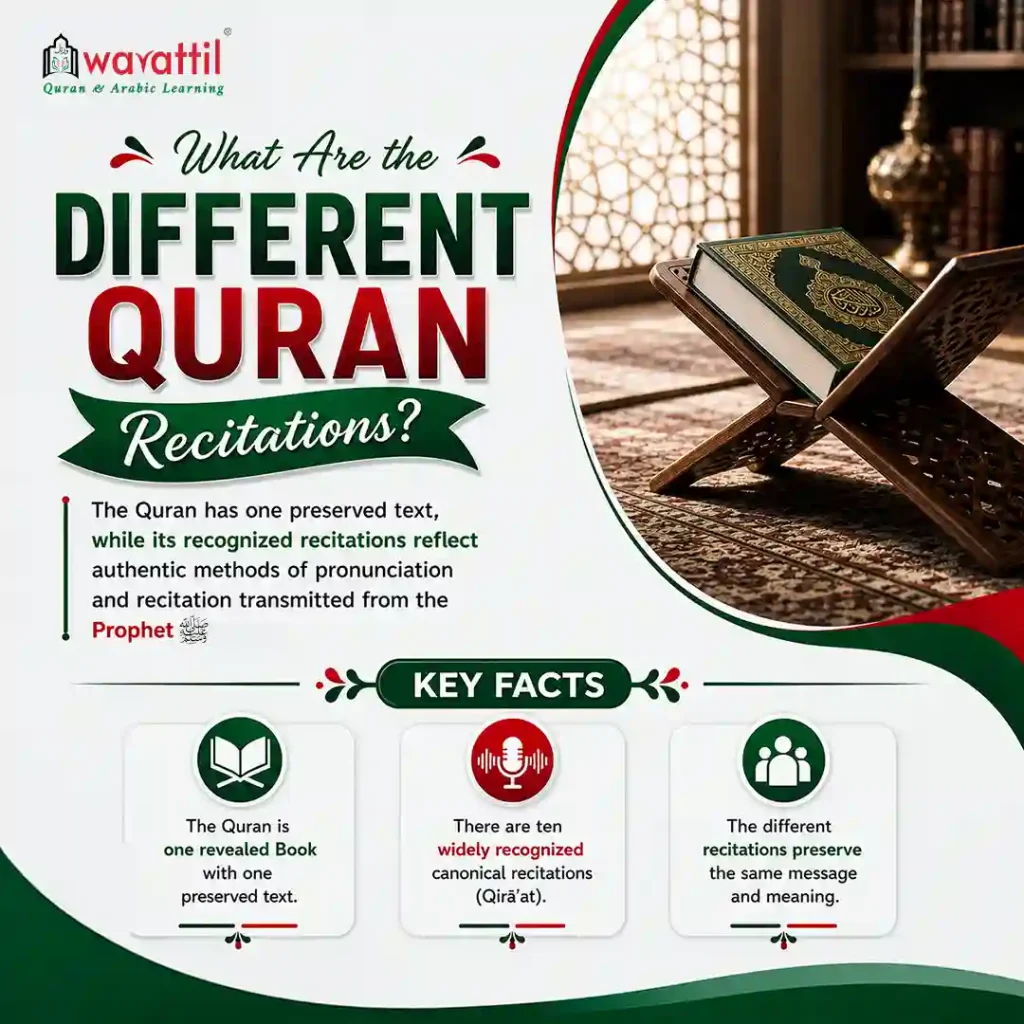
If you have ever searched for how many versions of Quran are there, you probably stumbled upon a mixture of confusion, bold claims, and outright misinformation. The question itself can mean very different things depending on who asks it, so let us begin with the clear, straightforward answer: There is only one Quran. The text that millions of Muslims recite, memorise, and turn to every single day is a single, unchanged book. Yet the answer does not stop there, because “versions” is a word that often points to something much richer – the divinely authorised modes of recitation known as the qira’at. Understanding this distinction transforms a seemingly simple query into an appreciation of how meticulously the Quran has been preserved.
When most people ask how many versions of Quran are there, they are almost never asking about different books with different words. They are reaching for an explanation of why you might hear a Moroccan reciter pronounce a word slightly differently from a Saudi imam, or why certain editions of the Arabic text have tiny orthographic marks that others lack. These are not different Qurans; they are different readings of the identical Uthmanic codex, all of which trace back to the Prophet Muhammad ﷺ through unbroken chains of transmission. The confusion arises because Western languages often translate qira’at as “versions,” a term that implies textual discrepancy rather than divinely revealed flexibility.
The fact that the Quran came down in multiple modes – traditionally referred to as the seven aḥruf – is a concession from God to accommodate the dialects of the early Arab tribes. From those modes, scholars later codified a set of canonical recitations that have survived until today. When you hear the number ten mentioned, that is the count of widely recognised mutawatir (mass-transmitted) qira’at. From those ten, twenty major riwayat (transmissions) branch out. So, if you pressed for a number, you could say there are ten canonical recitation traditions, but the Quran itself remains a single, unified revelation.
The ten qira’at are each named after a renowned reciter from the early centuries of Islam, and each was passed down through two primary students. The seven most famous, recorded in detail by the scholar Ibn Mujāhid in the 4th Islamic century, are:
Later, three more reciters were added to complete the ten, bringing the total number of accepted transmissions to twenty. The reader you are most familiar with is almost certainly Ḥafṣ ʿan ʿĀṣim, the transmission that dominates the modern Muslim world, printed everywhere from Saudi Arabia to Indonesia. In North and West Africa, however, Warsh ʿan Nāfiʿ holds sway, and in parts of Libya and Tunisia you will find Qālūn ʿan Nāfiʿ. What all of these recitations share is the exact same revealed words; the differences are in pronunciation, elongation, and, in a limited number of instances, a consonant or vowel that alters the shade of meaning without ever contradicting it.
A common misunderstanding suggests that there must be different “Quran books” for these recitations, but that is not how the written tradition works. The original Uthmanic codices were penned without diacritical dots or vowel signs, precisely so they could accommodate multiple valid recitations simultaneously. As later generations added dotting and vocalisation to fix one reading at a time, separate printed muṣḥafs emerged – one marked for Ḥafṣ, another for Warsh, another for Qālūn, and so on. The underlying consonantal skeleton, however, remains identical in all standard prints. No “version” adds or removes a surah, changes the order, or tampers with the core message. When you hold a Ḥafṣ muṣḥaf and compare it with a Warsh muṣḥaf, you will spot small differences like the spelling of words such as yakhdaʿūn versus yukhādiʿūn, or the famous variation in Sūrat al-Fātiḥah between maliki yawm al-dīn and māliki yawm al-dīn. Both readings enrich the meaning – master and owner – without any conflict.
Labelling these recitations as “versions” opens the door to a serious misconception. A version of a book typically implies a later edition, a revision, or a translation that departs from the original. The qira’at are none of these things. They are all part of the original revelation, taught by Gabriel to the Prophet, and preserved with a rigour that has no parallel in ancient texts. Muslim scholars treat every authorised qira’a as part of the Quranic text itself, not a separate entity. The moment you recite with Warsh in your prayer, you have recited the Quran; the same holds true for Ḥafṣ. Therefore, asking how many versions of Quran are there in the hope of uncovering different sets of content is a dead end. The number of recitations you can point to is ten, but the number of Qurans is one.
It is tempting to reach for the word “version” because it sounds familiar in English discourse about books. Yet when you apply it to the Quran, it distorts the reality. Muslims do not possess a Ḥafṣ Version, a Warsh Version, and a Qālūn Version sitting alongside each other as alternative texts. They possess one Book, gifted with multiple authentic oral expressions. So, to the question how many versions of Quran are there, the most honest reply you can give is this: the Quran has no versions. It has ten major recitation traditions – each perfectly preserved, each divinely sanctioned – that collectively form the single unchanged Word of God. Understanding that is far more rewarding than any simple number.

My son feels happy, amazing teachers and staff in wrattil and flexible prices MashaAllah Thank you so much
My daughter started learning in warattil academy and alhamdulilah we are really impressed and have enjoyed learning with wrattil. May Allah reward her sheikh
My teacher Ahmed is very good. He helped me recite and memorize holy Quran
Warattil is the most efficient way of learning Arabic. I like warattil curriculum and excellent teachers to support this learning Thank you so much
I highly recommend warattil Ijazah programs to anyone who wants to learn Quran properly.
Very well organized MashaAllah. I love it and this is a great course if you want to understand the Quran and learn tafsir
Warattil program is the best I have seen. The teacher is really great and is available to answer questions in a clear manner
I think warattil is the best academy in learning Arabic and I recommend Arabic course to anyone
We are so happy with ustad Hussein. He is very patient and comfortable teacher. May Allah the teachers and admin in warattil
Rating 10 mashaAllah and so grateful