Shopping cart
- +1 564-544-6614
- [email protected]
- 24/7 Available


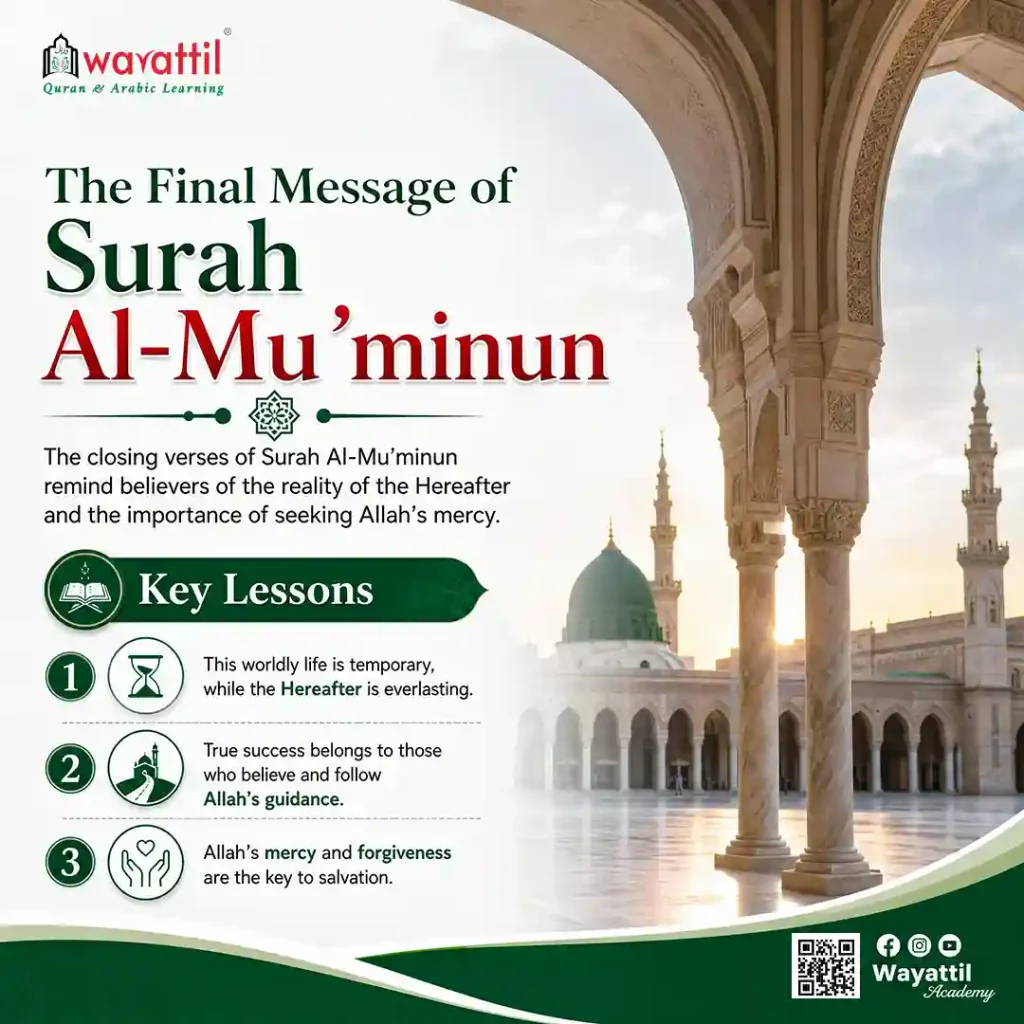
The surah muminoon last 4 ayat benefits are often discussed by Muslims who regularly recite and reflect on these powerful verses from the Quran. The final four verses of Surah Al-Mu’minun (23:115–118) contain profound reminders about the purpose of human life, accountability before Allah, His absolute sovereignty, and the importance of seeking His forgiveness and mercy.
These verses encourage believers to reflect on their relationship with Allah and to remember that life is not without purpose. While many Muslims recite these ayat as part of their daily worship, the greatest benefit comes from understanding their message and applying their teachings in everyday life.
Surah Al-Mu’minun is the 23rd chapter of the Quran. It focuses on the characteristics of successful believers, the signs of Allah’s creation, and the ultimate reality of the Hereafter.
The last four verses conclude the Surah with powerful reminders about:
These themes make the final verses particularly meaningful for Muslims seeking spiritual growth and a stronger connection with their faith.
Understanding the weight of these final four verses requires a brief look at what precedes them. Surah Al-Mu’minun, a Meccan revelation, builds its argument methodically. It begins by listing the qualities of true believers humility in prayer, avoidance of idle talk, active purification through charity, and guarding of chastity.
It then moves through the signs of creation, the stories of previous prophets, and the repeated refusals of their people to accept the truth. By the time the reader reaches the final passage, a tension has been carefully constructed: the believers have been described in their ideal state, and the disbelievers have been warned repeatedly. The question hanging in the air is simply this what will the final judgment look like?
The Surah Muminoon last 4 ayat benefits emerge precisely here, at the point of resolution. The verses function as a climactic conclusion that answers the implicit question posed throughout the chapter. They are not gentle suggestions; they are a divine proclamation that dismantles arrogance and simultaneously extends an offer of redemption that should leave no heart unmoved.
Verse 115: The Interrogation of Purpose
The passage opens with a piercing rhetorical question: Afahasibtum annama khalaqnakum ‘abathan wa annakum ilayna la turja’un “Did you think that We had created you in play, and that you would not be brought back to Us?” The word ‘abathan carries the connotation of aimless play, a thing done without serious purpose. This single verse dismantles the worldview that treats existence as a biological accident with no moral consequence. The question is directed at every human being who lives as though accountability were a myth. By placing this verse at the forefront of the concluding passage, Allah forces a confrontation with the most fundamental of all questions: the reason for one’s own existence.
Verse 116: The Declaration of Sovereign Truth
The next verse elevates the discourse from interrogation to glorification: Fata‘ala Allahu al-Maliku al-Haqq—”So exalted is Allah, the Sovereign, the Truth.” The transition marked by the particle fa indicates a logical consequence. Because creation is purposeful, the Creator must be exalted above the false attributions given by those who deny the resurrection. The pairing of al-Malik (the Sovereign) and al-Haqq (the Truth) is deliberate. His sovereignty is not arbitrary power; it is truth-based authority. There is no deity except Him, Lord of the Noble Throne. This verse serves as a verbal fortress for the believer who recites it—a reaffirmation that despite the chaos and injustice sometimes visible in the world, ultimate authority rests with undeniable truth.
Verse 117: The Warning Against Spiritual Bankruptcy
The third verse delivers a severe caution: whoever invokes another deity alongside Allah has no proof for it, and their reckoning rests with their Lord. Then comes the definitive statement—Innahu la yuflihul-kafirun—”Indeed, the disbelievers will not succeed.” The Arabic construction uses the emphatic particle inna and the negative la to create an absolute negation. This is not a possibility or a likelihood; it is a certainty. The word yuflihu, from the same root as the opening aflaha, creates a deliberate bookend. The surah began by announcing who has succeeded, and now it closes by announcing who will never succeed. One of the profound Surah Muminoon last 4 ayat benefits lies in this structural symmetry, which engraves the message deeply into the memory and consciousness of the reciter.
Verse 118: The Supplication of Hopeful Sinners
The final verse pivots to a direct, spoken supplication: Rabbighfir warham wa anta khayrur-rahimin—”My Lord, forgive and have mercy, and You are the best of the merciful.” After pages of describing believers, warning disbelievers, and establishing divine majesty, the surah ends by placing words directly onto the tongue of the reader. This is no accident. The imperative verbs ighfir (forgive) and arham (have mercy) form a dual request that addresses both the removal of harm and the bestowal of good. The reader is taught to ask for sins to be wiped clean and for a mercy that actively envelops and protects. The final phrase acknowledges that while humans may show mercy, it is always limited and often conditional; Allah’s mercy alone is qualitatively supreme
One of the most significant surah muminoon last 4 ayat benefits is the way these verses strengthen belief in Allah and the Hereafter.
Allah reminds humanity that they were not created without purpose. This message encourages believers to look beyond worldly distractions and focus on fulfilling their responsibilities toward their Creator.
Regular reflection on these verses helps develop a stronger sense of accountability and reminds Muslims that every action has significance in the sight of Allah.
Modern life often becomes busy and overwhelming. The final verses of Surah Al-Mu’minun encourage believers to pause and reflect on the deeper purpose of life.
These ayat invite readers to consider important questions:
By contemplating these questions, Muslims can develop greater awareness of their spiritual responsibilities and priorities.
The final verse of Surah Al-Mu’minun contains a beautiful supplication:
“My Lord, forgive and have mercy, and You are the Best of those who show mercy.”
This prayer highlights an essential aspect of Islamic belief: every person depends upon Allah’s mercy.
One of the key benefits of reciting and reflecting upon these verses is the reminder that forgiveness should always be sought from Allah. No matter how many mistakes a person has made, the door of repentance remains open as long as life continues.
These verses also help cultivate humility.
The Quran reminds believers that Allah alone is the True Sovereign and Lord of the universe. Human achievements, wealth, and status are temporary, while Allah’s authority is eternal.
When Muslims regularly reflect on these teachings, they become less attached to worldly pride and more focused on obedience, gratitude, and sincerity.
Many discussions online mention specific rewards or extraordinary outcomes associated with reciting the last four verses of Surah Al-Mu’minun.
It is important to approach such claims carefully. In Islamic scholarship, special virtues and specific rewards should only be attributed to Quranic verses when supported by authentic evidence from the Quran or reliable Hadith.
While these verses undoubtedly contain immense spiritual value and guidance, Muslims should avoid spreading claims that lack authentic sources. The established benefit is that reciting, understanding, and acting upon the Quran brings reward, guidance, and closeness to Allah.
The greatest benefit does not come from recitation alone but from understanding the message behind the words.
A practical approach includes:
Understanding the meaning allows believers to connect more deeply with the verses and their lessons.
These ayat encourage believers to think about why they were created and how they can live in accordance with Allah’s guidance.
The concluding prayer is a powerful reminder to seek forgiveness and mercy from Allah in daily life.
Faith grows when Quranic teachings are put into practice through sincere worship, good character, and obedience to Allah.
Several important Islamic themes appear throughout these verses:
Every person will return to Allah and be judged fairly for their actions.
Human life has meaning and direction according to Allah’s wisdom.
Allah alone possesses ultimate authority and power.
Believers are encouraged to continually seek Allah’s forgiveness and mercy.
These timeless lessons remain relevant regardless of time, place, or circumstance.
Many Muslims include the last verses of Surah Al-Mu’minun in their personal recitation because they provide a concise yet powerful summary of key Islamic beliefs.
They remind believers to:
For this reason, these verses continue to hold a special place in the hearts of Muslims around the world.
The surah muminoon last 4 ayat benefits are rooted in the profound guidance and spiritual lessons contained within these verses. They remind believers that life has a purpose, that every person will return to Allah, and that His mercy is greater than anyone can imagine.
By regularly reciting, understanding, and reflecting on these final ayat of Surah Al-Mu’minun, Muslims can strengthen their faith, increase their humility, seek forgiveness more sincerely, and maintain a stronger focus on their ultimate goal—the pleasure of Allah and success in the Hereafter.

My son feels happy, amazing teachers and staff in wrattil and flexible prices MashaAllah Thank you so much
My daughter started learning in warattil academy and alhamdulilah we are really impressed and have enjoyed learning with wrattil. May Allah reward her sheikh
My teacher Ahmed is very good. He helped me recite and memorize holy Quran
Warattil is the most efficient way of learning Arabic. I like warattil curriculum and excellent teachers to support this learning Thank you so much
I highly recommend warattil Ijazah programs to anyone who wants to learn Quran properly.
Very well organized MashaAllah. I love it and this is a great course if you want to understand the Quran and learn tafsir
Warattil program is the best I have seen. The teacher is really great and is available to answer questions in a clear manner
I think warattil is the best academy in learning Arabic and I recommend Arabic course to anyone
We are so happy with ustad Hussein. He is very patient and comfortable teacher. May Allah the teachers and admin in warattil
Rating 10 mashaAllah and so grateful