Shopping cart
- +1 564-544-6614
- [email protected]
- 24/7 Available


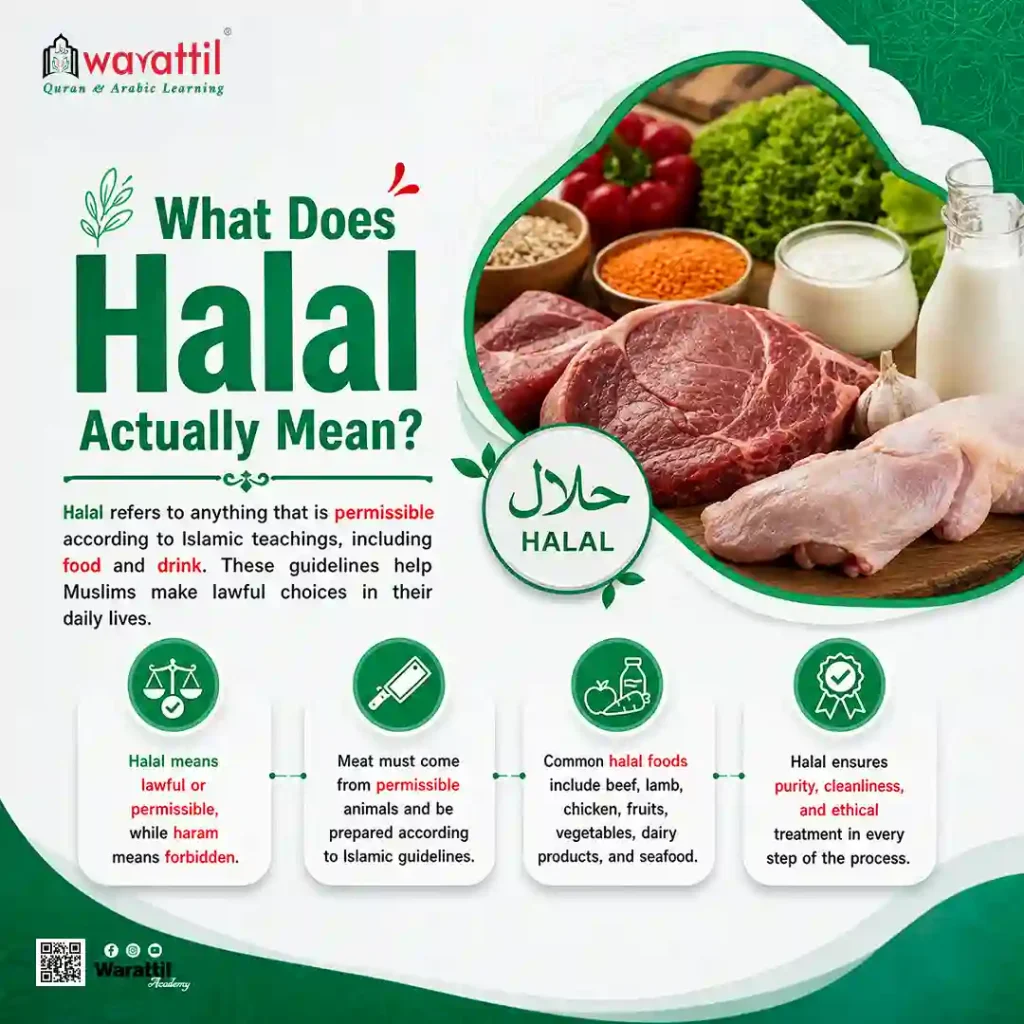
When exploring diverse culinary traditions, you will frequently encounter the term “halal” on restaurant menus, food packaging, and at local butcher shops. But what makes meat halal, and why does it hold such profound significance for over a billion people worldwide?
Far from being a simple culinary preference, the concept of halal represents a comprehensive framework governing ethics, animal welfare, and spiritual purity. To truly understand what makes meat halal, one must look beyond the final product and examine the entire journey of the food from the field to the dinner plate.
To grasp the mechanics of food production in Islam, it helps to start with the foundational vocabulary. The word halal is an Arabic term translating to “permissible” or “lawful.” In the context of nutrition, it refers to any food or drink that is allowed for consumption under Islamic dietary laws, which are derived from the Quran (the holy book of Islam) and the Hadith (the traditions and teachings of the Prophet Muhammad).
Conversely, the opposite of halal is haram, which means strictly forbidden. Islamic jurisprudence also recognizes two intermediate categories: makruh (discouraged behaviors or foods that are disliked but not explicitly penalized) and mashbooh (doubtful or questionable matters where the halal status is unclear).
Understanding these dietary boundaries is a straightforward process. The guidelines categorize all foods into clear groups, establishing a transparent framework for what can and cannot be consumed:
However, a crucial rule applies to livestock: even if an animal belongs to a permitted species, the meat only transforms into a permissible food source if it is harvested according to specific sacred protocols.
For any permissible livestock to be deemed truly halal, strict conditions must be observed. If any of these criteria are overlooked, the meat is classified as un-halal or haram.
The foundation of the entire process rests on the animal itself. It must belong to the list of naturally permissible species, and it must be alive, viable, and in excellent health at the exact moment of slaughter. Animals that are visibly diseased, injured, or have already succumbed to natural causes, accidents, or predators are entirely forbidden. This requirement functions as a natural safeguard for food safety and public health.
Islamic law dictates that the person executing the procedure must be a sane adult who understands the profound spiritual weight of taking a life for sustenance. Traditionally, this role is filled by a practicing Muslim, though certain historical and legal interpretations allow for slaughter by the “People of the Book” (Jews and Christians) under specific conditions.
Before the incision is made, the slaughterer must vocally pronounce a dedication, typically saying “Bismillah” (In the name of God) or “Bismillah, Allahu Akbar” (In the name of God, God is the greatest). This invocation serves as an explicit acknowledgment that life is sacred and is only being taken with divine permission to provide nourishment.
The physical act, known precisely as dhabiha (or zabiha), requires a specific surgical technique designed to minimize pain. A razor-sharp knife must be used to deliver a swift, deep incision across the throat. This single motion must cleanly sever the windpipe (trachea), the esophagus, and the major blood vessels the carotid arteries and jugular veins while leaving the spinal cord fully intact.
Keeping the spinal cord undamaged is vital because it ensures the nervous system continues to signal the heart to pump, allowing the blood to drain completely from the carcass. Because the consumption of blood is strictly prohibited in Islamic law, thorough drainage is a non-negotiable step in determining what makes meat halal.
The concept of halal is deeply intertwined with humane treatment. Islamic teachings place immense emphasis on compassion toward animals, mandating that livestock be raised under ethical conditions.
In Western nations like the United States and the United Kingdom, halal compliance is not directly monitored or regulated by central government agencies in the way standard agricultural inspections are handled. Instead, consumer trust relies on independent, third-party Islamic organizations that specialize in auditing food supply chains.
| Certifying Body | Scope of Operations |
| IFANCA (Islamic Food and Nutrition Council of America) | One of the largest global certifiers, inspecting standard food, pharmaceuticals, and consumer goods. |
| HFSAA (Halal Food Standards Alliance of America) | Focuses heavily on strict traditional standards, field audits, and verifying meat supply chains. |
| ISA (Islamic Services of America) | Partners extensively with commercial food manufacturers and global export markets. |
When a restaurant displays an official certificate or a food package bears a recognized stamp, it indicates that independent auditors have inspected the facilities. They verify that every ingredient, tool, and logistical process aligns perfectly with dietary laws. For modern consumers, looking for these certified marks remains the most reliable way to verify exactly what makes meat halal.

My son feels happy, amazing teachers and staff in wrattil and flexible prices MashaAllah Thank you so much
My daughter started learning in warattil academy and alhamdulilah we are really impressed and have enjoyed learning with wrattil. May Allah reward her sheikh
My teacher Ahmed is very good. He helped me recite and memorize holy Quran
Warattil is the most efficient way of learning Arabic. I like warattil curriculum and excellent teachers to support this learning Thank you so much
I highly recommend warattil Ijazah programs to anyone who wants to learn Quran properly.
Very well organized MashaAllah. I love it and this is a great course if you want to understand the Quran and learn tafsir
Warattil program is the best I have seen. The teacher is really great and is available to answer questions in a clear manner
I think warattil is the best academy in learning Arabic and I recommend Arabic course to anyone
We are so happy with ustad Hussein. He is very patient and comfortable teacher. May Allah the teachers and admin in warattil
Rating 10 mashaAllah and so grateful