Shopping cart
- +1 564-544-6614
- [email protected]
- 24/7 Available


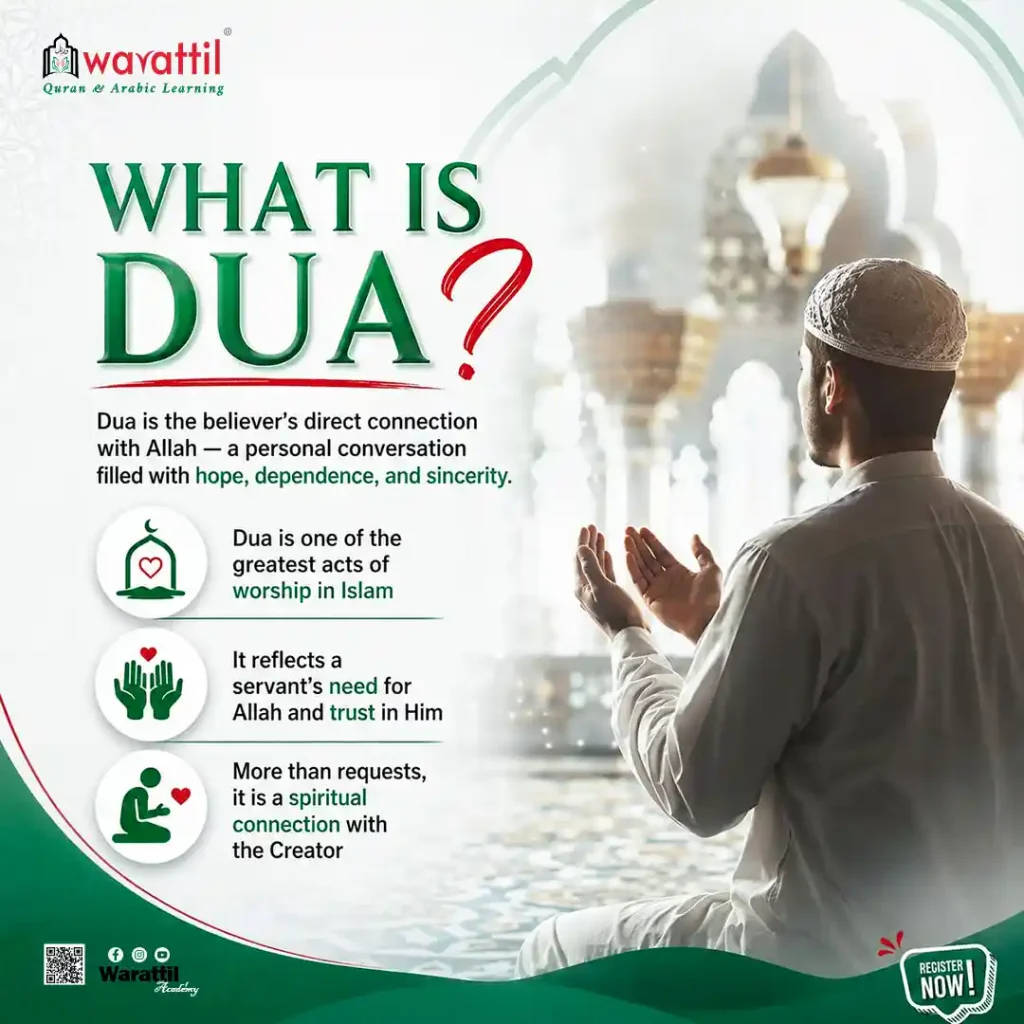
Every believer, at some quiet moment, has raised their hands and spoken words that no one else could hear. That inward turning, that direct conversation with the Creator, is the very essence of dua. To the newcomer and even to many born into the faith, the question “what is dua” is not merely a request for a dictionary definition. It is an inquiry into the nature of the human relationship with the Divine, an attempt to grasp the most intimate act of worship Islam provides. Dua is far more than a list of requests; it is the soul’s acknowledgement of its dependence on Allah, and it is, as the Prophet Muhammad ﷺ himself declared, the very core of worship.
The Arabic word du‘ā’ comes from the root da‘ā, which means to call, to summon, or to invoke. In its simplest linguistic sense, dua is a call. It is the act of a servant calling upon their Lord. When a person makes dua, they are not merely reciting words; they are turning their attention away from creation and directing it entirely towards the Creator. This is why the scholars of the Arabic language and the early Muslims understood dua as both a verbal act and a state of the heart. The renowned scholar Ibn Manzur, in his classical dictionary Lisan al-Arab, captures this dual meaning: dua is both the call itself and the profound longing that fuels it.
Spiritually, dua represents the highest form of recognition. It is an admission that one is, in essence, needy, and that Allah is, in His essence, entirely self-sufficient. The Qur’an makes this point unmistakably clear in Surah Fatir (35:15): “O mankind, you are those in need of Allah, while Allah is the Free of need, the Praiseworthy.” Every time a believer raises their hands and asks, they are living out this verse, turning a theological truth into a personal reality.
Perhaps the single most important hadith for understanding what is dua is the statement of the Prophet ﷺ recorded in Jami‘ at-Tirmidhi: “Al-du‘ā’ huwa al-‘ibādah” — “Dua is worship.” This is not a figure of speech. The scholars explain that the Prophet ﷺ used a grammatical construction of exclusivity, meaning that dua is the very heart and essence of worship. Why is this so? Because worship, at its core, is about recognising who Allah is and who we are in relation to Him. In dua, a person articulates their total dependence, their hope, their fear, and their love. All other acts of worship — prayer, fasting, charity — are outward manifestations of an inward state that dua expresses most directly.
Ibn al-Qayyim, one of the most profound scholars of Islamic spirituality, described dua as one of the most powerful means of repelling what has already been decreed and attaining what has not yet been granted. He viewed it not as a passive plea but as an active engagement with the divine decree, a means through which Allah, in His wisdom, has tied outcomes to the sincere asking of His servants.
It is important to draw a distinction here, particularly for those who are learning, because the English word “prayer” is used to translate both salah and dua, and this can cause confusion. Salah is the ritual prayer performed five times a day, with its prescribed movements, recitations, and conditions of purity. It is a fixed obligation. Dua, on the other hand, is supplication in its broadest sense. It can be made at any time, in any state of purity, in any language, and with any words that sincerely express what is in the heart. It can be a tear shed in the middle of the night, a whispered word while sitting in traffic, or a cry of gratitude upon receiving good news. Salah has its own time; dua has no time but the present moment.
To understand what is dua in practice, one must look beyond the act of asking and see it as a bridge. The Qur’an commands the believers directly: “Call upon Me; I will respond to you” (Surah Ghafir, 40:60). In another verse, Allah says, “And when My servants ask you concerning Me, indeed I am near. I respond to the invocation of the supplicant when he calls upon Me” (Surah Al-Baqarah, 2:186). Notice the language: there is no intermediary mentioned. Allah does not say, “Tell them I will respond through an angel” or “Tell them their prayers will be recorded for the Day of Judgement.” He says, “I am near. I respond.” This directness is what makes dua unlike any other relationship. When a believer internalises this closeness, their dua transforms from a routine recitation into a living conversation.
The early Muslims, the Salaf, understood this profoundly. It was reported that the great scholar Sufyan ibn ‘Uyaynah said, “Let none of you think that his dua will not be answered because of what he knows of his own sins. For Allah answered the dua of the worst of His creation, Iblis, when he said, ‘My Lord, grant me respite until the Day they are resurrected,’ and Allah said, ‘You are indeed of those granted respite.’ So who could be more evil than Iblis? Yet his request was granted. So do not despair.” This statement, while dramatic, reminds believers that Allah’s response is tied to the act of asking, not to the perceived worthiness of the asker.

Although dua is spontaneous and can be made in any state, the Sunnah has given it a beautiful structure that increases its likelihood of being accepted and deepens the experience. Knowing what is dua includes knowing how to approach it with proper manners.
The first step is to begin by praising Allah. The Prophet ﷺ heard a man making a supplication without first praising Allah or sending blessings upon him, and he remarked that the man had been hasty. The optimal way is to start with words such as Alhamdulillahi Rabbil ‘alamin and to send salawat upon the Prophet ﷺ. After that, one should raise the hands, face the qiblah if possible, and ask with humility, fear, and hope — three emotions the Qur’an mentions together in describing the believers.
It is also recommended to be persistent. A person should not say, “I made dua and it was not answered,” and then abandon the practice. The Prophet ﷺ said, “The supplication of any one of you will be answered so long as he is not impatient and says, ‘I made supplication but it was not answered’” (Sahih al-Bukhari, Sahih Muslim). Persistence in dua is itself an act of worship that draws one closer to Allah, regardless of the immediate outcome.
While every moment is an opportunity, the Sunnah highlights specific times when the gates of mercy are wide open. The last third of the night, when Allah descends to the lowest heaven and asks, “Who is calling upon Me that I may answer him?”, is the most celebrated of these moments. The time between the adhan and the iqamah, the final hour of Friday afternoon, the moments of breaking the fast, and the prostration during salah are all mentioned in authentic hadith as times when supplications are particularly powerful. Understanding these windows is part of grasping what is dua — it is not only a personal act but one that can be aligned with the rhythms of divine generosity.
No discussion of what is dua would be complete without addressing the experience that tests every believer: the feeling that one’s hands remain empty despite years of asking. The scholars have clarified, based on the hadith, that a dua is never truly rejected. It will either be granted in this life, stored as a reward for the Hereafter, or used to avert an equivalent harm that was destined for the person. Sometimes what we ask for is not what is best for us, and Allah, in His knowledge, withholds it to grant something far greater — either in this life or the next. This understanding does not diminish the pain of waiting, but it does transform it. The waiting itself becomes worship. The unanswered dua becomes a reason to remain in constant contact with the One who hears and knows.
To ask what is dua is to inquire about the very pulse of a believer’s relationship with Allah. It is the most accessible act of worship, requiring no ritual purity, no specific location, and no intermediary. It is worship in its most raw and honest form, a direct line between a heart that is in need and a Lord who is rich beyond all need. When a believer raises their hands and speaks — whether in Arabic or in the language of their own tears — they are fulfilling the purpose for which they were created. Dua is not merely about what we receive; it is about who we become in the act of asking. May Allah Almighty grant us all the understanding of this profound act of worship and accept our most sincere supplications, in this life and the next. Ameen.

My son feels happy, amazing teachers and staff in wrattil and flexible prices MashaAllah Thank you so much
My daughter started learning in warattil academy and alhamdulilah we are really impressed and have enjoyed learning with wrattil. May Allah reward her sheikh
My teacher Ahmed is very good. He helped me recite and memorize holy Quran
Warattil is the most efficient way of learning Arabic. I like warattil curriculum and excellent teachers to support this learning Thank you so much
I highly recommend warattil Ijazah programs to anyone who wants to learn Quran properly.
Very well organized MashaAllah. I love it and this is a great course if you want to understand the Quran and learn tafsir
Warattil program is the best I have seen. The teacher is really great and is available to answer questions in a clear manner
I think warattil is the best academy in learning Arabic and I recommend Arabic course to anyone
We are so happy with ustad Hussein. He is very patient and comfortable teacher. May Allah the teachers and admin in warattil
Rating 10 mashaAllah and so grateful