Shopping cart
- +1 564-544-6614
- [email protected]
- 24/7 Available


The question “Can I learn Quran online?” echoes in the minds of Muslims worldwide, from busy professionals in London to new reverts in rural America. Perhaps you live far from a mosque, or your schedule simply cannot accommodate traditional in-person classes. The answer is a resounding yes. With advancements in technology and the proliferation of qualified instructors, learning the Quran online has not only become possible but, for many, it is the most effective path forward. This guide explores the legitimacy, methods, and best practices for anyone asking themselves: can I learn Quran online in a way that is authentic, structured, and spiritually fulfilling?
Before diving into logistics, it is essential to address the religious perspective. Is it Islamically permissible to study the Book of Allah through a screen? Contemporary Islamic scholarship has addressed this question directly. The use of modern technology in teaching and memorizing the Quran is considered positive, beneficial, permissible, and even recommended, especially in our current era where technology permeates all aspects of life and is accessible to everyone. This ruling aligns with the general meaning of the Prophet’s (peace be upon him) statement: “The best among you are those who learn the Quran and teach it” (Sahih al-Bukhari).
The key condition is that the method preserves the sanctity and accuracy of the Quranic text. As long as the teacher is qualified and the text remains unaltered, the medium of instruction—whether in a mosque or via Zoom—does not invalidate the learning process. Indeed, technology today has transformed educational concepts and methods, making knowledge more accessible and expanding learning opportunities in unprecedented ways.
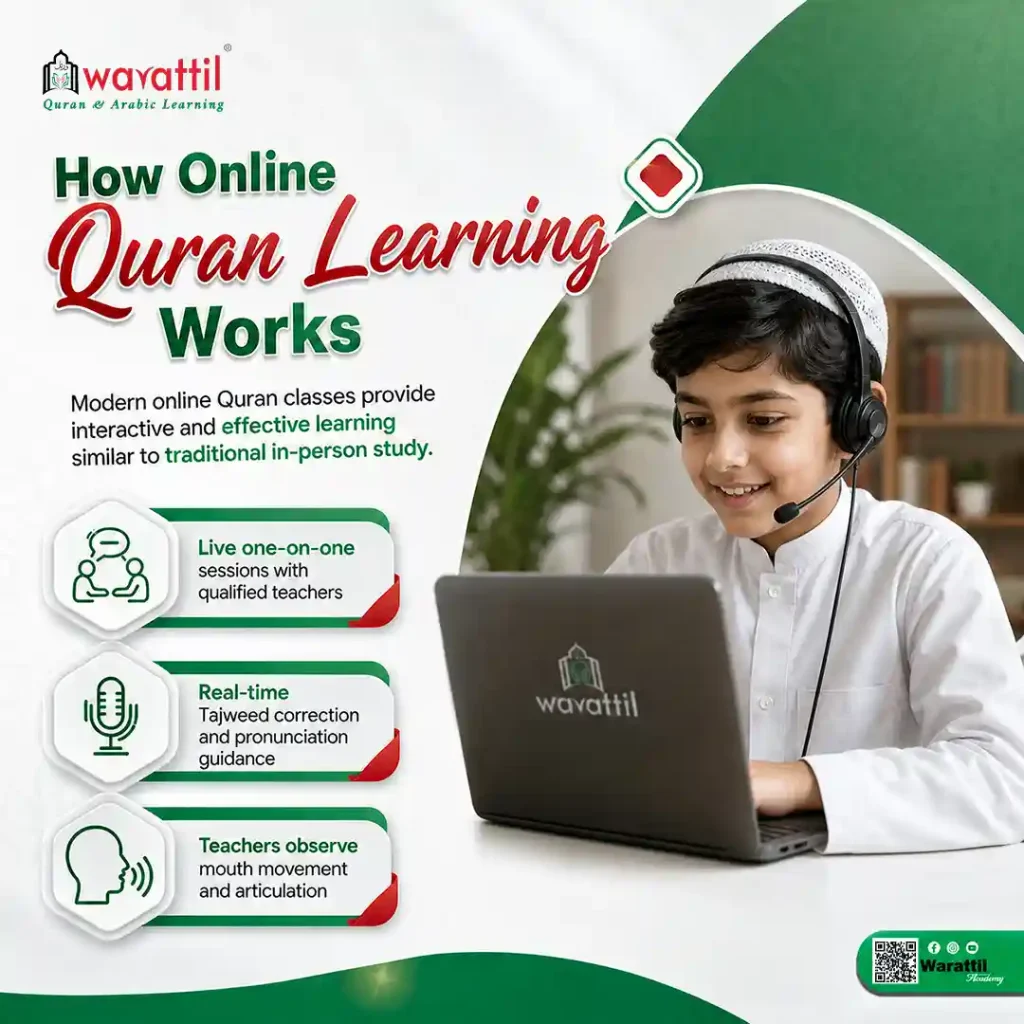
For those asking, “Can I learn Quran online as effectively as in person?” understanding the mechanics is crucial. Research comparing face-to-face and online Quran reading classes has found no significant difference in student performance between the two settings. The pedagogical tools available to online instructors often surpass what is available in a traditional setting.
Live one-on-one sessions form the backbone of most reputable online Quran academies. These classes take place via video conferencing platforms, allowing the teacher to observe the student’s mouth movements, correct pronunciation in real time, and build a personal rapport that mimics the traditional Talaqqi (oral transmission) method. For Tajweed correction, teachers actively listen to a student’s recitation, often several times, to identify recurring errors and pinpoint specific letters or rules that are consistently misapplied. They then demonstrate the correct articulation point (Makhraj) using visual aids, encourage students to mimic their movements, and have students repeat specific words until the correct sound is consistently achieved.
If you are asking, “Can I learn Quran online with a truly qualified teacher?” the answer depends entirely on the platform you select. Not all online Quran academies are created equal, and the difference between a transformative experience and a frustrating one often lies in the teacher’s credentials.
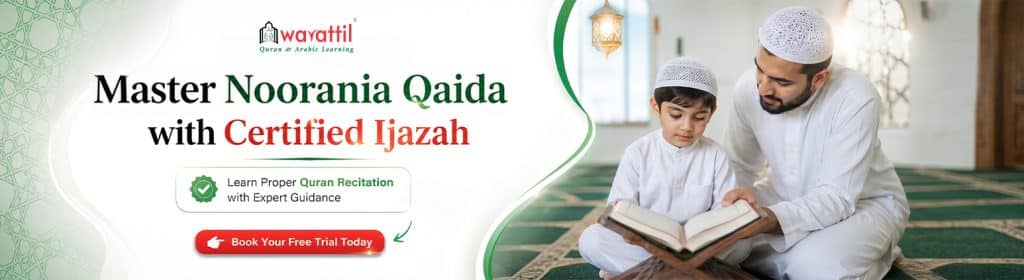
The highest and most trusted form of certification is the Ijazah (Sanad Certification). A teacher who holds an Ijazah has mastered Quran recitation with full Tajweed, recited the entire Quran accurately to a qualified scholar, and been granted permission to teach and transmit the Quran through a connected chain (Sanad) tracing back to the Prophet Muhammad (peace be upon him). When evaluating a platform, look for transparent teacher profiles, clearly stated qualifications, and documented Ijazah credentials rather than vague claims of “experienced” instructors.
Beyond certification, the platform should offer a structured curriculum with clear levels or stages from letter recognition to reading, Tajweed, and eventually memorization so you know exactly what you are learning and where you are headed.
Flexibility is the most obvious benefit, but it is far from the only one. Online learning eliminates geographical barriers, granting you access to qualified teachers from Egypt, Saudi Arabia, and other centers of Quranic scholarship who would otherwise be unreachable. One of the most appreciated advantages of distance Islamic education is the convenience of learning in your own home or location, which is particularly valuable for sisters, parents with young children, and those living in non-Muslim majority countries.
The personalized nature of online instruction also allows for a tailored pace. In a physical classroom, a student who struggles with a particular rule may feel pressured to keep up with the group. In a one-on-one online setting, the teacher can pause, repeat, and adapt the lesson until mastery is achieved before moving forward.
If you are a complete beginner asking, “Can I learn Quran online from scratch?” the answer is yes, and the process is well established. Your first month in a structured online Quran class will typically follow a clear progression: the first week is dedicated to meeting and mastering the Arabic alphabet, the second week to forming simple words, and subsequent weeks to reading short verses and applying basic Tajweed rules.
Start with the Noorani Qaida, a foundational text that teaches proper accent according to Tajweed rules and serves as an ideal first tutor for anyone learning to read the Quran in Arabic. Many platforms now incorporate AI-driven tools that offer personalized feedback, adaptive practice, and reflective engagement with Quranic texts within Islamic educational contexts, though these should complement, not replace, live instruction.
A sincere word of caution: many beginners unknowingly repeat mistakes that sabotage their progress. The most damaging error is choosing a platform without verifying the teacher’s qualifications. A qualified Quran teacher must hold an Ijazah in Tajweed or Quranic recitation, understand classical Arabic grammar, and know how to teach at different levels. Another common trap is ignoring Tajweed rules early on. Tajweed is not optional; it is part of respecting the Quran. As the great scholar Ibn al-Jazari stated, applying Tajweed is an obligation, and whoever does not apply it is sinful. Insist on correct pronunciation from your very first lesson.
Consistency also matters greatly. Online learning offers flexibility, but without a set schedule and clear goals, it collapses. Treat your Quran sessions like top-priority appointments. Even twenty minutes of daily study, with reflection and proper Tajweed, brings long-term results.
While modern technology is important in Quranic education, the spiritual and human dimensions remain crucial to this process. Striking a balance between the technical and spiritual aspects is necessary to fully and effectively achieve the goals of religious learning. Make dua before every session. Set your intention purely for the sake of Allah. Reflect on the meanings of the verses you recite, and consider pairing your recitation study with Tafsir lessons when possible. The Quran was not revealed merely for the tongue; it was sent to transform the heart.
The question, “Can I learn Quran online?” is ultimately answered not by the platform you choose, but by the sincerity of your intention, the consistency of your effort, and your willingness to seek knowledge from qualified sources. Technology has simply opened a door that was previously closed to many. Walking through it with humility and dedication remains, as it always has, a matter of the heart.

My son feels happy, amazing teachers and staff in wrattil and flexible prices MashaAllah Thank you so much
My daughter started learning in warattil academy and alhamdulilah we are really impressed and have enjoyed learning with wrattil. May Allah reward her sheikh
My teacher Ahmed is very good. He helped me recite and memorize holy Quran
Warattil is the most efficient way of learning Arabic. I like warattil curriculum and excellent teachers to support this learning Thank you so much
I highly recommend warattil Ijazah programs to anyone who wants to learn Quran properly.
Very well organized MashaAllah. I love it and this is a great course if you want to understand the Quran and learn tafsir
Warattil program is the best I have seen. The teacher is really great and is available to answer questions in a clear manner
I think warattil is the best academy in learning Arabic and I recommend Arabic course to anyone
We are so happy with ustad Hussein. He is very patient and comfortable teacher. May Allah the teachers and admin in warattil
Rating 10 mashaAllah and so grateful