Shopping cart
- +1 564-544-6614
- [email protected]
- 24/7 Available


Many Muslims dream of carrying the Book of Allah in their hearts, yet the journey to becoming a Hafiz often feels daunting. The good news is that Allah Himself has promised: “And We have certainly made the Quran easy to remember” (Qur’an, 54:17). This guide will walk you through how to memorise the Quran easily by harnessing structured techniques, consistent routines, and the power of sincere intention. Whether you are starting with the 30th Juz’ or aiming to memorise the entire text, the principles below will transform your hifz journey into a sustainable and deeply rewarding act of worship.
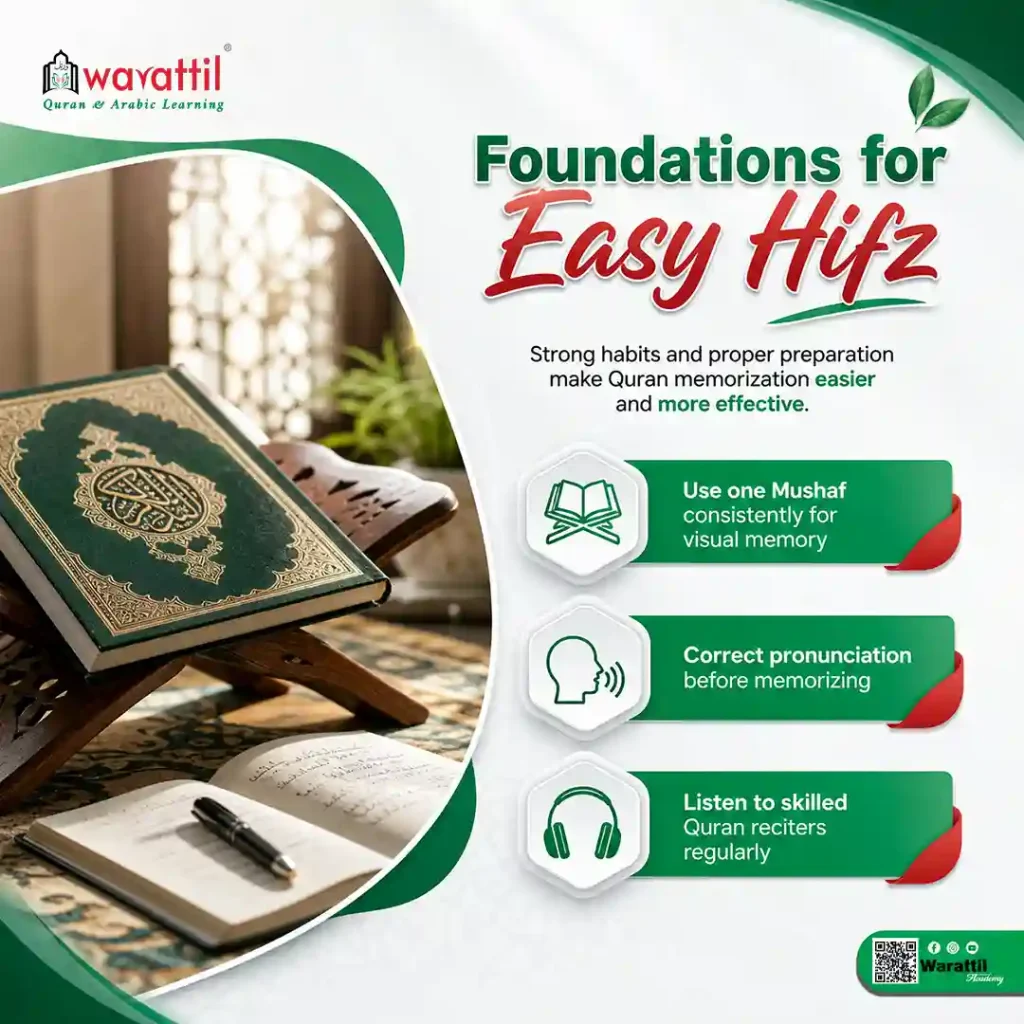
Before diving into specific methods, several foundational practices make memorisation significantly smoother. Ignoring these can turn the process into an uphill struggle, whereas attending to them creates an environment where the Quran settles into the heart with greater ease.

First, stabilise your visual memory by choosing a standard Mus-haf and never changing it. Hifz is not purely auditory; it is also photographic. Your brain “prints” the location of verses on the page, and switching between different editions destroys this mental image, making retention noticeably harder. The 15-line Madani Mushaf, often called the Huffaz Mushaf, is an excellent choice because every page begins and ends with a complete ayah.
Second, correct your pronunciation before attempting to memorise. Listen to the page recited by a master Qari—such as Sheikh Mahmoud Khalil Al-Husary—at least three times while following along with your finger. This practice, rooted in the concept of Talaqqi (oral transmission), prevents “fossilised errors” that become embedded in your memory and prove extremely difficult to fix later.
Third, establish a daily routine anchored to a specific time and place. The hours after Fajr prayer are particularly blessed, as the Qur’an describes dawn recitation as “ever witnessed” (Qur’an, 17:78). Select a quiet location—ideally a mosque—and devote a fixed period each day to memorisation so that it becomes an immovable part of your schedule.
Rather than passively reading a page repeatedly hoping it will stick, use the “Ayah-by-Ayah” approach. For each verse, read it five times while staring intentionally at the first and last word to anchor its position on the page, then look away and recite from memory. Once you have mastered one verse, connect it with the previous verse and recite them together five times. This progressive linking builds a solid chain, ensuring the bottom of the page is as strong as the top.
Repetition remains the backbone of hifz. A particularly effective framework is the 10:3 technique: read each verse ten times while looking at the Mushaf, then recite it three times from memory. This ratio provides enough reinforcement to push the verse into long-term memory without leading to mental fatigue.
One of the most powerful tools to memorise the Quran easily over the long haul is spaced repetition. The concept is simple: review material at gradually increasing intervals—after 1 day, 3 days, 7 days, 14 days, and so forth—just before you are about to forget it. This approach aligns with the brain’s natural forgetting curve and dramatically improves retention. Numerous hifz apps now incorporate spaced-repetition algorithms, automatically reminding you when it is time to revisit specific verses.
Mechanical repetition without comprehension is far less effective than memorising with understanding. Before committing a passage to memory, read its translation, review a brief tafsir, and note how the verses connect to what you have already memorised. When the words carry meaning, the process shifts from a dry exercise to a meaningful conversation with Allah’s guidance, and research confirms that memorisation with understanding produces both faster initial learning and significantly better long-term recall.

Consistency matters far more than quantity. The Prophet ﷺ said, “The most beloved deeds to Allah are those that are consistent, even if they are small” (Sahih al-Bukhari). Here is how to build a routine that lasts:
| Time of Day | Activity | Duration |
| After Fajr | Memorize new verses. | 10–15 minutes |
| Midday / Commute | Listen to audio recitation of the day’s portion. | Passive listening |
| Before Bed | Review the day’s new memorization and older portions. | 10 minutes |
If you struggle to find a single long block of time, break your hifz into micro-sessions scattered throughout the day. Even five minutes of focused work between tasks builds momentum. The 6446 Method—which sets a daily verse target based on the total number of verses in the Quran—offers a flexible, long-term framework: memorising just five verses per day leads to completion in roughly three and a half years.
Memorising is only half the battle; retaining it is the greater challenge. The Prophet ﷺ warned that the Quran “is easier to slip away from you than camels from their hobbles” (Sahih al-Bukhari). Make daily review a non-negotiable habit. As your memorised portions grow, divide them into manageable sections so that you complete a full review every thirty days.
Reciting from memory during your voluntary night prayers (qiyam al-layl) is one of the most effective ways to solidify what you have learned. Additionally, studying with a partner or within a group creates accountability and healthy competition, as members correct each other’s mistakes and strengthen one another’s resolve.
The brain is an organ that operates best when the body is well cared for. Sufficient sleep, a balanced diet, and regular physical exercise directly support memory performance. Avoid memorising when you are exhausted, particularly late at night after a long day of work. Approaching the Quran with a fresh mind and a sincere heart, coupled with earnest supplication for Allah’s help, unlocks the ease that He has promised.
The path to memorising the Quran does not require extraordinary talent—it requires a structured plan, consistent effort, and a heart that sincerely seeks closeness to its Creator. When these elements come together, what once seemed impossible becomes, by the permission of Allah, beautifully achievable.

My son feels happy, amazing teachers and staff in wrattil and flexible prices MashaAllah Thank you so much
My daughter started learning in warattil academy and alhamdulilah we are really impressed and have enjoyed learning with wrattil. May Allah reward her sheikh
My teacher Ahmed is very good. He helped me recite and memorize holy Quran
Warattil is the most efficient way of learning Arabic. I like warattil curriculum and excellent teachers to support this learning Thank you so much
I highly recommend warattil Ijazah programs to anyone who wants to learn Quran properly.
Very well organized MashaAllah. I love it and this is a great course if you want to understand the Quran and learn tafsir
Warattil program is the best I have seen. The teacher is really great and is available to answer questions in a clear manner
I think warattil is the best academy in learning Arabic and I recommend Arabic course to anyone
We are so happy with ustad Hussein. He is very patient and comfortable teacher. May Allah the teachers and admin in warattil
Rating 10 mashaAllah and so grateful