Shopping cart
- +1 564-544-6614
- [email protected]
- 24/7 Available


Understanding how to pray salah when traveling is essential, for it is an area where the Creator, in His infinite mercy, has granted ease to His servants. The rules of the musafir (traveller) are not a loophole but a divinely given gift accepted with gratitude by those on a journey. What follows is a clear, evidence‑based explanation, rooted in the Qur’an, the Sunnah and the mainstream schools of Islamic jurisprudence, so you can fulfil your obligation with confidence and peace of mind.

The permission to shorten the ritual prayer – known in Arabic as Qasr – is explicitly established in the Qur’an. Allah, the Exalted, states: “And when you travel throughout the land, there is no blame upon you if you shorten the prayer…” (Surah An-Nisa, 4:101). This verse removes any guilt from the traveller who reduces some of the five daily prayers, and the consistent practice of the Prophet Muhammad ﷺ confirmed that this was not merely a theoretical concession but his regular habit. Ibn ‘Umar (may Allah be pleased with him) testified, “I accompanied the Prophet ﷺ in travel; he never exceeded two units of prayer.”
In practical terms, Qasr applies exclusively to the four‑rak‘ah obligatory prayers – namely Dhuhr, ‘Asr and ‘Isha – which are each performed as two rak‘ahs instead of four. The prayers that are originally fewer than four units – Fajr (two rak‘ahs) and Maghrib (three rak‘ahs) – remain unchanged; they are never shortened.
Because the concession is linked to the state of travel, scholars set clear conditions to define who can rightfully apply the rules. The three conditions that attract the widest agreement are:
The main Sunni schools agree on the validity of shortening, but they differ on whether it is merely permissible or actually binding:
Beyond shortening, a traveller may also combine two obligatory prayers in one time slot, a dispensation designed to remove genuine hardship. The classical term for this is Jam‘.
There are two ways of combining:
| Form | Arabic Term | Description |
| Earlier combination | Jam‘ al-Taqdim | Performing both prayers in the time of the first (e.g., Dhuhr and ‘Asr prayed together during the Dhuhr window). |
| Later combination | Jam‘ al-Ta’khir | Delaying the first prayer to the time of the second and performing both together (e.g., Maghrib and ‘Isha performed during the ‘Isha window). |
The permissibility of combining during travel is where the schools of thought diverge most noticeably:
You drive about 300 km to visit family for three days and then return. According to the majority view, you can shorten the four‑unit prayers to two rak‘ahs and combine Dhuhr with ‘Asr, as well as Maghrib with ‘Isha, whenever it eases your journey.
You travel a long distance but intend to stay for 14 days on a work assignment. Under the Hanafi ruling, you may continue to shorten your prayers because your stay does not reach the 15‑day limit. Under the majority ruling, you must pray the full four units once you settle at your destination, since your intention to stay exceeds four days, although you may still combine prayers during the travelling days.
If you cannot determine how long you will stay – perhaps an unpredictable work trip – the more expansive opinion states that you can keep shortening and combining your prayers as long as you remain in the travel status, because the condition of temporary residence is not fulfilled with certainty.
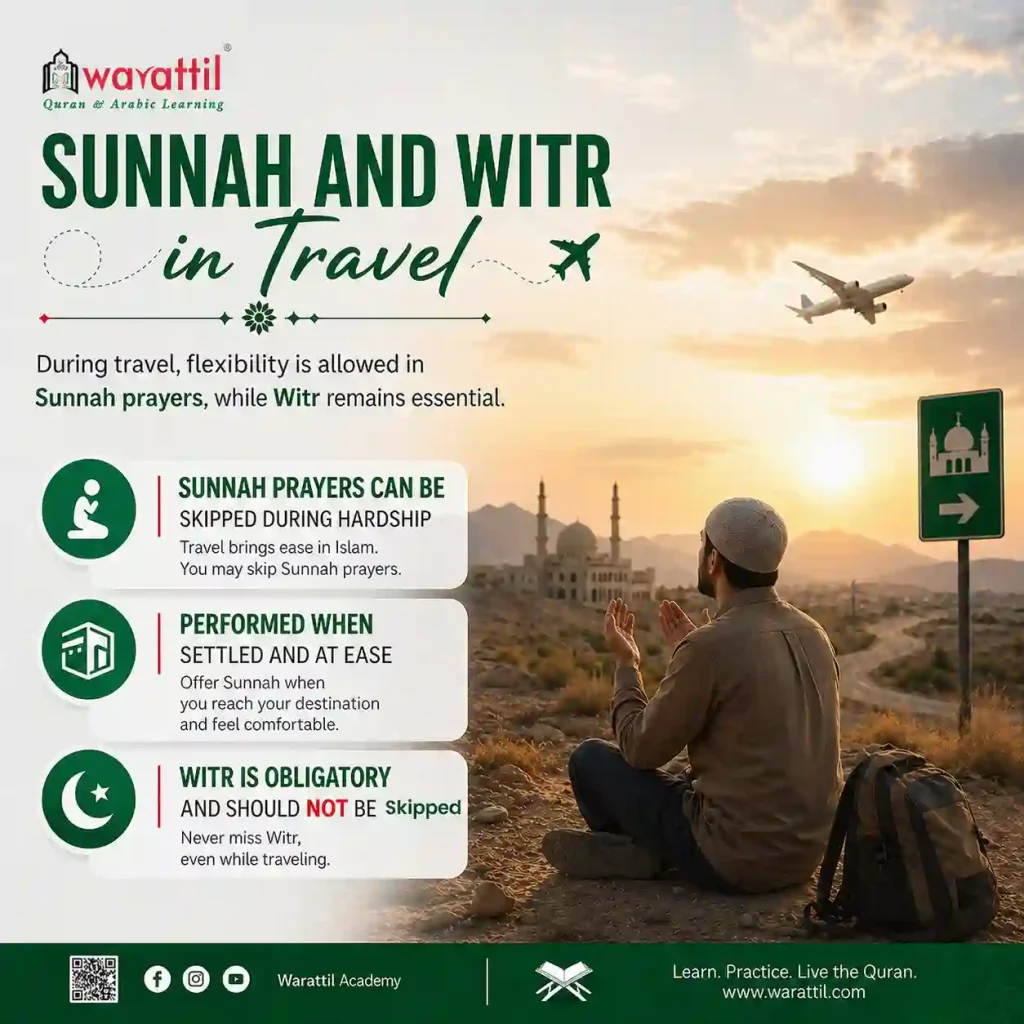
Many travellers worry about missing the optional prayers. The general position is that the confirmed sunnah prayers (sunan mu’akkadah), such as those before Fajr and after ‘Isha, are to be maintained if you are settled and at ease during a stop. However, if you are actively moving, in a hurry, or facing hardship, it is perfectly permissible to leave them without any blame.
As for the Witr prayer, scholars emphasise that it is unconditionally mandatory (fard ‘amali in Hanafi terms) and must be performed during travel just as it is at home. In practice, this means you should always make time for the Witr after ‘Isha.
Modern travel raises additional questions, and the classical principles are clear: salah cannot be skipped under any circumstances. If you are on a plane, ship, car, or train, the obligation remains.If you have a genuine fear that the prayer time will expire before you can stop, dry ablution (tayammum) can be performed instead of wudhu. However, if bathrooms are available on a plane or train, or if you can pull over with your car, you should perform water ablution normally.
| Situation | Ruling |
| Standing is possible | The obligatory prayer must be offered standing, with proper bowing (ruku‘) and prostration (sujud), facing the Qiblah to the best of your ability. |
| Standing is genuinely difficult (e.g., fear of falling, extreme turbulence) | You may pray sitting down, making the gestures for ruku‘ and sujud as best you can. |
| Facing the Qiblah is impossible (except for the opening “Allahu Akbar”) | Face the Qiblah for the opening takbiratul ihram and complete the prayer in whatever direction you are facing. |
If a prayer is missed while you are a traveller, it must be made up later in its shortened form, even if you perform it after returning home. The reason is that the obligation was incurred while you were still a musafir, and the status of the prayer at the time it became due determines how it must be offered.
A concession from the Lord is a mercy, and accepting it is an act of worship. The Prophet ﷺ said: “It is a charity that Allah has given to you, so accept His charity.” (Sahih Muslim). Deliberately avoiding the dispensation when it is genuinely applicable, or twisting its conditions to serve mere convenience, is to reject a gift. Apply the rules with sincerity, and your journey will remain an act of devotion from departure to return.

My son feels happy, amazing teachers and staff in wrattil and flexible prices MashaAllah Thank you so much
My daughter started learning in warattil academy and alhamdulilah we are really impressed and have enjoyed learning with wrattil. May Allah reward her sheikh
My teacher Ahmed is very good. He helped me recite and memorize holy Quran
Warattil is the most efficient way of learning Arabic. I like warattil curriculum and excellent teachers to support this learning Thank you so much
I highly recommend warattil Ijazah programs to anyone who wants to learn Quran properly.
Very well organized MashaAllah. I love it and this is a great course if you want to understand the Quran and learn tafsir
Warattil program is the best I have seen. The teacher is really great and is available to answer questions in a clear manner
I think warattil is the best academy in learning Arabic and I recommend Arabic course to anyone
We are so happy with ustad Hussein. He is very patient and comfortable teacher. May Allah the teachers and admin in warattil
Rating 10 mashaAllah and so grateful