Shopping cart
- +1 564-544-6614
- [email protected]
- 24/7 Available


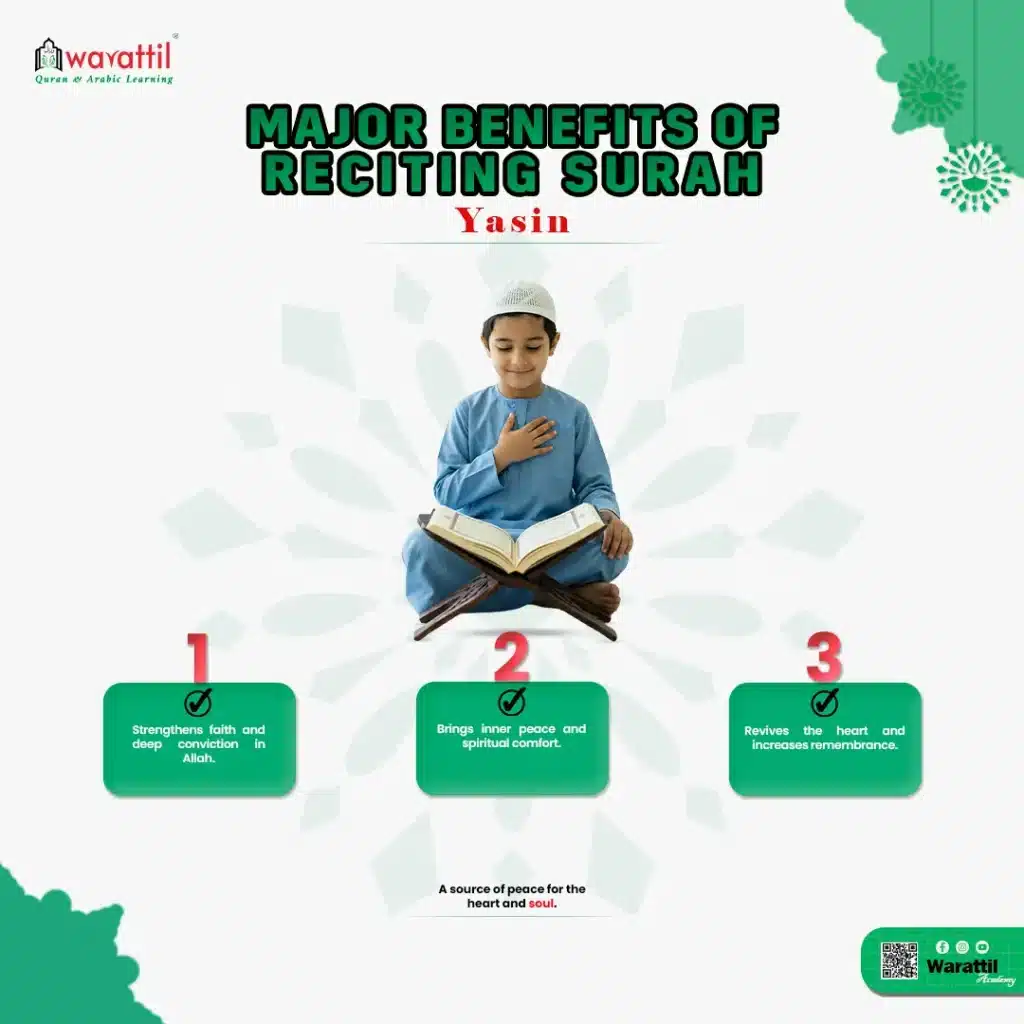
To truly comprehend the myriad Surah Yasin benefits, one must first understand the foundational nature of this remarkable chapter of the Holy Quran. Surah Yasin constitutes the thirty-sixth chapter of the Quranic text and serves as a monumental pillar of Islamic theology, eschatology, and spiritual guidance. The chapter derives its title from the two Arabic disjoined letters (Huruf al-Muqatta’at) with which it begins: “Ya” and “Sin”. The precise linguistic meaning of these letters remains a matter of exclusive divine knowledge, representing a structural miracle that continually challenged the eloquent orators of seventh-century Arabia.
Across centuries of Islamic scholarship and practice, the recitation of this specific chapter has profoundly permeated the daily lives of Muslims around the globe, establishing itself as an unparalleled source of solace, spiritual invigoration, and deep theological reflection. The text is characterized by its highly rhythmic cadence, consisting of relatively short verses and incredibly evocative imagery, all meticulously designed to capture the immediate attention of the human soul and awaken it from the spiritual slumber of worldly heedlessness. By directly addressing the most fundamental philosophical and existential questions of human existence where humanity originates, the ultimate purpose of conscious life, and the inevitable return to the Creator Surah Yasin serves as an all-encompassing, concentrated manifesto of authentic Islamic belief.
In traditional Islamic discourse, Surah Yasin is almost universally recognized by the profound and evocative epithet: “The Heart of the Quran”. This metaphorical designation is deeply rooted in the chapter’s intense thematic concentration. Anatomically speaking, the heart is the central, vital organ responsible for pumping life-giving blood to the entirety of the human body. In a parallel metaphysical and structural sense, Surah Yasin pumps the vital, life-giving essence of Islamic monotheism (Tawhid), the authenticity of Prophethood (Risalah), and the undeniable reality of Resurrection (Akhirah) into the conscious awareness of the believer.
Just as a biological body cannot function without a heart, the comprehensive Islamic worldview is considered incomplete without the foundational theological truths vigorously defended and articulated within these specific verses. The chapter effectively encapsulates the macrocosmic message of the entire Quranic revelation into a microcosmic, highly concentrated narrative, making it the indisputable thematic nucleus of the divine text.
The significance and cultural embeddedness of Surah Yasin within the broader Islamic tradition cannot be overstated. From the bustling, historic mosques of the Middle East to the quiet, reflective homes in Southeast Asia, the chapter is continuously recited across all phases of the human experience: in times of joyous celebration, during periods of profound sorrow, throughout the trials of daily life, and specifically at the precipice of death. Historically, orthodox Islamic scholars, jurists, and spiritual practitioners have continually emphasized the transformative psychological and spiritual power of engaging intimately with its verses.
The text serves not merely as a formulaic liturgical recitation, but as a comprehensive epistemological framework that shapes a Muslim’s entire perception of reality. By constantly shifting the reader’s cognitive focus from the temporal, ephemeral nature of the physical world to the eternal, unyielding permanence of the Afterlife, the chapter fundamentally reorients the human psyche toward absolute divine accountability.
The specific blessings and divine rewards associated with the regular recitation of this chapter are multifaceted, extending seamlessly across the spiritual, emotional, and psychological domains of human existence. A comprehensive analysis of primary Islamic texts and scholarly exegesis indicates that the Surah Yasin benefits range from the expiation and forgiveness of personal sins and the fortification of foundational faith, to the alleviation of severe psychological distress and the facilitation of divine peace during the agonizing physical moments of death.
While the specific historical authenticity of various individual traditions and narrations regarding these benefits has been a subject of rigorous, meticulous scholarly debate throughout the centuries, the overarching practical consensus among Muslims affirms that the sincere recitation of this chapter like all chapters of the Holy Quranacts as a powerful magnet that attracts immense divine mercy, deep psychological tranquility (Sakinah), and lasting spiritual illumination.
Within the carefully preserved structural compilation of the Holy Quran, Surah Yasin is systematically positioned as the 36th chapter. It is geographically situated spanning across the 22nd and 23rd parts (Juz’) of the Quranic text. This strategic placement follows Surah Fatir and precedes Surah As-Saffat, sitting in a section of the Quran heavily dedicated to establishing the undeniable sovereignty of the Creator and the inevitability of the final judgment.
The chapter comprises a total of 83 verses (Ayat). Structurally, these verses are notably brief and highly rhythmic, a specific linguistic characteristic that significantly facilitates rapid memorization, fluent public recitation, and deep emotional resonance. The intentional conciseness of the verses ensures that the complex theological arguments presented within the text are delivered with rapid, impactful precision, leaving a permanent intellectual and emotional imprint on the listener’s conscience without overwhelming them with excessive prose.
Surah Yasin is unanimously classified by Quranic exegetes as an early Makki Surah. This classification means it was revealed to Prophet Muhammad (peace be upon him) during the intense, early period of his prophetic mission in the city of Makkah, well prior to the historical migration (Hijrah) to the city of Madinah. To properly understand the chapter’s urgent and persuasive tone, one must examine the distinct characteristics of Makki verses compared to their Madani counterparts.
| Feature Classification | Makki Surahs (e.g., Surah Yasin) | Madani Surahs (e.g., Surah Al-Baqarah) |
| Primary Audience | Polytheist pagans and fierce deniers of the new faith | The established Muslim community, hypocrites, and People of the Book |
| Core Theological Themes | Belief, Tawhid (Absolute Oneness), Akhirah (Afterlife), urgent warnings | Civil laws, societal regulations, complex jurisprudence, community ethics |
| Linguistic Tone | Highly emotional, intensely persuasive, vivid, urgent | Rational, highly instructional, detailed, systematic |
| Verse Structure and Length | Short, highly rhythmic, poetic cadence designed for impact | Long, detailed, prose-like paragraphs for legal clarity |
The inherently Makki nature of Surah Yasin dictates its profound emotional intensity. During this specific historical phase of the revelation, the Prophet Muhammad faced severe, violent opposition from the Quraysh tribe, who vehemently and mockingly rejected the concepts of bodily resurrection after death and absolute monotheism. Consequently, the chapter operates as a formidable, unyielding defense of these core truths, utilizing logical deductions, historical precedents of destroyed nations, and observable signs within the natural universe to systematically dismantle pagan ideologies.

The thematic architecture of the chapter can be systematically divided into three primary, interconnected pillars:
The specific nomenclature identifying this chapter as the “Heart” represents a profound theological and anatomical metaphor within Islamic thought. In classical Islamic epistemology, the heart (Qalb) is understood not merely as a biological pump responsible for blood circulation, but as the true locus of human intellect, spiritual comprehension, moral reasoning, and divine reception. By calling Surah Yasin the Heart of the Quran, the tradition suggests that the absolute lifeblood of the entire Islamic message is densely concentrated within these 83 verses. The scholarly consensus dictates that if a believer truly comprehends and internalizes the multifaceted message of Yasin, they have effectively grasped the central, undeniable thesis of the entire Quranic revelation.
This revered title is directly derived from specific prophetic traditions (Ahadith). The most frequently cited and heavily scrutinized narration is attributed to the prominent companion Anas ibn Malik, who reported that the Prophet Muhammad (peace be upon him) explicitly stated: “Indeed, everything has a heart, and the heart of the Quran is Ya-Sin. Whoever recites it, Allah will write for him a reward equal to that of reading the Quran ten times”.
From the strict, academically rigorous viewpoint of classical Hadith science (Ilm al-Rijal), this specific narration, formally recorded by Imam al-Tirmidhi and Imam al-Darimi, has been evaluated critically over the centuries. The chain of transmission (Isnad) contains an unknown transmitter named Harun Abu Muhammad, prompting meticulous scholars like Imam Tirmidhi himself to classify its chain as weak (Da’if). Later scholars such as Shaykh Al-Albani went further, explicitly deeming it fabricated (Mawdu’) due to perceived flaws.
However, a highly nuanced, academic approach demonstrates that early and late masters of Hadith have historically permitted the use of slightly weak hadiths. One contemporary scholar noted a misidentification where a narrator was falsely accused of being the arch-liar Muqatil b. Sulayman, when in fact, al-Tirmidhi and al-Darimi explicitly identified the narrator as Muqatil b. Hayyan, who was a trustworthy (Thiqa) student of Qatada. Because of this, there exists a practical consensus (Ijma’ Amali) that permits relying on such narrations in matters pertaining strictly to meritorious, virtuous deeds (Fada’il al-A’mal), provided the text does not attempt to establish new binding laws or contradict established core theology. Thus, despite academic debates over the chain’s precise strength, the title “Heart of the Quran” has been widely, enthusiastically embraced by the Muslim Ummah throughout history, retaining its profound symbolic and spiritual resonance.
Beyond the dense academic discourse regarding Hadith authentication, the immense spiritual importance of this title resonates deeply within the collective, daily consciousness of practicing believers. When a Muslim sits to recite the chapter, they are acutely and emotionally aware that they are engaging directly with the concentrated core of the divine message. This intense awareness fundamentally alters the psychological and spiritual state of the reciter, actively engendering an atmosphere of profound reverence, emotional vulnerability, and heightened spiritual receptivity. The chapter effectively acts as a diagnostic tool for the believer’s own metaphysical heart, precisely measuring its emotional responsiveness to the promises and terrifying warnings of the Almighty.
The primary, foundational axis around which the Surah Yasin benefits revolve is the deep spiritual refinement of the individual believer. Engagement with the text is considered an act of profound remembrance (Dhikr) that actively elevates the human soul from the mundane, distracting preoccupations of temporal worldly life to the sublime, permanent reality of the divine presence.
Regular, contemplative recitation of the chapter acts as a powerful catalyst for strengthening unwavering conviction (Yaqeen) in the unseen. The verses systematically and logically dismantle atheistic and polytheistic doubts through a combination of rational argumentation and emotional appeal. For example, when the chapter directly questions how the Creator who easily originated complex human life from a mere drop of fluid could possibly be incapable of resurrecting decayed bones, it immediately reinforces the believer’s intellectual and spiritual confidence in the absolute omnipotence of God. This revives a hardened heart, replacing skepticism with resolute faith.
Severe psychological turbulence, anxiety, and stress are hallmarks of the modern human condition. Yet, the recitation of the Quran is fundamentally linked to the attainment of Sakinah (divine tranquility). By fully immersing oneself in the rhythmic cadence and majestic, overarching meanings of Surah Yasin, the physiological manifestations of stress are noticeably mitigated. The text provides a much broader cosmic perspective, effectively minimizing the perceived severity of worldly afflictions by sharply juxtaposing them against the vast, infinite expanse of eternity. It serves to soothe the restless mind and comfort the emotionally battered soul.
Through the continuous, dedicated recitation of the chapter, a profound, unbreakable intimacy is naturally cultivated between the servant and the Creator. The text vividly details God’s boundless, encompassing mercy, His incredibly intricate design of the cosmos, and His ultimate, inescapable justice. Deeply reflecting upon these divine attributes naturally engenders a dual state within the believer: profound, overwhelming love combined with reverential awe (Taqwa), which together form the very essence of true proximity to the Divine.
Soteriological concerns issues pertaining directly to ultimate salvation and the necessary absolution of earthly transgressions are absolutely central to daily Islamic practice. Surah Yasin is highly regarded within the tradition as a highly effective instrument for seeking divine pardon and mitigating the consequences of sin.
A widely circulated and deeply cherished tradition, narrated by the companion Jundub bin Abdullah and recorded in the Sahih of Ibn Hibban, states that the Prophet said: “Whoever recites Yasin in the night, seeking the Face of Allah, will be forgiven”. Other slight variations of this narration boldly assert, “Whoever reads Surah Ya-Sin in one night will be forgiven in the morning”. While some strict Hadith scholars point to discontinuities in the transmission chains of certain specific variations—such as Al-Hasan al-Basri’s narration being classified as weak due to the presence of ‘an’ana (a specific type of ambiguous transmission) prominent classical scholars like Imam Ibn Hibban have firmly classified specific routes of this tradition as authentic, while others grade it as having a good (Jayyid) chain.
The true efficacy of the chapter in successfully securing divine forgiveness is fundamentally and inextricably linked to the purity of the reciter’s intention (Ikhlas). As explicitly and carefully mentioned in the hadith—”seeking the Face of Allah”mechanical, unreflective, or performative recitation is deemed insufficient. True, lasting forgiveness is actualized only when the recitation precipitates genuine emotional remorse (Tawbah), a firm, unbreakable resolution to abandon sinful behavior, and a heart genuinely humbled by the stark warnings articulated within the verses. The vast Surah Yasin benefits are ultimately activated by the deep humility and the sincere, desperate need for Allah felt by the reciter during the act of reading.
The complex economy of spiritual rewards in Islam places an incredibly high premium on the recitation of the Quran, with Surah Yasin historically holding a uniquely distinguished rank among the chapters.
General, foundational Quranic injunctions promise ten rewards (Hasanat) for every single individual letter recited. However, specific narrations indicate that reciting this particular chapter brings massively amplified blessings, often metaphorically equated to reading the entire Quran ten times over. While rigorous authentication processes may categorize the literal “ten times” multiplication specifically as a weak narration, the overarching, universally accepted principle that profoundly engaging with central chapters yields immense spiritual dividends remains an undisputed tenet of Islamic theology.
Believers across generations have historically utilized the chapter as an invincible, metaphysical fortress against spiritual malevolence and sudden worldly calamities. Reciting the text is believed to actively establish a protective barrier, effectively shielding the vulnerable individual from unseen harms, the dark machinations of the devil, and unexpected tragedies. This specific protective mechanism operates on the core Islamic principle that the intense, focused remembrance of God inherently repels demonic influences and negative energies, as devils are known to escape from the recitation of powerful chapters like Yasin, Hashr, and the Mu’awwidhatayn.
Integrating the dedicated recitation of Surah Yasin into one’s daily routine initiates a profound, transformative paradigm shift in a believer’s life. Consistent, daily practice ensures that the human heart is continuously recalibrated to the frequency of divine guidance, rather than being dragged down by the gravity of worldly pursuits.
The temporal, physical world is inherently fraught with unpredictable spiritual and physical hazards. Daily engagement with the text serves as a reliable spiritual armor. By verbally acknowledging God’s absolute, unyielding dominion over the heavens and the earth, as vividly described in the chapter’s powerful concluding verse (“Therefore, glory be to Him in Whose Hand is the dominion over all things! To Him you will be brought back”) , the believer is deeply assured that absolutely no harm can transpire without explicit divine permission. This realization provides an unshakeable, profound sense of security as they navigate their day.
The vital Islamic concept of Barakah completely transcends mere material abundance; it denotes divine blessing, structural stability, and exponential growth in one’s time, physical health, and worldly provisions. Regular, daily recitation of the chapter actively invites this Barakah into the household and into all daily endeavors. Believers who maintain this practice frequently report a heightened sense of daily efficiency and a mysterious, almost miraculous facilitation of seemingly insurmountable tasks when their days are firmly anchored by this recitation.
The chapter’s compelling narratives, particularly the gripping story of the steadfast believers who bravely faced persecution with unwavering faith, inject profound psychological resilience into the modern reader’s psyche. It frames worldly difficulties and stressors not as random cruelties of fate, but as deliberate, meaningful trials intricately embedded within a divine master plan. Consequently, daily recitation actively fosters a positive, highly patient mindset, allowing individuals to successfully navigate emotional and physical tribulations with dignity, grace, and enduring hope.
The initial, quiet hours of the day set the definitive trajectory for all subsequent actions, thoughts, and emotional states. Consequently, morning recitation holds unique, highly regarded significance in Islamic jurisprudence and daily spirituality.
A prominent tradition, albeit carefully classified as weak in its transmission chain by scholars such as those evaluating the Mishkat al Masaabih, boldly states: “Whoever reads Surah Yaseen at the beginning of the day; his needs will be fulfilled”. Despite technical weakness regarding the chain of narrators, this specific narration is widely and enthusiastically acted upon under the established framework of performing virtuous deeds. Engaging with the text immediately after the Fajr prayer perfectly aligns the human soul with the cosmic awakening of nature, actively drawing down comprehensive divine blessings that permeate the entirety of the diurnal cycle.
Morning recitation acts as a powerful, preemptive supplication. By reciting the verses before actively engaging with the chaotic complexities of commerce, social interaction, and worldly labor, the believer intentionally places themselves under the protective custody of the Almighty. It serves to clear the morning mental fog, providing acute spiritual focus and effectively safeguarding the individual from impulsive errors, negative influences, and sudden adversities that may arise during the workday.
Mental clarity is directly and inextricably correlated to spiritual tranquility. The profound peace (Sakinah) actively generated by the morning recitation neutralizes early morning anxieties and dread, enabling the individual to approach their daily responsibilities with calm, deliberate productivity. The cognitive benefits of starting the day with profound metaphysical reflection cannot be understated; it creates a robust emotional buffer against the chaotic, often overwhelming demands of modern life.
The gradual transition into the night represents a necessary period of vulnerability, deep introspection, and physical cessation. Utilizing this specific, quiet time for the recitation of the chapter yields distinct and highly documented spiritual advantages.
The physiological state of sleep is frequently likened to a minor death in classical Islamic theology. Reciting the chapter immediately before sleep purifies the subconscious mind, forcibly detaching it from the lingering worldly anxieties of the day and reattaching it firmly to the divine presence. This conscious process facilitates profound, incredibly restful sleep, actively protected from terrifying dreams, nocturnal anxieties, and the whispering of malevolent entities (Shayatin).
As darkness completely envelops the earth, the unseen elements of the world become notably more active. The protective Surah Yasin benefits serve as an impenetrable, glowing spiritual shield over the sleeping individual and their entire household. The continuous metaphysical reverberation of the divine words acts as a powerful deterrent against spiritual intrusion, ensuring total safety and security until the break of dawn.
Nighttime is uniquely characterized by divine accessibility and mercy. As clearly established by the previously cited authentic and good traditions, reciting the chapter at night with the sole, pure intention of seeking Allah’s pleasure guarantees that the believer will awake in a pristine state of spiritual purification. Their previous minor sins are believed to have been completely expiated by divine mercy while they slept. Ending the day with the stark, powerful reminders of the Afterlife found in Yasin ensures that the individual’s final conscious act is one of profound theological submission and repentance.
Human existence is inextricably linked to inevitable periods of extreme duress, encompassing unexpected financial ruin, devastating emotional loss, and severe physical peril. The chapter serves as a reliable, emergency spiritual anchor during such violent tempests.
In moments of profound crisis, fragile human logic often fails entirely, and dark despair quickly encroaches upon the mind. Surah Yasin serves to immediately and forcefully recalibrate the distressed believer’s perspective. By vividly illustrating the absolute, unquestionable sovereignty of God over the massive, floating celestial bodies and the minute, hidden seeds deep within the earth , the text powerfully reminds the distressed individual that the exact same God controls their current hardship. It effectively transforms blind panic into profound, calculated reliance (Tawakkul) upon the Creator.
The strong correlation between spiritual well-being and physical medical recovery is increasingly well-documented. During periods of severe illness, the recitation of the chapter brings immense, tangible comfort to the afflicted individual. While it is never considered a replacement or substitute for necessary medical intervention, it operates as a potent spiritual remedy that successfully neutralizes the psychological agony that so often accompanies physical pain. The majestic verses soothe the restless, fearful heart, significantly mitigating the terror of mortality and strengthening the body’s innate physical resilience.
When standing paralyzed at the complex crossroads of life, facing monumental decisions without clear, discernible direction, the chapter acts as an unfailing spiritual compass. Recitation, when combined with sincere, tearful supplication (Dua), actively illuminates the intellect, allowing the believer to clearly discern the correct, righteous path. It forcibly clears the heart of selfish, ego-driven desires, ensuring that the subsequent decision is perfectly aligned with divine will rather than worldly ambition.
The intersection of the chapter with the complex rites of death represents one of its most profoundly established cultural and religious applications within the Islamic community, although it requires highly precise scholarly clarification to separate authentic practice from innovation.
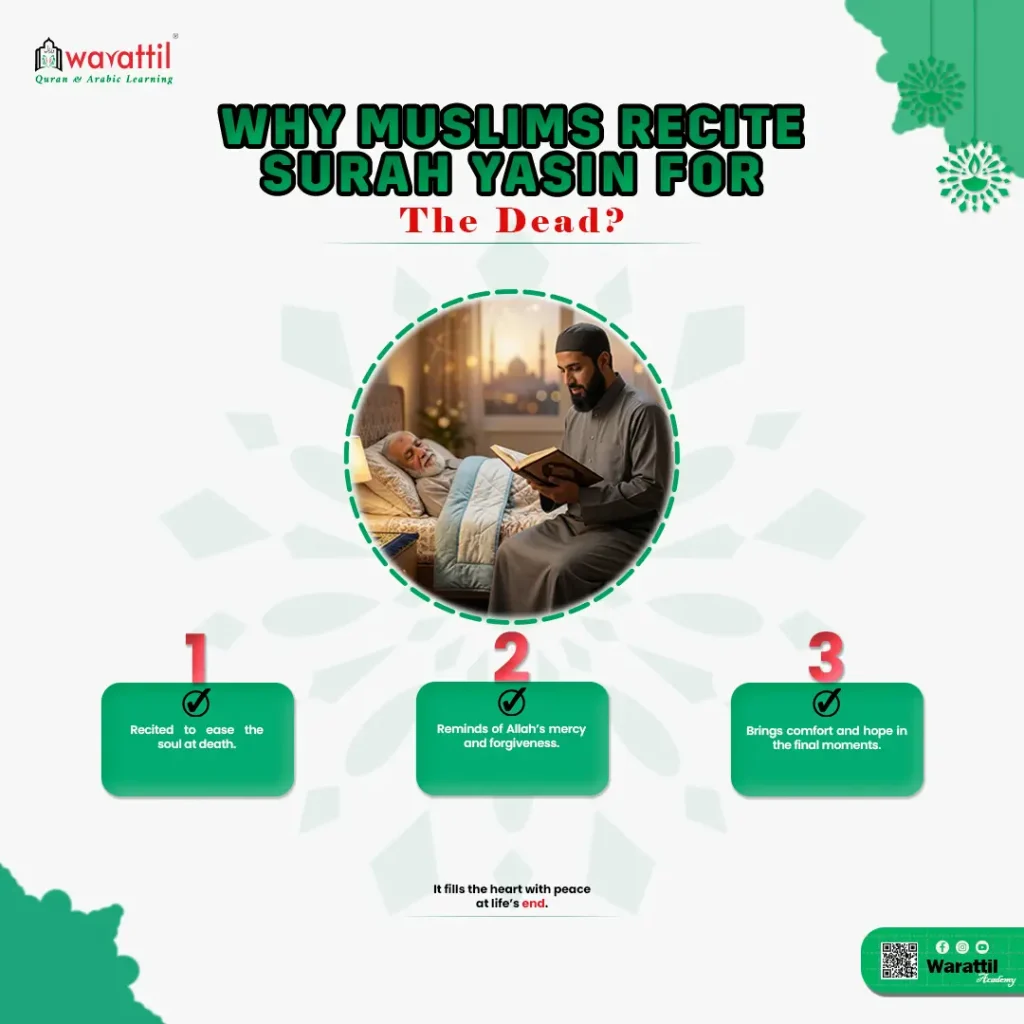
The transition from the physical, earthly realm to the intermediate spiritual realm (Barzakh) is widely considered the most agonizing and terrifying experience of human existence. Muslims historically recite the chapter over the dying individual to actively ease the soul’s painful extraction from the body. The core theological rationale is that the verses contain vivid, highly comforting descriptions of Paradise and the overwhelming mercy of God—particularly the moving verse where the martyred believer joyously exclaims, “Would that my people knew. That my Lord (Allah) has forgiven me, and made me of the honoured ones!” (Yasin 36:26-27). Hearing these specific, triumphant words at the very precipice of death induces immense hope and facilitates a peaceful, willing departure.
The application of this deeply entrenched practice is strictly governed by nuanced, highly technical scholarly discourse regarding authenticity and methodology. The rulings are generally bifurcated:
| Context of Recitation | Scholarly Ruling | Reasoning and Evidence |
| For the Dying Person (Muhtadar) | Highly Recommended (Mustahabb) | The majority of scholars support this based on the hadith “Recite Yaseen over your dying ones.” While slightly weak, it falls under the accepted principle of utilizing weak hadiths for virtuous, comforting deeds that ease hardship. |
| For the Already Deceased (at the Grave) | Discouraged / Fabricated | Scholars like Shaykh Al-Albani and Ibn Uthaymin have explicitly classified narrations promising reduced punishment for reciting Yasin at the graveyard as entirely fabricated (Mawdu’). There is no authentic basis in the Sunnah for this specific post-burial ritual. |
Consequently, while reciting to ease the painful process of active death is heavily supported and encouraged, utilizing it as a ritualistic, transactional absolution at the graveyard is actively discouraged by orthodox Islamic methodology.
A highly significant and visible phenomenon within the broader cultural landscape of the Muslim Ummah is the specific, targeted recitation of the chapter to facilitate marriage proposals or secure abundant financial provision (Rizq).
Many individuals facing frustrating obstacles in finding a suitable, pious spouse, or those experiencing severe marital discord, frequently turn to the intense recitation of Surah Yasin. It is absolutely vital to establish, from an academic perspective, that there is no explicit Quranic verse or authentic Prophetic Hadith that directly mandates or uniquely links this specific chapter to the facilitation of marriage. However, the practice remains highly validated under the broader, deeply authentic Islamic concept of Tawassul seeking proximity to Allah through the performance of righteous deeds. By reading the Quran with incredibly pure intentions and subsequently making targeted Dua, the believer utilizes the immense Barakah of the text to ask Allah to forcefully remove societal and personal blockages hindering their matrimonial success.
Similarly, individuals heavily grappling with financial stagnation, debt, or the threat of poverty frequently engage in the dedicated recitation of the chapter. The Quran as a whole is inherently a profound source of alleviation. The chapter explicitly and beautifully details God’s infinite capacity to provide sudden life to the barren, dead earth; meditating upon this specific imagery fosters an unwavering, iron-clad belief that the exact same Creator can effortlessly and rapidly revitalize a stagnant, dying financial situation.
The ultimate efficacy of these specific practices is entirely dependent upon the deep theological understanding that the chapter itself does not magically materialize a spouse or wealth like a spell. Rather, it is the profound state of humility, total desperation, and utter reliance on Allah—generated internally by the recitation—that successfully triggers the divine response. The chapter serves as a highly powerful preamble to supplication, actively elevating the spiritual state of the supplicant to a level where their prayers are readily and favorably answered by the Almighty.
The application of targeted Quranic recitation as a legitimate form of spiritual medicine (Ruqyah) is a well-established Sunnah of the Prophet, and Surah Yasin occupies a highly prominent, respected position in this healing paradigm.
Human illness is never merely a simple biological malfunction; it almost always precipitates a profound, secondary spiritual crisis involving deep fear, clinical depression, and a devastating loss of hope. The regular recitation of the chapter administers incredibly potent spiritual healing. The unique linguistic resonance and acoustic vibration of the Arabic verses are believed to interact directly with the metaphysical composition of the human soul, actively dislodging spiritual impurities, neutralizing severe anxiety, and restoring critical equilibrium to the internal emotional state.
For individuals battling agonizing chronic or terminal illnesses, the highly sanitized, clinical environment of a hospital is often completely devoid of metaphysical comfort. The rhythmic, gentle recitation of Surah Yasin by the bedside entirely transforms the atmosphere, completely enveloping the patient in a warm shroud of divine mercy. It powerfully shifts the patient’s cognitive focus away from the agonizing, inevitable deterioration of the physical body toward the immortal, indestructible nature of the human soul. Some narrations even suggest that angels gather to pray for the spirit to transition easily, providing unparalleled emotional sedation and deep relief.
The central, most vital therapeutic mechanism of the chapter during severe illness is its unparalleled capacity to drastically fortify the patient’s faltering hope. By repeatedly reiterating the historical and cosmological manifestations of God’s absolutely limitless power, the text implicitly argues that the eradication of a microscopic disease or failing organ is a completely trivial matter for the Sovereign of the universe. This profound understanding actively prevents the patient from succumbing to dark despair, promoting a highly resilient, combative psychology that very often complements and accelerates physiological recovery. It is absolutely crucial, however, that this spiritual reliance is practiced strictly alongside established, modern medical treatments, as explicitly commanded by Islamic jurisprudence.
While the text of the Holy Quran yields immense blessings regardless of the specific hour it is recited, certain temporal windows are historically and traditionally emphasized by scholars for maximizing the incredible spiritual yield of the chapter.
The quiet period immediately following the obligatory Fajr prayer is characterized by a unique cosmic stillness and profound spiritual receptivity. Reciting the chapter during this specific time perfectly aligns with the traditions suggesting that early morning recitation leads directly to the complete fulfillment of the day’s needs, clears the intellect of confusion, and provides a continuous, unbroken stream of Barakah until nightfall.
As established in earlier analytical sections, nighttime recitation acts as a highly effective mechanism for complete absolution and spiritual protection. By engaging with the text immediately prior to sleep, the believer ensures their final cognitive engagement of the day is steeped entirely in divine remembrance, successfully fulfilling the requirements of the various traditions that eagerly promise morning forgiveness for nighttime recitation.
Friday (Jumu’ah) is considered the sovereign of all days in the Islamic calendar, possessing unique, unmatched spiritual gravity. Some specific narrations highly suggest a unique virtue for reading the chapter on Friday or the eve of Friday (Thursday night). A prime example is the narration: “Whoever reads Surah Ya-Seen on the eve of Friday will be forgiven in the morning,” meticulously recorded by Al-Bayhaqi and similarly validated by Imam Ibn Hibban as an authentic tradition. Consequently, many Muslim communities integrate this specific recitation deeply into their weekly Friday observances to secure comprehensive, weekly expiation of sins.
Unlike the highly fixed daily or weekly schedules, reciting during sudden moments of acute hardship is spontaneous and entirely reactive. The absolute optimal time to recite the chapter is precisely when the heart is shattered by unexpected grief, overwhelmed by sudden fear, or paralyzed by terrible indecision. In these moments, the text acts as an immediate, life-saving spiritual tourniquet, violently halting the hemorrhage of faith and rapidly restoring psychological equilibrium.
The purely mechanical vocalization of Arabic letters without strict adherence to the established sciences of recitation deprives the reader of the text’s most profound aesthetic and spiritual impacts. Proper methodology is absolutely paramount.
Tajweed is the highly exacting, meticulous science of Quranic phonetics, governing the precise articulation points (Makharij) and characteristics (Sifat) of every single letter, as well as the complex rules of elongation, merging, and pausing. Reciting Surah Yasin with perfectly correct Tajweed is not merely an aesthetic, musical enhancement; it is a strict religious obligation that perfectly preserves the precise, intended meaning of the divine words. Incorrect pronunciation can catastrophically alter the theological meaning of a verse, turning a statement of belief into disbelief. For beginners, utilizing structured learning approaches, listening intently to expert, renowned reciters, and following word-by-word tutorials are essential, non-negotiable steps in mastering the chapter’s rhythmic complexities.
The miraculous, transformative nature of the text remains largely inaccessible if the verbal recitation is totally devoid of intellectual comprehension. While the sheer acoustic resonance of the Arabic generates a baseline level of Sakinah, true, lasting transformation requires deep, prolonged contemplation (Tadabbur). Believers must actively endeavor to read the text accompanied by a highly reliable translation and detailed exegetical commentary (Tafsir). Understanding the precise context of the Makkan revelation, the historical identity of the “People of the Town,” and the intricate logical arguments levied against polytheism elevates the practice from ritualistic, empty chanting to profound intellectual engagement. A highly recommended memorization strategy for this longer chapter is the 10×10 Hifz method. This rigorous technique involves reciting a single verse ten times with perfect Tajweed while looking at the Mushaf (written Quran), followed immediately by reciting it ten times purely from memory. If an error occurs, the entire process is repeated, ensuring both precise phonetic accuracy and permanent structural retention.
The successful conclusion of a Quranic recitation represents a moment of supreme, unmatched spiritual elevation—a specific time when the heavens are uniquely and intensely receptive to human supplication. Therefore, immediately following the completion of Surah Yasin, the believer is highly encouraged to raise their hands in earnest, desperate Dua, intelligently leveraging the massive spiritual momentum generated by the text to present their worldly and eschatological needs directly to the Almighty.
A highly critical component of expert analysis involves the meticulous, uncompromising separation of authentic, normative religious practices from localized cultural accretions and completely fabricated traditions. The immense, global popularity of the chapter has inevitably led to the rapid proliferation of severe misconceptions.
In many regions across the globe, the recitation of the chapter has been unfortunately commodified into highly specific cultural rituals that possess absolutely no foundation in orthodox Islamic jurisprudence. For instance, the widespread practice of printing and distributing small, isolated booklets of solely Surah Yasin as favors at weddings, or reading it specifically and communally over a grave immediately after burial to allegedly transmit merit directly to the deceased, are predominantly cultural phenomena rather than established Prophetic commands. While reading the Quran is universally beneficial in Islam, rigidly and dogmatically institutionalizing these highly specific localized practices as binding religious obligations (Sunnah) is considered a severe methodological error by scholars.
The massive corpus of traditions surrounding the chapter requires rigorous, unflinching epidemiological filtering by Hadith experts.
Orthodox Islamic scholarship maintains incredibly strict, unforgiving parameters regarding the utilization of weak hadiths. The majority of jurists permit their application exclusively for virtuous deeds (Fada’il al-A’mal) under four highly stringent conditions outlined by scholars such as Mufti Muhammad Taha Karaan:
Deeply understanding this rigorous epistemological framework perfectly protects the believer from dangerous theological deviation and ensures their religious practice remains tightly tethered to authentic revelation. When individuals experience profound, sudden relief or the miraculous fulfillment of needs after reciting the chapter, scholars like Shaykh al-Islam Ibn Taymiyah clarify that this is the direct result of their sincere humility and utter desperation before God at that specific moment, rather than the chapter itself possessing a mechanical, spell-like property.
Beyond its vast liturgical and protective benefits, Surah Yasin is an unmatched pedagogical masterpiece. It imparts highly critical ethical, theological, and historical lessons that remain intensely applicable to the complexities of contemporary human society.
The central, load-bearing architectural pillar of the chapter is the absolutely inescapable reality of the Akhirah. The verses vividly and terrifyingly describe the suddenness of the Trumpet blast, instantly shattering the comforting illusion of worldly permanence. By detailing the graphic, horrifying reality where the mouths of the guilty will be forcefully sealed and their very own hands and feet will testify against them to reveal their worldly corruption, the chapter establishes the ultimate, unyielding framework for ethical accountability. This intense eschatological narrative ensures that the true believer meticulously evaluates every mundane action against its eternal, irreversible consequence, actively fostering a society predicated on total justice and profound moral responsibility.
The text operates as a profound, poetic exposition of God’s dual attributes of infinite, terrifying majesty and boundless, nurturing compassion. The chapter expertly guides the human intellect to closely observe the intricate mechanics of the natural world—the miraculous revival of dead botanical life from dry dirt and the meticulously calculated, uncrashing orbits of the massive celestial bodies. These are presented not merely as dry astronomical or biological facts, but as highly deliberate, intentional signs (Ayat) of a Creator who sustains the incredibly complex universe with unfathomable precision and care. Consequently, the believer learns to navigate the physical world with a deep sense of continuous wonder and profound, tearful gratitude.
The extensive historical parable of the “People of the Town” intricately embedded within the chapter provides highly critical insights into the eternal dynamics of truth and societal rejection. It highlights the persistent, blinding arrogance of advanced civilizations that foolishly reject divine guidance simply due to their material prosperity or their blind, stubborn adherence to ancestral traditions. Crucially, the narrative introduces the inspiring figure of the righteous, unnamed man who came sprinting from the farthest part of the city to bravely defend the messengers. He ultimately achieved sudden martyrdom and was granted immediate, glorious entry into Paradise, famously wishing his ignorant people could see his reward. This powerful narrative directly instructs the modern believer on the absolute necessity of intellectual courage, the strict religious obligation to speak the truth even in the face of hostile majorities, and the ultimate, guaranteed victory awaiting those who maintain their integrity under severe persecution.

My son feels happy, amazing teachers and staff in wrattil and flexible prices MashaAllah Thank you so much
My daughter started learning in warattil academy and alhamdulilah we are really impressed and have enjoyed learning with wrattil. May Allah reward her sheikh
My teacher Ahmed is very good. He helped me recite and memorize holy Quran
Warattil is the most efficient way of learning Arabic. I like warattil curriculum and excellent teachers to support this learning Thank you so much
I highly recommend warattil Ijazah programs to anyone who wants to learn Quran properly.
Very well organized MashaAllah. I love it and this is a great course if you want to understand the Quran and learn tafsir
Warattil program is the best I have seen. The teacher is really great and is available to answer questions in a clear manner
I think warattil is the best academy in learning Arabic and I recommend Arabic course to anyone
We are so happy with ustad Hussein. He is very patient and comfortable teacher. May Allah the teachers and admin in warattil
Rating 10 mashaAllah and so grateful