Shopping cart
- +1 564-544-6614
- [email protected]
- 24/7 Available


Life has a way of pressing down on you when you least expect it. Bills pile up, relationships get complicated, health worries creep in at night, and before long, the weight of it all feels almost unbearable. If you have been searching for a dua for stress and anxiety, know that you are not alone and more importantly, you have come to the right place. Islam does not simply acknowledge that human beings experience worry and distress. Rather, it provides a complete spiritual toolkit, rooted in the Quran and the authentic Sunnah of the Prophet Muhammad ﷺ, to help believers navigate even their darkest moments. These supplications are not folklore or vague spiritual advice. They are verified, narrated prayers that have been passed down through authenticated chains of transmission for over fourteen centuries.
Before diving into the specific supplications, it is worth understanding how Islam frames these emotions in the first place. Stress and anxiety referred to in Arabic as hamm (worry about the future) and huzn (grief over the past) are natural human experiences. The Quran itself addresses this reality with a great deal of tenderness. Allah says in Surah Ash-Sharh (94:5-6): “For indeed, with hardship will be ease. Indeed, with hardship will be ease.” The repetition here is deliberate and profound. It is not just that ease follows hardship — it is that ease accompanies it.
Furthermore, the Prophet ﷺ himself experienced immense personal grief and difficulty throughout his life, including the loss of loved ones, persecution, and years of hardship. Yet through it all, he turned consistently to dua to direct, heartfelt conversation with Allah. This is the model that every Muslim is encouraged to follow.
Islam also recognises that seeking mental and emotional relief through prayer is not a sign of weakness. On the contrary, it is an act of worship and an acknowledgment of one’s complete dependence on Allah (SWT), which is known as tawakkul reliance upon God.
This is perhaps the most well-known supplication specifically taught for moments of anxiety and sorrow. Anas ibn Malik reported that the Prophet ﷺ would seek refuge in Allah with these words: “Allahumma inni a’udhu bika minal-hammi wal-huzni, wal-‘ajzi wal-kasali, wal-bukhli wal-jubni, wa dhala’id-dayni, wa ghalabatir-rijal” — meaning: “O Allah, I seek refuge in You from grief and sadness, from weakness and laziness, from miserliness and cowardice, from being overcome by debt and from being overpowered by men.” This supplication is recorded in Sahih al-Bukhari (7/158), which is the highest level of authentication in Islamic hadith scholarship.
What makes this dua particularly remarkable is its comprehensiveness. It does not merely ask for relief from anxiety in a vague sense it names every root cause of human suffering, from emotional burdens to financial hardship to social oppression.
Arabic: اللَّهُمَّ إِنِّي أَعُوذُ بِكَ مِنَ الْهَمِّ وَالْحَزَنِ، وَالْعَجْزِ وَالْكَسَلِ، وَالْبُخْلِ وَالْجُبْنِ، وَضَلَعِ الدَّيْنِ وَغَلَبَةِ الرِّجَالِ
Transliteration: Allahumma inni a’udhu bika minal-hammi wal-huzni, wal-‘ajzi wal-kasali, wal-bukhli wal-jubni, wa dhala’id-dayni, wa ghalabatir-rijal.
In an authentic narration, the Prophet ﷺ said: “There is absolutely no one amongst you who, when stricken with grief and anxiety, says ‘Allahumma inni ‘abduka, ibn ‘abdika, ibn amatika, nasiyati biyadika, madin fiyya hukmuka, ‘adlun fiyya qada’uka, as’aluka bi kulli ismin huwa laka sammayta bihi nafsaka…’” and then goes on to ask that the Quran be made the spring of his heart and the light of his chest, a departure for his sorrow and a release for his anxiety.
According to the narration, whoever recites this, Allah will take away his sorrow and grief, and replace them with joy. This hadith was classed as authentic by Al-Albani in As-Silsilah As-Sahihah (199).
Arabic: اللَّهُمَّ إِنِّي عَبْدُكَ، ابْنُ عَبْدِكَ، ابْنُ أَمَتِكَ، نَاصِيَتِي بِيَدِكَ…أَنْ تَجْعَلَ الْقُرْآنَ رَبِيعَ قَلْبِي، وَنُورَ صَدْرِي، وَجَلَاءَ حُزْنِي، وَذَهَابَ هَمِّي
Transliteration: Allahumma inni ‘abduka, ibn ‘abdika, ibn amatika, nasiyati biyadika, madin fiyya hukmuka, ‘adlun fiyya qada’uka, as’aluka bi kulli ismin huwa laka sammayta bihi nafsaka, aw anzaltahu fi kitabika, aw ‘allamtahu ahadan min khalqika, aw ista’tharta bihi fi ‘ilmil-ghaybi ‘andak, an taj’alal-Qurana rabi’a qalbi, wa nura sadri, wa jala’a huzni, wa dhahaba hammi.
Translation: “O Allah, I am Your servant, son of Your servant, son of Your maidservant. My forelock is in Your hand. Your command over me is forever executed, and Your decree over me is just. I ask You by every name belonging to You, which You named Yourself with, or revealed in Your Book, or taught to any of Your creation, or kept in the knowledge of the unseen with You that You make the Quran the life of my heart and the light of my chest, and a departure for my sorrow and a release for my anxiety.”
This is one of the most spiritually dense supplications in the entire prophetic tradition. It combines an acknowledgment of servitude, divine sovereignty, and deep personal need into a single, flowing prayer.

This dua was recited by Prophet Yunus (AS) from within the belly of the whale: “La ilaha illa anta subhanaka inni kuntu minaz-zalimin” — meaning “None has the right to be worshipped except You. How perfect You are. Verily, I was among the wrongdoers.” Of this supplication, the Prophet Muhammad ﷺ is reported to have said: “No Muslim supplicates with it for anything, ever, except Allah responds to him.” This hadith is recorded in Tirmidhi.
Arabic: لَآ إِلٰهَ إِلَّآ أَنْتَ سُبْحَانَكَ إِنِّيْ كُنْتُ مِنَ الظَّالِمِيْنَ
Transliteration: La ilaha illa anta subhanaka inni kuntu minaz-zalimin.
Think about the context for a moment. Yunus (AS) was not simply anxious about a difficult day at work. He was trapped in the stomach of a whale, in complete darkness, in the depths of the ocean. And yet, he did not despair. He turned to Allah with humility and acknowledgment of his own shortcoming. That is precisely the spirit in which this dua should be recited — not as a formula, but as a genuine surrender of the heart.
The phrase “Hasbunallahu wa ni’mal wakeel” translates to: “Allah is Sufficient for us, and He is the best Disposer of affairs.” This short yet extraordinarily powerful statement appears in the Quran in Surah Ali Imran (3:173), and it was recited by both Ibrahim (AS) when he was thrown into the fire, and by the Prophet Muhammad ﷺ and his companions when they were warned that a large army had gathered against them. In both cases, the response from Allah was not just emotional comfort it was actual deliverance.
Arabic: حَسْبُنَا اللَّهُ وَنِعْمَ الْوَكِيلُ
Transliteration: Hasbunallahu wa ni’mal wakeel.
This dua is particularly suited for moments when you feel outnumbered by your problems — when there are too many things going wrong at once and you simply do not know where to turn first.
The Prophet Ayyub (AS) recited this dua during his long years of illness and suffering: “Anni massaniyad-durru wa anta arhamur-rahimin” — meaning “Indeed, adversity has touched me, and You are the Most Merciful of the merciful.” This supplication is found in Surah Al-Anbiya (21:83), and it represents one of the most moving calls for divine mercy in the entire Quran.
Arabic: أَنِّي مَسَّنِيَ الضُّرُّ وَأَنتَ أَرْحَمُ الرَّاحِمِينَ
Transliteration: Anni massaniyad-durru wa anta arhamur-rahimin.
Notice the restraint in this dua. Prophet Ayyub (AS) does not demand relief. He does not complain at length. He simply states his condition and reminds himself — and in doing so, reminds all of us of who Allah is. Sometimes that is enough.
The Prophet ﷺ said that the dua of the person in distress is: “Allahumma rahmataka arju fa la takilni ila nafsi tarfata ‘ayn, wa aslih li sha’ni kullahu, la ilaha illa anta” — meaning “O Allah, I hope for Your mercy. Do not leave me to myself even for the blink of an eye, and set right all my affairs for me. There is no deity except You.” This hadith was narrated by Abu Dawud (5090) and Ahmad (27898).
Arabic: اللَّهُمَّ رَحْمَتَكَ أَرْجُو فَلَا تَكِلْنِي إِلَى نَفْسِي طَرْفَةَ عَيْنٍ، وَأَصْلِحْ لِي شَأْنِي كُلَّهُ، لَا إِلَهَ إِلَّا أَنْتَ
Transliteration: Allahumma rahmataka arju, fa la takilni ila nafsi tarfata ‘ayn, wa aslih li sha’ni kullahu, la ilaha illa ant.
The phrase “do not leave me to myself even for the blink of an eye” is one of the most powerful expressions of human vulnerability in any spiritual tradition. It acknowledges that without divine support, even the most capable person is lost.
Prophet Musa (AS) recited this supplication after fleeing from Egypt, alone and without resources: “Rabbi inni lima anzalta ilayya min khayrin faqir” — meaning “My Lord, I am truly in desperate need of whatever good You may have in store for me.” (Surah Al-Qasas, 28:24)
Arabic: رَبِّ إِنِّي لِمَا أَنزَلْتَ إِلَيَّ مِنْ خَيْرٍ فَقِيرٌ
Transliteration: Rabbi inni lima anzalta ilayya min khayrin faqir.
This dua is beautifully honest. There is no elaborate preamble, no lengthy listing of good deeds to justify the request. Musa (AS) simply admits his need and asks. Shortly after, Allah answered him in ways that changed the entire course of his life.
Knowing the dua is one thing. Knowing how to approach it is another matter entirely. There are a few practices that are widely recommended by Islamic scholars to maximise the sincerity and effectiveness of supplication:
Beyond formal dua, general remembrance of Allah known as dhikr plays a significant role in managing anxiety. The Quran states in Surah Ar-Ra’d (13:28): “Verily, in the remembrance of Allah do hearts find rest.” This is not metaphorical. It is a direct statement about the calming effect of turning one’s attention to Allah.
Practical forms of dhikr that scholars recommend for anxiety relief include:
These short phrases can be woven into the fabric of daily life. They do not require a prayer mat or a quiet room. They can be repeated while driving, cooking, walking, or lying awake at night when sleep refuses to come.
This is an important question, and the answer is clearly no. Seeking professional mental health support is entirely consistent with Islamic teachings. The Prophet ﷺ said: “Make use of medical treatment, for Allah has not made a disease without appointing a remedy for it.” (Abu Dawud, authenticated) While this hadith specifically refers to physical illness, Islamic scholars have consistently extended this principle to mental and emotional health.
Dua and therapy are not in competition with each other. Rather, they operate on different levels one addressing the spiritual dimension of suffering, the other addressing the psychological and neurological. A person dealing with clinical anxiety, depression, or trauma deserves both forms of support, and there is no contradiction in seeking them simultaneously.
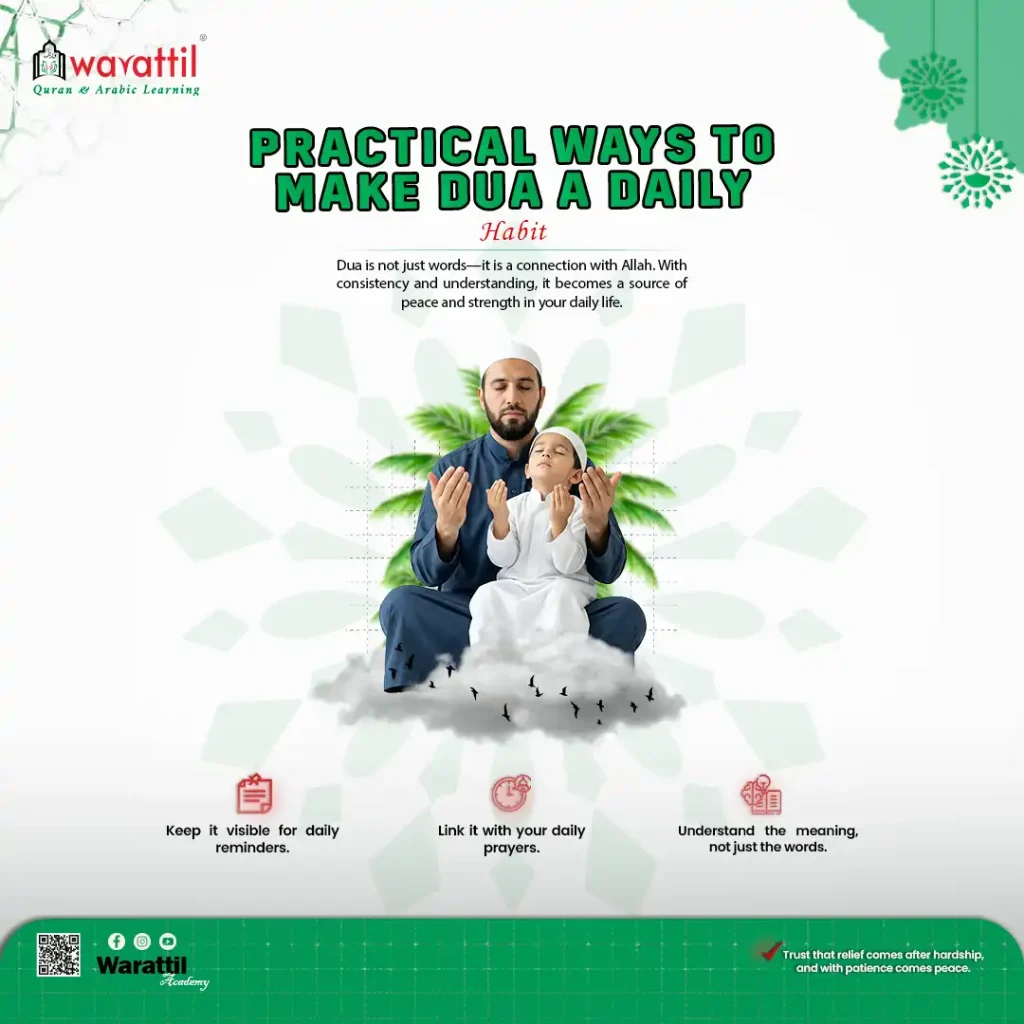
Making dua a consistent practice requires a little structure, especially for those who are just beginning. Here are some ways to build the habit:
Start with just one dua. Do not try to memorise all seven at once. Choose the one that resonates most deeply with your current situation perhaps the dua of Ayyub (AS) if you are dealing with prolonged suffering, or the dua of Musa (AS) if you are in a moment of sudden need and commit to reciting it daily.
Pin a transliteration somewhere visible. The refrigerator door, the bathroom mirror, or your phone wallpaper all work. Seeing the words regularly makes memorisation almost effortless over time.
Pair dua with an existing habit. Recite your chosen supplication right after Fajr prayer, or just before sleeping. Attaching a new practice to an established one makes it far more likely to stick.
Reflect on the meaning, not just the words. The deepest comfort comes not from mechanical repetition, but from understanding what you are actually saying. Read the translation slowly. Let it sit in your mind. Ask yourself how it applies to what you are going through right now.
Stress and anxiety are not signs that your faith is weak. Many of the greatest prophets in Islamic history Yunus (AS), Musa (AS), Ayyub (AS), Ibrahim (AS) faced profound suffering and turned to Allah in their darkest hours. Their duas were preserved not just as historical records, but as living guidance for every generation that would follow.
The Quran reminds us that with every hardship comes ease, and that Allah is ever near and ready to answer the call of those who seek His help. The dua for stress and anxiety that you recite tonight, in the quiet of your room or the middle of a difficult day, connects you to a tradition of sincere believers who have found comfort in exactly these words for over fourteen hundred years.Make the dua. Mean the words. And trust that Allah hears every single one of them.

My son feels happy, amazing teachers and staff in wrattil and flexible prices MashaAllah Thank you so much
My daughter started learning in warattil academy and alhamdulilah we are really impressed and have enjoyed learning with wrattil. May Allah reward her sheikh
My teacher Ahmed is very good. He helped me recite and memorize holy Quran
Warattil is the most efficient way of learning Arabic. I like warattil curriculum and excellent teachers to support this learning Thank you so much
I highly recommend warattil Ijazah programs to anyone who wants to learn Quran properly.
Very well organized MashaAllah. I love it and this is a great course if you want to understand the Quran and learn tafsir
Warattil program is the best I have seen. The teacher is really great and is available to answer questions in a clear manner
I think warattil is the best academy in learning Arabic and I recommend Arabic course to anyone
We are so happy with ustad Hussein. He is very patient and comfortable teacher. May Allah the teachers and admin in warattil
Rating 10 mashaAllah and so grateful