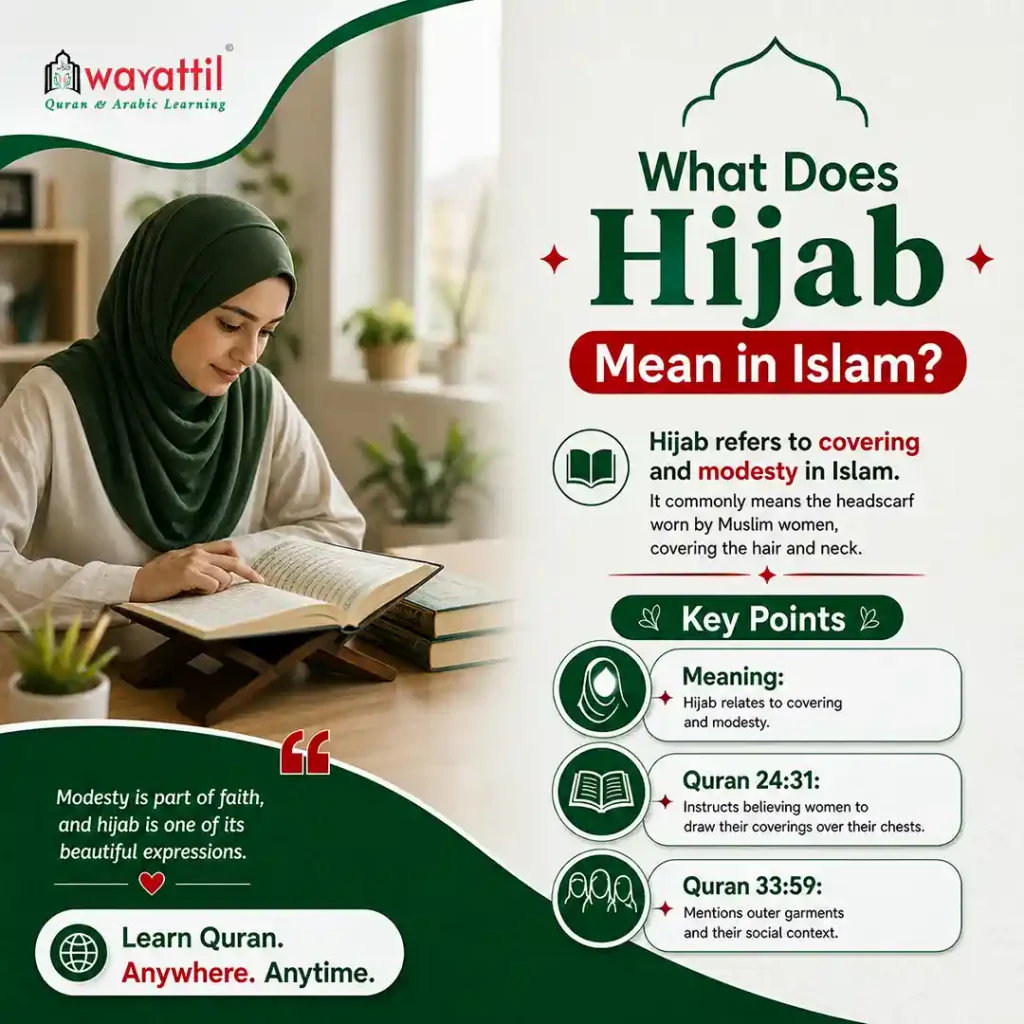
Why do Muslim women wear hijabs? For many Muslim women, the hijab is connected to faith, modesty, worship, and a desire to follow Islamic teachings. However, the reasons can differ from one woman to another. Some wear it primarily as an act of religious devotion, while others also see it as an important part of their identity, culture, or personal expression.
The word hijab is commonly used today to describe a headscarf worn by Muslim women. In a broader Islamic context, however, modesty involves more than a piece of clothing. The Qur’an discusses modest behavior and dress for both men and women, while particular verses address women’s clothing and covering.
It is also important to recognize the diversity among Muslims. Not every Muslim woman wears a hijab, and those who do may wear it in different styles. Research by Pew Research Center has found significant differences in attitudes toward veiling and modest dress among Muslims in different countries and communities.
What Does Hijab Mean in Islam?
The Arabic word hijab can have meanings related to covering, barrier, or separation depending on its context. In everyday English, however, “hijab” usually refers to the headscarf worn by a Muslim woman that covers the hair and neck while leaving the face visible.
The Qur’an’s discussion of women’s clothing appears particularly in Surah An-Nur 24:31 and Surah Al-Ahzab 33:59. In 24:31, believing women are instructed to lower their gaze, guard their modesty, avoid displaying their adornment and draw their khumur over their chests.
Surah Al-Ahzab 33:59 also tells the Prophet Muhammad to instruct his wives, daughters, and believing women to draw their outer garments around themselves when going outside. The verse gives a social context for the instruction, referring to being recognized and not being subjected to harm or harassment.
Because interpretations of Islamic texts and jurisprudence can differ, it is useful to distinguish the Qur’anic passages themselves from later legal interpretations and cultural practices.
Why Do Muslim Women Wear Hijabs?
1. Religious Devotion
For many Muslim women, wearing a hijab is primarily an act of obedience to God.
Islam places importance on modesty as part of religious life. The Qur’an first addresses believing men about lowering their gaze and guarding their modesty, and then gives guidance to believing women regarding their conduct and clothing.
A woman who chooses to wear hijab may therefore understand it as part of her worship and commitment to Islam. Rather than viewing it simply as an item of fashion, she may see the practice as a visible expression of her relationship with God.
2. Modesty
Modesty is one of the central concepts associated with hijab.
However, Islamic modesty is not limited to covering a woman’s hair. The Qur’an’s guidance includes lowering the gaze, guarding one’s private parts, avoiding inappropriate display of adornment, and behaving modestly. Similar principles are addressed to men as well.
For this reason, many Muslims understand hijab as part of a wider concept of haya, commonly translated as modesty or modest behavior. Clothing is one part of that broader principle.
3. Religious Identity
For some Muslim women, the hijab is also an important part of their religious identity.
A headscarf can make a woman’s Muslim identity visibly recognizable, particularly in communities where Muslims are a minority. Pew Research Center found that many Muslim Americans who wear hijab regularly describe their appearance as distinctly Muslim. The same research also found that dressing modestly is considered an important part of Muslim identity by a substantial share of American Muslims.
This does not mean every woman who wears hijab has the same experience. For some, it may be primarily spiritual; for others, identity and community can also be important.
4. Personal Commitment to Islamic Teachings
Religious practice is often personal. A Muslim woman may decide to begin wearing hijab after studying the Qur’an, learning more about Islamic teachings, becoming more religious, or reaching a point in her life where she feels ready for the practice.
For some women, the decision develops gradually rather than happening at a particular moment. Their understanding of modesty can also change over time.
This is one reason it can be misleading to assume that every Muslim woman wears hijab for exactly the same reason.
Is Hijab Only About Covering Hair?
No. In Islamic discussions, modesty encompasses behavior as well as clothing.
The Qur’an’s instruction in Surah An-Nur 24:31 does not discuss hair covering in isolation. It also mentions lowering the gaze, guarding chastity, and avoiding the public display of adornment.
This broader understanding explains why many Muslims describe hijab as a practice of modesty rather than simply a head covering.
At the same time, Islamic scholars have differed over some details of women’s dress, including which parts of the body must be covered and how particular texts should be interpreted. Pew Research Center notes that, although the Qur’an discusses modest dress, Islamic legal traditions have also drawn on hadith when developing rules concerning women’s veiling.
Do All Muslim Women Wear Hijab?
No. Muslim women have different beliefs, practices, cultural backgrounds, and personal circumstances.
Some Muslim women wear hijab consistently in public. Others wear it occasionally, while some do not wear it at all. This diversity exists even within the same country or Muslim community.
For example, a 2017 Pew Research Center survey found that among Muslim women in the United States, 38% said they always wore a headcover or hijab in public, 5% said they did so most of the time, 15% sometimes wore one, and 42% said they never did. These figures describe U.S. Muslims and should not be treated as representative of Muslim women worldwide.
The research also demonstrates that religious commitment, social environment, education, family background, and other factors can be associated with differences in hijab practices.
Hijab, Culture, and Religion
One common misunderstanding is that every form of Muslim women’s clothing is purely cultural or, conversely, that every style represents exactly the same religious requirement.
In reality, religion and culture can interact.
The basic concept of modest dress has a foundation in Islamic scripture, while the specific ways women dress vary considerably between regions and cultures. A Muslim woman in Indonesia may wear a different style from a woman in Egypt, Turkey, Pakistan, the United Kingdom, or the United States.
Styles can also change according to fashion, climate, profession, personal preference, and local customs.
Therefore, the hijab should not be treated as a single uniform style.
What Is the Difference Between Hijab, Niqab, and Burqa?
These terms describe different forms of clothing and should not be used interchangeably.
Hijab commonly refers to a headscarf that covers the hair and neck while leaving the face visible.
Niqab generally refers to a face veil that covers the face while leaving the eyes visible.
Burqa is a more extensive garment that covers the body and face, with a mesh or other covering over the eye area in some styles.
These garments have different histories and are practiced differently across Muslim communities. Research on Muslim-majority countries has also found substantial differences in public preferences concerning women’s clothing and the extent of covering.
Is Wearing a Hijab a Personal Choice?
This question requires some nuance because religious belief and social circumstances can be very different.
Many Muslim women describe wearing hijab as a personal religious choice. Others may experience family, community, workplace, or government pressures concerning women’s clothing. In some places, women have faced restrictions on wearing religious head coverings, while in other places laws or policies have required particular forms of women’s dress.
Pew Research Center’s international research has also found significant differences in Muslim attitudes toward whether women should have the right to decide whether to wear a veil in public.
Consequently, there is no single experience that can accurately describe every Muslim woman who wears, or does not wear, hijab.
Does the Hijab Mean a Woman Has No Freedom?
Wearing a hijab does not, by itself, tell us what a woman believes about education, employment, family life, politics, or personal freedom.
A Muslim woman can understand hijab as an expression of religious commitment while also pursuing education, building a career, running a business, participating in public life, and making decisions about her family and personal life.
Likewise, a woman who does not wear hijab cannot automatically be assumed to be less religious. Religious commitment is broader than one visible practice.
This distinction is important because Muslim women are not a single, uniform group. Their beliefs and experiences vary significantly across countries and communities.
Why Do Some Muslim Women Choose Not to Wear Hijab?
There are many possible reasons.
Some Muslim women may interpret Islamic requirements differently. Others may consider modesty important but not believe that covering the hair is required. Some may be in the process of deciding whether to wear hijab, while others may have stopped wearing it because of personal, professional, family, or social circumstances.
It is therefore inaccurate to assume that every Muslim woman who does not wear hijab rejects Islam or does not value modesty.
Similarly, it would be inaccurate to assume that every woman who wears hijab does so because of pressure. Individual experiences need to be understood on their own terms.
Why Is Hijab Important to Many Muslim Women?
For women who choose to wear it, the hijab can represent several things at once: faith, modesty, religious obedience, identity, and personal commitment.
The Qur’an provides important guidance concerning modesty and women’s clothing, particularly in Surah An-Nur 24:31 and Surah Al-Ahzab 33:59. At the same time, Muslim communities have developed different interpretations, practices, and styles throughout history.
Understanding the hijab therefore requires more than looking at the scarf itself. It involves understanding Islamic teachings, individual belief, cultural diversity, and the personal experiences of Muslim women.
So, why do Muslim women wear hijabs? For many, the answer begins with faith and modesty. They may view the hijab as an act of worship and a way to follow what they understand to be Islamic guidance. For others, it can additionally express religious identity, community, or personal values.
At the same time, Muslim women are not all the same. Some wear hijab every day, some wear it occasionally, and some do not wear it. Their reasons can be religious, personal, cultural, social, or a combination of these factors.
A balanced understanding of hijab recognizes both the Islamic teachings surrounding modesty and the diversity of Muslim women’s individual experiences. That approach avoids reducing a complex religious practice to a single explanation.