Shopping cart
- +1 564-544-6614
- [email protected]
- 24/7 Available


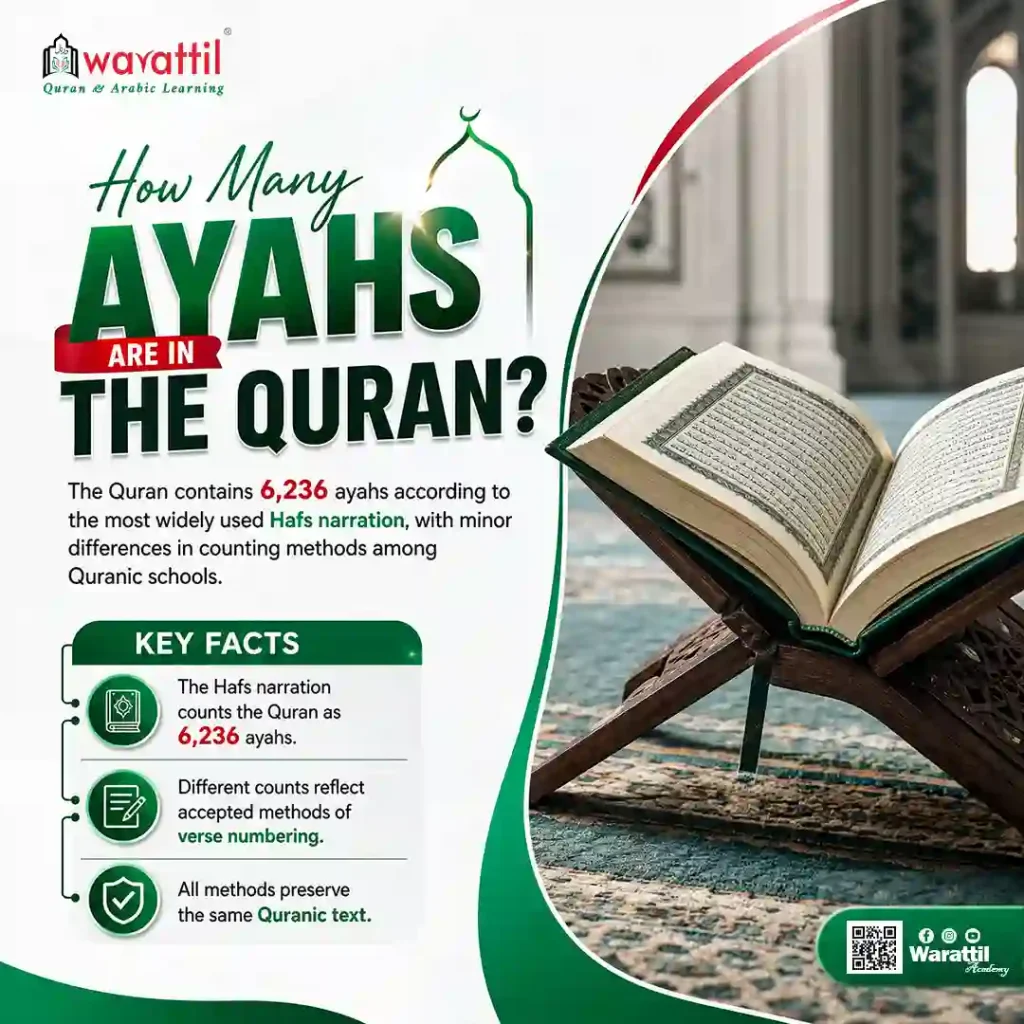
If you have ever asked yourself how many ayahs in the Quran, you are tapping into a question that has fascinated scholars and laypeople alike for centuries. The answer, while straightforward in many Muslim households today, actually rests on a rich tradition of meticulous counting and preservation. The most widely recognised figure is 6,236 ayahs in the standard Ḥafṣ ʿan ʿĀṣim muṣḥaf – the text recited by the vast majority of the Muslim world. Yet the story behind this number is far more layered than a single digit can convey.
When you open a typical modern muṣḥaf based on the Kufan school of counting, you will find exactly 6,236 verses. This count excludes the standalone basmalahs that open 113 of the 114 surahs, treating them as separators rather than numbered ayahs. The sole exception is Sūrat al-Fātiḥah, where the basmalah is firmly counted as the first verse. This Kufan enumeration, associated with the transmission of Ḥafṣ, has become the global benchmark because the majority of printed Qurans today follow it. So, for a quick and precise reply, the Quran contains 6,236 ayahs.
Yet no student of the Quranic sciences stops there, because this number is not the only historically authenticated one. Early Muslim communities in Medina, Mecca, Basra, and Damascus each produced authorised counts that vary slightly, reflecting different methodologies for determining where a verse ends. These differences are not contradictions; they are a testament to the care taken in preserving every syllable.
The Quran was revealed orally, and the Prophet Muḥammad ﷺ taught his companions precisely where to pause and where a verse was complete. As Islam spread to different cities, local authorities inherited distinct traditions about verse boundaries. Over time, scholars codified these into a handful of well-known numbering systems – often named after the region that adopted them. Each system is fully canonical and goes back to the companions, so none is more “correct” than the other. What changes is the punctuation of the divine speech, never a single word.
Understanding these variations explains why someone might encounter a total different from 6,236. In West Africa, for instance, where the Warsh transmission is dominant, the muṣḥaf contains fewer numbered verses. None of this alters the revealed text; it merely adjusts where the breaks fall.
Classical sources like al-Suyūṭī’s al-Itqān list at least six authoritative counts. When you sum the ayahs according to each school, you see figures such as:
The two Medinan totals differ because Nāfiʿ’s two principal transmitters received slightly different stopping instructions. Notice that three schools – Basran, second Medinan, and first Medinan – cluster in the 6,210s, while the Kufan stands alone at the higher end. These divergences arise in only a handful of surahs; the vast majority of verses are segmented identically across all traditions.
A practical question that often crops up is whether the basmalah – bismillāh al-raḥmān al-raḥīm – should be treated as a separate verse. The consensus in all schools is that it forms a verse only within Sūrat al-Fātiḥah. In the remaining 112 surahs that begin with the basmalah (Sūrat al-Tawbah has none), it is written as an unnumbered line. If you were to add each basmalah as an independent ayah, the total would rise to 6,236 + 112 = 6,348 ayahs. This figure is sometimes cited in pious literature and should be understood as the full number of “verse-like” units, not the actual numbering displayed in the muṣḥaf.
A surprisingly persistent myth claims the Quran contains 6,666 verses. You will find this number mentioned in older cultural works and even in some orientalist writings, but it has no foundation in any classical Islamic counting system. The earliest reliable authorities never recorded 6,666, and no known chain of transmission supports it. Scholars of Quranic history point out that this number likely emerged as an approximation or a mnemonic device, and it later gained unwarranted credibility. When you are asked how many ayahs in the Quran, 6,666 is the one answer you can confidently set aside.
The Quran is also universally agreed to contain 114 surahs, a number about which there is no difference among Muslim scholars. The surahs vary dramatically in length. Sūrat al-Baqarah, the longest, spans 286 ayahs, while Sūrat al-Kawthar, the shortest, consists of only 3. Sūrat al-Fātiḥah holds 7 verses, and Sūrat al-Ikhlāṣ 4. These extremes remind us that the divine message does not lean on quantity but on the weight of meaning contained in each word.
Alongside the verse count, the text’s letter and word statistics are often mentioned: the Quran contains roughly 320,000 letters and about 77,430 words, depending on how particles are counted. These figures, while not as rigorously standardised as the verse counts, give you a sense of the text’s scale.
What makes these numbers so significant is the living chain of preservation behind them. Muslim scribes did not simply decide on a number; they transmitted it with the same precision they applied to the consonants and vowels of the text itself. Each system of ʿadad al-āy (verse counting) was passed down through an unbroken line of teachers and students, often accompanied by certificates of mastery. That multiple, equally authentic counts exist side by side is a sign of honesty in preservation, not of confusion.
When you hold a modern muṣḥaf, you are holding a document whose every pause and boundary was debated, documented, and transmitted with phenomenal care. The answer to how many ayahs in the Quran is therefore not just a piece of trivia – it is a window into the scholarly dedication that has safeguarded the final revelation for over fourteen centuries.
So, how many ayahs in the Quran? For the vast majority of readers today, the answer is 6,236, following the Kufan system embedded in the Ḥafṣ muṣḥaf. Understanding the handful of other legitimate totals only deepens your appreciation of the Quran’s meticulous preservation. Next time you open the Book, you can let your eyes trace the verse numbers knowing that each one was counted, verified, and lovingly passed down by a community that treated every letter as a trust.

My son feels happy, amazing teachers and staff in wrattil and flexible prices MashaAllah Thank you so much
My daughter started learning in warattil academy and alhamdulilah we are really impressed and have enjoyed learning with wrattil. May Allah reward her sheikh
My teacher Ahmed is very good. He helped me recite and memorize holy Quran
Warattil is the most efficient way of learning Arabic. I like warattil curriculum and excellent teachers to support this learning Thank you so much
I highly recommend warattil Ijazah programs to anyone who wants to learn Quran properly.
Very well organized MashaAllah. I love it and this is a great course if you want to understand the Quran and learn tafsir
Warattil program is the best I have seen. The teacher is really great and is available to answer questions in a clear manner
I think warattil is the best academy in learning Arabic and I recommend Arabic course to anyone
We are so happy with ustad Hussein. He is very patient and comfortable teacher. May Allah the teachers and admin in warattil
Rating 10 mashaAllah and so grateful