Shopping cart
- +1 564-544-6614
- [email protected]
- 24/7 Available


The Quran is not just a book of guidance it is a living, breathing source of power that speaks directly to the human heart. Every single verse carries the weight of divine authority, but some stand out for their extraordinary spiritual force and the profound impact they have on those who recite them with sincerity. These powerful ayat of Quran serve as anchors for our faith, shields against harm, and windows into the majesty of Allah. Let us explore the verses that the Prophet Muhammad (ﷺ) himself highlighted as especially significant, drawing from authentic narrations and scholarly consensus.
If you take nothing else away from this article, memorise and recite this verse daily. Ayat-ul-Kursi (Surah Al-Baqarah, 2:255) is unanimously regarded as the most powerful ayat of Quran—the verse that displays Allah’s absolute sovereignty over the heavens and the earth. The Prophet (ﷺ) once asked Ubayy ibn Ka’b, “O Abu’l-Mundhir, which verse from the Book of Allah is the greatest?” When Ubayy recited Ayat-ul-Kursi, the Prophet struck his chest and said, “May this knowledge be a blessing to you.” This is why scholars refer to it as Sayyidat al-Ayat—the master of all verses.
What makes this verse so exceptional? It declares Allah’s oneness, confirms His living and self-sustaining nature, and negates any hint of weakness such as sleep or fatigue from His perfect being. To Him belongs whatever is in the heavens and whatever is on the earth, and His throne extends over them both.
The benefits of regular recitation are well-documented in authentic hadith. If you recite Ayat-ul-Kursi in the morning, it provides you with twenty-four hours of protection from all forms of harm. Reading it at home keeps your house safe from Shaytan. The Prophet (ﷺ) also taught that reciting it after every obligatory prayer means that nothing stands between you and Paradise except death. One famous narration describes how Abu Huraira (RA) was tricked by a thief who turned out to be Shaytan himself—the devil then confessed that reciting Ayat-ul-Kursi before sleeping ensures a guardian from Allah protects you until morning.
Right on the heels of Ayat-ul-Kursi come the closing verses of the same chapter. The last two powerful ayat of Quran from Surah Al-Baqarah (2:285–286) hold a special place in the hearts of believers. These verses affirm the faith of the Prophet (ﷺ) and all believers in Allah, His angels, His books, and His messengers without making any distinction between them. Then they turn into a heartfelt plea: “Allah does not burden any soul beyond what it can bear…” a phrase that has comforted countless Muslims facing hardship.
The Prophet (ﷺ) made a crystal-clear promise about these verses. He said, “Whoever recites the last two verses of Surah Al-Baqarah at night, they will be sufficient for him.” Scholars interpret “sufficient” in several ways. It means sufficient for your night worship, sufficient to protect you from the harm of Shaytan and jinn, and sufficient to safeguard you from any danger from humans. In other words, these two verses act as a complete spiritual armour when you recite them before sleep.
Beyond these two monumental passages, the Quran contains other powerful ayat of Quran that address particular situations with remarkable precision.
For protection from the evil eye and all forms of harm, Surah Al-Falaq and Surah An-Nas (the last two chapters of the Quran) are your daily companions. The Prophet (ﷺ) recited them every morning and evening as part of his routine, and you should too.
When you feel overwhelmed by anxiety, grief, or weakness, turn to the supplication within the last verses of Surah Al-Baqarah mentioned above. The prayer, “Our Lord, do not hold us accountable if we forget or make a mistake…” directly addresses human fragility and asks for divine mercy in the most eloquent manner.
Abdullah ibn Mas’ud (RA) also prescribed a powerful formula: reciting the first four verses of Surah Al-Baqarah, followed by Ayat-ul-Kursi and the two verses that come after it, and concluding with the last three verses of the same chapter. He said that anyone who recites these ten verses in the morning will remain protected from Shaytan until the evening, and will not face unpleasant surprises in his family or wealth. If the same verses are recited in a home, no Shaytan will enter it until morning.

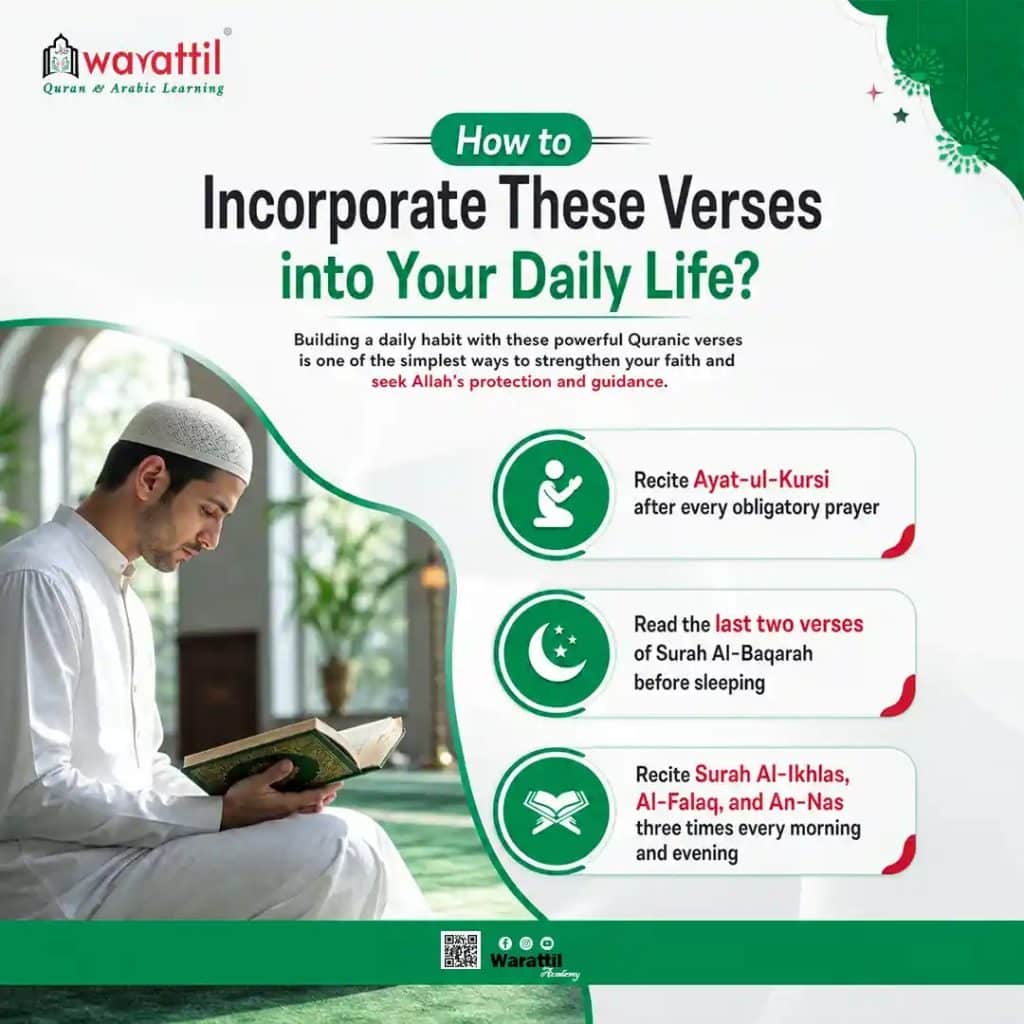
You do not need to be a scholar to benefit from these powerful ayat of Quran. The key is consistency, not volume. Start with Ayat-ul-Kursi after every obligatory prayer it takes less than a minute. Add the last two verses of Surah Al-Baqarah to your bedtime routine. In the morning and evening, recite the three Quls (Surah Al-Ikhlas, Al-Falaq, and An-Nas) three times each. This is the minimum, and it is more than enough to build a powerful spiritual shield around you.
Remember that these verses work best when recited with understanding and trust. Let your heart rest in the fact that Allah does not burden you beyond your capacity. Let Ayat-ul-Kursi remind you that He is always watching over you. And let the closing verses of Al-Baqarah teach you to turn to Him in humility, seeking forgiveness and mercy in every moment.
The powerful ayat of Quran explored above are not magical incantations—they are direct conversations between you and your Creator. When you recite them with sincerity, you are not just uttering words; you are inviting divine protection, mercy, and strength into your life. Make them part of your daily rhythm, teach them to your children, and watch how they transform your spiritual state. May Allah grant us all the ability to recite His Book with understanding and to live by its guidance, Ameen.

My son feels happy, amazing teachers and staff in wrattil and flexible prices MashaAllah Thank you so much
My daughter started learning in warattil academy and alhamdulilah we are really impressed and have enjoyed learning with wrattil. May Allah reward her sheikh
My teacher Ahmed is very good. He helped me recite and memorize holy Quran
Warattil is the most efficient way of learning Arabic. I like warattil curriculum and excellent teachers to support this learning Thank you so much
I highly recommend warattil Ijazah programs to anyone who wants to learn Quran properly.
Very well organized MashaAllah. I love it and this is a great course if you want to understand the Quran and learn tafsir
Warattil program is the best I have seen. The teacher is really great and is available to answer questions in a clear manner
I think warattil is the best academy in learning Arabic and I recommend Arabic course to anyone
We are so happy with ustad Hussein. He is very patient and comfortable teacher. May Allah the teachers and admin in warattil
Rating 10 mashaAllah and so grateful