Shopping cart
- +1 564-544-6614
- [email protected]
- 24/7 Available


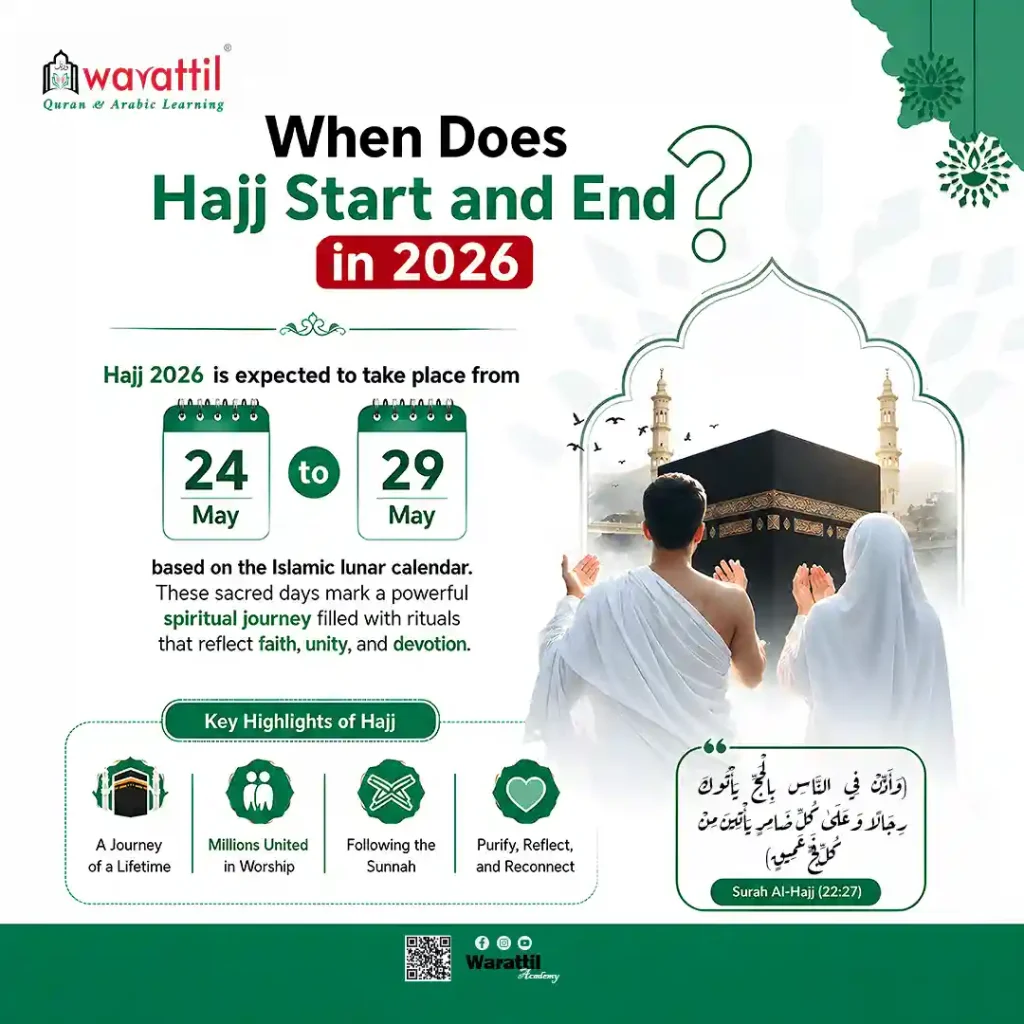
For millions of Muslims worldwide, the sacred pilgrimage of Hajj represents the pinnacle of their spiritual journey. One of the most common questions asked by those preparing for this profound obligation is: when does Hajj start and end? The answer is determined by the Islamic lunar calendar, specifically the month of Dhul Hijjah. In 2026 (1447 AH), Hajj is expected to take place from the evening of Sunday, 24 May 2026 through to Friday, 29 May 2026.
Understanding the precise timeline is essential for anyone intending to answer the call, as the pilgrimage spans five to six days filled with deeply symbolic rites that connect Muslims to the legacy of Prophet Ibrahim and the finality of Prophet Muhammad’s (peace be upon them) message.
Unlike the Gregorian calendar, the Islamic calendar is lunar, causing the dates of Hajj to shift earlier by approximately 11–12 days each year. The pilgrimage formally commences on the 8th of Dhul Hijjah and concludes on the 12th or 13th of the same month, depending on the moon sighting.
Based on current astronomical predictions and authoritative sources, here is the expected timeline for 2026:
Crucial Note: These dates are estimates. The official beginning of Dhul Hijjah is confirmed by the physical sighting of the new moon. In 2026, the new moon is expected to be born on 16 May 2026, with the first day of Dhul Hijjah likely being Monday, 18 May 2026. Pilgrims should always rely on the official announcement from the relevant authorities in Saudi Arabia.
To fully grasp the timeline, one must walk through the rites of Hajj. Each day holds a specific purpose, and the journey is designed to be a physical manifestation of complete submission to Allah.
On the first official day, pilgrims enter the state of Ihram, a sacred condition marked by simple white garments for men and modest dress for women. They make their way to the vast tent city of Mina, where they spend the night in preparation for the most important day of the pilgrimage.
This is the heart of Hajj. The Prophet Muhammad (peace be upon him) said: “Hajj is Arafah.” On the Day of Arafah, pilgrims gather on the plain of Mount Arafat from noon until sunset. It is a day of intense supplication, seeking Allah’s boundless mercy and forgiveness. No act of worship on Earth carries more weight than this sincere standing.
After sunset on the Day of Arafah, the procession moves to Muzdalifah, an open area between Arafat and Mina. Here, pilgrims combine their Maghrib and Isha prayers and spend the night under the open sky. At dawn, they collect pebbles for the symbolic stoning of the devil (Ramy al-Jamarat).
The 10th of Dhul Hijjah marks Eid al-Adha, the Festival of Sacrifice. Pilgrims proceed to the Jamarat in Mina to throw seven pebbles at the largest pillar, symbolising the rejection of evil. This is followed by the sacrifice of an animal, commemorating Prophet Ibrahim‘s willingness to sacrifice his son in obedience to God. Men then shave or trim their hair, and women trim a fingertip‘s length. Pilgrims then return to Makkah to perform Tawaf al-Ifadah (the circling of the Kaaba) and Sa’i (walking between the hills of Safa and Marwah).
The final days are spent in Mina, stoning all three pillars over two or three days. This concludes the physical rites of Hajj.
The pilgrimage is not merely a logistical exercise; it is a command from Allah and a source of immense spiritual reward. Allah (SWT) instructs the believers in the Holy Quran:
اَلْحَجُّ أَشْهُرٌ مَّعْلُوْمٰتٌۚ
Al-Hajju ashhurum ma‘lumat.
“Hajj is (in) the well-known months…”
(Surah Al-Baqarah, 2:197)
These “well-known months” refer to Shawwal, Dhul Qa’dah, and the first ten days of Dhul Hijjah, during which one can enter the state of Ihram. The verse continues to instruct believers on the
etiquette of this sacred journey:
…فَلَا رَفَثَ وَلَا فُسُوْقَ وَلَا جِدَالَ فِى الْحَجِّۗ
…fala rafatha wa la fusuqa wa la jidala fil-hajj.
“…so whoever has made Hajj obligatory upon himself therein, there is (to be for him) no sexual relations and no disobedience and no disputing during Hajj.”
This powerful guidance elevates the pilgrimage to a state of pure worship, forbidding arguments, obscenity, and sin. It reminds the pilgrim that the journey is an opportunity for spiritual cleansing and renewed focus on the Creator.
The reward for a successful Hajj is unparalleled. The Prophet Muhammad (peace be upon him) gave the glad tidings:
The Prophet (peace be upon him) said: “Whoever performs Hajj and does not engage in immoral behavior or sin will return as sinless as the day his mother gave birth to him.”
(Sahih al-Bukhari)
This promise of complete forgiveness is a cornerstone of hope for every believer who answers the call. Furthermore, the Prophet (peace be upon him) emphasised the urgency of this duty, encouraging all who are able to hasten to fulfil it before unforeseen obstacles arise.
If you are considering performing Hajj in 2026, preparation should begin immediately. The Kingdom of Saudi Arabia has implemented a strict digital system for registration. International pilgrims must register exclusively through the official Nusuk Hajj platform (hajj.nusuk.sa), which handles visa applications, package selection, and permits. Unauthorised agencies have been phased out to ensure transparency.
Remember that entry to the holy sites is strictly prohibited for those holding only a tourist or visit visa. You must secure a dedicated Hajj visa through the authorised channels. Health requirements, including the mandatory meningococcal meningitis vaccination, must also be documented and uploaded.
So, when does Hajj start and end? In 2026, it begins on the evening of 24 May and concludes on 29 May. Yet the true journey begins long before that date—in the heart of the believer who makes the sincere intention (Niyyah) to answer Allah‘s call. It is a journey of sacrifice, patience, and profound devotion. For those fortunate enough to be invited as Guests of the Most Merciful, it is an experience that forever reshapes the soul.
May Allah grant the sincere intention and the ability to perform this blessed pilgrimage to all those who seek it. Ameen.

My son feels happy, amazing teachers and staff in wrattil and flexible prices MashaAllah Thank you so much
My daughter started learning in warattil academy and alhamdulilah we are really impressed and have enjoyed learning with wrattil. May Allah reward her sheikh
My teacher Ahmed is very good. He helped me recite and memorize holy Quran
Warattil is the most efficient way of learning Arabic. I like warattil curriculum and excellent teachers to support this learning Thank you so much
I highly recommend warattil Ijazah programs to anyone who wants to learn Quran properly.
Very well organized MashaAllah. I love it and this is a great course if you want to understand the Quran and learn tafsir
Warattil program is the best I have seen. The teacher is really great and is available to answer questions in a clear manner
I think warattil is the best academy in learning Arabic and I recommend Arabic course to anyone
We are so happy with ustad Hussein. He is very patient and comfortable teacher. May Allah the teachers and admin in warattil
Rating 10 mashaAllah and so grateful