Shopping cart
- +1 564-544-6614
- [email protected]
- 24/7 Available


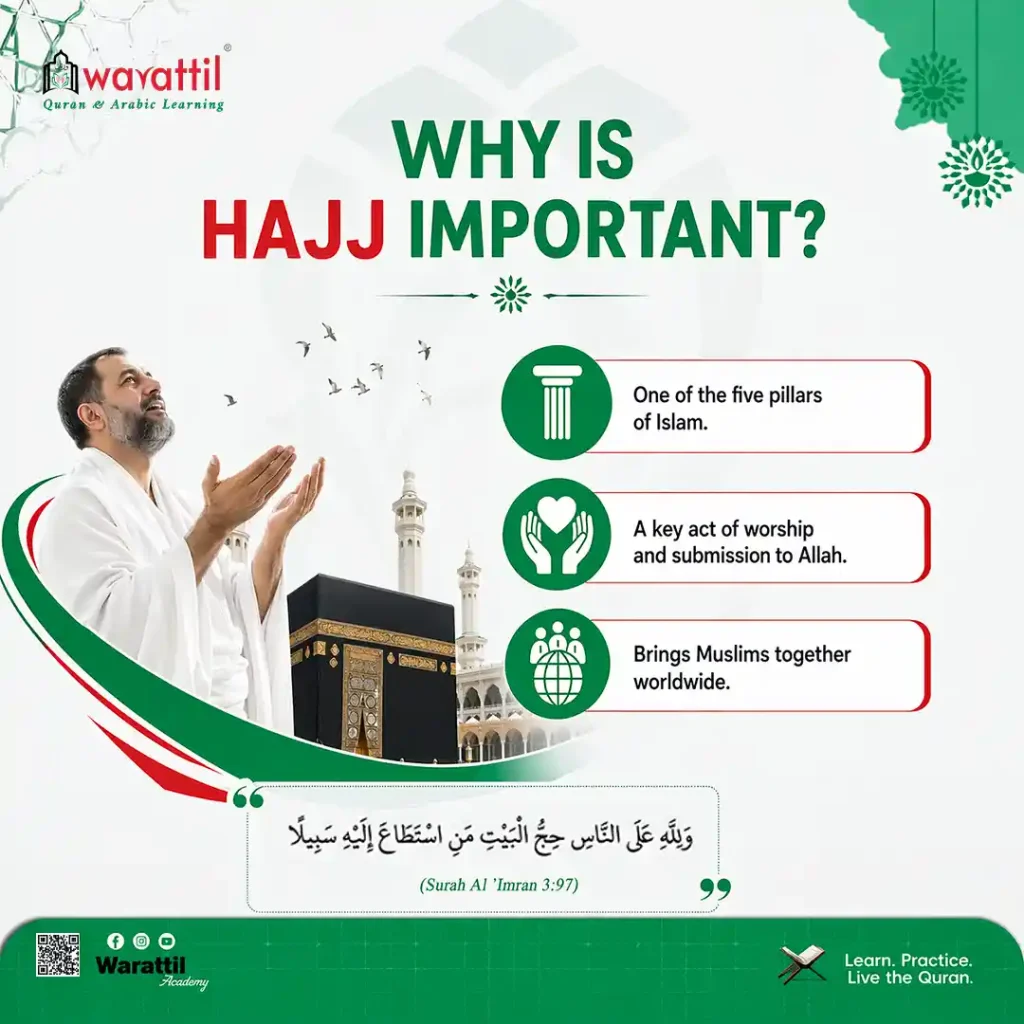
Every year, the month of Dhul-Hijjah witnesses a spectacle of faith unmatched anywhere else on Earth. Millions of Muslims from every corner of the globe converge on the ancient city of Makkah, leaving behind their homes, their status, and their daily lives to answer a divine call. This is Hajj, a sacred pilgrimage that is far more than a mere journey. To understand the very core of Islam, one must first grasp why is Hajj important. It stands as one of the five foundational pillars upon which the entire faith is built and represents the ultimate act of worship and submission to Allah.
Hajj is not simply a recommended act of piety; it is a mandatory religious obligation for every adult Muslim who is physically and financially capable of undertaking the journey at least once in their lifetime. This decree is firmly established in the Qur’an, where Allah states:
وَلِلَّهِ عَلَى ٱلنَّاسِ حِجُّ ٱلْبَيْتِ مَنِ ٱسْتَطَاعَ إِلَيْهِ سَبِيلًۭا ۚ وَمَن كَفَرَ فَإِنَّ ٱللَّهَ غَنِىٌّ عَنِ ٱلْعَـٰلَمِينَ
“Pilgrimage to this House is an obligation by Allah upon whoever is able among the people. But whoever disbelieves – then indeed, Allah is free from need of the worlds.” (Surah Ali-’Imran, 3:97)
The importance of this duty is further cemented by the words of the Prophet Muhammad (peace be upon him), who said:
بُنِيَ الْإِسْلَامُ عَلَى خَمْسٍ: شَهَادَةِ أَنْ لَا إِلَهَ إِلَّا اللَّهُ وَأَنَّ مُحَمَّدًا رَسُولُ اللَّهِ، وَإِقَامِ الصَّلَاةِ، وَإِيتَاءِ الزَّكَاةِ، وَالْحَجِّ، وَصَوْمِ رَمَضَانَ
“Islam is built upon five: to testify that there is no god but Allah and that Muhammad is the messenger of Allah, to establish prayer, to give Zakat, to perform Hajj, and to fast the month of Ramadan.” (Sahih al-Bukhari and Sahih Muslim)
The Prophet (peace be upon him) also directly commanded the believers and warned against complacency, stating, “O people, God has made Hajj obligatory upon you, so perform Hajj” (Sahih Muslim). He further advised, “Hasten to perform Hajj (the obligatory Hajj), as no one of you knows what might happen to him” (Ahmad). As the fifth and final pillar, Hajj completes the framework of a Muslim’s life, representing a climactic spiritual renewal and the fulfillment of a fundamental covenant with God.
The question of “why is Hajj important” is often answered by its unparalleled spiritual rewards. At the heart of the pilgrimage is the promise of a complete spiritual reset. The Prophet Muhammad (peace be upon him) described this beautifully, stating:
مَنْ حَجَّ لِلَّهِ فَلَمْ يَرْفُثْ وَلَمْ يَفْسُقْ رَجَعَ كَيَوْمِ وَلَدَتْهُ أُمُّهُ
“Whoever performs Hajj to this House for the sake of Allah, and does not have sexual relations nor commit any disobedience, will go back like the day his mother bore him.” (Sahih al-Bukhari and Sahih Muslim)
This powerful hadith signifies that a properly performed and accepted Hajj wipes away all previous sins, allowing the pilgrim to return with a slate as clean as a newborn baby. The reward for this pure state is immense, with another narration confirming:
الْحَجُّ الْمَبْرُورُ لَيْسَ لَهُ جَزَاءٌ إِلَّا الْجَنَّةُ
“The reward for an accepted Hajj (Hajj Mabrur) is nothing less than Paradise.” (Sahih al-Bukhari and Sahih Muslim)
Furthermore, Hajj is considered a profound means of purification and a way to alleviate hardship. The Prophet (pbuh) said, “Perform the Hajj and the Umrah consecutively; they remove poverty and sins just as a bellowing furnace removes impurities from iron.” (Ibn Maajah; Al-Albaani: Saheeh). These teachings collectively highlight that Hajj is not just a duty but a divine opportunity for spiritual, and even material, cleansing and renewal.
Hajj is a meticulously structured set of rites that commemorate the faith, sacrifice, and devotion of Prophet Ibrahim (Abraham), his wife Hajar (Hagar), and their son Prophet Ismail (Ishmael). This journey is not a vacation but an active and physically demanding act of worship that spans five to six days in and around the holy city of Makkah. The rituals include:
إِنَّ ٱلصَّفَا وَٱلْمَرْوَةَ مِن شَعَآئِرِ ٱللَّهِ ۖ فَمَنْ حَجَّ ٱلْبَيْتَ أَوِ ٱعْتَمَرَ فَلَا جُنَاحَ عَلَيْهِ أَن يَطَّوَّفَ بِهِمَا ۚ وَمَن تَطَوَّعَ خَيْرًۭا فَإِنَّ ٱللَّهَ شَاكِرٌ عَلِيمٌ
“Indeed, Safa and Marwah are among the symbols of Allah. So whoever makes Hajj to the House or performs ‘Umrah – there is no blame upon him for walking between them.” (Surah Al-Baqarah, 2:158)
الْحَجُّ عَرَفَةُ
“Hajj is Arafah.” (Sunan Abi Dawud/Ahmad)
This underscores its absolute centrality. It is here that he delivered his Farewell Sermon, and it is believed to be a day of immense mercy and forgiveness from Allah.
ثُمَّ لْيَقْضُوا۟ تَفَثَهُمْ وَلْيُوفُوا۟ نُذُورَهُمْ وَلْيَطَّوَّفُوا۟ بِٱلْبَيْتِ ٱلْعَتِيقِ
“Then let them end their untidiness and fulfill their vows and perform Tawaf around the ancient House.” (Surah Al-Hajj, 22:29)
Finally, before departing, pilgrims perform a farewell Tawaf.
Beyond its profound individual spiritual benefits, Hajj serves as a living, breathing testament to global Islamic unity and the principle of human equality. Annually, the pilgrimage convenes what is arguably the largest single religious gathering on the planet. In the 2025 season, for instance, official statistics recorded a total of 1,673,230 pilgrims from across the world. This immense, diverse congregation—united by a single faith, chanting the same prayers, and performing identical rituals—is a powerful demonstration of the universal brotherhood and sisterhood inherent in Islam. The simple white ihram garments worn by all effectively erase any mark of social or economic hierarchy; a king stands shoulder to shoulder with a laborer, both equal in the sight of their Creator.
This annual gathering not only reinforces a shared Muslim identity but also provides a unique opportunity for the global exchange of ideas and the fostering of solidarity that transcends national and ethnic boundaries. This concept of a global, unified response to a divine call is beautifully captured in the Qur’an, where Allah commands Prophet Ibrahim:
وَأَذِّن فِى ٱلنَّاسِ بِٱلْحَجِّ يَأْتُوكَ رِجَالًۭا وَعَلَىٰ كُلِّ ضَامِرٍۢ يَأْتِينَ مِن كُلِّ فَجٍّ عَمِيقٍۢ
“And proclaim to the people the Hajj; they will come to you on foot and on every lean camel; they will come from every distant pass.” (Surah Al-Hajj, 22:27)
In essence, Hajj is far more than a set of rituals; it is a transformative odyssey of the soul, a fulfillment of a divine command, and a powerful symbol of a united global community. Understanding why Hajj is important is to understand a central, unifying, and deeply personal act of devotion in the life of a Muslim.

My son feels happy, amazing teachers and staff in wrattil and flexible prices MashaAllah Thank you so much
My daughter started learning in warattil academy and alhamdulilah we are really impressed and have enjoyed learning with wrattil. May Allah reward her sheikh
My teacher Ahmed is very good. He helped me recite and memorize holy Quran
Warattil is the most efficient way of learning Arabic. I like warattil curriculum and excellent teachers to support this learning Thank you so much
I highly recommend warattil Ijazah programs to anyone who wants to learn Quran properly.
Very well organized MashaAllah. I love it and this is a great course if you want to understand the Quran and learn tafsir
Warattil program is the best I have seen. The teacher is really great and is available to answer questions in a clear manner
I think warattil is the best academy in learning Arabic and I recommend Arabic course to anyone
We are so happy with ustad Hussein. He is very patient and comfortable teacher. May Allah the teachers and admin in warattil
Rating 10 mashaAllah and so grateful