Shopping cart
- +1 564-544-6614
- [email protected]
- 24/7 Available


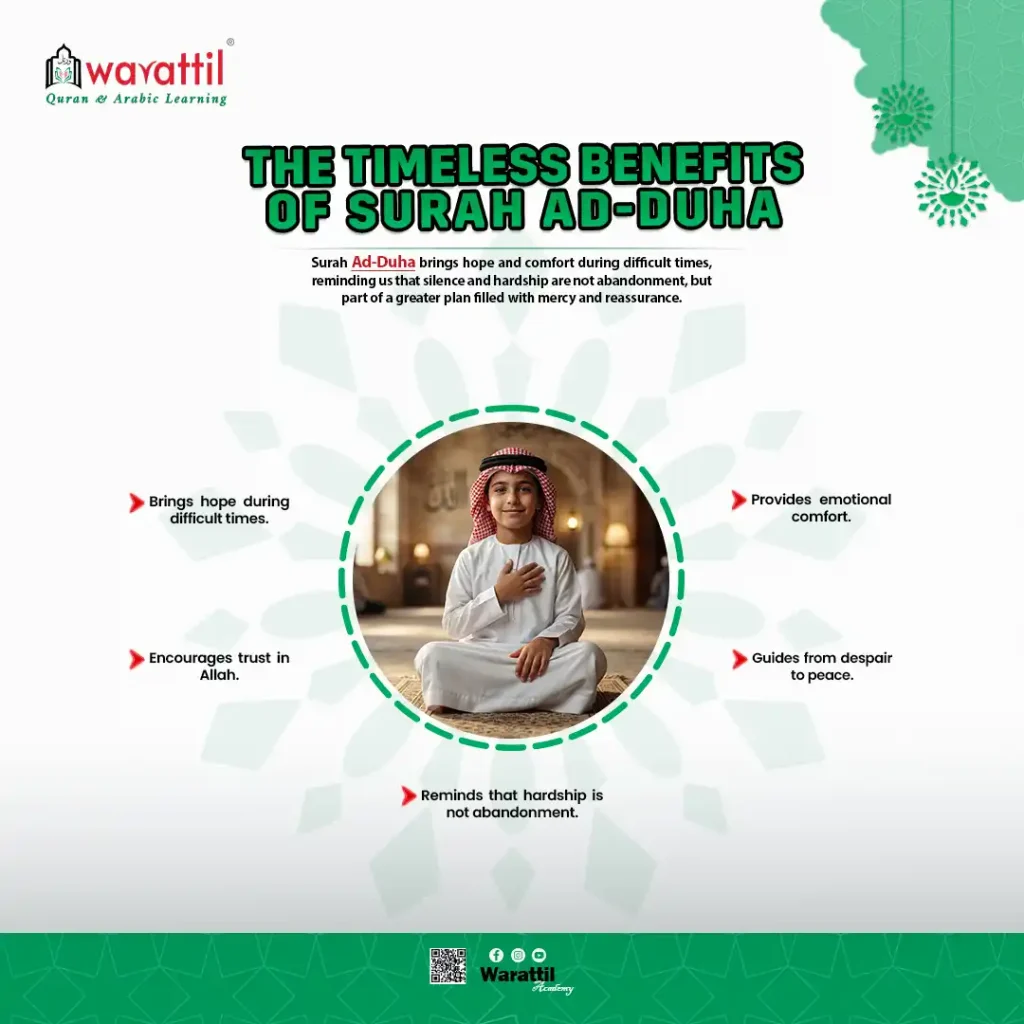
Life is rarely a straight line. We all encounter moments of profound silence—periods when it feels as though the heavens have closed their doors, our prayers have gone unanswered, and we are left navigating a seemingly endless, dark night of the soul. It is a universal human experience, a state of spiritual and emotional desolation that even the most faithful among us are not immune to. For those seeking a balm for such afflictions, the Qur’an offers a powerful and direct remedy. In this post, we will explore the benefits of Surah Duha (also known as Surah Ad-Duha), a short chapter that delivers a monumental message of reassurance, providing a divine roadmap from the depths of despair to the brightness of renewed hope.

To fully grasp the profound impact and the benefits of Surah Duha, one must first understand the circumstances under which it was revealed to the Prophet Muhammad (peace be upon him). The initial revelations of the Qur’an had suddenly ceased, and this period of silence, known as Fatrat al-Wahy, stretched on for what is believed to be six months. During this time, the Prophet (PBUH) was subjected to the taunts of his adversaries, who cruelly suggested that his Lord had forsaken him and was displeased with him. The weight of this perceived abandonment was immense, plunging the Prophet (PBUH) into a state of deep anxiety and grief.
It was in the midst of this painful silence that Surah Ad-Duha was revealed. It descended not as a set of new laws or a complex narrative, but as a direct, compassionate, and powerful reassurance from the Divine. The very first word, “Wad-duha” (By the morning brightness), acted as a signal that the long night of silence was over and a new dawn of hope had arrived. This context is critical; the Surah’s primary purpose is to console, uplift, and reaffirm the unbroken bond between the Creator and His beloved Messenger, making its message universally applicable to any believer who feels lost, forgotten, or alone.
While rooted in a specific historical moment, the wisdom contained within Surah Ad-Duha is timeless, offering a multitude of spiritual and psychological benefits for anyone who reflects upon its verses.
The most immediate and palpable of the benefits of Surah Duha is its capacity to act as a spiritual remedy for sadness, anxiety, and emotional distress. The Surah was revealed to soothe the Prophet (PBUH) during a time of depression, and its words carry the same healing resonance today. The opening verses function as a form of cognitive reframing. The oath by the “morning brightness” (Ad-Duha) and the “night when it covers with darkness” (Al-Lail) reminds us of the natural rhythm of life: hardship is always followed by ease, and no darkness is permanent.
The direct reassurance, “Your Lord has not taken leave of you, [O Muhammad], nor has He detested [you]” (Qur’an 93:3), is the core of its healing power. This verse directly counters the whisperings of despair and the internal narrative of abandonment, affirming that divine displeasure is not the cause of our trials. The Yaqeen Institute even outlines a “Duha Approach” to healing from trauma, which includes re-attachment to God and a shift in perspective, both of which are powerfully facilitated by this Surah’s verses.
One of the central themes and a major benefit of Surah Ad-Duha is its ability to instill a spirit of optimism, even in the face of overwhelming hardship. The Surah serves as a divine guarantee that the current state of difficulty is not the final destination. This is encapsulated in the powerful verse: “And the Hereafter is better for you than the first [life]. And your Lord is going to give you, and you will be satisfied” (Qur’an 93:4-5).
This promise shifts the believer’s focus from the immediate, transient pain of the world to the infinite and permanent joy of the Hereafter. It reassures us that Allah’s plan is greater than our immediate comprehension and that our patience will be rewarded with divine contentment. This message of hope is not just for the individual; it was a message of future victory and strength for the early Muslim community facing severe persecution.
Surah Ad-Duha gently guides the believer toward a state of deep gratitude (shukr) by recalling past blessings. The verses, “Did He not find you an orphan and give [you] refuge? And He found you lost and guided [you]. And He found you poor and made [you] self-sufficient” (Qur’an 93:6-8), serve as powerful reminders of Allah’s constant care and provision throughout life’s journey.
This is a masterful psychological and spiritual technique. By focusing on past mercies, the Surah helps to reframe one’s current mindset from one of lack to one of abundance. This practice of gratitude is not just a passive feeling; it is an active acknowledgment of divine favor, which in turn cultivates contentment (rida) with one’s situation. Scholars note that this very act of thankfulness is a key that can unlock further blessings (barakah) in one’s life and sustenance (rizq).
The final verses of Surah Ad-Duha transform its message of hope and gratitude into a call for tangible, positive action. They provide a practical roadmap for healing and spiritual growth by directing the believer outward. Allah commands: “So as for the orphan, do not oppress [him]. And as for the petitioner, do not repel [him]. But as for the favor of your Lord, report [it]” (Qur’an 93:9-11).
These commands serve a dual purpose. Firstly, they are an expression of gratitude for the blessings the Prophet (and by extension, the believer) has received. Having been an orphan who was given refuge and one in need who was enriched, the natural response is to show kindness to orphans and those who ask. Secondly, from a psychological perspective, engaging in acts of service and charity is a powerful antidote to depression and anxiety. It shifts the focus away from one’s own pain and onto the needs of others, creating a sense of purpose and connection. The final instruction to “proclaim the blessings of your Lord” is an act of sharing hope and positivity, which reinforces the believer’s own faith.
The benefits of Surah Duha are not merely theoretical; they are meant to be experienced. Here are ways to bring its light into your daily life:
In conclusion, the enduring power of Surah Ad-Duha lies in its simple yet profound message: the darkness is temporary, and the dawn is a divine promise. It assures us that silence does not equate to abandonment, and that with every hardship, ease is on the horizon. By turning to this chapter, we equip ourselves with a divinely revealed tool to navigate life’s inevitable valleys, finding solace in the knowledge that the Morning Brightness is always just a prayer away.

My son feels happy, amazing teachers and staff in wrattil and flexible prices MashaAllah Thank you so much
My daughter started learning in warattil academy and alhamdulilah we are really impressed and have enjoyed learning with wrattil. May Allah reward her sheikh
My teacher Ahmed is very good. He helped me recite and memorize holy Quran
Warattil is the most efficient way of learning Arabic. I like warattil curriculum and excellent teachers to support this learning Thank you so much
I highly recommend warattil Ijazah programs to anyone who wants to learn Quran properly.
Very well organized MashaAllah. I love it and this is a great course if you want to understand the Quran and learn tafsir
Warattil program is the best I have seen. The teacher is really great and is available to answer questions in a clear manner
I think warattil is the best academy in learning Arabic and I recommend Arabic course to anyone
We are so happy with ustad Hussein. He is very patient and comfortable teacher. May Allah the teachers and admin in warattil
Rating 10 mashaAllah and so grateful