Shopping cart
- +1 564-544-6614
- [email protected]
- 24/7 Available



Learn quran reading is the first real step on the path to understanding Allah’s Book and building a strong spiritual relationship with it. Many Muslims wish to read the Quran independently, but hesitate to begin due to the perceived difficulty of the Arabic language or fear of mispronunciation. The truth is, learn quran reading is much easier than some might think, provided a correct approach and clear steps suitable for beginners are followed.
In this comprehensive guide, we will explain what learning to read the Quran means, why it is essential for every Muslim, and how beginners, whether children or adults, can start from scratch. We will also discuss common challenges in pronouncing Arabic letters, the role of Tajweed rules, the best recitation techniques, and the effectiveness of learning to read the Quran online.
Learn quran reading means being able to pronounce the words of the Holy Quran correctly, as they were revealed, adhering to the basic articulation points of the letters without mispronunciation or distortion. This differs from memorizing or interpreting the Quran, as its initial stage focuses on recognizing Arabic letters and associating them with correct sounds, then gradually progressing to reading words and verses.
Correct reading is the foundation upon which everything else is built, whether memorization, Tajweed (rules of recitation), or contemplation. Therefore, it is a stage that cannot be skipped or underestimated.
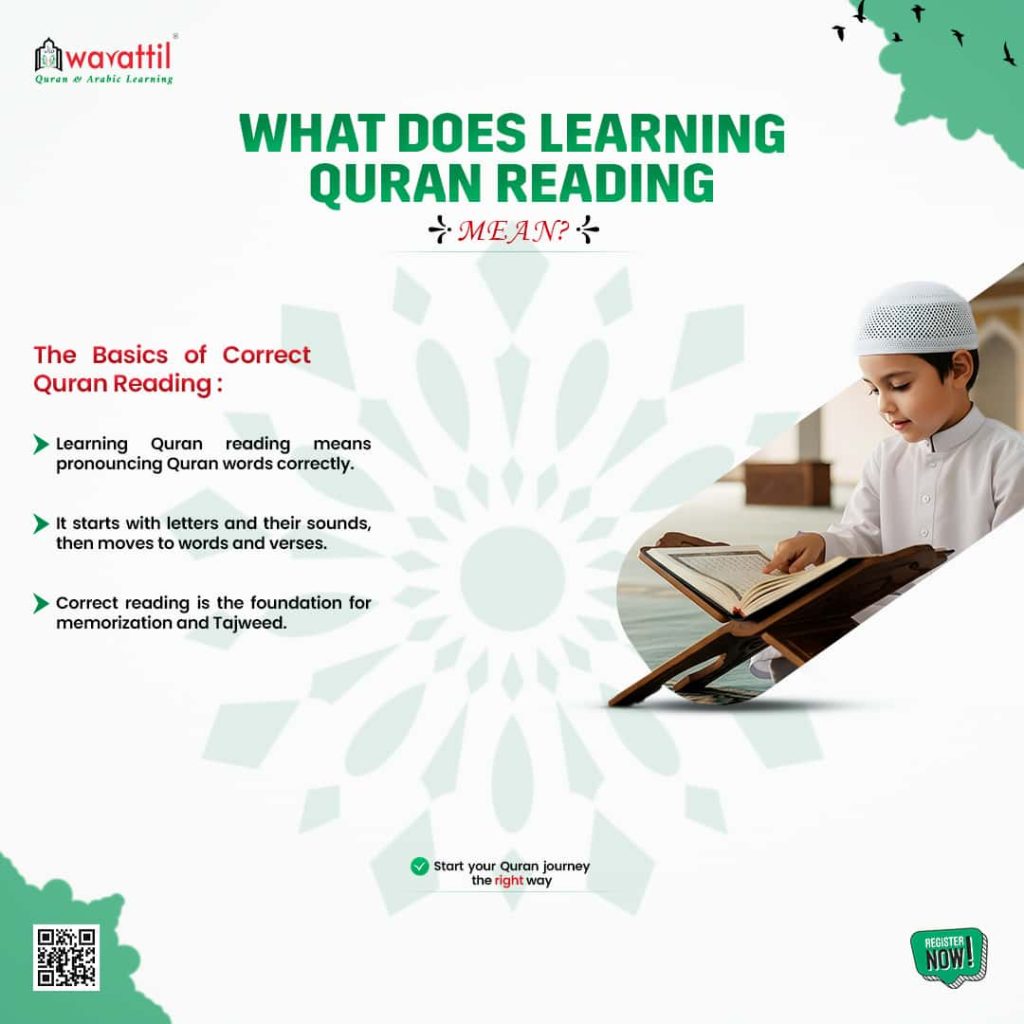
Learn quran reading is not merely a linguistic skill, but an act of worship in itself. Correct Quran reading:
Furthermore, mastering reading gives Muslims greater confidence in their worship and encourages them to continue learning and drawing closer to the Quran without hesitation or fear of making mistakes.
A good start is key to success, and therefore, beginners should adhere to the following basic steps:
The first stage in learn quran reading is becoming familiar with the 28 Arabic letters, including their forms at the beginning, middle, and end of words, and associating them with their correct sounds. The focus here is on listening and repetition rather than rote memorization.
Some Arabic letters do not exist in other languages, such as (ع، ح، خ، ق، ص، ض). Therefore, learners need specific training in the articulation of these letters. A good understanding of correct pronunciation at this stage prevents many mistakes in the future.
After mastering the letters and basic pronunciation, learners begin reading short surahs such as Al-Fatihah, Al-Ikhlas, Al-Falaq, and An-Nas. This stage is crucial for building confidence and connecting learning with practical application.
Many beginners face common challenges such as:
These challenges are quite normal and can be overcome gradually, through repeated listening, and by learning with a qualified teacher who can correct mistakes immediately.
Many beginners mistakenly believe that learning to read the Quran requires memorizing all the rules of Tajweed from day one. In fact, the primary goal at the beginning is to read words and verses correctly, free from serious errors that could alter the meaning. The focus should be on pronouncing letters from their correct points of articulation and connecting them smoothly.
The rules of Tajweed are a supplementary stage aimed at improving recitation, beautifying the voice, and perfecting performance. They can be learned gradually after acquiring a strong foundation in reading. This gradual approach makes learning easier and more consistent, especially for beginners.
Improving Quran reading depends not only on memorization but also on the method of practice. One of the most effective methods is slow reading, which gives the learner the opportunity to focus on each letter without rushing. Repeatedly listening to correct recitations also helps train the ear for proper pronunciation. Other helpful methods include:
Learn quran reading online is no longer a secondary option; it has become a practical solution for many, especially those with limited time or access to nearby learning centers. Online learning provides a comfortable environment that helps learners focus without pressure or embarrassment, and allows them to progress at their own pace.
The most important advantage of online learning is the ability to interact directly with the teacher and receive immediate error correction, which is essential for learning correct recitation. With a clear curriculum and continuous follow-up, online learning can be as effective as, or sometimes even better than, in-person learning.
Both achieve correct recitation when following a method appropriate for their age group.
Learning to read the Quran is not a race, but a cumulative process that relies more on commitment than speed. Some learners make rapid progress in the first few weeks, while others need more time to establish correct pronunciation.
On average, with consistent learning and practice, a learner can progress from a beginner level to a stable recitation level within two to three months. With continued practice, fluency and confidence gradually improve without pressure or rushing.
Consistency is one of the most important keys to success when learning to read the Quran. Regular practice helps solidify letter recognition, correct pronunciation, and gradually turns reading into a daily habit. To stay consistent, beginners can follow these steps:
Learning to read the Quran is a blessed journey that begins with a simple step and grows with persistence and patience. You don’t need to be an expert in Arabic or start at a young age; the door to learning is open to everyone. By following a sound methodology, focusing on correct pronunciation, and practicing daily, you will find that reading the Quran becomes easier and more accessible than you ever imagined.
Choosing a reliable educational institution and adhering to a clear learning plan are key to success on this journey. Most importantly, have a sincere intention, for with it, Allah blesses your time and effort, and makes the Quran a light in your heart and life for your soul.
Start by learning the Arabic alphabet, then correct pronunciation, and reading short surahs with a qualified teacher.
Yes, online learning is very effective when choosing a reliable educational platform.
No, learning to read the Quran does not require fluency in Arabic.
Not initially; it can be learned later after mastering basic reading.
Two to four months with commitment and regular practice.

My son feels happy, amazing teachers and staff in wrattil and flexible prices MashaAllah Thank you so much
My daughter started learning in warattil academy and alhamdulilah we are really impressed and have enjoyed learning with wrattil. May Allah reward her sheikh
My teacher Ahmed is very good. He helped me recite and memorize holy Quran
Warattil is the most efficient way of learning Arabic. I like warattil curriculum and excellent teachers to support this learning Thank you so much
I highly recommend warattil Ijazah programs to anyone who wants to learn Quran properly.
Very well organized MashaAllah. I love it and this is a great course if you want to understand the Quran and learn tafsir
Warattil program is the best I have seen. The teacher is really great and is available to answer questions in a clear manner
I think warattil is the best academy in learning Arabic and I recommend Arabic course to anyone
We are so happy with ustad Hussein. He is very patient and comfortable teacher. May Allah the teachers and admin in warattil
Rating 10 mashaAllah and so grateful